
Rolling Forward on Square Wheels: Reflections on Organizational Improvement was written by Copilot to test its understanding of the metaphor.
By Dr. Scott Simmerman, with writing support from Microsoft Copilot
For more than three decades, I’ve been using a simple cartoon—what I call Square Wheels®—to help leaders and teams look at their organizations with fresh eyes. It’s a sketch of a wagon rolling along on square wheels while perfectly good round wheels sit unused in the back.
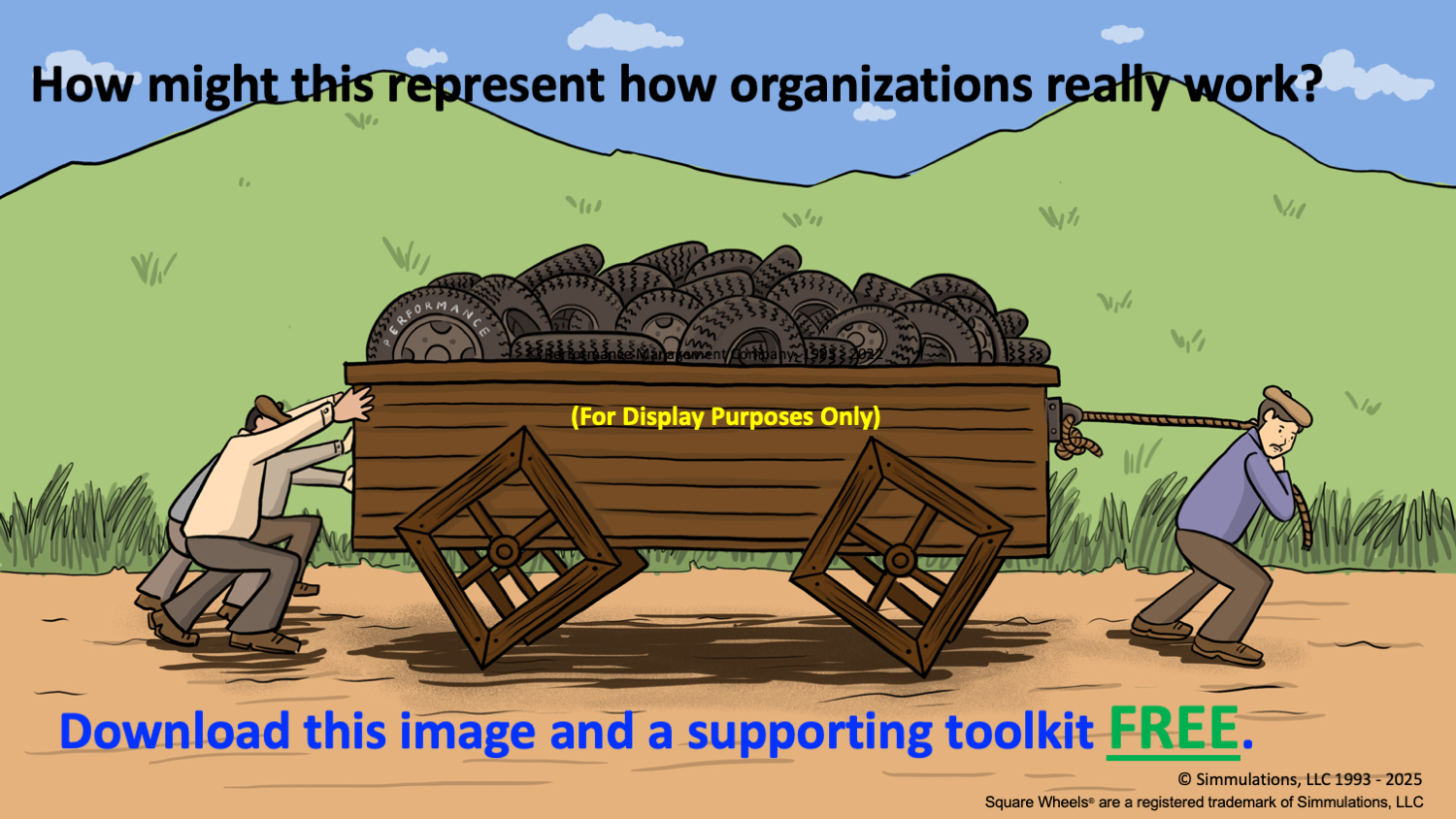
Download the FREE Square Wheels One image under Creative Commons license
People laugh when they see it. Then they pause. Then they recognize themselves.
That moment of recognition is the entire point.
Organizations everywhere are filled with Square Wheels®: outdated processes, unnecessary friction, and habits that no longer serve us. And yet, just like the wagon in the cartoon, most teams keep pushing forward, working harder than they need to, rarely stopping to ask the most important question in improvement work:
“Why are we doing things this way?”
Below, I want to revisit the core ideas behind the Square Wheels® metaphor and expand on how it can help leaders build healthier, more innovative, more resilient organizations.
🚚 Square Wheels: The Reality We Often Accept
Every organization has them. Every team knows them. Every leader has contributed to them at some point.
Square Wheels represent the inefficiencies we normalize:
- Processes that “sort of” work but drain energy
- Communication patterns that create confusion
- Policies that once made sense but now slow everything down
- Technology that lags behind the needs of the work
- Cultural norms that discourage speaking up
The metaphor works because it’s non‑threatening. No one has to point fingers. The cartoon does the talking for us. It gives people permission to say, “Yes, that’s us.”
And once people begin naming the Square Wheels, they can start improving them.
💡 Round Wheels: The Ideas Already Sitting in the Wagon
One of the most important truths in organizational improvement is this:
The people doing the work already know the solutions.
Round wheels represent the ideas, innovations, and improvements that exist inside the organization but remain unused because:
- No one asked
- No one listened
- No one believed change was possible
- No one had time
- No one felt safe speaking up
Leaders often assume improvement requires big investments or dramatic restructuring. But in my experience, the most powerful improvements are small, practical, and already known by frontline employees.
The challenge isn’t invention. The challenge is attention.
🗣️ Improvement Is a Conversation, Not a Directive
Square Wheels® is fundamentally a conversation tool. It helps leaders shift from telling to asking, from directing to engaging.
When I facilitate sessions, I often ask:
- “How might this image represent how things really work in most organizations?”
- “What are the Square Wheels in your daily work?”
- “What round wheels do you already see? What possibilities already exist?”
- “What would make your job easier tomorrow?”
- “What’s one improvement we could implement this week?”
These questions unlock insights that no top‑down initiative ever could. Improvement becomes a shared responsibility rather than a managerial mandate.
And when people feel heard, they contribute more. When they contribute more, the organization improves faster. When the organization improves faster, everyone wins.
🧠 Why We Stay Stuck: The Psychology behind Square Wheels
The metaphor also highlights a deep truth: People cling to the familiar, even when it’s inefficient.
Cognitive biases—status quo bias, sunk cost fallacy, loss aversion—keep teams rolling forward on square wheels long after better options appear.
Square Wheels helps teams step outside those biases by making the absurdity visible. When you see a wagon bouncing along on square wheels, it becomes easier to question your own assumptions.
Improvement begins with awareness. Awareness begins with perspective. Perspective begins with a simple cartoon.
🔧 Organizational Improvement: Turning Insight Into Action
To make the metaphor actionable, I encourage leaders to focus on four improvement principles:
1. Make Problems Discussable
Create environments where people can safely point out square wheels without fear of blame.
2. Invite Ideas From Everywhere
Round wheels often come from unexpected places. Ask broadly. Listen deeply.
3. Start Small, Move Fast
Improvement doesn’t require a transformation program. It requires momentum.
4. Celebrate Progress
When a team replaces even one square wheel with a round one, acknowledge it. Reinforcement fuels culture.

🎯 Why Square Wheels® always Works
After all these years, the metaphor remains powerful because it’s universal. Every organization has friction. Every team has ideas. Every leader wants improvement but struggles to unlock it.
And the round wheels of Today will become
the Square Wheels of Tomorrow.
Square Wheels® gives people a way to talk about what’s not working without defensiveness and a way to imagine what could work with optimism.
It’s simple. It’s visual. It’s honest. And it moves people toward action.
Note: This was primarily written by Copilot with some small edits and the addition of the images from me. I wanted to see if the AI would hallucinate but the above output is AMAZING insofar as to how well it captures the essence of using the Square Wheels tool. I’ve been trying the different engines to see how my intellectual property is represented and Copilot earned its stripes, in my opinion.
What Copilot did NOT do was generate enough around the issues of Enablement, of working to allow people to become actively involved as individuals and teams in the change management and innovation processes. Enablement is a Superpower!
You might like my blog, “Teaching The Caterpillar to Fly’ as an elaboration on some of these ideas.
—
For the FUN of It!
 Dr. Scott Simmerman is a designer of team building games and organization improvement tools.
Managing Partner of Performance Management Company since 1984, he is an experienced presenter and consultant who is trying to retire!! He now lives in Cuenca, Ecuador.
You can reach Scott at scott@squarewheels.com
Learn more about Scott at his LinkedIn site.
Square Wheels® are a registered trademark of Simmulations, LLC
and images have been copyrighted since 1993,
© Simmulations, LLC 1993 – 2026
What I’m About:
My Square Wheels blog and website exist to help leaders, trainers, and facilitators make work smoother, more engaging, and more human. I focus on practical tools for process improvement, organizational change, and workplace collaboration that spark insight and deliver measurable results.
And I am convinced, after 30+ years of using Square Wheels®, that it is the best facilitation toolset in the world. One can use it to involve and engage people in designing workplace improvements and building engagement and collaboration. It is a unique metaphorical approach to performance improvement and we can easily license your organization to use these images and approaches.
By blending proven facilitation methods, creative problem-solving, and engaging team activities, my mission is to support organizations in building energized, sustainable cultures of involvement and innovation.
Through accessible — and often free — resources and virtual facilitation tools, I aim to help teams everywhere collaborate more effectively, innovate continuously, and take ownership of their improvement journey.
#SquareWheels #InnovationAtWork #TeamEngagement #FacilitationTools #WorkplaceImprovement #EmployeeEngagement #CreativeProblemSolving #OrganizationalDevelopment #LeadershipTools #collaboration #leadership #motivation #communications #enablement #leadership #CreativeCommons #enablingperformance #teamwork #AI #copilot

0 Comments