
Why Square Wheels Works: Thoughts on using Visual Metaphors and Kolb’s Experiential Learning Cycle to impact learning and performance.
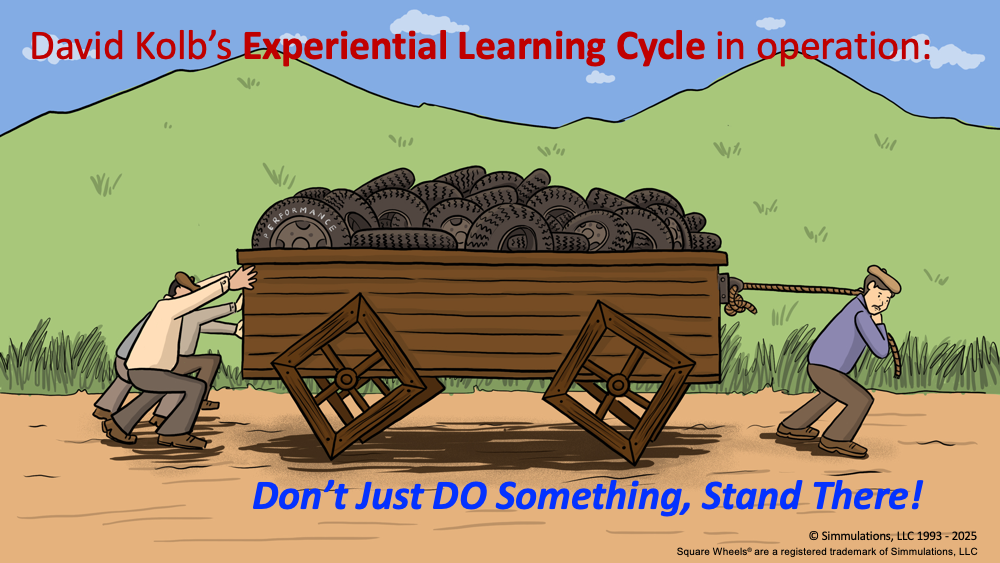
When people see the Square Wheels One image for the first time, they laugh and then they wince when they actually look at it. The image is so simple that it feels almost childlike on first impression, yet it captures a very adult reality: we are pushing and pulling our way through things rolling on “square wheels,” while better “round wheels” already exist but are ignored, underused or invisible.
That instant recognition is not just a silly reaction; it is the starting point of a powerful learning cycle that helps individuals and teams see, think, and choose to change. Understand that reality should be helpful to all of us.
At the heart of this idea is David Kolb’s Experiential Learning Cycle, a four-stage model that explains how people turn experience into new behavior. Kolb’s big idea is that learning is not about being told what to do; it is about cycling through experience, reflection, insight, and experimentation in a way that people own for themselves.
After all, “Nobody ever washes a rental car.”
Ownership is IMPORTANT!
Kolb’s Model in 30 Seconds
Kolb describes learning as a continuous loop of four stages:
-
Concrete Experience – doing or encountering something.
-
Reflective Observation – stepping back to notice what happened.
-
Abstract Conceptualization – making sense of it, finding patterns and principles.
-
Active Experimentation – trying something new based on those insights.
Crucially, Kolb never said this must be a slow, rigid sequence. In real life, people move through “cycles within cycles wheels within wheels,” looping through these stages multiple times inside a single task or conversation. That makes his model ideal for well-designed learning tools that invite continuous discovery and continuous learning rather than deliver pre-packaged answers. In my framework, “Continuous continuous improvement” with the notion that.
“The Round Wheels of this moment are the Square Wheels of another.”
How Square Wheels Creates a Concrete Experience
The Square Wheels One illustration and the series of other slides is the concrete experience. People do not start with a slide of theory; they start with a picture of a wagon with square wheels, a leader in front, people pushing in back, and unused round wheels nearby. You ask them a simple question like, “What’s happening here?” and the learning process begins as they project their experiences on to the image(s).
Because it is metaphor, the image is emotionally safe but personally relevant. Participants project their own workplace reality onto the picture: communication gaps, misaligned goals, overworked teams, leaders out of touch with the day-to-day, and good ideas lying unused inside the wagon. That shared experience becomes the raw material for reflection.
Reflection: Turning a Cartoon into a Mirror
Once the image is on the table, the room fills with Reflective Observation. People describe what they see: who is doing the work, who is steering, what is hard, what is frustrating, what is being ignored. Different voices notice different things, and the group begins to realize that the cartoon is not “about” the drawing—it’s about them.
In this stage, the facilitator’s job is mostly to ask, not tell. Questions like, “Where are you in this picture?” or “What are the Square Wheels in your operation?” move the conversation from “that wagon” to “our reality.” As people connect the dots between the metaphor and their lived experience, they are already halfway into the next phase of Kolb’s cycle.
Insight: From Picture to Principles
“Abstract Conceptualization” shows up when comments shift from description to explanation. Participants start saying things like, “We keep pushing harder instead of stopping to change the wheels,” or “Our best ideas are there, but no one owns the process of putting them under the wagon.” The group begins to generate its own principles about leadership, communication, continuous continuous improvement, and engagement.
We can also show them images of ideas for improvement to stimulate their thinking of possibilities and how to start implementing change. For example, when things break, we are driven to fix the problem and this can represent an opportunity to make changes:
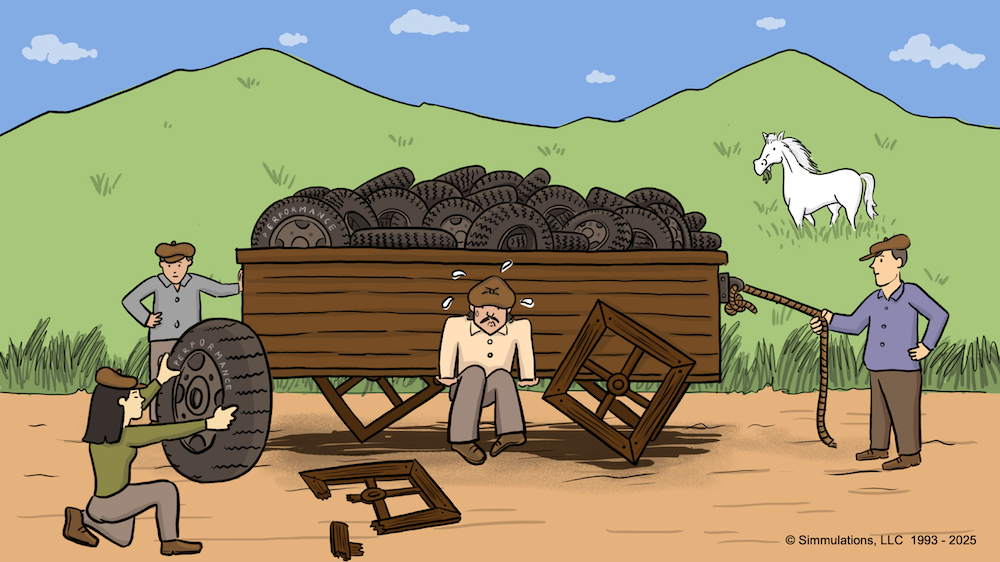
This activity interface is where the simplicity of both Kolb and Square Wheels becomes a strength, not a weakness. The model is not trying to explain every nuance of human behavior; it is giving people a clean, memorable framework for understanding why their current patterns produce current results—and what has to change if they want different outcomes.
Experimentation: Choosing More Better Faster “Round Wheels”
The final stage, Active Experimentation, is where learning turns into change. After naming their Square Wheels and the considered alternatives, the round wheels, participants can design small, specific experiments they can run back at work: a new way to run a team huddle, a clearer process for surfacing ideas, a different way for managers to “get involved” and listen.
Managers can be very helpful, or not. They do often have different views about how things are working and they can also generally share the missions and visions if they understand the general reality of how things are working:

Because the insights emerged from their own plus others’ interpretation of the metaphor, these tests are not seen as imposed programs; they are their ideas. That sense of ownership matters. People are far more likely to try, persist, and refine changes they believe they created themselves.
Cycles Within Cycles: Why This Doesn’t Feel Forced
Some critics of Kolb argue that the model is too sequential and slow to reflect the messy reality of real work. Watch a group working with Square Wheels and you see the opposite: multiple fast cycles of Kolb’s loop happening in real time. Someone notices a detail, the group reflects on it, an insight emerges and then another, a new “round wheel” idea appears, and someone immediately starts planning how to test it.
In other words, A Square Wheels session is not a single, grand Do–Review–Learn–Apply arc; it is many micro-cycles nested inside a shared experience. Kolb provides the underlying engine for learning, while the Square Wheels metaphor provides the fuel: a vivid, flexible image that keeps generating new connections and possibilities.
Why This Approach Changes Behavior
The Square Wheels approach integrates beautifully with Kolb because it respects how adults and teams actually learn and choose to change:
-
It starts with a safe but provocative experience rather than a lecture.
-
It builds in natural opportunities for people to reflect and compare experiences and perspectives.
-
It invites and engages them to generate their own theories about what is and is not working.
-
It ends with practical, self-chosen experiments that they can own and refine, individually or collectively
When you design learning this way, change is no longer about compliance with an external model. It becomes an internal decision: “These are our square wheels. These are our round wheels. Here is what we are going to try next.” That is Kolb in action—and it is why a simple wagon drawing can become a long-lasting catalyst for better work and better workplaces.
Choose to get the Square Wheels One image for FREE. How you use it becomes your choice. And there is a free toolkit included:
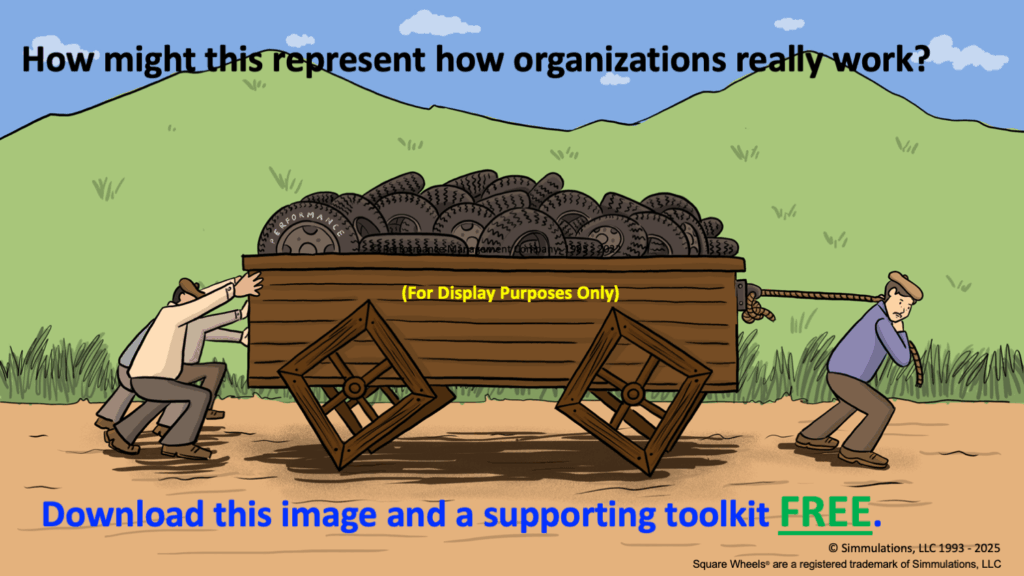
Download the FREE Square Wheels One image under Creative Commons license
Two useful URLs for readers
For readers who want a clear explanation of Kolb’s model, you can point them to:
-
A concise overview of Kolb’s Experiential Learning Cycle and learning styles:
https://www.simplypsychology.org/learning-kolb.html -
A practical explanation of the four-stage learning cycle with examples and graphics:
https://www.structural-learning.com/post/kolbs-learning-cycle
—
For the FUN of It!
 Dr. Scott Simmerman is a designer of team building games and organization improvement tools.
Managing Partner of Performance Management Company since 1984, he is an experienced presenter and consultant who is trying to retire!! He now lives in Cuenca, Ecuador.
You can reach Scott at scott@squarewheels.com
Learn more about Scott at his LinkedIn site.
What I am about:
My Square Wheels blogs and website exist to equip leaders, trainers, and facilitators with practical process improvement tools along with effective organizational change tools. My purpose is to facilitate engagement and active involvement to help make work smoother and more human.
By blending change management facilitation with proven workshop facilitation techniques, team collaboration activities, and creative problem solving activities, my mission is to support organizations in designing employee engagement strategies that are both energizing and sustainable. Through accessible, sometimes free team building resources and virtual facilitation tools, my focus is on helping teams everywhere discover better ways to collaborate together, innovate continuously, and own their path to improvement.
Square Wheels® are a registered trademark of Simmulations, LLC
and images have been copyrighted since 1993,
© Simmulations, LLC 1993 – 2025
#SquareWheels #InnovationAtWork #TeamEngagement #FacilitationTools #WorkplaceImprovement #EmployeeEngagement #CreativeProblemSolving #OrganizationalDevelopment #LeadershipTools #collaboration #leadership #ExperientialLearningCycle #stormz #Kolb #DavidKolb’sExperientialLearningCycle




0 Comments