
Front-line supervisors are living in a quiet, muddy, grinding paradox. They are told to be culture carriers, coaches, and engagement champions, but their actual day is a blur of meetings, reports, and firefighting that makes good leadership feel structurally impossible.
Square Wheels® tools exist to give those supervisors a simple way to enable better performance and to dramatically improve engagement, to improve the reality of the work, collaboratively name the pain safely, and co-create better ways of working without needing some big program or complicated model from HR. And, using the materials and ideas is not rocket surgery.
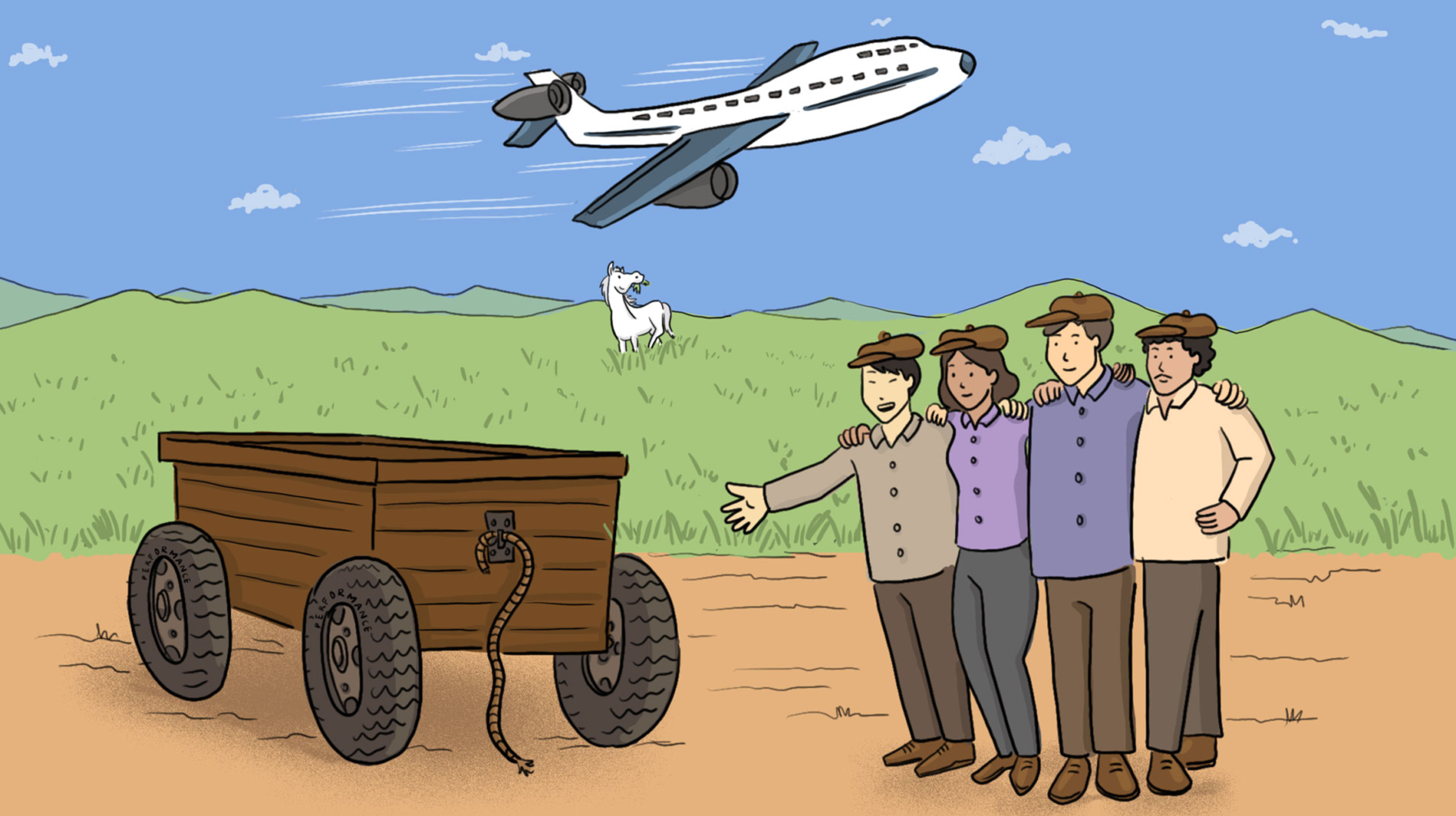
Not the current reality but a vision of the future?
The Supervisor’s Paradox: Accountable for Everything, Enabled for Very Little
Talk to almost any frontline supervisor and you hear the same tired laugh when you bring up “engagement” or “coaching conversations.” They know it matters. They have read the news and seen the articles. They have attended the webinars and heard the speeches. But their calendar is a solid wall of tasks and interruptions, and the message from above is clear: performance first, people work if there is time.
The problem is not that supervisors don’t care. The problem is that the system they sit in was never designed around the realities of their day. They are being asked to pull a heavy wagon rolling on Square Wheels—and then blamed when it doesn’t corner like a sports car. At minimum, things work like this:

The mud is just one more factor in workplace reality
Square Wheels tools start with this basic reality, with an honest picture of how things work: a wagon, a team pushing, a leader pulling, and some very obvious Square Wheels thumping and bumping up to their axles in the mud that we call The Organization. It is a funny little image, but it opens a serious conversation: “What in our world feels like those Square Wheels? What’s slowing us down today? And, how can we manage the mud and get up on the road?”
Suddenly, supervisors are not defending performance; they are facilitating a discussion about the work, the workplace and the systems and processes that control the flow.
From “No Time to Lead” to Round Wheels, in the Same Day
One of the loudest complaints from supervisors is simple: “I don’t have time for all this people stuff.” Behind that line is a deeper fear: if they slow down long enough to coach or listen, something will break and goals will not be met — and it will be their fault.
Square Wheels gives supervisors a simple tool to lead and enable without adding “one more thing” to an already impossible schedule. Instead of scheduling a big offsite or a heavy training session six months out, a supervisor can use a single image in a 10-minute huddle to talk about improving performance:

Download this image and use it for free
It can be as simple as this:
-
Show the wagon with Square Wheels and ask: “How might this image represent how things really work?”
-
Then, ask “Where do we feel our thumps and bumps right now?”
-
Have the team label the Square Wheels as real local roadblocks—forms, approvals, broken tools, unclear priorities.
-
Capture one or two round wheel ideas the team believes would make today’s work just a little smoother. Ask them how to implement to get things rolling…
That simple visual conversation turns “I don’t have time” into “I used the time I already had to remove friction from the work.” The act of engaging their people to generate ideas for doing the work better becomes the leadership focus, not a separate activity bolted on the side or something dragging in the dirt behind the wagon.
When Engagement Feels Personal: “Am I the Problem?”
Many supervisors understand the research that says “most of the variance in team engagement sits with the manager” and feel a quiet punch in the gut. If their team seems checked out or cynical, it is hard not to conclude, “That’s on me.”
Square Wheels reframes that guilt. The image makes a clear point: it is not that the people are broken; the wheels that are systems and processes simply don’t work smoothly. The job of the leader is not to pull harder or cheer louder—it is to help the team see and change the Square Wheels they have been pushing on for years. They work, but they do NOT work smoothly and, using the image with their people, they will quickly identify 10 or 20 things that should be improved, often thing that THEY can improve.
In practice, this looks like:
-
Using the image in a team meeting and asking people to identify what feels like a Square Wheel in their daily work.
-
Inviting them to sketch out or describe some potential round wheels—better processes, clearer roles, smarter handoffs. Round wheels represent ideas for improvement, very often already in the wagons.
-
Agreeing together on small, low-risk experiments to test one better “wheel” in the next week.
The supervisor’s role shifts from “I must personally motivate everyone” to “I help my team remove the things that demotivate them.” That is a far more realistic and sustainable way to own engagement. I call the whole thing DIS-un-engagement and it is a way to enable people to make improvements; it even involves and engages the Spectator Sheep — the 50+% of the people who have been choosing not to be involved.
From “Winging It” to Having a Tool for Tough Conversations
Most new supervisors are thrown into leadership with little real preparation for the people side of the job. They know how to do the work; they do not know how to talk about performance, conflict, or burnout without making it worse. Many quietly Google “how to have a tough conversation” the night before a difficult 1:1.
The Square Wheels One image, once shared with the group and discussed around issues and opportunities, offers a safe, structured way to talk about problems without making it personal. Instead of saying, “You’re not performing,” which can be viewed as a personal attack and generate defensiveness, a supervisor can start a conversation around:
-
“Let’s look at our wagon together. Where do you feel the bumps the most?”
-
“Which Square Wheels in your day are making it hardest for you to be successful?”
-
“What Round Wheels would help you do your best work?”
The conversation becomes about shared obstacles and shared solutions, not about character. The image is the “third thing in the room” that both people can look at, which reduces defensiveness and gives a practical script to a supervisor who has never been trained in coaching models or difficult conversations.
Escaping the Middle: Using Images and Metaphors to Push Back Without Getting Punished
Front-line managers often feel like human shock absorbers for their workplaces, taking hits from senior leaders from above and from the frustrated employees below. Push back too hard and they look disloyal to leadership. Side with the team too openly and they look negative or resistant to change. Neither are good for performance and both operate against improving the organizational flow. And shouldn’t a key KPI of supervisor performance be the enablement of their people and the improvement of results?
Square Wheels tools help supervisors surface system problems in a way that is constructive and visual, not emotional or accusatory. A manager can literally show the wagon to senior leaders and say:
-
“Here is what our current wagon looks like from the front line.”
-
“These are the Square Wheels my team named as operating in our workplace (and show an actual list).”
-
“Here are some round wheel ideas we believe would improve both output and engagement.”
-
“Here is what we’re willing to do locally if we get support to try to implement these wheels.”
The image and the details keeps the conversation
focused on process and opportunities, not personality.
These discussions give senior leaders something tangible to respond to and enable and makes it easier for a supervisor to challenge the status quo without being written off as just another complainer.
Burnout, Headroom, and Designing a Job a Human Can Actually Do!
Perhaps the most painful truth supervisors hold in the dark is the fear that the job is slowly burning them out—stealing their sleep, their health, and their presence at home. They worry that if they admit how bad it is, someone will quietly decide they are not “leadership material.”
Square Wheels does not magically fix workload, but it gives supervisors a practical way to reclaim headroom by simplifying the work with their team. Each time they use the image and the enabling framework to remove a recurring roadblock or streamline a clumsy process, they are inching the wagon toward something a human being can actually push and pull.
Over time, that has three powerful effects:
-
The team feels heard, because their pain points become the agenda for improvement. This is dis-un-engagement.
-
The supervisor feels less alone, because the responsibility for better wheels is shared and they have a common language focused on continuous improvement.
-
The system starts to see that enabling supervisors—giving them tools and time to work on the wagon—is not “soft,” it is strategic.
In other words, Square Wheels is not just a cute cartoon about the workplace. The images are simple visual engagement tools and a language for talking honestly about the work, naming the real pain, and co-creating solutions in the places where supervisors feel the grind the most.
—
For the FUN of It!
 Dr. Scott Simmerman is a designer of team building games and organization improvement tools.
Managing Partner of Performance Management Company since 1984, he is an experienced presenter and consultant who is trying to retire!! He now lives in Cuenca, Ecuador.
You can reach Scott at scott@squarewheels.com
Learn more about Scott at his LinkedIn site.
Square Wheels® are a registered trademark of Simmulations, LLC
and images have been copyrighted since 1993,
© Simmulations, LLC 1993 – 2026
What I’m About:
My Square Wheels blog and website exist to help leaders, trainers, and facilitators make work smoother, more engaging, and more human. I focus on practical tools for process improvement, organizational change, and workplace collaboration that spark insight and deliver measurable results.
And I am convinced, after 30+ years of using Square Wheels®, that it is the best facilitation toolset in the world. One can use it to involve and engage people in designing workplace improvements and building engagement and collaboration. It is a unique metaphorical approach to performance improvement and we can easily license your organization to use these images and approaches.
By blending proven facilitation methods, creative problem-solving, and engaging team activities, my mission is to support organizations in building energized, sustainable cultures of involvement and innovation.
Through accessible — and often free — resources and virtual facilitation tools, I aim to help teams everywhere collaborate more effectively, innovate continuously, and take ownership of their improvement journey.
#SquareWheels #InnovationAtWork #TeamEngagement #FacilitationTools #WorkplaceImprovement #EmployeeEngagement #CreativeProblemSolving #OrganizationalDevelopment #LeadershipTools #collaboration #leadership #motivation #communications #enablement #leadership #CreativeCommons #enablingperformance #teamwork #supervisors

0 Comments