
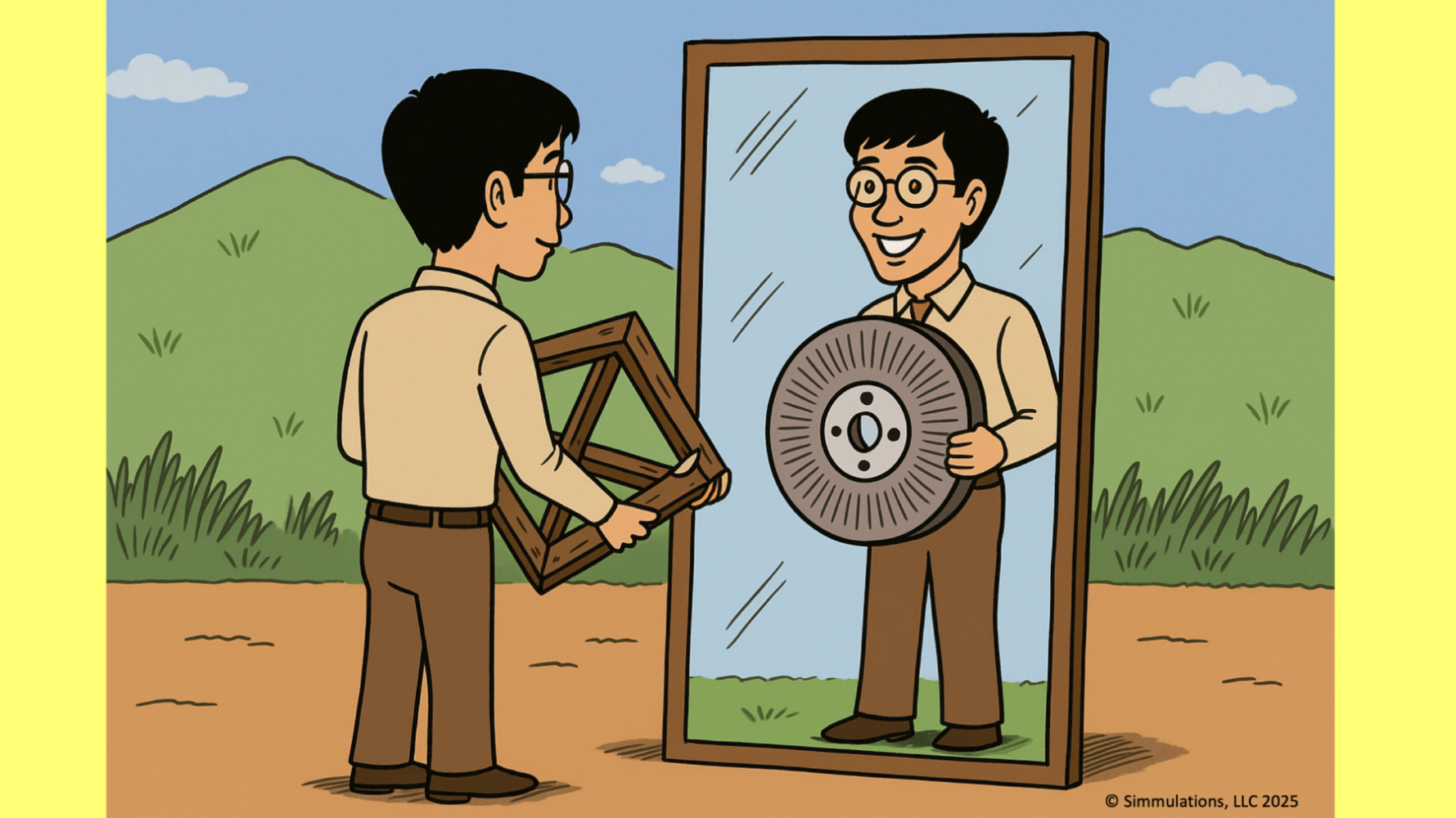
Charlie Munger would certainly love Square Wheels® because they do, visually, what his “invert, always invert” mindset does cognitively: the images force you to see that the problem is not that the wagon isn’t rolling, but that it’s rolling on low effectiveness wheels while better ones are already available but unused.
The combination of the “Inversion Rule” and visual imagery transforms reflection into action. Words alone create awareness, but images create retention and trigger behavior. By linking concepts to visual anchors, individuals can literally “see” their habits, blind spots, and inefficiencies—making the insights stick and accelerating their ability to redesign performance. This dual-channel approach leverages how the brain actually works: we remember what we see far more reliably than what we only hear.
Since I focus so much on people and performance and teams, let me frame this idea as if Munger were coaching someone through a Square Wheels® session focused on personal development, not just organizational change.
”Reflection is by far the cheapest personal and organizational improvement tool. It requires no training and the results are almost always actionable.”
Here is Square Wheels One, the main image in the series of more than 200 different scenes and scenarios all designed to generate active involvement and engagement in a discussion of issues and opportunities.
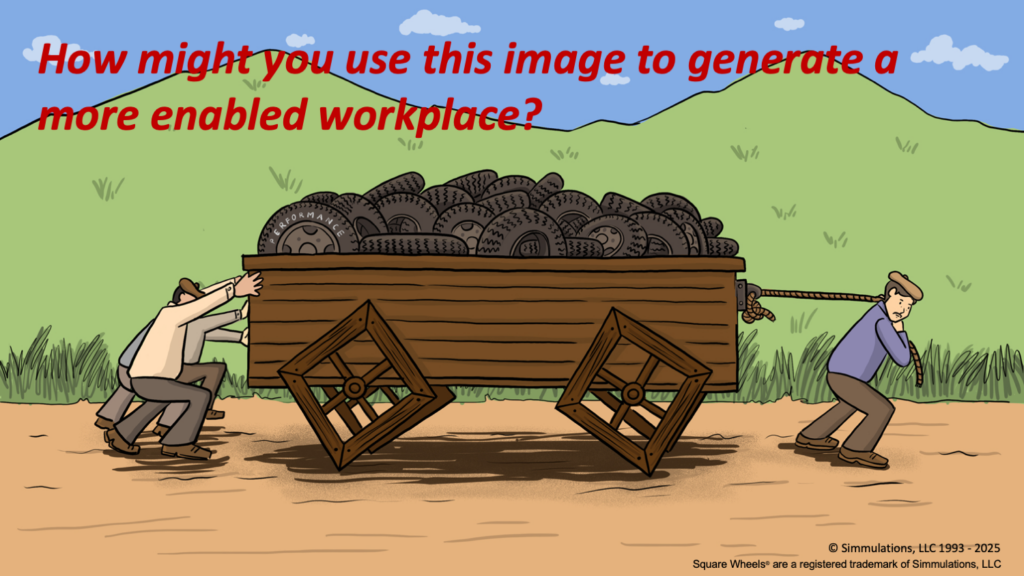
Click on the image to download it for your use, FREE
1. How Munger’s Inversion Rule fits Square Wheels Enablement
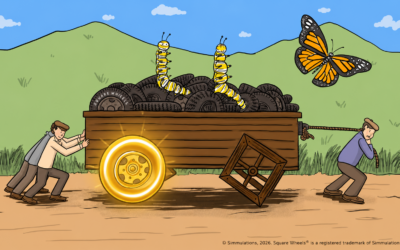
Charlie Munger’s Inversion Rule is simple: instead of only asking “How do I succeed?”, you also ask “How do I fail or stay stuck?” and then work hard to avoid those failure paths. Square Wheels images show a wagon that is technically moving but painfully inefficient, with wooden Square Wheels on the axles and round rubber wheels already in the wagon as in the image above.
Put together for personal growth, the logic becomes:
-
“My life is the wagon” – career, working, health, relationships, learning.
-
“Those Square Wheels are the ways I’m doing things that technically work but are slow, clunky, or exhausting (habits, beliefs, routines).”
-
“The round wheels are better options that I already possess or can easily access but am not using (skills, resources, support, ideas).”
-
“Inversion” asks: instead of “How can I grow more?”, it start with “How am I guaranteeing that I don’t grow?” (i.e., where are my personal Square Wheels, and what would happen if I stubbornly keep them?).
That cognitive dissonance — seeing obvious better wheels in the wagon and still thumping and bumping along on the square ones — is exactly the discomfort Munger exploited with inversion to reveal stupidity and remove it before chasing brilliance.
Munger’s approach is to self-reveal one’s stupidity
and remove it before chasing brilliance.
2. If Munger facilitated with the image tools
Imagine Charlie facilitating a personal growth workshop using these Square Wheels image of the wagon: leader out front pulling on a rope, pushers behind, wooden Square Wheels on the wagon, and the round wheels in the cargo, already in the wagon. His view of the world and personal growth might look something like this, along the lines of, “Is this the real reality of mine? If I see nothing wrong, is there actually something I can improve?”
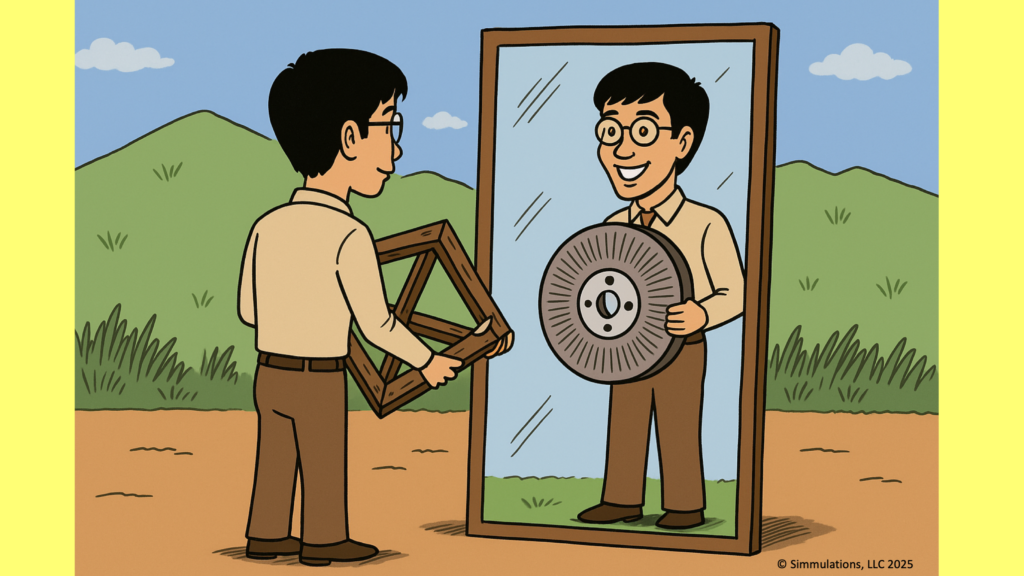
Reflection might help one to identify things that can be done differently and offer some different choices.
Here is how he’d likely run a performance improvement coaching conversation, just a guess:
-
Name the Square Wheels working in your life
-
He’d ask: “In what areas of your life are you making progress, but in a very square‑wheel way?” (career, health, finances, relationships, learning, work).
-
Participants identify where things “work” but feel jerky, slow, or fragile. the overwork, procrastination, staying in a poor role, poor sleep, lack of reflection, etc. For most of us, this is a long list.
-
-
Invert: design a life of misery around those wheels
-
Munger loved to ask: “If I wanted a miserable life, what would I do?” and then list the patterns to avoid. He’d use the metaphor in that same way to help develop the cognitive dissonance.
-
Here he might say: “Suppose you wanted to guarantee your life doesn’t improve for the next 10 years. How would you keep these Square Wheels firmly in place?”
-
People then describe the behaviors that would lock in the problems—never seeking feedback, staying in the wrong job out of comfort, always reacting instead of planning, keeping resentment, etc.
-
-
Invert again: what round wheels would you refuse to use?
-
“If I wanted to stay stuck, which easy-to-use round wheels would I stubbornly ignore?”
-
Examples: reading 30 minutes a day, exercising 3 times a week, finding a mentor, asking for help on a key project, designing a better morning routine.
-
The visual of round wheels in the wagon makes it obvious that many solutions are not missing; they’re just unused. And by choice!
-
-
Forward thinking only after backward thinking
-
Munger’s view: many problems can’t be solved forward until you’ve thought them through backward. You need to reflect on things. And invert.
-
Once people see how to guarantee failure, the “don’t do these things” list becomes a personal checklist to eliminate Square Wheels before layering on new goals or tactics.
-
In practice, the image anchors the discussion in something playful and safe, while inversion drives it into candid, sometimes uncomfortable self-assessment.
3. Specific mental models Munger would map onto the images
Munger’s toolkit of mental models maps beautifully onto Square Wheels for personal growth.
Here are a few he’d likely emphasize:
-
Inversion – “avoid stupidity, don’t chase genius”
-
Square Wheels prompt the question: “What are the stupid, avoidable frictions in how I live or work?”
-
Personally, that might be chronic lateness, poor email habits, living beyond your means, unhealthy diet, toxic relationships, or staying in an ill‑fitting role.
-
-
Psychology of misjudgment and bias
-
The image shows a leader out front and pushers behind, each with partial information, mirroring how our fast, intuitive System One can drag us forward while our reflective System Two sits unused.
-
Munger would use this to talk about confirmation bias (“I’ve always done it this way”), social proof (“everyone in my industry burns out”), and commitment bias (“I’ve invested so much in this path I can’t change”).
-
-
Marginal improvement and compounding
-
Replacing one Square Wheel with a round one doesn’t instantly transform everything, but the ride gets noticeably smoother, and that smoother ride compounds over time with continuous improvement.
-
Munger’s advice to get “a little wiser each day” maps directly to swapping one wheel at a time, not waiting for a perfect overhaul. I call it continuous continuous improvement.
-
-
Circle of competence
-
The wagon’s current path might be outside your true circle of competence—wrong career, wrong game, wrong metrics. Are you really headed in your desired direction? Are you really headed to where you want to go?
-
A “round wheel” might be shifting toward work and environments where you have an actual advantage and genuine interest in moving forward, instead of simply grinding forward where you’re structurally disadvantaged.
-
In short, the Square Wheels One image becomes a multi-model self-teaching device: it carries inversion, bias, compounding, and circle-of-competence all in one memorable metaphor.
4. How the metaphor changes how people see themselves
My writing in the dozens of blogs on Square Wheels point out that people move from passive acceptance of the current state to active exploration of better ways once they see the image and are given a safe conversation space. They can design situations to produce more FLOW, for example. With Munger’s inversion layered in, that shift deepens in a few ways relevant to personal growth:
-
From “problems” to “design flaws”
-
The wagon is not “failing” because it actually works; it is simply poorly designed relative to what is possible.
- The Journey represents where one wants to go.
-
Likewise, a person is not “broken”; their systems, habits, and incentives are just misaligned. Any positive, intentional framing reduces shame and increases agency.
-
-
From “I’m stuck” to “I’m choosing not to use my round wheels”
-
Seeing unused round wheels in your wagon makes it hard to maintain a pure victim narrative.
-
Inversion turns that into a provocative question: “If I were deliberately trying to waste my talents and opportunities, what would I be doing differently from what I’m doing now?” Often, the honest answer is “Not much.”
-
-
From future‑fantasy to present‑friction focus
-
Instead of “How do I become my best self?” (vague and aspirational), the Square Wheels + inversion combo pushes: “What specific frictions and inefficiencies can I remove this month that are clearly dumb to keep tolerating?”
-
That moves people from abstraction to specific behaviors and self-directed change: stop checking email first thing, start a weekly thinking block, design a real sleep routine, have the hard conversation, etc.
-
-
From top‑down solutions to self‑discovered insights
-
Because the Square Wheels One image and our dozens of other images and metaphors are imetaphorical and non-threatening, people project their own reality onto it and generate their own “round wheel” solutions.
-
Munger constantly emphasized learning from others and building your own latticework of models; this approach lets each person build that lattice around their personal situation rather than swallow generic advice.
-
In other words, the images don’t just illustrate inefficiency; paired with inversion, they reframe personal growth as removing self-imposed Square Wheels and deliberately installing better ones, one domain at a time.
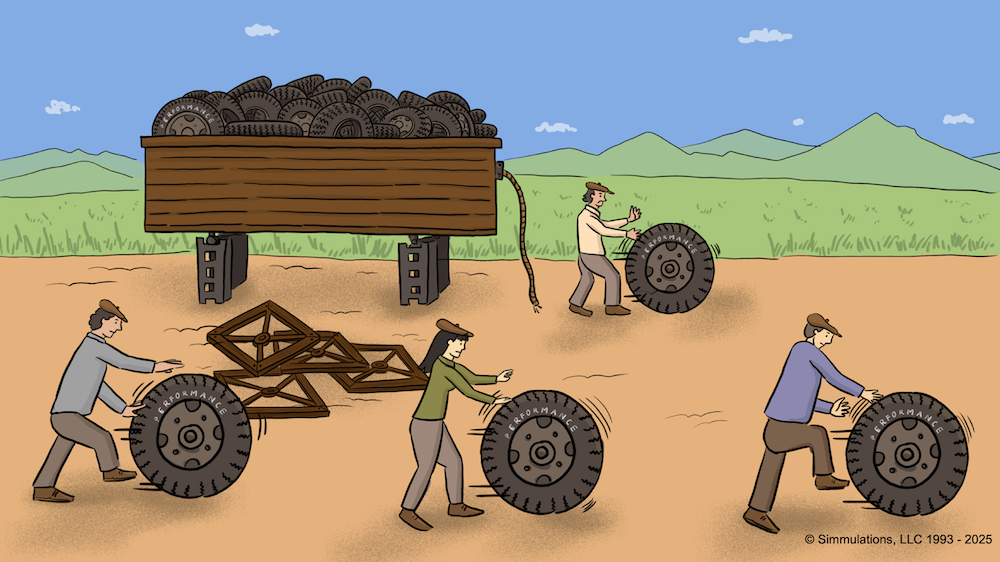
Playing with Round Wheel Ideas creates lots of cognitive dissonance about the Square Wheels and round wheel possibilities.
5. A simple Munger-style personal growth exercise with Square Wheels
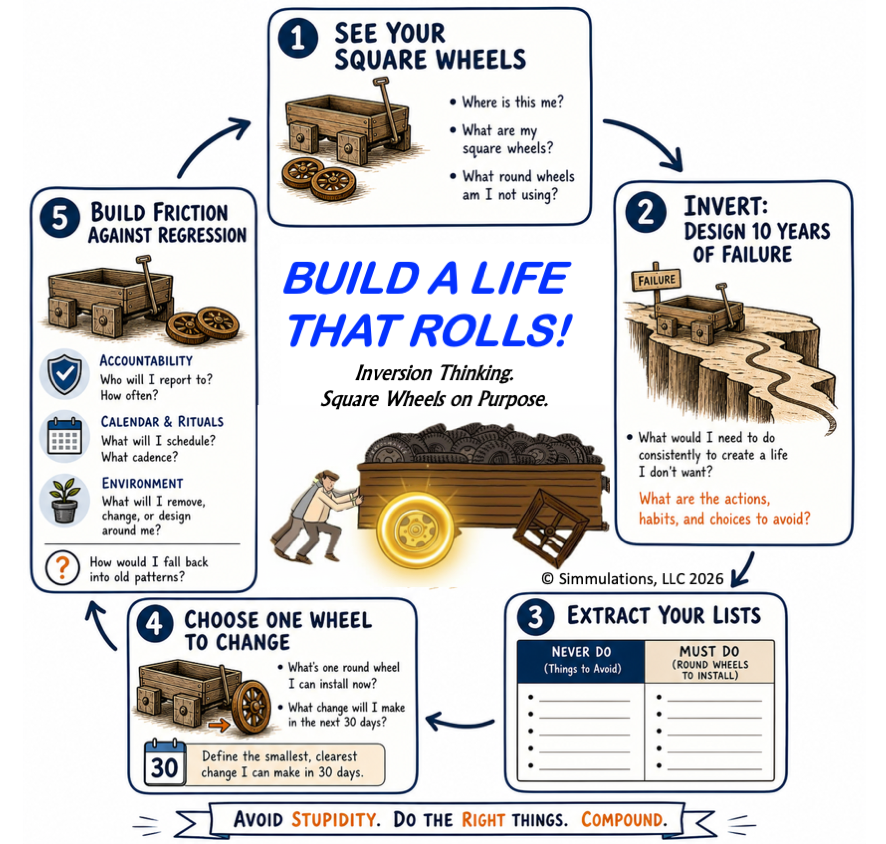
If you wanted to build a short exercise (say, 45–60 minutes) around this, a Munger-flavored flow might look like this:
-
Show the Square Wheels image and ask three questions
-
“Where is this me?” (identify 3 life domains where the wagon feels ‘square’).
-
“What are my square wheels in each domain?”
-
“What round wheels are already in my wagon that I’m not using?”
-
-
Invert: design the next 10 years of avoidable failure
-
For each domain, write: “If I wanted to guarantee that I make no real progress here, what would I keep doing? What would I never start doing?”
-
This will surface the habits and omissions that are obviously unsustainable.
-
-
Extract the “never do” and “must do” lists
-
From the inverted picture, derive a short “Do not do” list (behaviors to remove) and a short “Round wheel to install” list (one small improvement per domain).
-
-
Choose just one wheel to change now
-
Munger would argue for focus and compounding rather than scattered, heroic change.
-
Pick one square wheel you will address in the next 30 days and one round wheel you will actually put on the axle (e.g., daily reading, sleep, weekly reflection, difficult conversation, financial system).
-
-
Build in friction against regression
-
Inversion again: “If I wanted to fall back into my old square-wheeled pattern after 30 days, what would have to happen?”
-
Use the answer to design safeguards: accountability partner, environment changes, calendar blocks, small penalties for breaking the new habit, etc.
-
Used this way, the Square Wheels images become the “storyboard,” and Charlie Munger’s Inversion Rule provides the method that turns insights and reflections into specific behavioral change.
I hope you found this simple idea and flow to be useful. I’d love to chat with Charlie Munger one day as to how he might react to this visual approach to his thinking about performance,
—
For the FUN of It!
 Dr. Scott Simmerman is a designer of team building games and organization improvement tools.
Managing Partner of Performance Management Company since 1984, he is an experienced presenter and consultant who is trying to retire!! He now lives in Cuenca, Ecuador.
You can reach Scott at scott@squarewheels.com
Learn more about Scott at his LinkedIn site.
Note that I often use Perplexity AI to help research and generate ideas for my posts.
Square Wheels® are a registered trademark of Simmulations, LLC
and images have been copyrighted since 1993,
© Simmulations, LLC 1993 – 2026
What I’m About:
My Square Wheels blog and website exist to help leaders, trainers, and facilitators make work smoother, more engaging, and more human. I focus on practical tools for process improvement, organizational change, and workplace collaboration that spark insight and deliver measurable results.
And I am convinced, after 30+ years of using Square Wheels®, that it is the best facilitation toolset in the world. One can use it to involve and engage people in designing workplace improvements and building engagement and collaboration. It is a unique metaphorical approach to performance improvement and we can easily license your organization to use these images and approaches.
By blending proven facilitation methods, creative problem-solving, and engaging team activities, my mission is to support organizations in building energized, sustainable cultures of involvement and innovation.
Through accessible — and often free — resources and virtual facilitation tools, I aim to help teams everywhere collaborate more effectively, innovate continuously, and take ownership of their improvement journey.
#SquareWheels #InnovationAtWork #TeamEngagement #FacilitationTools #WorkplaceImprovement #EmployeeEngagement #CreativeProblemSolving #OrganizationalDevelopment #LeadershipTools #collaboration #leadership #motivation #communications #enablement #leadership #CreativeCommons #enablingperformance #teamwork #storytelling #storyasking

0 Comments