
Staind’s song, “Falling“ is a great tool for discussing the “I’m Not Worthy,” Imposter Thinking and some tools to help people move forward and make personal progress
Produced with some assistance of Perplexity and lots of my thinking and editing
Many capable people at work quietly carry a belief that, “I’m not worthy,” including many top performers. This can show up as hesitation, silence and stalled initiatives. You know it because you see it and feel it. The song, “Falling” by Staind is a powerful lens for reflection and as a conversation starter in the workplace, one to surface the stories and shift beliefs toward forward actions.
Staind’s music has long explored shame, self-doubt, and the emotional residue of dysfunctional beliefs and flawed systems, themes that have made the band resonate with listeners well beyond hard-rock audiences. Read the comments in their YouTube videos and you will read comments about the positive impacts their music has had on many individuals.
That broad emotional landscape makes “Falling” a very interesting and also useful lens for examining common workplace stories: the private belief that “I’m not worthy,” and the very public hesitation, delay, and self-protection that often follow from it. This blog is about people and performance.

“Falling“ appeared on their self‑titled 2011 album Staind, marked by a mix of melodic singing and dark, angry, and depressive lyrics focused on life and living.
The song’s central issue is not simply low confidence. It is the shift from “I made a mistake” to “I am the mistake,” a move that turns temporary setbacks into identity statements and risk-taking into a threat to one’s basic legitimacy. In that sense,
“Falling” can be heard as an emotional portrait of people who feel unworthy of trust, success, or opportunity, and who then protect themselves by avoiding the very actions that might help them grow.
1 – BEFORE moving on, Listen to the song on Youtube.
Falling contrasts hiding in a “shell” waiting to be rescued with the harder work of “getting back up” after falling. It suggests that believing you can find a way out is central to solving your “problem. Here are the ending lyrics that anchor to our desired end state::
2 – Why ‘I’m not worthy’ feels rational
The most damaging part of the “I’m not worthy” narrative
is that it sounds and feels prudent and maybe a little safe.
If a person believes that being exposed is only a matter of time, then staying quiet, playing small, and avoiding stretch opportunities can feel rational rather than fearful. This is one reason imposter-type thinking is so persistent: it presents caution as wisdom, and self-erasure as humility.
Imposter Thinking presents caution as
wisdom, and self-erasure as humility.
Research on imposter thinking consistently describes a pattern in which capable people discount their accomplishments, attribute success to luck or timing, and worry that future visibility will expose them as frauds. That pattern aligns closely with the emotional world Staind often explores: people carrying shame, expecting rejection, and struggling to believe they deserve a different future. The result is not just pain; it is paralysis. And the paralysis can affect nearly everything as related to the choices we make.
Many multi‑year studies have found that people with higher self‑esteem later report better perceived support and justice at work, along with higher satisfaction and performance, even after controlling for prior conditions. They tend to do more.
Self-esteem matters in organizations because identity beliefs shape behavior. Longitudinal research has found that higher self-esteem predicts better later work conditions and outcomes, including stronger perceived support and justice, less stress, and greater satisfaction and success. Related research also shows a positive relationship between self-esteem and job performance, especially when a person’s sense of worth is not totally dependent on perfect performance.
When anyone believes their worth disappears with every mistake, they become more defensive, more cautious, and less willing to experiment and change. We need to look at some ways to address this in our workplaces because it has many incredibly important implications.
Soon, in section 7, we’ll connect this to a simple Square Wheels One image you can get and use to surface these beliefs and support in a nonthreatening way.
3 – How ‘Falling’ maps to everyday performance problems
Used as a metaphor, “Falling” captures a familiar organizational cycle. A person doubts their value, avoids action, experiences reduced contribution or visibility, and then uses that reduced impact as proof that they were not worthy in the first place. It becomes a self-reinforcing loop: fear shrinks action, smaller action shrinks results, and poorer results strengthen fear.
This pattern is easy to see in everyday performance problems. Managers delay difficult conversations because they fear they will say the wrong thing. Employees hold back ideas because they assume others are more qualified. Teams avoid trying new methods because failure might confirm leadership’s doubts about them. In each case, the deeper issue is not capability alone; it is the identity story underlying the behavior.
That is why the phrase “I’m not worthy” deserves attention in leadership and engagement work. It is rarely spoken directly, but it often hides inside statements like “I’m just not good at this,” “someone else should lead that,” or “this kind of thing never works for us.” Those sentences sound practical, yet they often reveal a fixed and self-protective story about what is possible and what is to be avoided.
5 – Why action feels dangerous (and how to shrink the fear)
Fear of failure does not only produce anxiety; it narrows imagination.
In this section, let’s look at how imposter thinking turns caution into what feels like good judgment and how we might help.
When people are consumed by the risk of embarrassment, rejection, or exposure, they stop thinking creatively about next steps and start thinking only about threat management. That is one reason avoidance can feel so compelling.
Picture a capable analyst who quietly stops volunteering for cross‑functional projects after one presentation goes badly. The reduced visibility then “proves” their belief that they were never leadership material in the first place.
Applied guidance on fear of failure emphasizes reframing failure as information rather than identity, naming worst-case scenarios, and taking small, graded risks that create new evidence. Those practices matter because confidence rarely appears first. More often, action produces evidence, and evidence slowly changes self-belief. People do not wait until they feel worthy and then act. They act in small ways while still feeling unworthy, and those actions begin to revise the story.
This principle is highly relevant for leaders. Many leaders assume they must project certainty before they speak, coach, or challenge old assumptions. Yet teams often benefit more from a leader who says, “This is uncomfortable, but it matters, and we are going to learn through it,” than from one who waits for total confidence before moving. Courage in organizations is frequently less about fearlessness than about motion despite doubt. It can help to develop that thick skin of resilience and reality.
6 – Building psychological safety so people will try
“Fear is the mindkiller.” (Dune)
The social environment determines whether people treat mistakes as learning or as indictment. Psychological safety is widely understood as a climate in which people can ask questions, speak up, admit uncertainty, and take interpersonal risks without fear of humiliation or punishment. In such environments, people are less likely to turn every stumble into evidence that they do not belong.
This raises an important leadership question: is the culture amplifying “I’m not worthy,” or interrupting it? Emerging commentary and research summaries suggest that imposter feelings are often intensified by high-pressure, exclusionary, or perfectionistic workplaces, rather than being solely private defects of insecure individuals. When only flawless performance is rewarded, people learn to hide, edit, and protect themselves. When thoughtful risk-taking is recognized, people become more willing to participate before they feel fully ready.
For engagement work, this means the remedy is not motivational language alone. The deeper task is to create settings where people can test ideas, admit uncertainty, and recover from mistakes without being defined by them. That kind of climate does not eliminate self-doubt, but it reduces the cost of acting while self-doubt is still present.
7 – Where The Square Wheels metaphors and the round wheel ideas fit
(Go ahead, click to play the song again!)
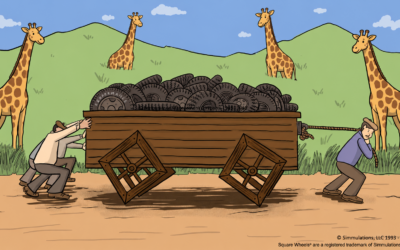
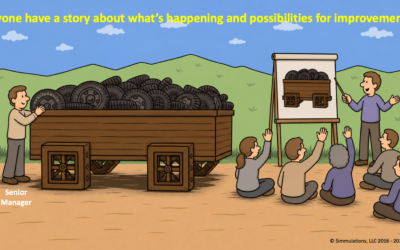
This is where Square Wheels® tools can add real leverage. For decades, I’ve watched groups go from quiet, self‑critical stories to very specific developmental changes within 20–30 minutes of seeing and playing with the image. This is where YOU can come with a message and a tool, a way to demonstrate YOUR support for their development, the individuals and the teams.
The metaphor works because it externalizes the problem: instead of “What is wrong with me?” the conversation becomes “What in our system keeps making forward movement harder than it needs to be?” That shift will lower defensiveness and make reflection more honest. This works at an individual as well as a team level.
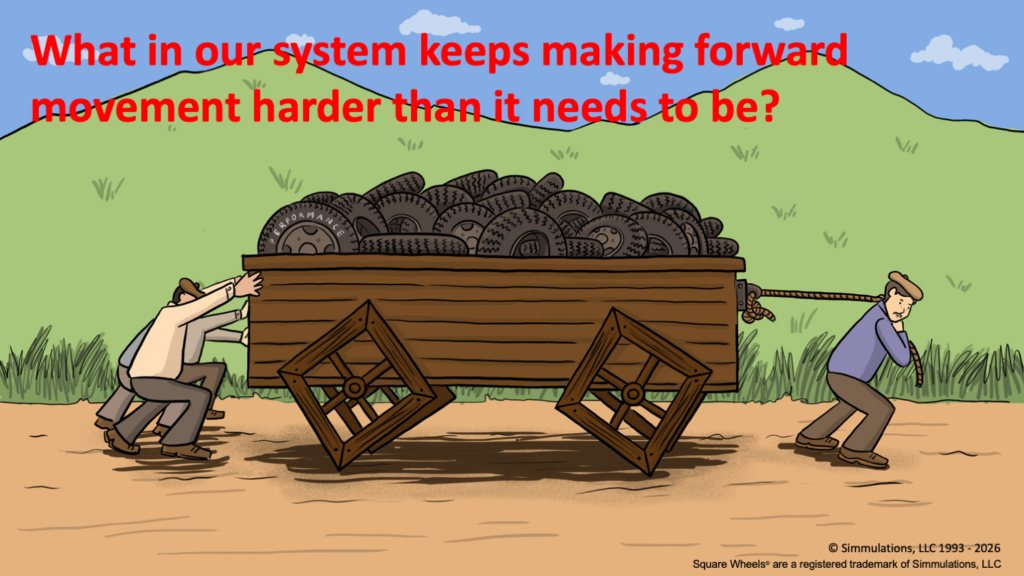
Click to get this image for FREE and use it to generate reflection and perspective.
Several practical integration points stand out:
-
Read the basic facilitation guide that comes with the FREE Creative Commons Square Wheels One image first. That will help you to better understand the basic design for facilitating active involvement and engagement and generating commitment to change.
-
Use this SWs One wagon image early in a workshop or blog-based discussion to ask, “Where are people still pushing hard while privately believing they are not good enough to suggest a better way?” This creates a bridge between self-worth beliefs and system constraints.
-
Ask teams to identify the “Square Wheels” in their own language: outdated routines, unclear expectations, fear-based leadership, or norms that punish questions. There can be many dozens of things that do not work smoothly and these differ by each individual’s perceptions This helps people see that hesitation is often co-produced by culture, not just personality. And the round wheels are already in the wagon.
-
Introduce round wheel ideas as small experiments rather than heroic transformation. That reinforces the research-backed idea that progress comes from low-risk action that creates new evidence.
- Understand that there can be a lot of different emotions underlying the beliefs of the people and that discussions and perceived support can help people understand and address them. Openness and perceived support are powerful change agents.
-
During debriefs and discussions, ask, “What story keeps us from reaching for the round wheels?” Many groups will name busyness or habit first; with reflection, they often uncover deeper beliefs such as “management will never listen,” “we are not ready,” or “we will probably fail anyway.”
- Consider going to the lyrics and printing and distributing the actual song lyrics to your people as a handout. They can even follow along! It is all part of the same message. Find it here.
- Lastly, as a manager, keep a list of all the different successes for individuals and teams and freely refer to them over time. Be sustainable. Create the culture that you are most interested in this continuous continuous improvement and that everyone contributes to making the workplace better. Peer support is powerful to help sustain positive improvements in how people think of themselves.
Some ideas will be around systems and processes. And some will be around personal issues as outlined above. All the ideas for improvement have value.
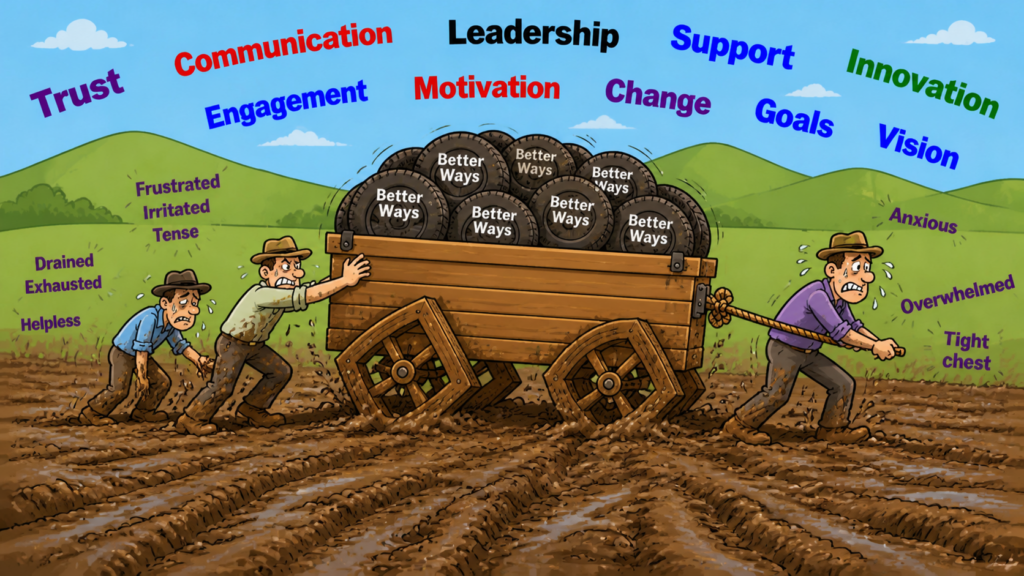
People feel different emotions as they do their work. They benefit by support and considered alternatives. Round wheels are in the wagon!
Questions like the collection above help turn a song like “Falling” into a reflection tool rather than just a mood piece. The goal is not to psychoanalyze anyone or everyone. The goal is to help people notice where shame-based stories are silently shaping performance, participation, and willingness to improve.
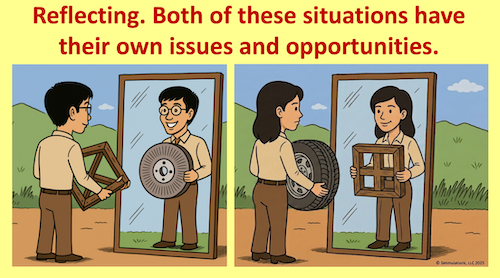
There are different perceptions around how we see ourselves when we reflect on things that we can choose to improve.
8 – Reflection prompts for teams and leaders
The Big Idea of this blog is to give readers some tools to use to help people move from their current views on things to insight and to application. Some thoughts and prompts for personal and team reflection:
-
Where in the current role does “I’m not worthy” show up as hesitation, overpreparation, silence, or withdrawal?
-
What recent action was avoided because failure felt like exposure rather than learning?
-
Which Square Wheels in the culture make people protect themselves instead of participate fully?
-
What is one round-wheel experiment that would be safe enough to try this week?
- How can we build on our personal improvements over time, what the author calls, “continuous continuous improvement?”
-
How can leaders respond to mistakes in ways that separate the person from the pattern and that help support change and improvement to create more safety?
These prompts fit coaching conversations, team meetings, and workshop debriefs because they connect inner narrative to shared systems. They also align with evidence showing that performance and engagement improve when people experience support, fairness, and safety rather than chronic judgment.
Performance and engagement improve when people experience
support, fairness, and safety rather than chronic judgment.
9 – Moving forward, rocking and rolling and making progress
The most important idea in this entire discussion is simple: action does not have to wait for worthiness. People often assume they must first conquer self-doubt, silence the inner critic, or feel fully legitimate before taking meaningful action.
In practice, growth usually works in the opposite direction. Small acts of contribution, candor, and experimentation create the evidence that eventually weakens the belief “I’m not worthy.” And Peer Support can have huge positive benefits when the acts and actions are perceived as supportive.
Note: In many workplaces, what gets labeled “constructive criticism” lands as judgment, not support, and it reinforces the “I’m not worthy” script. Feedback that focuses on behaviors, possibilities, and support for change is far more useful than critiques of the person. In my view, Constructive Criticism is an oxymoron. It only contributes to the “I’m Not Worthy” brainscheme. It does NOT improve performance or mindset.
That is why the themes in the “Falling” song work so well as a leadership and personal-growth metaphor. It names the emotional gravity of shame without glorifying passivity. It allows a conversation about fear, identity, and hesitation, while also opening the door to a better question: what would positive forward movement look like, even now? For leaders, teams, and organizations alike, the breakthrough often begins not when doubt disappears, but when someone reaches for a round wheel while doubt is still in the room.
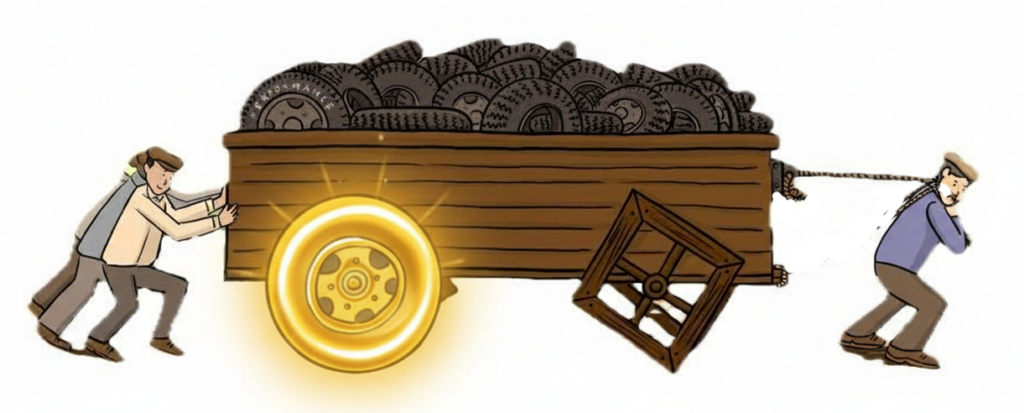
Build confident action by implementing round wheels.
I hope that something in here rings right with you, and I hope that you can use these communications tools to have positive impacts on others around you,
DO SOMETHING!!! This week, pick one conversation—a 1:1, team huddle, or short workshop—and try two moves: play “Falling” or reference its central idea, and then use the Square Wheels image to ask, “What makes forward motion harder than it needs to be, and what one small round wheel could we try?”
Grab that Square Wheels One image for FREE at:
https://performancemanagementcompany.com/square-wheelsone/
And play the Falling song again — https://www.youtube.com/watch?v=sXFUqKJ6hDA
—
For the FUN of It!
 Dr. Scott Simmerman is a designer of team building games and organization improvement tools.
Managing Partner of Performance Management Company since 1984, he is an experienced presenter and consultant who is trying to retire!! He now lives in Cuenca, Ecuador.
You can reach Scott at scott@squarewheels.com
Learn more about Scott at his LinkedIn site.
Note that I often use Perplexity AI to help research and generate ideas for my posts.
Square Wheels® are a registered trademark of Simmulations, LLC
and images have been copyrighted since 1993,
© Simmulations, LLC 1993 – 2026
What I’m About:
My Square Wheels blog and website exist to help leaders, trainers, and facilitators make work smoother, more engaging, and more human. I focus on practical tools for process improvement, organizational change, and workplace collaboration that spark insight and deliver measurable results.
And I am convinced, after 30+ years of using Square Wheels®, that it is the best facilitation toolset in the world. One can use it to involve and engage people in designing workplace improvements and building engagement and collaboration. It is a unique metaphorical approach to performance improvement and we can easily license your organization to use these images and approaches.
By blending proven facilitation methods, creative problem-solving, and engaging team activities, my mission is to support organizations in building energized, sustainable cultures of involvement and innovation.
Through accessible — and often free — resources and virtual facilitation tools, I aim to help teams everywhere collaborate more effectively, innovate continuously, and take ownership of their improvement journey.
#SquareWheels #InnovationAtWork #TeamEngagement #FacilitationTools #WorkplaceImprovement #EmployeeEngagement #CreativeProblemSolving #OrganizationalDevelopment #LeadershipTools #collaboration #leadership #motivation #communications #enablement #leadership #CreativeCommons #enablingperformance #teamwork #storytelling #storyasking

0 Comments