
The topic of this blog is, “What would Pete Buttigieg do for Enablement of the US Workforce” with a focus on generating real leadership around a national workplace improvement program.
Imagine, for a moment, that Pete Buttigieg decided to “do a Japan on Quality” on the American workplace.
 Not a slogan. Not another white paper or government report that hits the media one day and then dies in a filing cabinet. I mean a serious, sustained, national commitment to workplace quality, engagement, and performance that echoes what Japan did with quality in the 1960s–1980s, only this time focused on how people work, learn, and lead inside American organizations. The impacts are obvious.
What might that actually look like?
From Potholes and Runways to People and Work
Buttigieg’s public brand is already tied to infrastructure, transportation, and metrics. You can almost hear the framing: “If we can demand world‑class standards for our bridges and airports, why are we tolerating third‑rate standards for how we manage, engage, and support the people who use them?”
That’s the pivot: infrastructure to infrastructure of work.
In Japan’s quality revolution, the heroes weren’t slogans, they were systems. W. Edward Deming’s ideas about variation, Juran’s focus on planning, Toyota’s obsession with defects and continuous improvement. They treated quality as a national survival strategy, not a side project.
American workplaces today, in contrast, lose staggering amounts of value to disengagement, rework, conflict, and wasted time. A Buttigieg‑style national effort would start from that same survival premise: we cannot stay competitive with workplaces that generate as much noise as they do value.
So what are the levers of a “National Commitment to Workplace Quality”?
A National Vision: The American Workplace Upgrade
A serious campaign would start by naming the target. Not just “good jobs,” not just “higher wages,” but a visible, measurable upgrade to the way work is organized and experienced.
Imagine a simple, compelling vision:
“By 2035, the United States will be the best place in the world to work and to lead: safer, more engaging, more productive, and more innovative.”
Behind that sentence sit four big, intertwined outcomes:
-
Higher levels of employee engagement and enablement
-
Measurably better management and leadership practices
-
Reduced waste in meetings, processes, and bureaucracy
-
Stronger capability for learning, improvement, and innovation
Japan committed to “zero defects” and “just‑in‑time.” A modern American version could commit to “zero pointless jobs” and “just‑in‑time learning.” It reframes quality not as inspection of product, but as design of experience and process. It involves the active engagement of workers and managers and one hell of a lot of collaboration.
Pillar 1: Standards for the Human Side of Work
We have building codes, aviation standards, and food safety regulations. But when it comes to the human side of work, standards are fuzzy at best and downright horrible at worst.

A Perplexity-generated image of what I call, The Supervisor Hellscape. One of a series.
A Buttigieg‑style workplace quality movement would borrow from that regulatory mindset, but with a twist. Rather than micromanaging culture, it would define minimum standards for:
-
Psychological and physical safety at work
-
Reasonable workload and scheduling practices
-
Managerial basics: feedback, 1:1s, clarity of expectations
-
Access to development and voice in improvement
We have the metrics and we have the tools for managing them. AI offers us a wide variety of ways to address the leadership development issues. (Here I joke about using drones to manage toxic managers, but we have the actual serious technology to provide feedback and coaching.) Think of it as the equivalent of “workplace quality codes”—baseline expectations that any serious employer must meet if they want public money, tax incentives, or certain forms of federal contracting. Not a script for culture, but a floor under abuse, chaos, and neglect. We can implement “Moneyball“ approaches to manage the right metrics — again, we have the tools; we just need the leadership.
This becomes powerful when combined with transparency. If every large employer had to report a handful of simple, auditable indicators about their workplace (turnover in key roles, internal promotion rates, basic engagement markers), the market itself begins to react. Boards, investors, and candidates can see who’s serious and who is coasting. And we know that the economic payoffs already exist — now we get to the impacts on people.
Pillar 2: Investing in Managers as a National Asset
Japan’s quality push invested heavily in front‑line capability, training operators, supervisors, and engineers in problem‑solving and process thinking. They developed simple, great, actionable tools along with the accountability that transformed their entire nation. The analog in the American workplace is our vast, underprepared and unengaged population of managers.
Most managers in the U.S. did not choose “management” as a profession; they were promoted for technical performance and thrown into the deep end. The data on this are brutal: workers and teams don’t quit companies, they quit managers. And they quit often.
A national workplace quality initiative would treat managers the way we treat pilots or air‑traffic controllers: as people who perform a critical, high‑impact job that demands training, standards, and recertification. They need competencies and support.
That might include:
-
Nationally recognized manager capability frameworks and micro‑credentials like we do for teachers.
-
Funded, scalable development programs for first‑line supervisors, not just executives
-
Incentives for employers who certify a high percentage of managers and demonstrate improvement in team outcomes
-
Research centers that identify evidence‑based practices and push them into organizations in practical, usable formats
We already do this in so many professions. Think of all the licensed roles that touch our daily lives: barbers, cosmetologists, nail technicians, massage therapists, tattoo artists, electricians, plumbers, HVAC technicians, real estate agents, and commercial truck drivers. We can’t offer certifications for managers?
Pete Buttigieg has always talked the language of “investing in people,” “skills,” and “future‑ready workers.” A workplace quality agenda would simply extend that argument: if we underinvest in managers, we underperform as a nation.
Pillar 3: Making Engagement and Performance Visible
Japan’s factories made performance visible at the gemba—the place where work happens. Status boards and simple metrics that everyone could see and understand. The premise was: if people can see the system, they can improve the system. That is just how basic performance feedback operates. Measure it and share it.
Modern American organizations, ironically, often bury the essentials. Engagement surveys are confidential and infrequent and ineffective, and they are not acted on in meaningful ways. Performance data is hoarded at the top as if they produced the numbers, not the managers and the workers. Process problems are whispered about but seldom mapped. Square Wheels are everywhere and hands-on people know what needs improvement. Always.
But, a desk is a dangerous place from which to view the world.
A national initiative could flip this performance paradigm to make things actionable. This ain’r rocket surgery:
-
Encourage (or require, in certain sectors) regular, shareable engagement and enablement measures
-
Promote simple, standardized workplace dashboards that combine safety, quality, and people metrics
-
Provide tools and frameworks that help teams run their own improvement cycles based on that data
This isn’t about adding another survey; it’s about weaponizing the information leaders already have but don’t use. If you want to create a “Japanese” level of commitment, you need everyone, not just executives, to be watching the same scoreboards.
Pillar 4: Public–Private Learning Labs for Workplace Innovation
Japan’s quality journey wasn’t just a corporate thing; it involved government, industry associations, academics, and consultants all pulling in roughly the same direction. Germany, South Korea and Singapore all followed pretty-much the same national playbook. The result: shared learning, common methods, and stories that reinforced the message.
In a Buttigieg‑led American campaign, you’d likely see:
-
Federally funded “Workplace Innovation Labs” pairing companies, unions, researchers, and local governments and probably done in collaboration with our universities using existing structures.
-
Sector‑specific playbooks: what workplace quality looks like in healthcare, logistics, manufacturing, tech, and public service. We already have most of these best practices and systems and processes. We implemented Japanese-style quality with the ISO-9000 and similar kinds of initiatives.
- Use the AI tools that are developing to measure and provide specific performance feedback to organizations about issues and opportunities.
-
National awards and recognition programs that celebrate real improvements in engagement, safety, and productivity and not just glossy culture marketing. Remember “The Malcolm Baldrige National Quality Award” — and do you know that we still do that?
This is where we engage everyone, especially readers with an intrinsic interest in this. Facilitators, OD consultants, serious‑game designers, and learning professionals become the applied R&D teams of this movement. My Square Wheels images, for example, might become a diagnostic lens through which organizations ask their people about their current reality and design their “round wheels” for the future. Actively involved and engaged in making changes.
Pillar 5: Storytelling, Symbols, and the National Narrative
Every serious social or economic transformation has its stories and symbols.
Japan had tales of Toyota stopping the line, of humble factories beating global giants on defect rates. The stories traveled; they became templates for what “good” looks like.
A Buttigieg‑led effort would need the same:
-
Signature stories: a hospital that cuts serious safety events in half while raising staff engagement; a logistics hub that slashes turnover by redesigning schedules and supervisor roles; a city government that uses team‑based improvement to transform citizen experience.
-
Simple metaphors: “We fixed the bridges; now we fix the bridges inside your company—the ones between leadership and front line, between silos, between goals and daily work.”
-
Iconic commitments: mayors or governors declaring their cities “Best Place to Work Regions” with clear multi‑year plans and public tracking. Government becomes more responsive to the people because that is what people actually want and are paying for.
All of us are in an ideal position to curate, shape, and broadcast those stories. They make the abstract project of “workplace quality” feel concrete and possible. We generate hope around actions.
Why This Matters Now
The American workplace is at a crossroads.
On one hand, we have world‑class talent, technology, and capital. On the other, we have chronic disengagement, burnout, and a pandemic hangover of mistrust and fragmentation. We can continue to treat these as HR issues and wellness campaigns or we can elevate them to the level of national capability and excellence.
The Japanese taught the world that quality isn’t about catching errors at the end; it is about designing excellence into the way work is done, minute by minute. A modern American echo of that commitment would recognize that:
-
Engagement is not a perk; it is the energy that powers performance and innovation.
-
Managers are not a cost center; they are the transmission system of strategy. Let’s change how we do accounting and treat people as VALUE to the company, not just a cost like we do now.
-
Workplace design is not “soft stuff”; it is the architecture of productivity and innovation.
Pete Buttigieg, or any real national leader willing to pick up this mantle, doesn’t have to invent a new theory. The frameworks exist. The data is clear. What’s missing is the level of seriousness Japan brought to its quality journey, as did Singapore along with the willingness to say, “This is not optional if we want to thrive (or survive).”
Your Role in a National Workplace Quality Movement
For consultants, trainers, and organizational leaders, this hypothetical national push is more than an interesting thought experiment. It’s a prompt:
-
What would it look like if you treated workplace quality the way Toyota treated defects?
-
Where are the Square Wheels in your organization that everyone knows about but nobody feels empowered to change?
-
Which “round wheels” are already leaning against the Square Wheel’d wagon, waiting for permission, attention, and resources?
A national commitment can set the tone, fund the labs, and standardize some expectations. But the real work happens in teams, meetings, facilitation sessions, and candid conversations about how we actually do the work.
If Japan could transform its reputation from “cheap junk” to “world‑class quality” in a generation or South Korea become a leading exporting nation in just a couple of decades, there is no structural reason the United States cannot do the same for the quality of its workplaces. The only real questions are: who will champion it, and how serious are we willing to be?
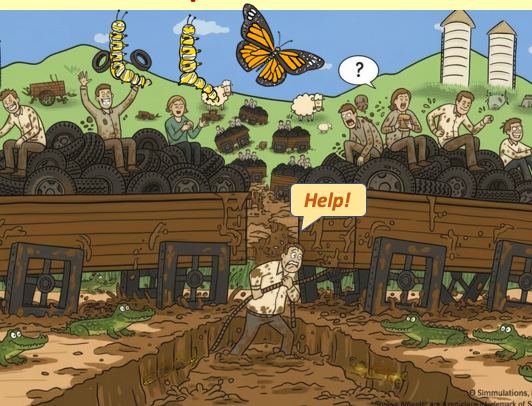
Appendix – After writing this, I reflected and thought to also share this image. Note that the Butterfly stands for my idea of Hope. And caterpillars can fly, if they just lighten up! The round wheels are already in the wagons and getting out of the ditch and up on the road is a choice for most.
—
For the FUN of It!
 Dr. Scott Simmerman is a designer of team building games and organization improvement tools.
Managing Partner of Performance Management Company since 1984, he is an experienced presenter and consultant who is trying to retire!! He now lives in Cuenca, Ecuador.
You can reach Scott at scott@squarewheels.com
Learn more about Scott at his LinkedIn site.
Note that I often use Perplexity AI to help research and generate ideas for my posts.
Square Wheels® are a registered trademark of Simmulations, LLC
and images have been copyrighted since 1993,
© Simmulations, LLC 1993 – 2026
What I’m About:
My Square Wheels blog and website exist to help leaders, trainers, and facilitators make work smoother, more engaging, and more human. I focus on practical tools for process improvement, organizational change, and workplace collaboration that spark insight and deliver measurable results.
And I am convinced, after 30+ years of using Square Wheels®, that it is the best facilitation toolset in the world. One can use it to involve and engage people in designing workplace improvements and building engagement and collaboration. It is a unique metaphorical approach to performance improvement and we can easily license your organization to use these images and approaches.
By blending proven facilitation methods, creative problem-solving, and engaging team activities, my mission is to support organizations in building energized, sustainable cultures of involvement and innovation.
Through accessible — and often free — resources and virtual facilitation tools, I aim to help teams everywhere collaborate more effectively, innovate continuously, and take ownership of their improvement journey.
#SquareWheels #InnovationAtWork #TeamEngagement #FacilitationTools #WorkplaceImprovement #EmployeeEngagement #CreativeProblemSolving #OrganizationalDevelopment #LeadershipTools #collaboration #leadership #motivation #communications #enablement #leadership #CreativeCommons #enablingperformance #teamwork #storytelling #storyasking



Good work Scott 👍
Scott,
So interesting. What struck me most is how you positioned workforce enablement as a systems design problem. I like that perspective.
Too often organizations respond to disruption by creating more content, more courses, and more information repositories. But in an AI-driven environment, content is becoming abundant and cheap. The differentiator is designing tools or aids that help people make decisions, practice skills, receive feedback, and adapt in real time.
If we really want workforce enablement, we need to move beyond episodic training events and toward continuous performance support, coaching, simulations, AI-guided practice, and manager enablement embedded directly into the flow of work.
The organizations that succeed won’t be the ones with the biggest content libraries. They’ll be the ones that intentionally design environments where employees can continuously learn, apply, and evolve as work itself changes.
Love the insights, keep them coming!
Thanks, Karl. My sentiments exactly. We spend so much on “training” and on senior managers while the people really impacting the organization are the supervisors, and their world pretty much sucks.
If we want to impact workforce enablement, we have to impact the workforce! When the supervisors don’t care because their managers don’t care, why should the workers. And aren’t the workers actually the ones producing everything?