
Why Morale Crashes After Six Months on the Job – and how to use simple Square Wheels tools to keep hope alive and enable improvements.
Consider your newest hire. On day one, they arrive with high hopes, energy, and a story in their head about how this job will be better than the last one. Six months later, that story has unraveled. We have known about this “honeymoon then hangover” pattern for decades, and the data always shows the same thing: enthusiasm drops, belief in leadership softens, and people start quietly deciding whether to endure the job, redesign it, or leave.
New Hires start with High Hopes,
a story that quickly unravels.
Most of the time, we explain that crash with surface factors: broken processes, weak onboarding, overwhelmed supervisors, or clumsy performance systems. All true. But there is a deeper pattern underneath: people do not stay energized by structure alone. They stay energized when the work feels meaningful, when they have some say in how they contribute, when they feel they belong, and when they see tangible growth. When that inner connection fades, the system might still “work,” but the work goes emotionally flat.
People do not stay energized by structure alone.
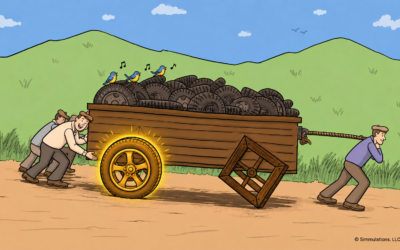
That is where Square Wheels comes in. For 30+ years, I have used a simple wagon‑and‑wheels metaphor to help managers and teams talk about friction, possibilities, and change in a low‑risk way.

Today, the opportunity is bigger: we can use Square Wheels tools not only to fix process problems, but to deliberately surface purpose, autonomy, belonging, and growth, four engines that keep that new‑hire hope alive beyond month six. Sharing the images and discussing the metaphors give people a safe way to point at the wagon, frame the wheel problems, talk about the push and the pull, name what is really in the way of improvement, and then design better round wheels together.
Managers can use the simple Square Wheels images to redesign both the work and the why.
One key is real conversations about the workplace. Managers need to stop pretending that everything works fine or that no changes are possible. Discouragement with workplace systems and process has always been part of the disengagement problem and we must stop pretending that nothing can be done.
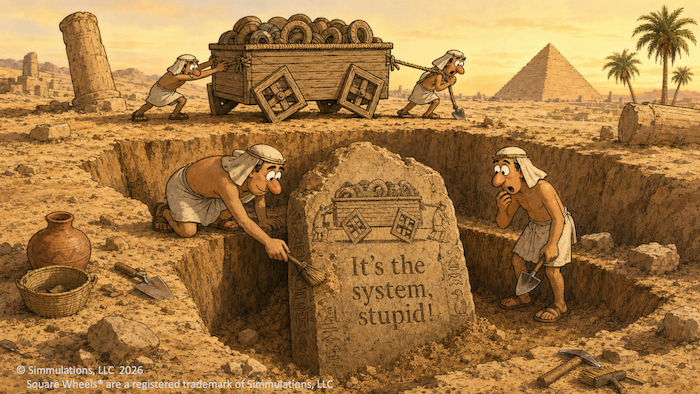
We must focus on the supervisors, yes—but not just as enforcers of systems and process. We need them as designers of meaning, autonomy, belonging, and growth in the daily work. Here is how a manager can use Square Wheels as a practical tool to do exactly that.
1. Connect the work to a real purpose (who does improvement help, and why does it matter?).
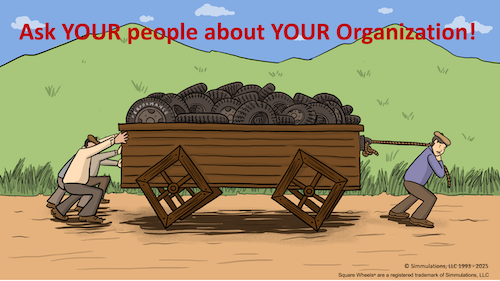
How might this image represent how things really work in most organizations?
Put up a basic Square Wheels image of the wagon rumbling along on square wheels with some round ones just behind it. Ask your team:
-
“How might this image represent how things really work in most organizations?”
-
“In this wagon, what is actually happening in regards to how people feel about working?”
-
“If we pull this more smoothly, who benefits, and how?”
Capture answers on a flip chart next to the image: customers, co-workers, patients, students, internal partners, community. You are not just fixing a process; you are rebuilding the story people tell themselves about why the struggle is worth it. The metaphor makes it easier to say, “If we replace this particular Square Wheel, it directly improves life for these people,” which is a much stronger motivator than “because leadership said so.”
2. Name the real obstacles, not just the symptoms.
When morale drops, it is tempting to label people as lazy or resistant. Use the wagon to get underneath that. Point to a Square Wheel and ask:
-
“If this wheel had a label, what would it be: confusion, overload, fear of failure, perfectionism, lack of recognition, or loss of meaning?”
You’ll hear things like, “We never know what success looks like,” “We’re afraid to make a mistake,” or “No one notices when we go the extra mile.” Suddenly, you are not talking about “bad attitudes”; you are diagnosing specific emotional and structural frictions you can actually address.
3. Increase autonomy in visible ways (let people help design your round wheels).
Once you have a few Square Wheels labeled, flip the conversation:
-
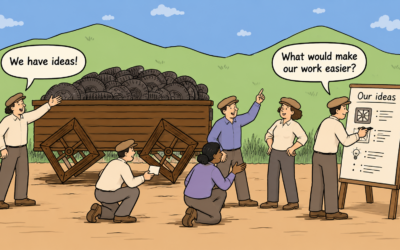
“If you could design one small ‘round wheel’ to make this better, what would you try first? What are three ideas around this?”
Invite people to sketch their own round wheels on sticky notes and put them behind the wagon. Then commit, as a supervisor, to helping piloting one or two of their ideas in the next two weeks. When people see that they can shape not just what work they do, but how it gets done, autonomy becomes visible and real. The wagon picture keeps it playful and non‑threatening, even while you are shifting control.
4. Make growth and progress tangible early (show the wagon rolling more, better or faster).
The first months on the job are fragile. New hires need early evidence that they are learning and that the wagon is rolling a bit more smoothly because of them. Keep a version of the Square Wheels Ons image handy in team meetings and 1:1s. Periodically ask:
-
“Where have we already replaced a Square Wheel with something a bit rounder?”
-
“What can you now do more easily than you could 60 days ago?”
Draw or annotate the image over time—new wheels, fewer rocks, clearer road. That simple visual history tells a progress story people can see. It reinforces the idea: “My effort here actually changes the wagon,” which is a powerful antidote to the six‑month crash paradigm.
5. Build belonging, not just inclusion (make the conversation about ‘our’ wagon).
Finally, belonging is not just “you’re on the team”; it is “your uniqueness is needed to move this wagon.” When you facilitate Square Wheels® discussions:
-
Make sure every voice gets heard, especially the quiet ones.
-
Celebrate unconventional ideas (“That’s an odd round wheel, let’s explore it.”).
-
Use language like “our wagon,” “our wheels,” and “our road,” not “my plan” or “their initiative.”
- Give people active ownership around the ideas for improvement, because they always have them.
The images give people something external to talk about, which lowers defensiveness and makes it safer to offer honest views. Over time, that shared language—“this is a Square Wheel,” “that’s a round wheel idea”—becomes part of a culture where people feel seen, heard, and involved in designing their own work.
—
For the FUN of It!
 Dr. Scott Simmerman is a designer of team building games and organization improvement tools.
Managing Partner of Performance Management Company since 1984, he is an experienced presenter and consultant who is trying to retire!! He now lives in Cuenca, Ecuador.
You can reach Scott at scott@squarewheels.com
Learn more about Scott at his LinkedIn site.
Note that I often use Perplexity AI to help research and generate ideas for my posts.
Square Wheels® are a registered trademark of Simmulations, LLC
and images have been copyrighted since 1993,
© Simmulations, LLC 1993 – 2026
What I’m About:
My Square Wheels blog and website exist to help leaders, trainers, and facilitators make work smoother, more engaging, and more human. I focus on practical tools for process improvement, organizational change, and workplace collaboration that spark insight and deliver measurable results.
And I am convinced, after 30+ years of using Square Wheels®, that it is the best facilitation toolset in the world. One can use it to involve and engage people in designing workplace improvements and building engagement and collaboration. It is a unique metaphorical approach to performance improvement and we can easily license your organization to use these images and approaches.
By blending proven facilitation methods, creative problem-solving, and engaging team activities, my mission is to support organizations in building energized, sustainable cultures of involvement and innovation.
Through accessible — and often free — resources and virtual facilitation tools, I aim to help teams everywhere collaborate more effectively, innovate continuously, and take ownership of their improvement journey.
#SquareWheels #InnovationAtWork #TeamEngagement #FacilitationTools #WorkplaceImprovement #EmployeeEngagement #CreativeProblemSolving #OrganizationalDevelopment #LeadershipTools #collaboration #leadership #motivation #communications #enablement #leadership #CreativeCommons #enablingperformance #teamwork #storytelling #storyasking #emotionalintelligence

0 Comments