

“The Facilitation Graveyard – The Supervisors” — The human “Pause Buttons” on progress, innovation and workplace engagement because of all of the constraints we put on them. And some ideas about what we can choose to do differently.
I first lay out the problem. Then I offer some specific
actionable ideas and some useful tools at the end.
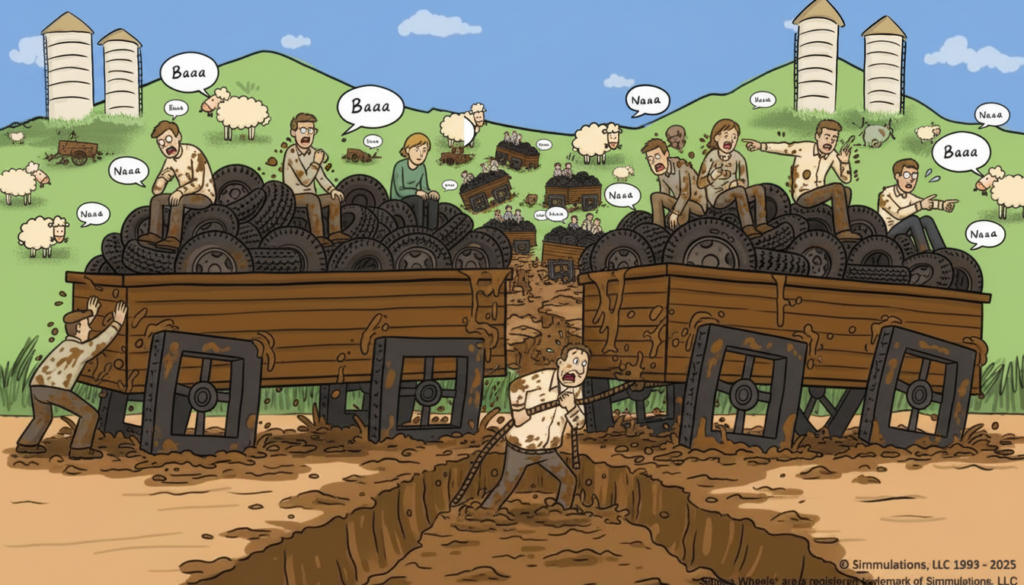
My first image about Supervisor Hellscape looked like this below, where the supervisor has mud to deal with along with the expected Silos and Spectator Sheep voicing their opinions about things. I mean, with this reality, can we really expect them to involve the wagon sitters that represent the 4 in 5 disengaged workers to improve progress?
Why development initiatives fail: Implementation Graveyards
Organizations invest somewhat in supervisor development, yet most initiatives consistently fail. Nearly 1 in 4 organizations report that their training efforts fail to meet adoption expectations. But the reality is probably much higher as things do not get reported. Reasons form a predictable pattern:
There is little actual supervisor training. Of course that varies from organization to organization but the numbers say only about 40% of workers promoted to supervisors get any formal leadership training, and the workers who DO get promoted are generally SMEs and high performers, so they do not have the skills. They wing it and try to model their behavior to that of their previous (and sometimes bad) managers. (See my “SkyNet” article on ideas to use AI to deal with bad managers.)
Training as theater, not transformation. Most organizations design management training like a calendar appointment, booking a hotel and hoping one good workshop will solve something or everything. But behavior doesn’t change in a day; it changes through repetition and reinforcement.
One problem is that training is done as soon as the workshop ends with no follow-through, no structured practice, no accountability and no space for reflection. It is not that the training is bad. And there are simple AI tools for coaching that can be used. But training without reinforcement is a motivational speech, and “motivational speech” is an oxymoron.
Training without reinforcement is a motivational speech, and “motivational speech” is an oxymoron.
The follow-through failure. The most common mistake organizations make during rollouts is assuming that employees will figure out how to use the tools without formal training. Being trained is not about implementation. And without a sense of active ownership, motivation just does not appear. Do the supervisors OWN the desired outcomes that are expected?
Manager support determines success or failure. The number one predictor of whether training sticks is not the trainer, the model or the learning platform: It’s the line manager. When the line manager is involved before, during and after the training, behavior change skyrockets. When they’re not, training fades almost instantly.
Brilliant supervisors fail simply because their manager never followed up. They walk out of a session full of ideas, then return to a leader who says, “We don’t really do it like that here,” or “Just focus on getting through the workload.” That one sentence kills the entire program.
Supervisor Resistance: Fear, Skepticism, and Competing Realities
Supervisors resist new facilitation methods for rational reasons that organizations often dismiss as reluctance to change. Bottlenecks often stem from unclear localized use cases and resistance from middle managers and frontline employees. And supervisors are overloaded with meetings, tasks, reports and other stuff which roadblock their efforts to do things differently.
Incomplete initial implementation. The first try at some improvement may not often be the best but their managers will criticize the initial effort, so things stop. No changes and back to normal is the realistic outcome.

Managers often put a Blame Frame around initial attempts to improve the wagon.
Fear of incompetence. The vulnerability of learning and performing weighs heavily on supervisors who are exposed every day. Humans do not want to be seen making mistakes so they resist doing things differently if there is any perceived risk.. This dynamic extends to any new facilitation effort where supervisors must demonstrate competence they haven’t yet developed.
Skepticism about value. Supervisors who’ve witnessed initiative after initiative fail develop a protective skepticism. They wait and see the reactions to others making attempts to change. If they do not see a personal positive impact for doing things differently, you cannot expect change.
Employee resistance: Cynicism from broken promises and lack of trust
The cynicism that undermines facilitation and engagement efforts stems from legitimate disappointment. HR starts with an employee engagement survey, then launches some new initiatives to help boost morale, tops down and withour feedback. Employees appreciate Summer Fridays and Taco Tuesdays, but it’s a new version of the same initiative every year. Each initiative gets wrapped up in the next, the novelty quickly fades, and the ideas are always from the outside of the workgroup so there is no active ownership-involvement.
Innovation initiatives prove largely futile year-over-year because engagement fatigue settles in. Employees roll their eyes with each new wave of surveys and meetings, since no real change ever comes of these efforts. The employees get jaded.
A study conducted by four of the most valuable companies in the US found that over 70% of employees don’t trust their Human Resources department. Whether or not such a statistic is fair to HR is a moot point considering the overwhelming prevalence of that lack of trust. The facilitations done by their supervisors do not have to deal with the trust dynamics in general.
Cultural and organizational barriers: The system working against itself
Generally, supervisors experience a real lack of organizational support and are told not to make changes without approvals. This is generally un-engaging and un-empowering.
Leadership misalignment undermines everything. A common theme among most successful implementations is that the more time you spend planning and testing, the better the results. When everyone, from the CEO to the supervisors knows the end goal and takes steps in the same direction, it can make the implementation unbelievably simple. This may seem trivial, but this is what can make or break the implementation.
The reality is the above is not reality. Reality looks like this:

The middle management squeeze intensifies. Recent research from Gallup (2024) underscores that managers and supervisors are more affected by disruptive organizational change than any other group. Compared to their teams or senior leaders, they’re more likely to report burnout, disengagement, and confusion about the strategic direction and what they need to do differently. And yet, in many change strategies,
managers remain under-supported, under-informed, and expected to “figure it out” and “just do it.”
Supervisors are caught between different sets of expectations without the tools. Senior leaders want alignment and flawless execution. They can see what needs to result, but they have no real clue as to how to accomplish it. Employees going through the changes need empathy, clarity, and real-time support. Supervisors are forced to navigate these competing demands while being left out of many critical planning conversations.
Many supervisors don’t try; they just disengage.
Only 30% of supervisors are engaged.
What actually works: Evidence-based solutions
The research points to specific interventions that break through these barriers:
Structured reinforcement over time. Effective reinforcement strategies include spaced learning that distributes content over time rather than concentrating it in single events. Structured follow-up activities that require recall and application along with on-the-job application assignments that connect learning to daily work are important. Just-in-time performance feedback is important and positive support from coaching can provide feedback during implementation.
Enablement, not just training. Supervisors need tools that work for them, simple and effective and without the need for extensive training. Our Square Wheels toolkits offer simple visual images that generate reflection on workplace reality and allow people to share their ideas about issues and opportunities. By allowing workers to share ideas for improvement, they quickly become engaged in generating solutions that they can implement. Our tools start with this question about how things are working:

(See my blog on Performance Feedback here.)
A Solution: Square Wheels Images as Simple Tools to Engage and Innovate
Real improvement doesn’t happen in some training room. And research shows that supervisors have a lot of actual power to implement changes and drive active involvement if they have the tools and the commitment. Imporovement happens in conversations with team members, in moments of pressure, in the messy reality of work.
The best innovation engagement programs ask workers to try something new within days, not weeks: give feedback using this structure and have them hold regular performance conversations with the supervisor.
So, why not show them this image below and simply ask for their thoughts to get things rolling? They will tell you about the problems and issues they see and feel.
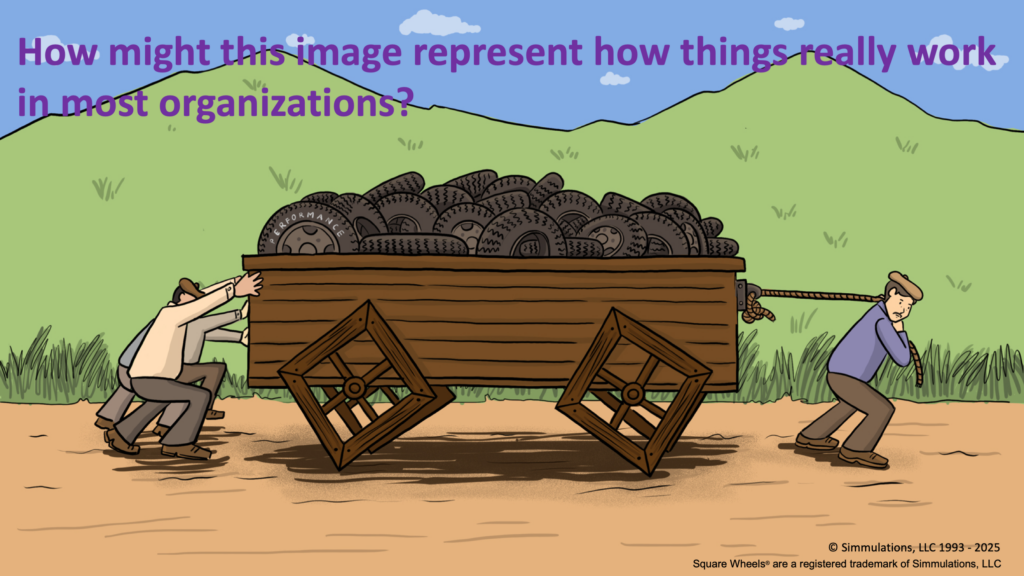
Click on this image to download Square Wheels One for free
As soon as a team leader or supervisor sees that the new behavior works, confidence grows and habits begins to form. When training stays theoretical, nothing changes. When training forces action in the real world, everything changes. Using people’s hands-on reality to identify and address issues and opportunities is what works!
I have written extensively about how this works and I include a training toolkit with the Creative Commons licensed image you can download. Grab it! Use it!
Understand that:
Nobody ever washes a rental car.
Active ownership of solutions is a requirement.
The bottom line: Stop blaming supervisors for systemic failures. Give them the tools and the time they need to ask their people for ideas about what they can be doing differently to improve results. The employees WILL buy in, even your Spectator Sheep.

Spectator Sheep can become supporters — they see what is wrong and continue to comment about it but nobody pays them much attention. They see things differently. Make them team leaders!
—
For organizations with multiple stuck teams, book a short free conversation for ideas around designing a program using Square Wheels across your organization, We can easily build some really great tools and courses and support systems,
For the FUN of It!
 Dr. Scott Simmerman is a designer of team building games and organization improvement tools.
Managing Partner of Performance Management Company since 1984, he is an experienced presenter and consultant who is trying to retire!! He now lives in Cuenca, Ecuador.
You can reach Scott at scott@squarewheels.com
Learn more about Scott at his LinkedIn site.
Square Wheels® are a registered trademark of Simmulations, LLC
and images have been copyrighted since 1993,
© Simmulations, LLC 1993 – 2025
What I’m About:
My Square Wheels blog and website exist to help leaders, trainers, and facilitators make work smoother, more engaging, and more human. I focus on practical tools for process improvement, organizational change, and workplace collaboration that spark insight and deliver measurable results.
And I am convinced, after 30+ years of using Square Wheels, that it is the best facilitation toolset in the world. One can use it to involve and engage people in designing workplace improvements and building engagement and collaboration. It is a unique metaphorical approach to performance improvement.
By blending proven facilitation methods, creative problem-solving, and engaging team activities, my mission is to support organizations in building energized, sustainable cultures of involvement and innovation.
Through accessible — and often free — resources and virtual facilitation tools, I aim to help teams everywhere collaborate more effectively, innovate continuously, and take ownership of their improvement journey.
#SquareWheels #InnovationAtWork #TeamEngagement #FacilitationTools #WorkplaceImprovement #EmployeeEngagement #CreativeProblemSolving #OrganizationalDevelopment #LeadershipTools #collaboration #leadership #motivation #communcations #supervisors #supervisorhellscape


0 Comments