
The Workplace Chemistry of Square Wheels is a framework for understanding changing Culture and how to impact motivation.
Think of the Square Wheels wagon reality as a slow chemical reaction that is “stable but stuck,” and the Round Wheels reality as the faster, more efficient reaction state that people could reach with the right activation energy and catalysts. The inspiration for this came from a “management chemistry” post by Mike Mears.
Current state: stable but inefficient
- In chemistry, reactants can sit in a low-energy but unproductive state until enough activation energy is applied to let them transform into more useful products. Think of what happens to ice as we add heat: It turns to water which is much more flexible and adaptable and then, with more heat, it can turn to steam, a high energy state that powers high speed turbines very efficiently.
- The Square Wheels wagon is like those reactants: the organization is rolling but somewhat frozen and on “low-performance chemistry” where friction, drag, and resistance are accepted as normal. But, adding energy, we can change things.
Round Wheels as Products
- The round wheels represent the products of a better reaction: generating less friction, more speed, cleaner processes, and higher yield from the same raw materials (people, time, money).
- Chemically, round wheels are the more thermodynamically favorable state: once people get rolling, it often takes less energy to keep going than it did to stay stuck and be thumping and bumping along.
Activation energy and resistance
- The “but we’ve always done it this way” mindset and structural constraints are the activation energy barrier that keeps the organization locked into Square Wheels.
- Leaders misread resistance as “bad attitude,” when it often behaves like molecules needing just enough energy, clarity, and safety to cross the hill and react differently.
Senior Managers can diminish energy
- John LeCarre’s notion that, “A desk is a dangerous place from which to view the world” is an oft-helpful perspective. Senior managers are NOT familiar with how things really work from the hands-on perspective of a worker or supervisor.
- Leaders can read low performance as an outcome of factors that they can change from the tops-down. They might be driven to generate a new mission / vision or to implement some new “training program” from HR when skill is not the issue underlying poor results.
- Instead of dis-un-empowering their front line managers, they may implement more roadblocks to generating results.
Let me illustrate with a common reality. In this image, senior managers might push a change in the workplace.
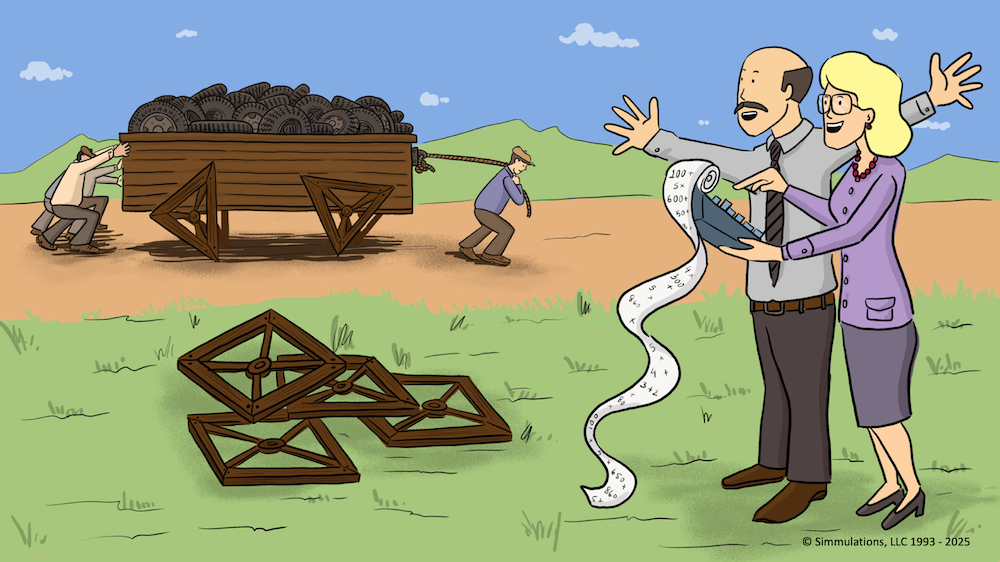
This is partly why, “A desk is a dangerous place from which to view the world.”
The image has different names:
- Square Wheels to Triangular Wheels represents a 25% cost reduction
- The cost of human capital, or my favorite one below,
- One Less Bump per Revolution. Some people can actually measure “an improvement” if one is not really paying attention.
Leaders as Catalysts of Change
- In chemistry, catalysts lower activation energy so the same reaction happens faster and with less effort; the catalyst itself isn’t consumed.
- Leaders, facilitation, and tools like the Square Wheels images act as catalysts: they create conversations, psychological safety, and shared insight that let people experiment with possible round wheels instead of defending the old Square ones.
- People are MUCH less resistant to change if the ideas for doing things differently are THEIR ideas and not someone else’s. Doing things WITH people has a much different chemistry than doing thing TO them.
Designing the “reaction conditions”
- Just as chemists adjust temperature, pressure, and concentration, the most effective leaders adjust context variables: information flow, meeting design, incentives, and cross-functional contact to make the round wheel ideas more likely to “collide and stick.”
- Adding energy (heat) to a reactions causes the molecules to move faster and faster, which is what happens when water boils. Helping them to add their own heat to their reactions and ideas generates more action and engagement.
- The performance jump is not magic; it is engineered by lowering the energy cost of new behaviors and raising the energy cost of keeping the Square Wheels bolted on.
I hope that you like playing around with ideas to add energy and change to your organization or team,
—
For the FUN of It!
 Dr. Scott Simmerman is a designer of team building games and organization improvement tools.
Managing Partner of Performance Management Company since 1984, he is an experienced presenter and consultant who is trying to retire!! He now lives in Cuenca, Ecuador.
You can reach Scott at scott@squarewheels.com
Learn more about Scott at his LinkedIn site.
Square Wheels® are a registered trademark of Simmulations, LLC
and images have been copyrighted since 1993,
© Simmulations, LLC 1993 – 2025
What I’m About:
My Square Wheels blog and website exist to help leaders, trainers, and facilitators make work smoother, more engaging, and more human. I focus on practical tools for process improvement, organizational change, and workplace collaboration that spark insight and deliver measurable results.
And I am convinced, after 30+ years of using Square Wheels®, that it is the best facilitation toolset in the world. One can use it to involve and engage people in designing workplace improvements and building engagement and collaboration. It is a unique metaphorical approach to performance improvement and we can easily license your organization to use these images and approaches.
By blending proven facilitation methods, creative problem-solving, and engaging team activities, my mission is to support organizations in building energized, sustainable cultures of involvement and innovation.
Through accessible — and often free — resources and virtual facilitation tools, I aim to help teams everywhere collaborate more effectively, innovate continuously, and take ownership of their improvement journey.
#SquareWheels #InnovationAtWork #TeamEngagement #FacilitationTools #WorkplaceImprovement #EmployeeEngagement #CreativeProblemSolving #OrganizationalDevelopment #LeadershipTools #collaboration #leadership #motivation #communications #enablement #leadership #CreativeCommons #enablingperformance #teamwork #energy #chemistry

0 Comments