
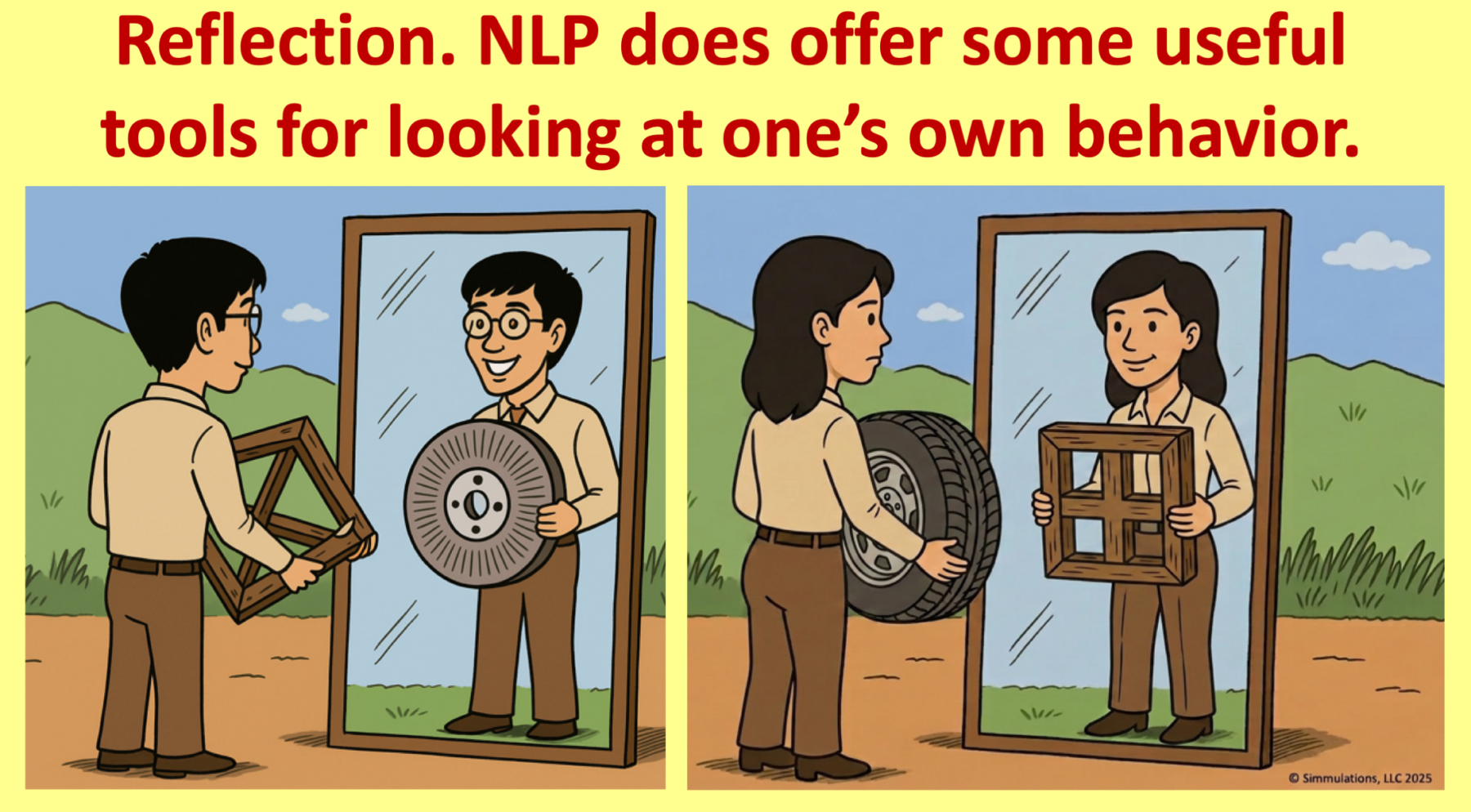
Many years ago, I went through solid training in Neurolinguistic Programming (NLP) with a view of its uses in Leadership Development. But those skills and thinking patterns have been deep in the background. What I wanted to do in this post is take a new look at old things just to see how training and development people view these tools today.
Neurolinguistic Programming (NLP) today sits in an interesting split-screen: it remains popular in parts of the coaching and training world for leadership and communication skills, but it is widely regarded as weakly evidenced and often pseudoscientific within the academic and scientific community. How you use it — and how you label it — really matters in an organizational setting.
Overall reputation in 2026
-
In mainstream science and evidence-based OD, NLP is generally viewed as a pseudoscience with poor empirical support for its big claims about behavior change, cognition, or therapy.
-
A 2012 systematic review of NLP for health outcomes (RCTs and pre–post studies) concluded there is “little evidence that NLP interventions improve health-related outcomes,” and that research quality is limited.
-
Reviews and critiques since then echo that most strong claims rely on anecdotes, outdated brain metaphors, and low‑quality studies, so the consensus among psychologists and neuroscientists remains negative.
-
At the same time, NLP is still marketed heavily in corporate training, executive coaching, and sales enablement, particularly around “influence,” “rapport,” and “high‑performance leadership.”
- And, at the same time, many users of the approach DO find it useful for self-reflection and understanding. My personal belief is that it can help explain some things that are useful in developmental situations. And I have a useful simple program on Information Sorting Styles focused on preferences in dealing with information, a program that only requires a bit of self-reflection that is useful.
In practice, NLP lives as a toolset in the coaching / training and personal development marketplace, but it does not have the credibility of, say, cognitive‑behavioral approaches, motivational interviewing, or evidence-based leadership models in the OD / I‑O psychology world. There are a lot of useful tools and models out there.
Use in leadership development
Vendors and practitioners position NLP as a way to enhance leaders’ internal state management and interpersonal impact. It becomes a language for reflection and understanding. The approach can push you to think about thinking.
Common themes you see in current leadership offerings:
-
Improved self-awareness and resource state management: working with internal dialogue, reframing, and “anchoring” to manage stress and emotional reactions.
-
Modeling “excellent” leaders: teaching people to observe and adopt patterns of thought, language, and behavior from high performers.
-
Goal focus and outcome‑oriented thinking: framing goals in sensory‑rich, future‑oriented ways, with attention to beliefs and identity.
A 2018 systematic review of NLP in organizational settings (7 empirical studies here) reported that NLP‑based interventions were used to target outcomes like self‑esteem, trustworthiness, organizational commitment, and occupational stress, with some positive findings but small sample sizes and variable quality. The authors’ tone is cautious: promising signals, but not a robust evidence base.
My personal experience is that NLP training can improve one’s observation and awareness skills as to the most effective behaviors of high performers. It has good modeling applications because of its focus on the behaviors of others.
So: it is actively used in parts of the leadership/coaching market, but mostly on the strength of practitioner enthusiasm and client testimonials, not strong organizational research.
Use for communication in organizations
On the communication side, NLP is marketed around very specific skill claims. Typical organizational communication angles include:
-
Rapport and trust building: pacing and leading, mirroring, sensory‑based language, and attention to others’ belief/values systems to improve connectedness.
-
Framing and reframing: shifting the “meaning” of events or problems to reduce resistance and foster solution focus. (My Square Wheels to round wheels concept is an example of reframing.)
-
Language patterns for influence: presuppositions, embedded suggestions, and future‑pacing in leadership messages (“When we implement this solution…” rather than “If this project succeeds…”). This is the “linguistic” aspect of NLP.
-
Conflict and negotiation: perspective taking, exploring underlying needs and motivations, and aligning language with desired outcomes. This is the reflection aspect of NLP.
Several current providers argue that NLP techniques can improve communication, negotiation, and team management, especially when integrated with emotional intelligence and behavioral science. But these are usually not backed by large, well‑controlled organizational field studies; they’re mostly case examples and small‑scale evaluations.
From a risk / credibility standpoint, organizations that are research‑sensitive often strip out the NLP label and present the content as “advanced communication skills,” “coaching conversations,” or “cognitive reframing,” which aligns more comfortably with accepted psychology. Many of the approaches and techniques are effective based on my personal experiences.
How experts and evidence-based practitioners view it
If you ask people in psychology, neuroscience, or evidence-based management, three themes show up consistently:
-
Lack of robust empirical support: Systematic reviews and critical papers conclude that there is insufficient evidence to recommend NLP as an intervention for health or behavior change outside research contexts.
-
Methodological issues: Positive studies often have small samples, weak controls, and inconsistent outcome measures, while higher‑quality work tends to show null or mixed effects.
-
Pseudoscience label: Because NLP uses neuroscience‑sounding terminology without real links to neural mechanisms and contains factual errors regarding language and cognition, it is widely cited in education and psychology as an example of pseudoscience.
At the same time, there is a small camp of proponents attempting to rehabilitate NLP by combining selected techniques with neuroscience and cognitive‑behavioral concepts under banners like “neuroleadership.” These efforts tend to lean heavily on broader brain science, with NLP elements as a secondary layer. See more here.
Practical implications if you’re designing programs
If you want to work in this space without damaging credibility with more skeptical clients or HR/OD partners, a few design choices are emerging as best practices:
-
De‑emphasize the NLP brand, emphasize observable behaviors: focus on concrete skills like asking better questions, reframing problems, listening for assumptions, and structuring messages, rather than selling “NLP” as a magic lever. Use the tools and not the name.
-
Integrate with evidence-based frameworks: layer any useful NLP‑style tools inside coaching models, solution‑focused approaches, or strengths‑based leadership where there is better empirical grounding.
-
Avoid unfalsifiable or grandiose claims: stay away from promises about “reprogramming the brain,” guaranteed behavior change in X days, or specific therapeutic outcomes. But then you should do that always, right?
-
Evaluate at the level that matters: in organizations, what counts is whether managers communicate more clearly, build trust, and get better performance conversations; measure those outcomes, not whether participants endorse the NLP philosophy.
An example that tends to land well: teaching leaders to notice and reframe “stuck” complaint stories into future‑focused solution narratives — that looks and feels a lot like NLP reframing, but it also mirrors techniques from coaching psychology and solution‑focused brief therapy, which have stronger support.
Note that my Square Wheels tools do the above dissociations and reframing pretty elegantly and that I started the development of these in 1993, two years after I started my NLP training with Jon Linder and Ed Reese. There were probably many different influences as the tools evolved.
From where many of us sit as OD consultants who lean on data and pragmatics, the current sweet spot is probably: use some of the pragmatic micro‑skills that NLP popularized, but describe and ground them in language that fits with contemporary coaching and behavioral science, and be transparent about the limits of the evidence behind “NLP” as a branded methodology.
I hope you have found this informative and useful,
—
For the FUN of It!
 Dr. Scott Simmerman is a designer of team building games and organization improvement tools.
Managing Partner of Performance Management Company since 1984, he is an experienced presenter and consultant who is trying to retire!! He now lives in Cuenca, Ecuador.
You can reach Scott at scott@squarewheels.com
Learn more about Scott at his LinkedIn site.
Note that I was one of the leaders of ASTD’s Neurolinguistic Network for five years back in the late 1980s, and that we did a variety of pre-conference workshops before the main international conference programs. We had great attendance and excellent reactions to the tools that we shared.
Please also note that I often use Perplexity AI to help research and generate ideas for my posts.
Square Wheels® are a registered trademark of Simmulations, LLC
and images have been copyrighted since 1993,
© Simmulations, LLC 1993 – 2026
What I’m About:
My Square Wheels blog and website exist to help leaders, trainers, and facilitators make work smoother, more engaging, and more human. I focus on practical tools for process improvement, organizational change, and workplace collaboration that spark insight and deliver measurable results.
And I am convinced, after 30+ years of using Square Wheels®, that it is the best facilitation toolset in the world. One can use it to involve and engage people in designing workplace improvements and building engagement and collaboration. It is a unique metaphorical approach to performance improvement and we can easily license your organization to use these images and approaches.
By blending proven facilitation methods, creative problem-solving, and engaging team activities, my mission is to support organizations in building energized, sustainable cultures of involvement and innovation.
Through accessible — and often free — resources and virtual facilitation tools, I aim to help teams everywhere collaborate more effectively, innovate continuously, and take ownership of their improvement journey.
#SquareWheels #InnovationAtWork #TeamEngagement #FacilitationTools #WorkplaceImprovement #EmployeeEngagement #CreativeProblemSolving #OrganizationalDevelopment #LeadershipTools #collaboration #leadership #motivation #communications #enablement #leadership #CreativeCommons #enablingperformance #teamwork #storytelling #storyasking


0 Comments