
You CAN improve Engagement and impact Profitability – Gallup’s top performers treat engagement as a business strategy that shows up daily in conversations and decisions at every level.
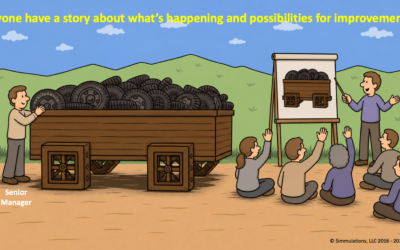
Square Wheels® plug into an organizational improvement initiative as a way to keep that strategy visible and practical: the wagon with its Square Wheels is a simple vivid picture of “how work really works” today, while the round wheels in the wagon represent the ideas people already have but are not yet using. And, it is an image of continuous improvement because the round wheels of today will become the Square Wheels of tomorrow.
-
When senior leaders share that image in town halls or business reviews, they signal: “We know there are Square Wheels. We expect everyone to help find the round ones.”
-
When business units or plants run short, focused Square Wheels sessions, they translate the engagement strategy into a tangible question: “Where is our wagon dragging, and what’s one round wheel we can try?”
Instead of engagement being something that’s measured and reported, it becomes something that is regularly seen and talked about in the work improvement itself.
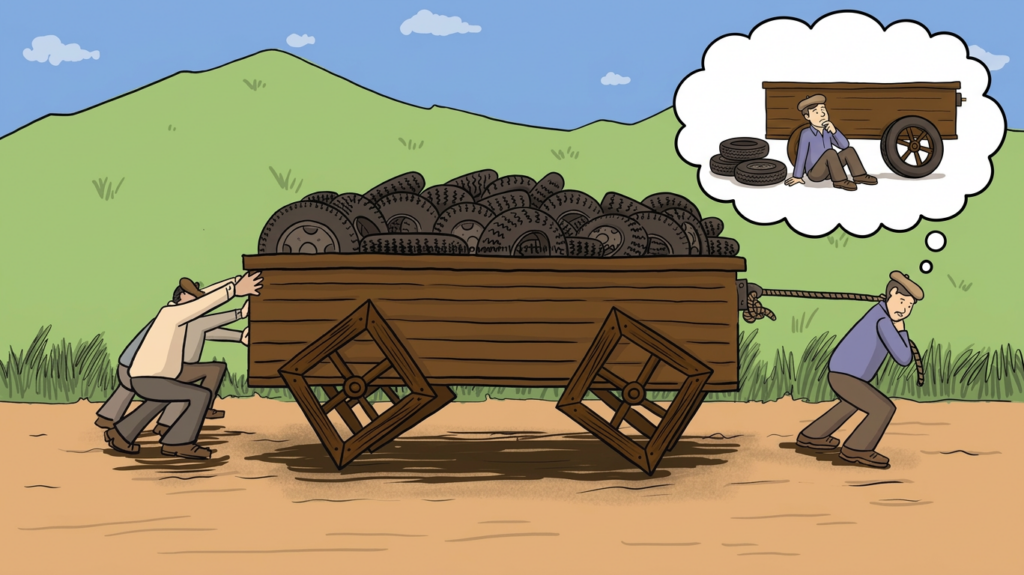
And the round wheels of today will become
“The Square Wheels of Tomorrow.”
Equipping Managers to Coach, Not Just Supervise
High‑engagement companies invest heavily in managers as coaches: setting clear expectations, recognizing strengths, and holding frequent check‑ins. The challenge is that many managers still feel awkward or exposed when talking about what’s not working smoothly.
The Square Wheels metaphor gives them a neutral, non‑blaming way to do exactly that:
-
A manager can open a 1:1 or team huddle with, “If this wagon is our team, what are two Square Wheels you see?”
-
People are now talking about the image and the process, not criticizing each other.
-
The follow‑up question, “What Round Wheel ideas do we already have?”naturally shifts the conversation to strengths, resources, and next steps.
This aligns with a coaching style: curiosity, joint problem solving, future focus. It also provides structure for those frequent, short check‑ins that high‑engagement organizations want managers to have but managers often don’t know how to frame.
Making Purpose and Customer Impact Real
Top‑performing cultures (see Gallup) are very good at connecting daily work to purpose, mission, and customer outcomes. Yet most people don’t experience purpose in mission statements; they experience it in the removal of daily friction that allows them to do great work for customers and other employees.

Customers can feel every thump and bump in their journey without understanding the systems and processes we can fix.
Square Wheels sessions can be explicitly framed around that line of sight:
-
“Where are our Square Wheels getting in the way of delivering what this customer segment really values?”
-
“Which Round Wheel idea, if we implemented it, would improve safety and reliability for our customers?”
Each team’s wagon becomes a micro‑story about how their work contributes to the larger mission and organizational impacts. When people see their Round Wheel ideas implemented, purpose stops being abstract. It becomes: “We persuaded management to replace that broken process, and now we can actually serve patients, students, or customers better.”
Recognition, Feedback, and Visible Wins
Best‑in‑class organizations such as those noted in Gallup’s Exceptional Workplace Award (GEWA) list build systems for frequent recognition and performance feedback. And the Square Wheels tools can add a simple, highly visible discussion frame for recognizing contributions and progress.
Instead of generic “great job” messages, leaders can call out successes:
-
“This month’s Round Wheel Award goes to the logistics team, who identified a Square Wheel in our returns process and tested a new handoff that cut cycle time by 20%.”
-
“Our call center team surfaced three Square Wheels that were slowing resolution time; two of those Round Wheel ideas are now in production.”
Now feedback and recognition are tied explicitly to finding and fixing Square Wheels. You get:
-
A running narrative of improvement that people can see and understand.
-
Reinforcement that speaking up about problems is valued, not punished.
-
Clear role‑model stories managers can share across locations or functions.
The more specific those stories are to “here is the Square Wheel, here is the Round Wheel, here is the impact,” the more believable and contagious engagement becomes.
Turning Listening into Action, Not Just Data
High‑engagement companies listen in short cycles — pulse surveys, listening sessions, open forums — and then act visibly on what they hear. The biggest credibility risk is when people share input that disappears into analysis and slide decks and never gets operational. Employees feel that they wait forever for things to be done differently, and than no one really cares.
Square Wheels will be the “missing middle” between listening and action:
-
After a pulse survey, a plant or team runs a quick Square Wheels meeting to identify three concrete friction points behind a low‑scoring item.
-
The group prioritizes one or two Round Wheel ideas they can implement locally and one that needs escalation.
-
They document “who will try which Round Wheel by when” on a simple one‑page action board.
Now the loop looks like this:
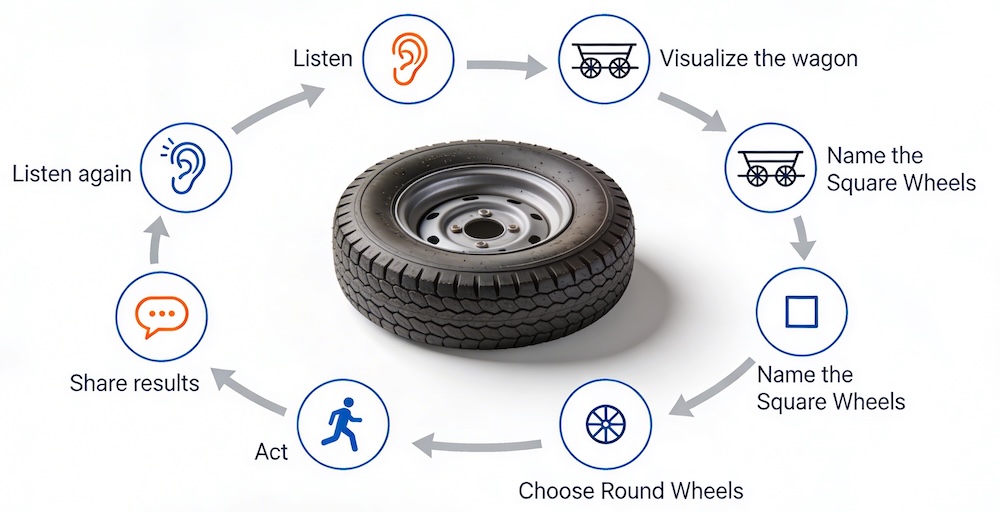
With the key ideas of “Listen” and “Listen Again.”
This process makes engagement activity visible and gives teams a clear storyline to track over time. And note that so many round wheels already exist as ideas and best practices. It also helps senior leaders see where systemic Square Wheels recur across sites, guiding larger policy or systems changes. Note that most senior managers actually have a very poor understanding of the actual workplace Square Wheels and the possibilities of round ones.
Development, Mobility, and Growing Internal Capability
High‑engagement cultures invest heavily in development and internal mobility. Square Wheels are easily repurposed as a continuous development tool rather than just some workshop exercise.
Examples:
-
Emerging leaders can be trained to facilitate Square Wheels sessions as part of their development. Learning to guide a room through problem identification, idea generation, and prioritization is a core leadership capability. Facilitation skills are powerful tools for motivation and innovation, asking people for their ideas for improvement and change.
-
Project leads can use the metaphor at key milestones: kickoff (to surface risks and friction), midpoint (to identify what’s slowing progress), and close‑out (to capture Round Wheel learning for future teams).
Because the tool is simple and bombproof, it does not need “training” to use and it scales easily: you don’t need external facilitators to run every conversation. That supports internal mobility by giving new leaders a practical method they can take with them as they move across functions or geographies.
Rituals, Culture, and a Shared Language
Award‑winning workplaces design rituals, those team‑building, cross‑functional projects, and CSR, that reinforce identity and pride. Square Wheels is well suited to become one of those organizational rituals. You are changing the language of improvement and attacking the things that do not work smoothly, not the people.
You might see:
-
A quarterly “Square Wheels Day” where teams intentionally step back to identify obstacles and round wheel ideas, then share a few of the most powerful stories across the organization.
-
Cross‑functional Square Wheels sessions during major transformations (new systems, reorganizations, M&A) where people can safely surface concerns and co‑design improvements.
-
CSR or community‑oriented teams using the metaphor to improve how they deliver impact externally, not just internally.
Over time, phrases like “That’s a Square Wheel we need to fix” or “That’s a Round Wheel idea so let’s test it” become part of everyday language. That linguistic shorthand is a powerful signal that continuous continuous improvement and voice are “how we do things here.”
Making Ownership and Accountability Tangible
One of the most powerful overlaps between high‑engagement practices and Square Wheels is the focus on visible ownership. Great organizations know that when employees feel they own both the problems and the solutions, engagement and performance rise together.
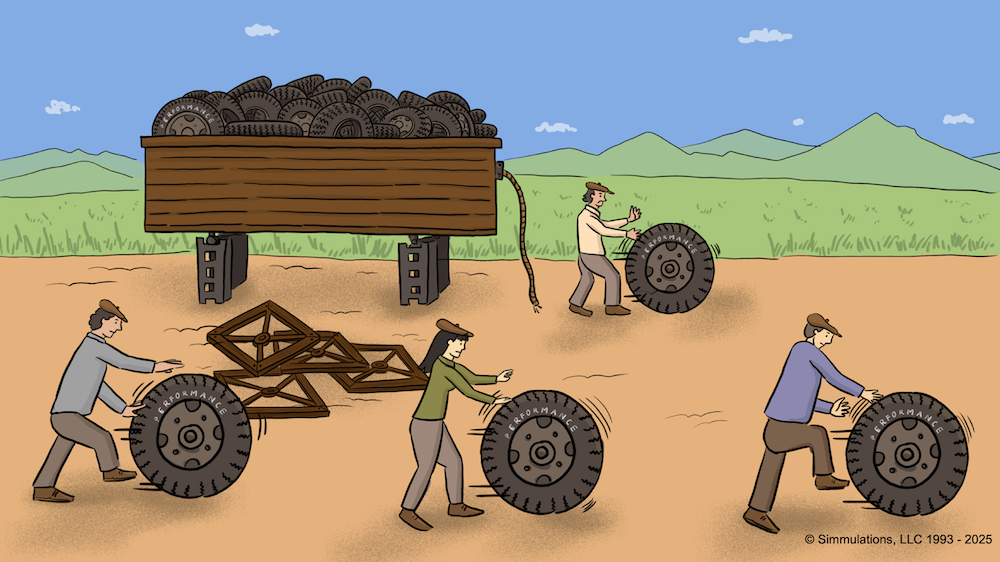
Playing with Round Wheel Ideas creates lots of cognitive dissonance about the Square Wheels and motivates change
Square Wheels makes that ownership concrete by ending each discussion with:
-
A short list of specific Square Wheels the team agreed are important.
-
A selected set of Round Wheel ideas they commit to testing.
-
Named owners and timelines: who will do what, by when, and how they’ll share progress.
That simple discipline links the metaphor directly to metrics—whether those are safety incidents, customer satisfaction, throughput, or retention. It turns a “nice discussion” into a series of small, trackable experiments that reinforce both accountability and optimism. And, it sets the stage for the broad implementation of ideas for improvement, directly impacting engagement and enablement of change.
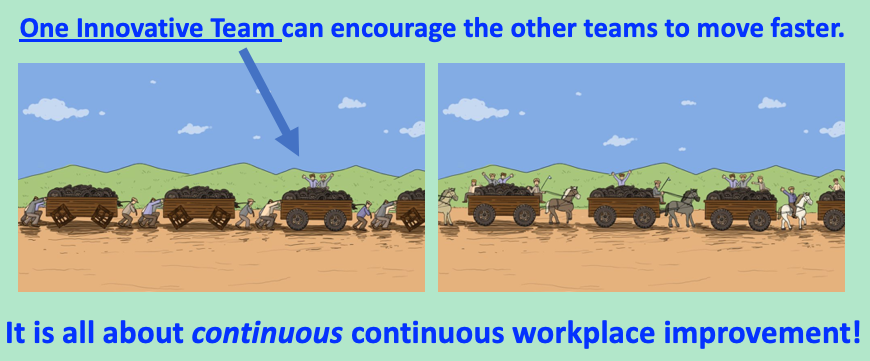
You can lead the continuous improvement process with good communications and recognition.
—
For the FUN of It!
 Dr. Scott Simmerman is a designer of team building games and organization improvement tools.
Managing Partner of Performance Management Company since 1984, he is an experienced presenter and consultant who is trying to retire!! He now lives in Cuenca, Ecuador.
You can reach Scott at scott@squarewheels.com
Learn more about Scott at his LinkedIn site.
Note that I often use Perplexity AI to help research and generate ideas for my posts.
Square Wheels® are a registered trademark of Simmulations, LLC
and images have been copyrighted since 1993,
© Simmulations, LLC 1993 – 2026
What I’m About:
My Square Wheels blog and website exist to help leaders, trainers, and facilitators make work smoother, more engaging, and more human. I focus on practical tools for process improvement, organizational change, and workplace collaboration that spark insight and deliver measurable results.
And I am convinced, after 30+ years of using Square Wheels®, that it is the best facilitation toolset in the world. One can use it to involve and engage people in designing workplace improvements and building engagement and collaboration. It is a unique metaphorical approach to performance improvement and we can easily license your organization to use these images and approaches.
By blending proven facilitation methods, creative problem-solving, and engaging team activities, my mission is to support organizations in building energized, sustainable cultures of involvement and innovation.
Through accessible — and often free — resources and virtual facilitation tools, I aim to help teams everywhere collaborate more effectively, innovate continuously, and take ownership of their improvement journey.
#SquareWheels #InnovationAtWork #TeamEngagement #FacilitationTools #WorkplaceImprovement #EmployeeEngagement #CreativeProblemSolving #OrganizationalDevelopment #LeadershipTools #collaboration #leadership #motivation #communications #enablement #leadership #CreativeCommons #enablingperformance #teamwork #storytelling #storyasking

0 Comments