
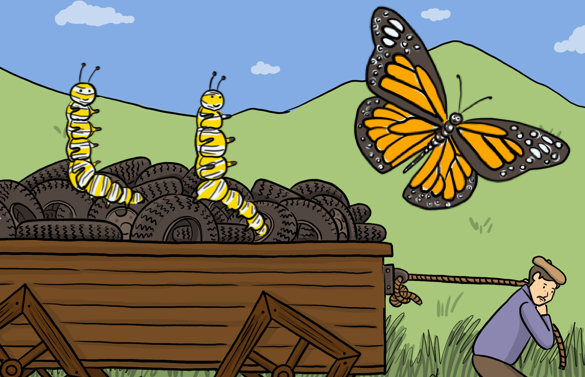
Dr. Scott Simmerman’s “Teaching the Caterpillar to Fly” is a creative and useful metaphor for understanding individual and organizational transformation.
“Teaching the Caterpillar to Fly” is my metaphor about why Metamorphosis is the Heart of Change Management, that seeing one’s own potential for improvement can be a driving force in personal change as well as a leadership metaphor for organiational improvement.
Look. Change is hard and resistance is normal —and nothing illustrates this better than the humble caterpillar with the potential to be a butterfly (maybe – I will explain this later!)
As organizational leaders, consultants, and managers, we’re often trying to encourage teams to embrace new ways of working. But what if, deep inside, we’re all just caterpillars, looking up at the butterflies and saying, “You’ll never get me up on one of those butterfly things!”?

This image above captures the emotional, psychological, and structural challenges of change management through humor and imagery. And it can generate some unique and practical coaching and mentoring around the personal growth of others.
The concept has been a cornerstone of Performance Management Company’s change management workshops and the Square Wheels tools that are used worldwide to facilitate engagement and improvement discussions.
The Core Metaphor
The central story is simple:and this humorous punchline helps to frame the natural resistance to change—people often fear transformation even when it leads to growth or greater freedom.
The caterpillar symbolizes individuals or organizations stuck in familiar routines. The butterfly represents a new possibility, perspective, or identity that feels distant or risky. The story motivates reflection on how transformation is inevitable and how attitude shapes whether we suffer through or grow from it.
Why It Works as a Change Management Paradigm
The metaphor embodies several key change management principles:
-
Resistance to Change: Like the caterpillar clinging to what it knows, people tend to resist transformation due to fear of the unknown or loss of control.
-
Perspective and Vision: Butterflies have a broader view; leaders and change agents must help organizations gain perspective and see beyond immediate operational survival to broader opportunities.
-
Engagement and Ownership: Change cannot be done to people—it succeeds when individuals are engaged, involved, and see personal benefit or meaning in the process.
-
Continual Transformation: Each metamorphosis (from caterpillar to butterfly) mirrors continuous improvement cycles—change is recurring, not one-time, and each stage develops readiness for the next.
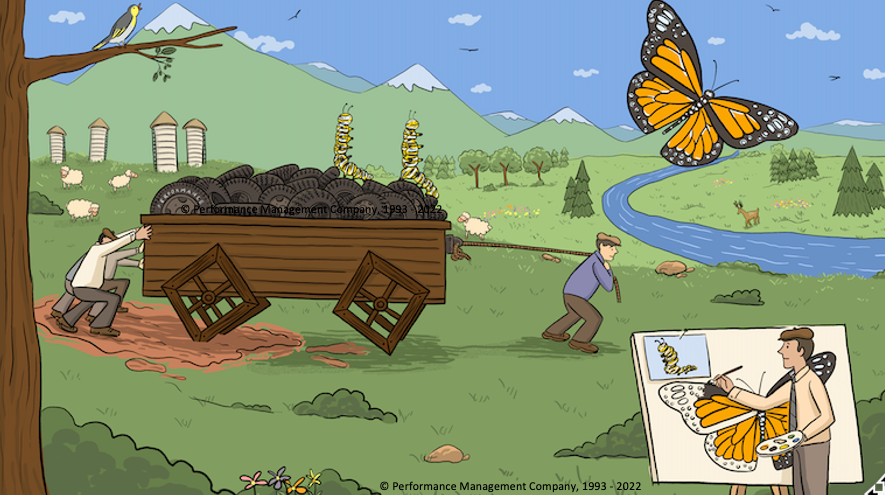
- Coaching and Support: The coach or mentor can see the potential and act to tie the story to the Square Wheels’ continuous improvement methodology. Good leaders help “caterpillars” develop wings through feedback, coaching, and collaborative exploration of new ideas, as you can see in the supporting image below.
A Key Learning Lesson
“It’s Dangerous to Know The Answer” is a reality in change, continuous improvement and innovation. And I demonstrate this when I tell the joke / story with the, “You’ll never get me up in one of those things” punchline.
The reality is that people get the joke and stop thinking. ONE answer and that’s it. Thus, I show, “It is dangerous to know The Answer” slide, and then I share the 21 different responses that I captured in a workshop when I let participants brainstorm about, The Joke.” It IS dangerous to think that you have the only answer to some situation; that is worse than being blind.
When people “Get The Answer,” they generally STOP thinking,
which is deadly to innovation.
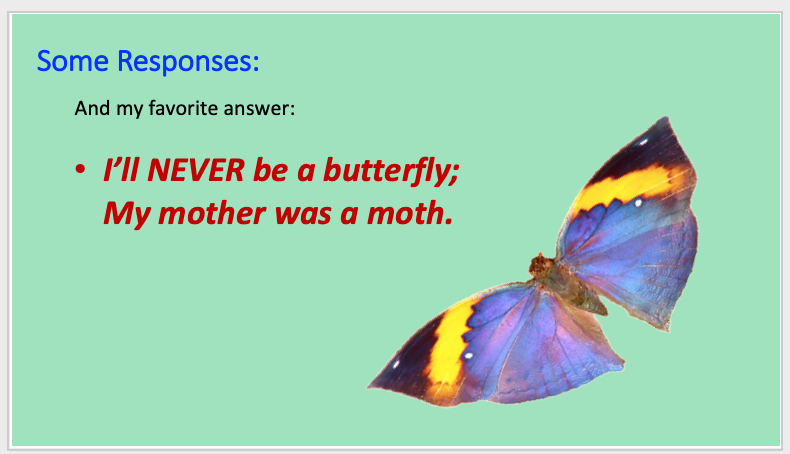
My favorite answer to the joke is this one:
Integration with the Square Wheels Approach
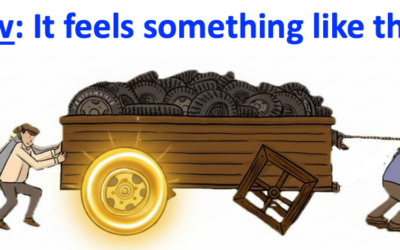
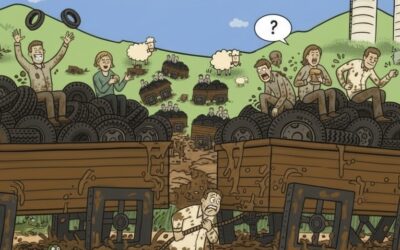
Square Wheels cartoons show teams pulling wagons with “Square Wheels”—a visual metaphor for inefficient systems and practices that can be improved. Linking it to the caterpillar metaphor suggests that innovation requires perspective, reflection, and participation. Leaders who engage employees in diagnosing “what’s not working” and envisioning “round wheels” create psychological safety for transformation, along with peer support and a vision of the future grounded in the cognitive dissonance aroond how things really work.
Why using these metaphors makes sense
The “Teaching the Caterpillar to Fly” framework resonates because it turns complex organizational dynamics into a relatable story. It balances humor with insight, creating a psychologically safe way to discuss fear, identity, and potential. In essence, Simmerman shows that change isn’t about forcing wings onto a caterpillar—it’s about enabling metamorphosis through dialogue, support, and shared purpose.
This metaphor endures because it speaks to a central truth in modern organizations: most people want to become butterflies, but few want to go through the cocoon. Simmerman’s approach gives facilitators a powerful, memorable way to guide teams through that journey.
The Power of Metaphor in Change
My “Teaching the Caterpillar to Fly” story has become a cornerstone metaphor for the change journeys we all face. At Performance Management Company (PMC), we use humor and images to spark new perspectives and real conversations about transformation. The caterpillar may symbolize safety, routine, and predictability, but it also represents the very real resistance people feel when asked to become something new.
Change isn’t simply about telling people to “grow wings.” Most of us are perfectly content munching our leaves, thank you very much! The leap into unknown territory – stopping all things and creating and entering one’s own cocoon is fraught with perceived uncertainty, discomfort, even fear. But it’s within that developmental cocoon, hidden from view, where growth truly happens.
Why Square Wheels Resonate in the Real World
Managers need good tools for effective communications and leadership. They need better tools for innovation and engagement. And having a simple language of continuous continuous improvement simply makes good sense. Let’s face it: in organizations, resistance to change isn’t just normal—it’s expected. This approach, through both these metaphors and the effective Square Wheels cartoons, reminds us that:
-
People cling to what’s familiar. Like the caterpillar, we’d rather stick to our leaves than risk falling.
-
Transformation requires vision. Butterflies have a new perspective—so, as leaders, we must help others see the bigger picture.
-
Engagement is essential. Change succeeds when we involve people, inviting them to explore, question, and discover new capabilities.
- Peer support for change and improvement can be powerful motivators for challenging onsself and one’s team to improve.
-
Coaching and support are critical. Nobody grows wings alone. Leaders must nurture, challenge, and support the transformation process.
At PMC, we share the Square Wheels metaphor to show that improvement isn’t about blaming people for slow progress. It’s about identifying the “wheels” that aren’t rolling smoothly and creating space for new, rounder solutions. Teaching the caterpillar to fly is the ultimate act of enabling, not forcing—opening the door to what’s possible.
Leading Organizational Metamorphosis
Here’s what truly sets this “Teaching the Caterpillar to Fly” paradigm apart: it normalizes discomfort.
It acknowledges that, for most of us, “cocooning” is lonely, even scary. But that’s also the stage where teams shed outdated behaviors, mindsets, or processes, emerging on the other side better equipped, stronger, and ready to soar.
“Teaching the Caterpillar to Fly” isn’t about superficial change. It’s about authentic transformation—of people, processes, and possibilities. That journey demands empathy, creativity, and a willingness to help others see themselves as butterflies-in-waiting.
Ready to Inspire Change? Download the Square Wheels One Image! FREE
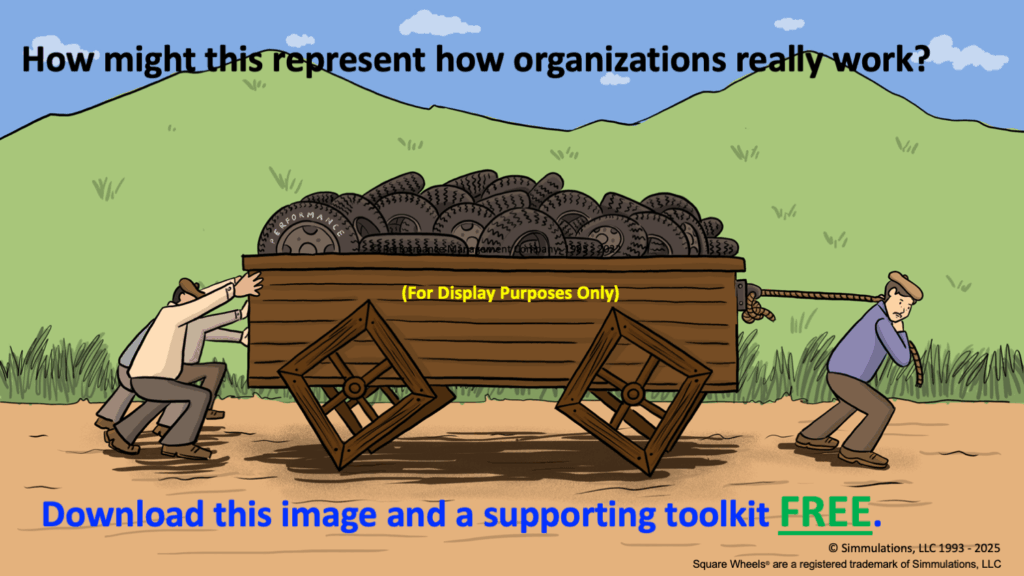
Download the FREE Square Wheels One image under Creative Commons license
Help your team visualize what’s holding them back—and what’s possible on the other side of change. The Square Wheels One illustration is the perfect conversation starter for managers, facilitators, and trainers.
Click here to download Square Wheels One and spark your next big metamorphosis!
Let’s make change a little less scary—and a lot more fun. Butterflies await!
—
For the FUN of It!
 Dr. Scott Simmerman is a designer of team building games and organization improvement tools.
Managing Partner of Performance Management Company since 1984, he is an experienced presenter and consultant who is trying to retire!! He now lives in Cuenca, Ecuador.
You can reach Scott at scott@squarewheels.com
Learn more about Scott at his LinkedIn site.
Square Wheels® are a registered trademark of Simmulations, LLC
and images have been copyrighted since 1993,
© Simmulations, LLC 1993 – 2026
What I’m About:
My Square Wheels blog and website exist to help leaders, trainers, and facilitators make work smoother, more engaging, and more human. I focus on practical tools for process improvement, organizational change, and workplace collaboration that spark insight and deliver measurable results.
And I am convinced, after 30+ years of using Square Wheels®, that it is the best facilitation toolset in the world. One can use it to involve and engage people in designing workplace improvements and building engagement and collaboration. It is a unique metaphorical approach to performance improvement and we can easily license your organization to use these images and approaches.
By blending proven facilitation methods, creative problem-solving, and engaging team activities, my mission is to support organizations in building energized, sustainable cultures of involvement and innovation.
Through accessible — and often free — resources and virtual facilitation tools, I aim to help teams everywhere collaborate more effectively, innovate continuously, and take ownership of their improvement journey.
#SquareWheels #InnovationAtWork #TeamEngagement #FacilitationTools #WorkplaceImprovement #EmployeeEngagement #CreativeProblemSolving #OrganizationalDevelopment #LeadershipTools #collaboration #leadership #motivation #communications #enablement #leadership #CreativeCommons #enablingperformance #teamwork
Note: Square Wheels is a unique and incredibly powerful tool for organizational improvement. I know of no better tool out there for engagement and change.


0 Comments