
Sam Liberty blogged about Motivation and Everest in Medium and I loved the image and quote he shared about motivation and performance:
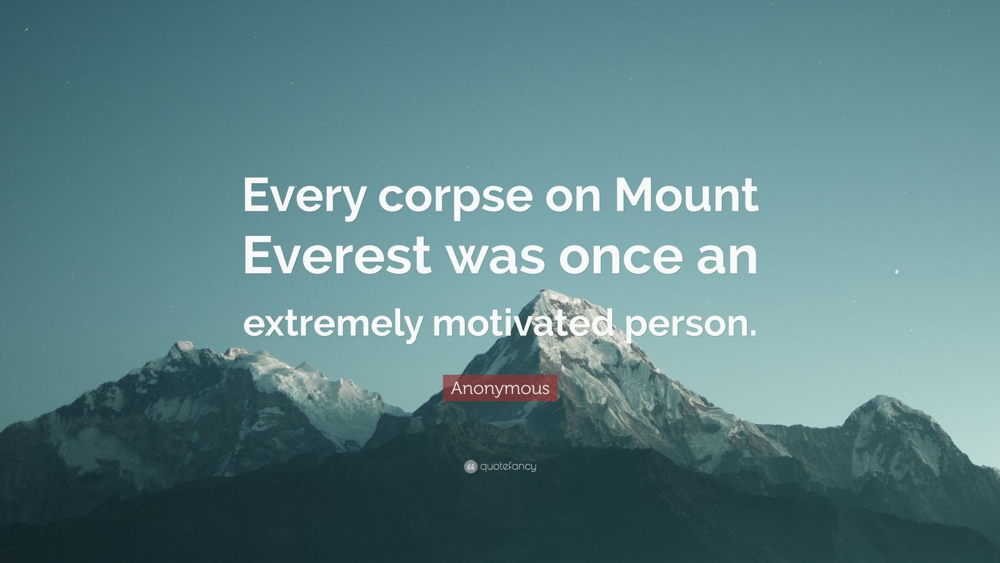
I liked that and my mind immediately went to, “Who said that?” and “How can I use this to frame people and performance?” A quick Perplexity search found:
The line “Every corpse on Everest was once an extremely motivated person” is widely circulating online, but it does not have a single, clearly verified original author.
Several writers, speakers, and a lot of internet users have picked up some version of this line, usually in a tongue‑in‑cheek, anti‑hustle context.
Named authors
-
Oliver Markus Malloy (humor writer)
-
Version: “Food for thought: Every dead body on Mount Everest was once a highly motivated person. Stay lazy my friends. It may save your life one day.”
-
Appears in his quote collections and is widely reposted as a standalone meme.
-
-
Lani Lynn Vale (novelist)
-
Version: “Every corpse on Mount Everest was once an extremely motivated individual. That’s why I love my couch. A couch has never killed anybody.” from The Hail You Say.
-
Her wording is the source for many image quotes and reposts that keep the “extremely motivated individual” phrasing.
-
OD / management voices
-
Leandro Herrero (organizational change consultant)
-
Uses the exact wording “Every Corpse on Everest was once an extremely motivated person” as the title hook of a leadership and change blog post about motivation and behavior.
-
He uses it to question simplistic “motivation” narratives in corporate change work.
-
-
Dave Snowden / The Cynefin Co
-
In a post on “Sacred Cows of OD,” he quotes the line on a transition slide: “Every Corpse on Everest was once an Extremely motivated person,” explicitly noting he picked it up from Facebook.
-
He uses it as a setup to critique conventional change‑management wisdom.
-
-
Business / HR social media
-
Various LinkedIn posts (for example, by Nika Golob) use “Every corpse on Mount Everest was once an extremely motivated individual” as a light, anti‑stress message about not over‑pushing yourself.
-
Similar phrasing appears in corporate‑style posters and wall art marketed as “demotivational” or “teamwork” quote pieces.
-
Internet meme ecosystem
-
Reddit (Showerthoughts, Jokes, AskReddit, etc.)
-
Variants like “Remember that every dead body on Mt. Everest was once a highly motivated person. Stay lazy, my friends” have been heavily upvoted and remixed in joke threads.
-
People also quote shortened forms such as “Every dead body on mount Everest was once a highly motivated person” as their go‑to anti‑hustle reminder.
-
-
Instagram, Facebook, YouTube, TikTok‑style reels
-
Short video and image posts repeat: “Every dead body on Mount Everest was once a highly motivated person, so maybe calm down a little bit,” often around New Year’s resolutions.
-
Image macros use either the Malloy “dead body” phrasing or the Vale “corpse… extremely motivated individual” wording, frequently with mountain photos.
-
-
Merchandise / posters
-
Multiple online shops sell posters reading “Every Corpse on Everest Was Once An Extremely Motivated Person,” classed as funny or demotivational office art.
-
Attribution pattern
-
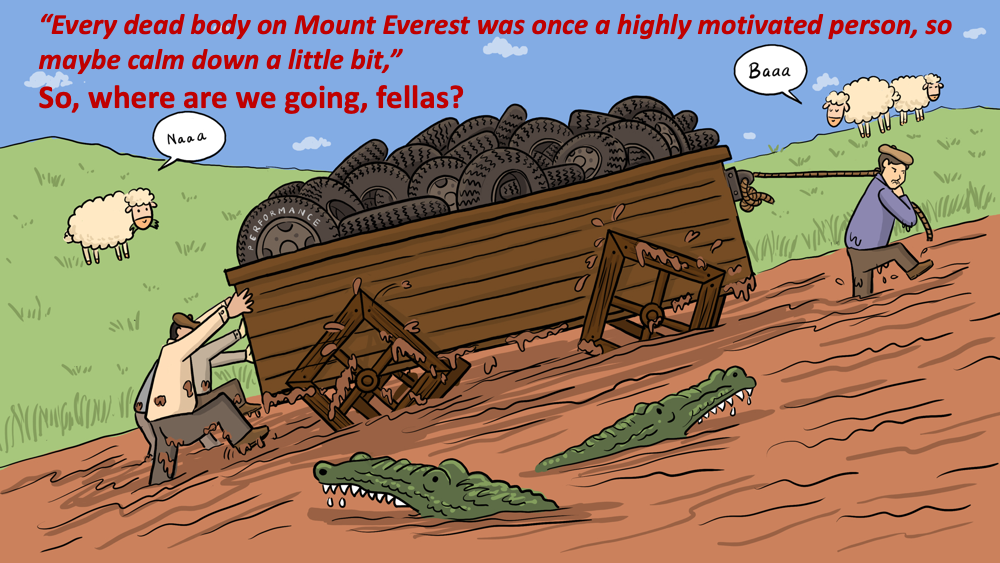
The two clearest attributed literary versions are by Oliver Markus Malloy and Lani Lynn Vale. and now, maybe I will make the list with my image below.
-
The exact sentence you’re using (“every corpse on Everest was once an extremely motivated person”) is best understood as a memetic paraphrase that has been repeatedly recycled, merchandised, and adapted across social media and demotivational products without a single, provable original source.
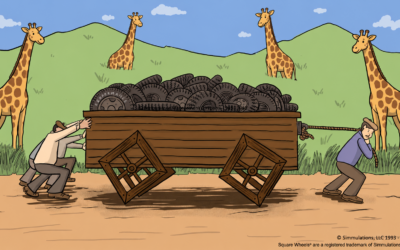
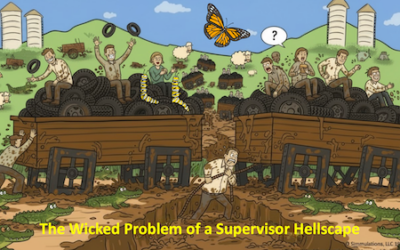
So, there you go. I get this in my head when I mesh the above ideas into my Square Wheels themes about how things really work in most organizations:
—
For the FUN of It!
 Dr. Scott Simmerman is a designer of team building games and organization improvement tools.
Managing Partner of Performance Management Company since 1984, he is an experienced presenter and consultant who is trying to retire!! He now lives in Cuenca, Ecuador.
You can reach Scott at scott@squarewheels.com
Learn more about Scott at his LinkedIn site.
Square Wheels® are a registered trademark of Simmulations, LLC
and images have been copyrighted since 1993,
© Simmulations, LLC 1993 – 2026
What I’m About:
My Square Wheels blog and website exist to help leaders, trainers, and facilitators make work smoother, more engaging, and more human. I focus on practical tools for process improvement, organizational change, and workplace collaboration that spark insight and deliver measurable results.
And I am convinced, after 30+ years of using Square Wheels®, that it is the best facilitation toolset in the world. One can use it to involve and engage people in designing workplace improvements and building engagement and collaboration. It is a unique metaphorical approach to performance improvement and we can easily license your organization to use these images and approaches.
By blending proven facilitation methods, creative problem-solving, and engaging team activities, my mission is to support organizations in building energized, sustainable cultures of involvement and innovation.
Through accessible — and often free — resources and virtual facilitation tools, I aim to help teams everywhere collaborate more effectively, innovate continuously, and take ownership of their improvement journey.
#SquareWheels #InnovationAtWork #TeamEngagement #FacilitationTools #WorkplaceImprovement #EmployeeEngagement #CreativeProblemSolving #OrganizationalDevelopment #LeadershipTools #collaboration #leadership #motivation #communications #enablement #leadership #CreativeCommons #enablingperformance #teamwork

0 Comments