
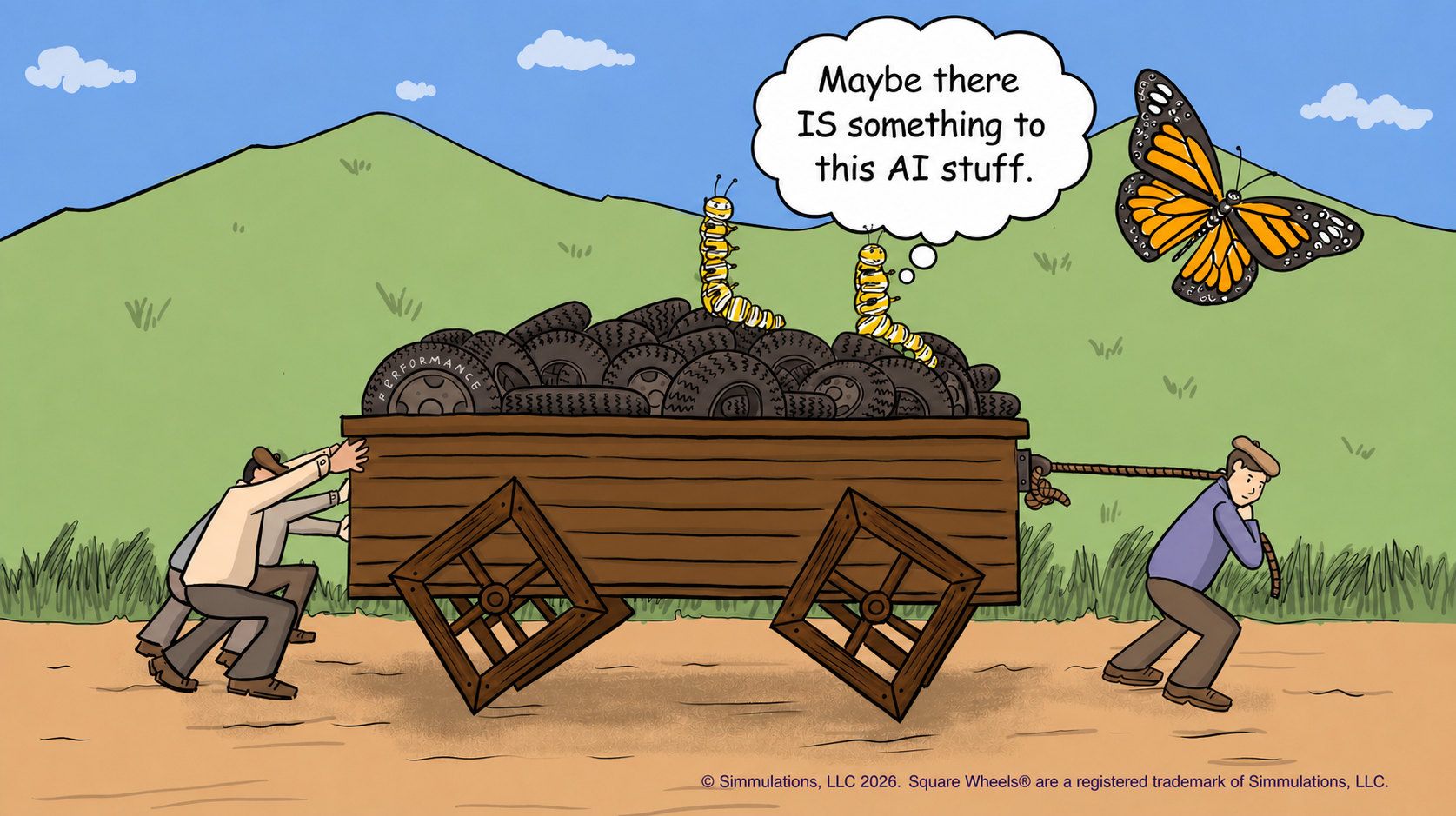
This post is about Protecting Image Copyright when using LinkedIn®. I regularly share my Square Wheels® images and we were talking about AI and image protection in a Facilitator’s Guild discussion.
Basically, you keep ownership of what you create. Posting your graphics, photos, or frameworks on LinkedIn® does not magically erase your copyright protection or turn your work into public domain property. That simple idea sits at the core of this article. You should protect your work through registration (or not) and then share it with others as you see beneficial. It is still protected as your work.
What does change when you post is risk, visibility, and how easily others can copy or misuse your work. As someone who has built and protected a visual framework like my Square Wheels® images for more than three decades, I’ve learned that understanding copyright basics is not optional anymore—it’s part of being a facilitation professional on social platforms.
Below is a practical, story‑driven explainer I want to with readers, anchoring to my Square Wheels images as a visual anchor.
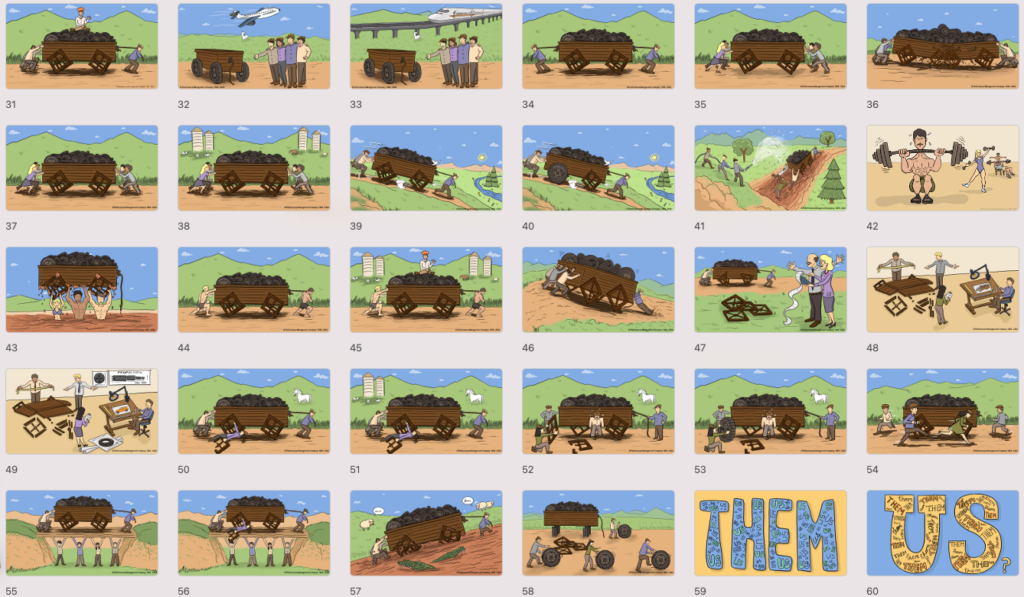
Here is the evolution of my images, from line art to using LEGO to the current state of colored images that I can produce using Perplexity, my preferred AI tools. In all these years, there have been very few infringements that have had any real negative impact on my intellectual property.

Why LinkedIn Makes Copyright and Ownership Feel Confusing
LinkedIn feels like a professional town square. We share posts, articles, slide decks, infographics, and clever images to generate reactions and comments. We like, repost, and comment and it’s easy to forget there is real law behind all that clicking and sharing.
The confusion often starts with questions like:
-
“If I post my graphic on LinkedIn, can anyone just grab it and use it?”
-
“Does LinkedIn’s fine print user agreement mean I give up ownership?”
-
“Do I need to worry about copyright if I’m just posting a meme or a quote image?”
- Can I repost someone else’s work?
(And there is also this trademark thing: “You can generally just write “LinkedIn” in your articles, slides, and posts without adding ®, ™, or other legal notation, as long as you are simply referring to the platform in a descriptive way and not implying endorsement or affiliation” according to Perplexity.)
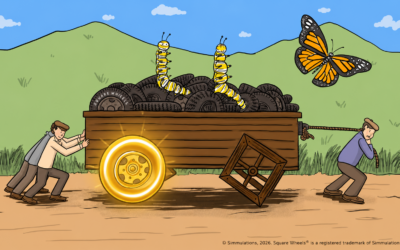
Let’s use a concrete anchor: imagine you scroll by one of my Square Wheels® cartoons, in this case Square Wheels One, a wooden wagon rolling on Square Wheels (a trademark), with people pushing and pulling and round rubber tires sitting unused inside the wagon. It’s simple, visual, and instantly usable in workshops. And that’s exactly why it needs protection. (And, this simplicity and usefulness is why I allow people to use it for FREE (more information here)).
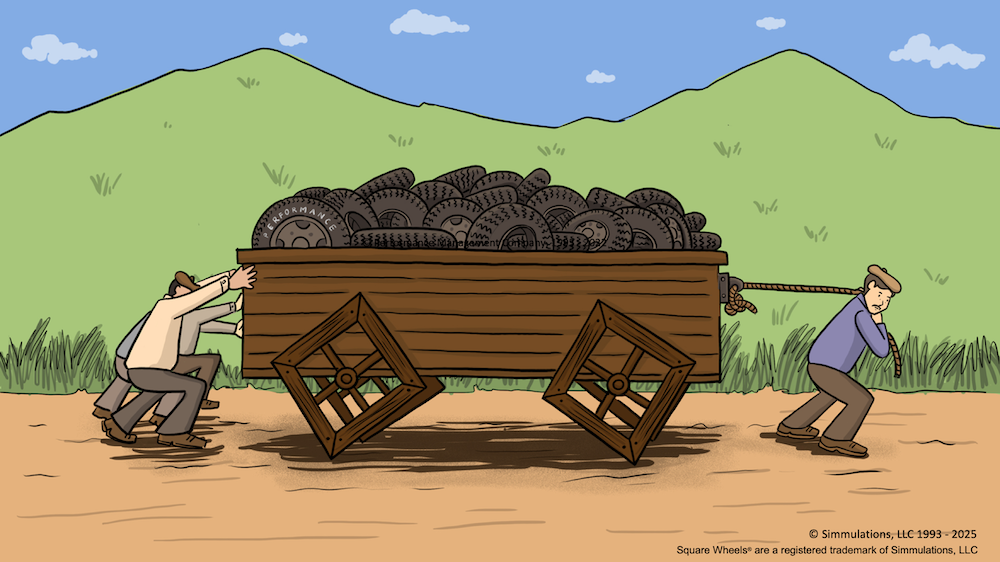
When you see the above image in your feed, you can:
-
Look at it and consider its possibilities and simplicity as an explainer of how things work
-
Like it
-
Comment on it and the associated content
-
Share the post within LinkedIn by reposting (using the platform’s share function)
But you cannot legally:
-
Download it and drop it into your training deck or your toolkit
-
Put it into a PDF you sell or distribute
-
Paste it into your book or e‑book
- Past it into your post as your image
-
Rebrand it and call it your own model
Why? Because copyright rights will always travel with the image, even when the image travels across platforms and internationally.
The Core Copyright Rule: Creation = Protection
Here’s the plain‑language rule you and your audience need to remember:
The moment you create an original graphic, photo, drawing, or written piece and fix it in some tangible form (a file, a sheet of paper, a slide), it is automatically protected by copyright.
No registration is required for it to exist. No watermark is required for it to be enforceable. You don’t have to put a © symbol on it for it to be “real.” Creation plus fixation equals protection.
That simple creating gives you protection, and that protection gives you exclusive rights to:
-
Reproduce the work (copy it)
-
Distribute the work (share, sell, gift)
-
Display the work publicly
-
Create derivative works (adaptations, spin‑offs)
-
License the work (give others permission under specific terms)
Square Wheels is a good, practical example. The original line drawings and image panels were created in 1993 in line art and shown in workshops and training programs by me since 1993. I have presented it and given out transparencies and powerpoints in 49 countries with the idea that people will share my protected works. I’ve published the image in hundreds of articles and it has been used in books by others, with permission. The images and associated metaphors are distinctive and easily recognizable — people seeing me present 25 years earlier comment on their remembering my presentations (amazing!). When you see one of them, you’re not just looking at “a cartoon”— you’re looking at intellectual property.
“Square Wheels® One” shown above, takes this one step forward to generate the ability for people to use it. That image is licensed for use under a specific Creative Commons BY-ND License, allowing people to use the image in their own work, with it needing attribution to Simmulations, LLC, the copyright owner. See more here and get the image and user’s guide for FREE.
My original line art image now exists as hundreds of different images and frameworks to be used in organizational development toolkits and packages. I make new ones almost every day.
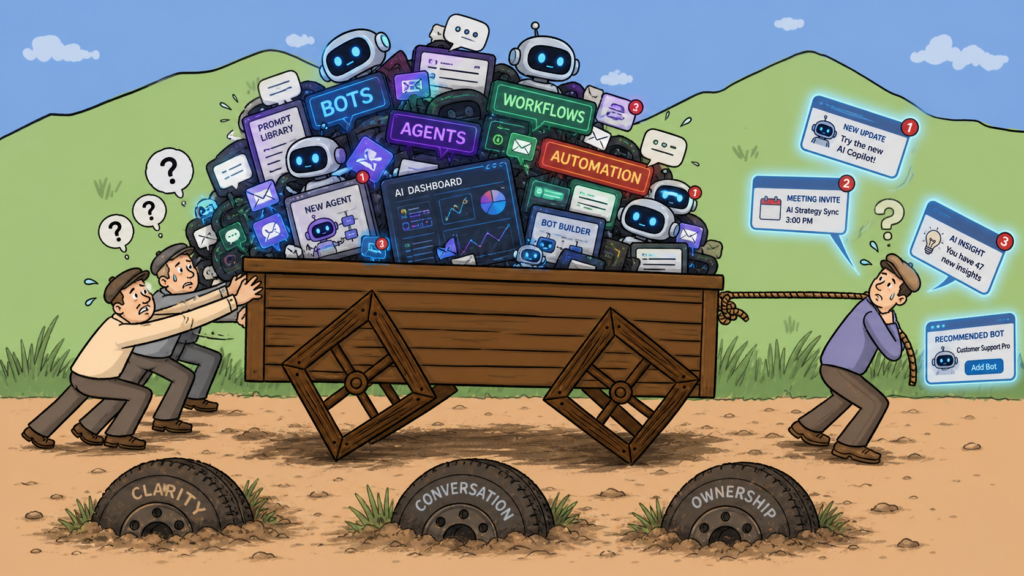
And these are the two newest ones, being thought exercises / discussion tools around the use of AI in the workplace.
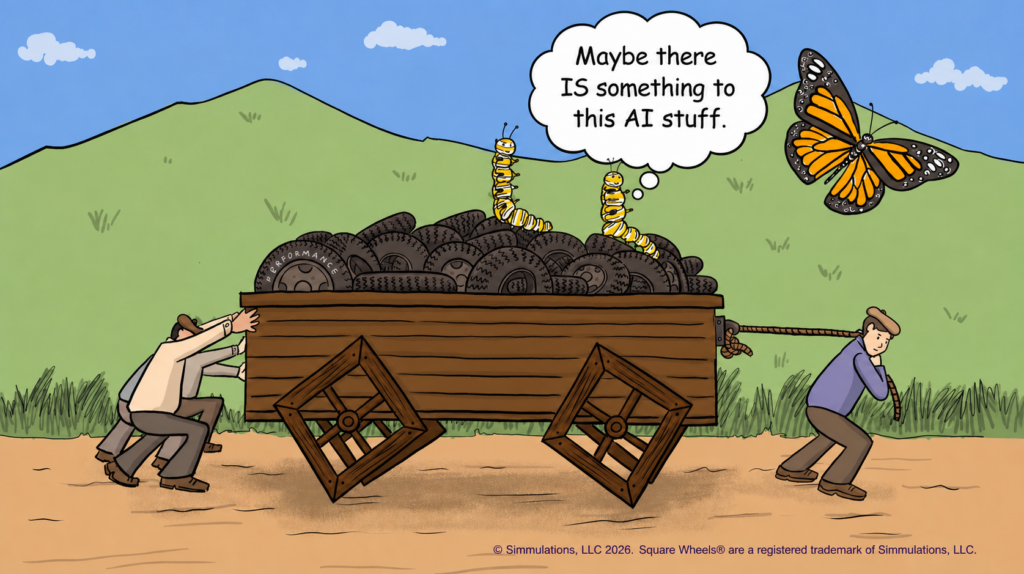
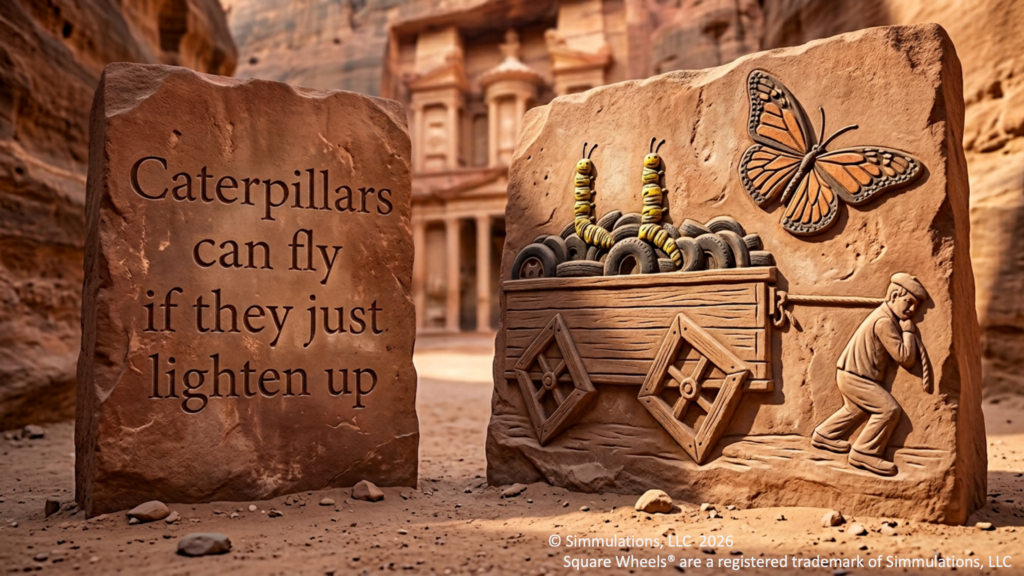
And, here is another in the theme but of a different style. Note the copyright and trademark information on the image.:
So you are an IP owner and copywriter if you create and post:
-
A unique leadership model graphic
-
An original process map or infographic
-
A series of metaphorical images
-
A staged photograph for your brand
Understand that the images you see on LinkedIn and other social media are not “just cartoons or images” that you can simply borrow. They are business assets protected by law. And these restrictions pretty much apply to every image you see on LinkedIn. They are MEANT to be interesting, illustrative and anchoring, and they are often MEANT to communicate some message. But they are NOT free to grab and distribute, or to use as the beginning of some derived work. You need permission. Go ask!
What Happens When You Post something on LinkedIn?
Here’s the part that worries many professionals with IP: platform Terms of Service.
When you post your content on LinkedIn, you do not hand over ownership. You do, however, grant LinkedIn a broad license to use, host, copy, distribute, modify for technical purposes (such as formatting or translation), display, store, and sometimes redistribute that content across its services.
It will process your content as necessary to operate and improve the platform, including formatting, indexing, caching, and other technical functions. Your agreement to its Terms of Service is what allows LinkedIn to:
-
Show your post in other people’s feeds
-
Send email digests that include your content
-
Run services that cache, index, or translate content
Think of it this way: LinkedIn needs a license from you to operate. If they didn’t have permission to show your post to other users or across devices, the platform wouldn’t work.
But that license is:
-
Non‑exclusive – You can still license the same image to other places.
-
Revocable – If you delete the content, they will eventually stop displaying it (allowing for technical lag). Note that this depends on whether others have already reshared or copied it — the license doesn’t retroactively unwind those copies.
-
Not their ownership – You don’t lose your rights; you just allow the platform to function.
The practical risk is not that LinkedIn acquires your copyright: it doesn’t. The greater risk is that other users may copy, repost, or reuse your work without understanding (or respecting) the limits of copyright law. Posting content publicly does not place it in the public domain or give others permission to reuse it beyond what’s allowed by copyright law or LinkedIn’s features (such as sharing or reposting within the platform).
LinkedIn’s terms explicitly prohibit copying or distributing others’ content outside the platform’s built-in sharing tools without permission, so a user who screenshots and reposts someone else’s image elsewhere is, in fact, potentially violating LinkedIn’s rules and possibly copyright law, even though the platform itself is licensed to display it.
Visibility is NOT Permission.
The license does not mean LinkedIn (or anyone else) can claim authorship of your work nor does it transfer your copyright and intellectual property to someone else. It simply gives LinkedIn the legal permission necessary to operate and promote its service using your content. That is actually its benefit to you.
What Other Users Can—and Can’t—Do
There’s a useful distinction between:
-
Using platform tools
-
Downloading and reusing content off‑platform
When someone sees my Square Wheels image in LinkedIn, they may:
-
Share your post using LinkedIn’s share feature
-
Comment on it – Please oh please! (smile)
-
Save it as a bookmark
-
Screenshot it for personal, noncommercial reference (a gray area, but low risk if it stays private)
They may not, legally:
-
Grab the file and drop it into their own LinkedIn post as if it were theirs
-
Use it in a training program they sell
-
Add it to their course materials, website, or book
-
Edit it and pretend they created the underlying concept
Those actions typically require your explicit license or permission and they act at their risk if they do things differently.
The same is true for your content.
And if they do, you’re not helpless. You do not give up your intellectual property rights.
Trademark Layers: Logos, Names, and Brands
Many of us layer branding on top of our images:
-
Logos
-
Product names (e.g., “Square Wheels®,” “The Square Wheels® Toolkit”)
-
Taglines
Copyright protects the expression (the drawing, the composition, the text in the speech bubbles). Trademark protects identifiers of source (names, logos, slogans) that tell the market “this comes from us.”
If someone grabs your Square Wheels image and:
-
Removes your logo
-
Keeps the Square Wheels name without permission
-
Or uses it in a way that makes participants believe they are you
You may now have both copyright and trademark issues: infringement plus confusion or false association.
For your own work, consider:
-
Registering key marks (names, logos, product identifiers) if they’re central to your brand
-
Using ® or ™ consistently
-
Keeping your brand visually connected to the images you share
Practical Ways to Protect Your Images on LinkedIn
You don’t need to be paranoid. You do need to be intentional. Here are practical steps you can explain to your readers and model yourself:
1. Use Visible Notices
Add a simple, clear notice on each image:
-
“© [Year] [Your Name or Company]. All rights reserved.” (That latter part is not a requirement.)
-
“Square Wheels® is a registered trademark of [Owner]. Used with permission.” if you own a trademerk or service mark. (Using “™” is a whole separate blog post!)
This doesn’t “create” rights—you already have them—but it makes ownership obvious and reduces the “I didn’t know” excuses.
2. Clarify Usage in Your Post Text
Under your image, add one sentence in plain language:
-
“This image is part of the Square Wheels® framework and may not be reused in training materials or publications without written permission.”
-
“You’re welcome to share this post here on LinkedIn. For any other use, please contact me.”
- Or, whatever… Just consider clarifying. “Click on the image to download a Creative Commons version…” or whatever you want to communicate about it.
This invites sharing within the platform while drawing a clear line around commercial or off‑platform use.
3. Decide Which Images Are “Showpieces” and Which Are “Tools”
You might have:
-
A few iconic images (like my classic Square Wheels® One wagon) that you show widely for marketing.
-
More detailed sets and variations or infographics used inside workshops, simulations, or licensed programs.
Consider posting lower‑resolution or watermarked versions of the images that are core tools, while using higher‑resolution images only in controlled contexts (client platforms, licensed materials, paywalled courses). I choose NOT to watermark things because it creates hundreds more images and make sorting difficult.
4. Register Your Most Important Works
Registration (where available in your jurisdiction) gives you:
-
A stronger position for statutory damages and attorney fees if you need to enforce
-
An official record tying the work to you and to a specific date
If your business depends on a visual framework—like Square Wheels does for me—consider registering:
-
The core illustrations
-
The key panels or cartoons
-
The distinctive graphic elements of your model
This is part of treating your IP the way you’d treat a physical asset or a product line.
5. Monitor and Respond Professionally
From time to time, you may see someone:
-
Using your image in their post with no attribution
-
Dropping your framework into their slides
-
Reposting your content as if they created it
A reasonable sequence is:
-
Start with a polite note
“I’m glad you found the Square Wheels® image useful. It’s copyrighted material. Please either link back to my original post or remove the image. If you’d like to license it for training, I’d be happy to talk.” -
If needed, escalate through the platform
Most platforms have a copyright / DMCA process. You can submit a takedown request if informal outreach doesn’t work. -
Consider whether this is a pattern or a one‑off
Some people genuinely don’t know. Others repeatedly build businesses on other people’s IP. Respond accordingly. You DO have legal resources to protect your IP.
Coaching Your Audience: How to Stay on the Right Side of Copyright
Since I speak and write about organizational performance, let me can turn this last part into a teachable moment for my LinkedIn audience.
A short “rules of thumb” section helps non‑lawyers stay safe:
-
If you didn’t create it and don’t have permission, don’t reuse it outside the platform. Ever.
-
Sharing a post inside LinkedIn is fine; downloading and repurposing the image is not.
-
Attribution alone is not a license. “Image by Scott Simmerman” is polite but not permission. I CAN sue you!
-
Templates, frameworks, and distinctive visuals are business assets—treat them with respect.
-
Ask. Many creators are happy to license content when people come to them honestly. I do this pretty often. I’d like to do it even more. I WANT to collaborate and develop for-sale training packages around my tools.
I use my Square Wheels images, like the wagon stuck in the mud with Spectator Sheep and Silos and the unused round wheels as a metaphor of “continuous continuous improvement” and to illustrate where organizations get stuck and what they might consider doing differently.

Commonly,
-
Leaders and Consultants assume “everything on LinkedIn is free.”
-
Trainers borrow visuals without understanding the legal or ethical implications and put themselves and their companies in legal jeopardy, Big Time.
-
Creators fear posting because they feel they’ll lose control.
Your message: we get better journeys when we understand the terrain. Copyright is not about shutting down sharing; it’s about enabling appropriate sharing that positively respects creative work.
Note that I used Perplexity to help create this content and review LinkedIn’s public agreement — and we had it reviewed in Gemini and in ChatGPT.. Gemini saw it as “highly accurate.” Claude also saw it “highly accurate” and we implemented the improvement suggestions of both platforms. ChatGPT offered some suggested edits to “tighten the language.” (mostly just style differences between Perplexity and ChatGPT). It gets a 9/10 from Chat. SO, we think and hope that you find this useful.
A Closing Thought about my many years of playing with these visuals:
When I post a Square Wheels® image on LinkedIn, I’m not throwing it into the public domain. I’m inviting conversation, reflection, and engagement around the idea that things can always be improved. The image is a visual tool that others can use, and it’s also intellectual property. And it is what I do!
The same is true for my carefully crafted graphics and frameworks. I own them. Platforms host them. People see them. A few may misuse them out of ignorance; a few will misuse them despite knowing better.
I see my job as a professional in organizational development and a communication and change agent is to do three things: create value, communicate clearly, and protect what I create.
Understanding how copyright applies to my (and your) LinkedIn content is one more round wheel you can put under your wagon of ideas. It makes the journey smoother and safer for you and for everyone who respects the decades of hard work behind the images.
I REALLY hope that you have found this useful,
—
For the FUN of It!
Dr. Scott Simmerman is a designer of team building games and organization improvement tools.
Managing Partner of Performance Management Company since 1984, he is an experienced presenter and consultant who is trying to retire!! He now lives in Cuenca, Ecuador.You can reach Scott at scott@squarewheels.com
Learn more about Scott at his LinkedIn site.Note that I often use Perplexity AI to help research and generate ideas for my posts.
Square Wheels® are a registered trademark of Simmulations, LLC
and images have been copyrighted since 1993,© Simmulations, LLC 1993 – 2026
What I’m About:
My Square Wheels blog and website exist to help leaders, trainers, and facilitators make work smoother, more engaging, and more human. I focus on practical tools for process improvement, organizational change, and workplace collaboration that spark insight and deliver measurable results.
And I am convinced, after 30+ years of using Square Wheels®, that it is the best facilitation toolset in the world. One can use it to involve and engage people in designing workplace improvements and building engagement and collaboration. It is a unique metaphorical approach to performance improvement and we can easily license your organization to use these images and approaches.
By blending proven facilitation methods, creative problem-solving, and engaging team activities, my mission is to support organizations in building energized, sustainable cultures of involvement and innovation.
Through accessible — and often free — resources and virtual facilitation tools, I aim to help teams everywhere collaborate more effectively, innovate continuously, and take ownership of their improvement journey.
#SquareWheels #InnovationAtWork #TeamEngagement #FacilitationTools #WorkplaceImprovement #EmployeeEngagement #CreativeProblemSolving #OrganizationalDevelopment #LeadershipTools #collaboration #leadership #motivation #communications #enablement #leadership #CreativeCommons #enablingperformance #teamwork #storytelling #storyasking

0 Comments