
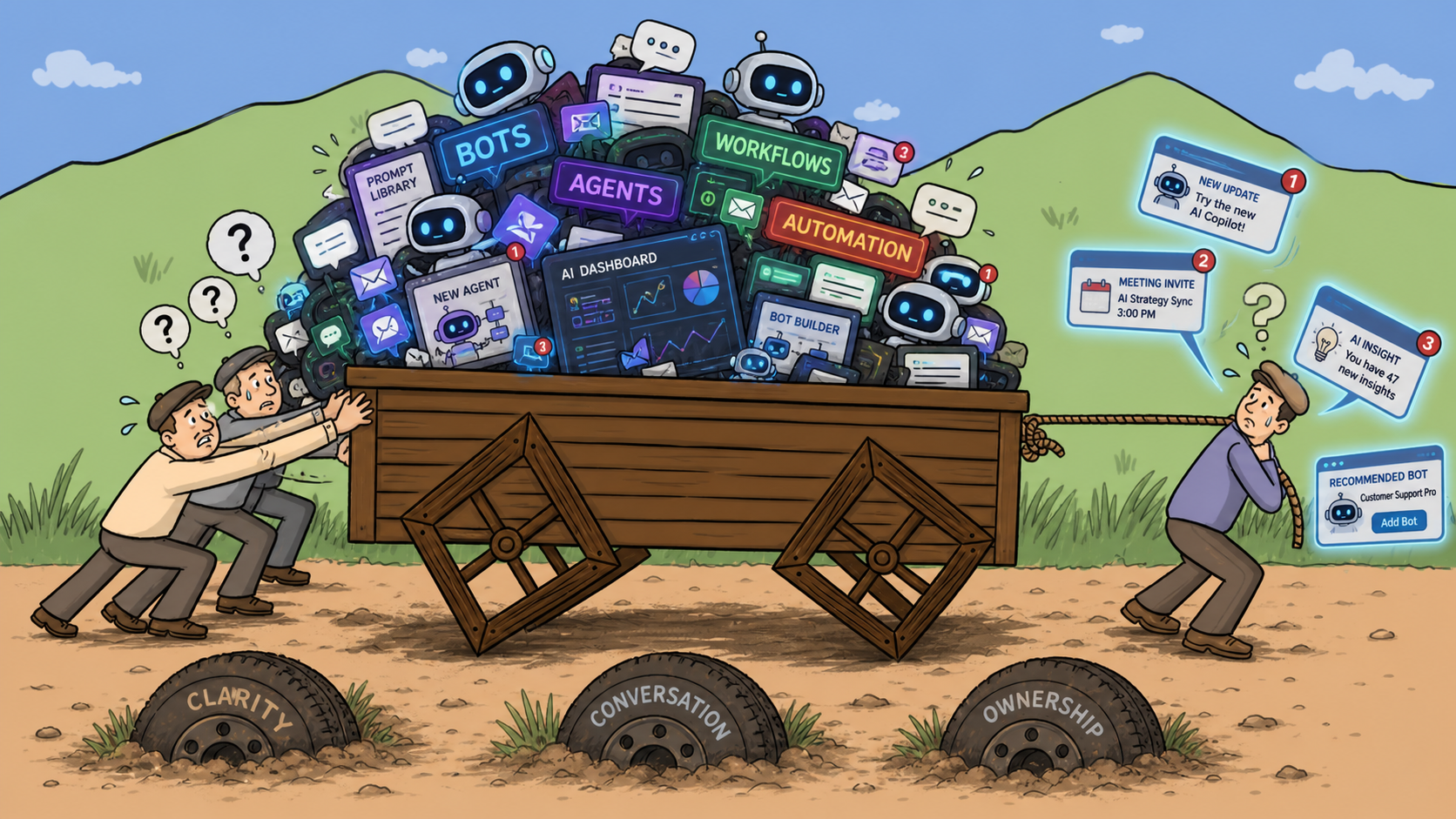
When Our Organizations Roll on Square Wheels: AI Agent Sprawl, Lost Agency, and the Power of Conversation to impact real organizational performance.
The Key Point: We are thumping along on Square Wheels, and AI “agent sprawl” is just the latest bump in the journey forward. We can choose to do things better.
In an excellent recent article, Christopher Lind explores how the rapid spread of AI agents, bots, and automated workflows is quietly (?) eroding human agency inside organizations. His core argument is not anti‑technology but it is a warning about what happens when we keep adding tools faster than we add shared understanding, engagement, ownership, and accountability. Without these, there is a real loss of involvement and all kinds of things suffer. We’re creating disengagement and frustration.
From my Square Wheels® lens, where I filter ideas through this easy to understand metaphor about reality, that picture feels very familiar and I will discuss it below. I felt I could contribute to this conversation by adding some different perspectives and some possible solutions arising from workplace sharing of my simple SWs metaphor and my tools and thus impacting organizational performance.
The Hidden Cost of Agent Sprawl
Agent sprawl happens when every problem seems to justify “just one more” AI tool, bot, or workflow. Individually, each solution looks helpful. Collectively, they create a fragmented operational landscape where:
-
No one is quite sure who or what is responsible for a given outcome.
-
Decisions seem to happen “somewhere in the system,” not in human conversations.
-
People feel more like operators of tools than owners of results.
When complexity reaches that point, people hit a wall and find themselves up to their axles in mud. They struggle to move forward. And, faced with constant change and a growing constellation of tools, they default to two basic and normal coping strategies:
-
Resist everything (“I don’t trust any of this agent AI stuff…”), or
-
Abdicate judgment and let the systems decide (“Whatever the bot says must be right…”).
In both cases above, something essential is lost: that felt sense that “I can see or feel what’s going on, I can influence it, and I’m accountable for what I choose.” That loss of agency is deadly for engagement since no one owns the outcomes.
Square Wheels: A Clarifying Picture of a Complex Problem
For years, I’ve used the Square Wheels metaphor as a way to help organizations talk about how work really gets done. (You can read about my thoughts on solving Wicked Problems here.)
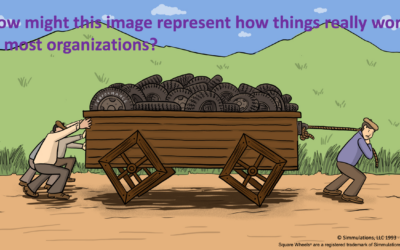
The Square Wheels One image is improvement and change made simple:
-
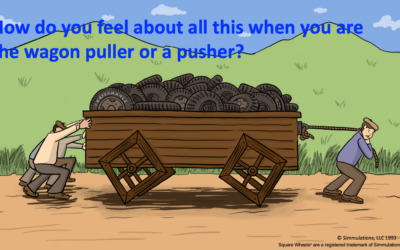
A solid wooden wagon rolling forward on Square Wheels®.
-
A leader pulling from the front, unable to see or feel what’s happening behind.
-
People pushing from the back, feeling the thump and bump of every step and unable to see forward.
-
Round wheels, those better ideas and smoother processes, are already in the wagon, unused.
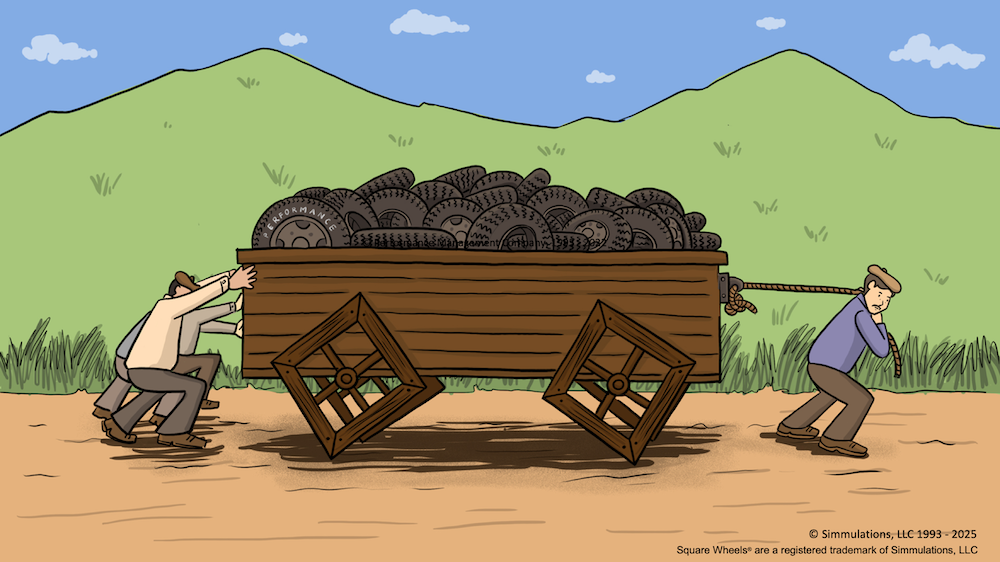
Everyone is working hard, but the system itself makes the journey very difficult. And, add to it the normal uphill progress and the entire team being bogged down by the mud of organizational reality, and you have a situation worth improving, now.
The most interesting thing about the image above is that once you understand the metaphor, you will almost automatically begin defining various workplace issues around the wooden Square Wheel idea, and you will almost automatically begin looking for round wheel possibilities. And that gap between what is working but not smoothly and those ideas for improvement generate cognitive dissonance, an optimizing motivational imperative to implement change and improvement. The LANGUAGE of Square Wheels will stick with you!
In a world of agent sprawl, that wagon is surrounded by different AI tools, dashboards, and automated workflows. The wooden wheels have gotten more “digital,” but many are still square. Leaders pull harder. Teams push harder. And the conversation about actually improving the wagon rarely happens. People are just too busy to listen for new ideas.
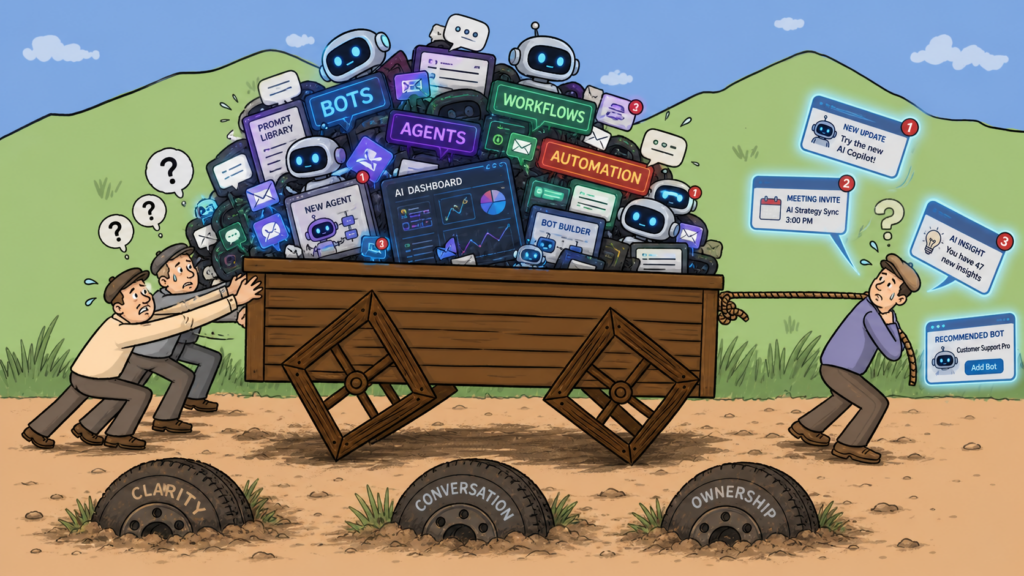
Let’s call this “AI Agent Sprawl” as a workplace reality.
The genius of the Square Wheels metaphor is that it gives people a safe, shared language for discussing what’s not working without turning the conversation into blame or resistance. It is a collaborative group thinking tool that is extraordinarily effective because it relates so well to reality.
Restoring Connectiveness Through Conversation
So how do we respond to agent sprawl without simply shutting down innovation?
We start by talking about the wagon and the journey forward. A leader facilitating Square Wheels conversations across the organization notes three important things:
-
It reconnects people to each other.
When teams gather around the image and describe their Square Wheels, they hear that others are experiencing similar frictions and issues. The language shifts from “my problem” to “our pattern.” -
It reconnects people to the work.
Instead of seeing themselves as passive users of tools, participants become co‑diagnosticians. They are invited to notice where the journey forward feels rough or muddy, where roles and visions are unclear, and where “the system” is quietly undermining agency. -
It reconnects scattered initiatives.
As different functions share their common language of Square Wheels and round‑wheel ideas, leaders can see common themes: duplicated tools, unnecessary automation, unclear ownership, or missing conversations. The picture of the whole wagon emerges and possible improvements become a natural part of the discussions.
In a complex digital environment, that kind of facilitated dialogue is not a “nice to have.” It is the basic infrastructure of connectiveness. It brings people together.
From Complaints to Co‑Creation
Done poorly, “let’s talk about our problems” becomes a complaint session.
Done well, a Square Wheels conversation becomes an innovative co‑creation session.
Here’s a simple pattern leaders can use:
-
Start with the image.
Show the wagon on Square Wheels. After some introduction, ask, “Where is our ride this bumpy today?” (Get the Square Wheels One image and a toolkit / facilitation guide here, free.) -
Name the Square Wheels.
Invite people to identify specific frictions: tools that don’t talk to each other, automations that create more rework, workflows that confuse accountability. -
Surface the round wheels already in the wagon.
Ask, “What do we already know we could do differently?” You will hear ideas for better handoffs, clearer roles, smarter use of existing technology, and simpler decision rules. They will talk about generating more agency, individual and group. -
Connect the dots across teams.
Share what different groups are seeing and begin to deal with the silos. Highlight common Square Wheels and cross‑functional round‑wheel solutions. -
Commit to visible change.
Pick a few high‑impact round wheels and implement them quickly. Make it easy for people to see: “Our conversation changed our wagon.”
This is where engagement lives. People are not being told to “adapt.” They are being invited to help redesign the way work gets done.
Reclaiming Agency in a Digital World
Christopher Lind’s warning about agent sprawl is timely. We can absolutely benefit from AI agents and automation. But if we allow those systems to proliferate without deliberate, human‑centered sensemaking, we will get faster and more efficient at something that feels increasingly disconnected and disempowering.
Using the Square Wheels languaging gives us a way to reclaim that sensemaking and agency.
By regularly facilitating conversations around the wagon—where the ride is rough, where the wheels are square, and where the round wheels already exist—we:
-
Put people back in the driver’s seat of improvement.
-
Turn vague frustration into shared diagnostics and practical solutions.
-
Transform “change fatigue” into “change agency.”
The message to your organization becomes clear:
- We will use technology. We will use agents. But we will not surrender our conversations, our ownership, or our responsibility for shaping how this all works together.
- We will keep looking at our Square Wheels, and we will work together to turn them round.
Call to action
If your organization is feeling the thump of agent sprawl—too many tools, too many workflows, and not enough clarity—consider starting with a simple Square Wheels session. Put the wagon in front of your people. Ask them where the ride is rough. Listen carefully to the round wheels they already see.
Get the Square Wheels One image and a toolkit / facilitation guide here, free.
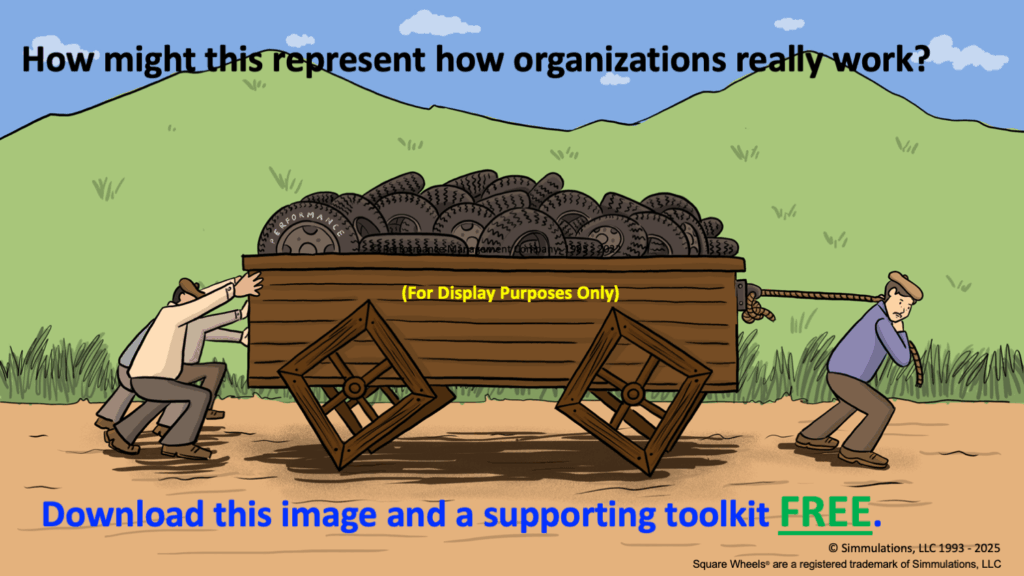
Download the FREE Square Wheels® One image and instructor’s guide under a Creative Commons license
You may discover that the most powerful technology upgrade you can make right now is not another agent, but better conversations. The round wheels are already in the wagon!
—
For the FUN of It!
 Dr. Scott Simmerman is a designer of team building games and organization improvement tools.
Managing Partner of Performance Management Company since 1984, he is an experienced presenter and consultant who is trying to retire!! He now lives in Cuenca, Ecuador.
You can reach Scott at scott@squarewheels.com
Learn more about Scott at his LinkedIn site.
Note that I often use Perplexity AI to help research and generate ideas for my posts.
Square Wheels® are a registered trademark of Simmulations, LLC
and images have been copyrighted since 1993,
© Simmulations, LLC 1993 – 2026
What I’m About:
My Square Wheels blog and website exist to help leaders, trainers, and facilitators make work smoother, more engaging, and more human. I focus on practical tools for process improvement, organizational change, and workplace collaboration that spark insight and deliver measurable results.
And I am convinced, after 30+ years of using Square Wheels®, that it is the best facilitation toolset in the world. One can use it to involve and engage people in designing workplace improvements and building engagement and collaboration. It is a unique metaphorical approach to performance improvement and we can easily license your organization to use these images and approaches.
By blending proven facilitation methods, creative problem-solving, and engaging team activities, my mission is to support organizations in building energized, sustainable cultures of involvement and innovation.
Through accessible — and often free — resources and virtual facilitation tools, I aim to help teams everywhere collaborate more effectively, innovate continuously, and take ownership of their improvement journey.
#SquareWheels #InnovationAtWork #TeamEngagement #FacilitationTools #WorkplaceImprovement #EmployeeEngagement #CreativeProblemSolving #OrganizationalDevelopment #LeadershipTools #collaboration #leadership #motivation #communications #enablement #leadership #CreativeCommons #enablingperformance #teamwork #storytelling #storyasking


0 Comments