
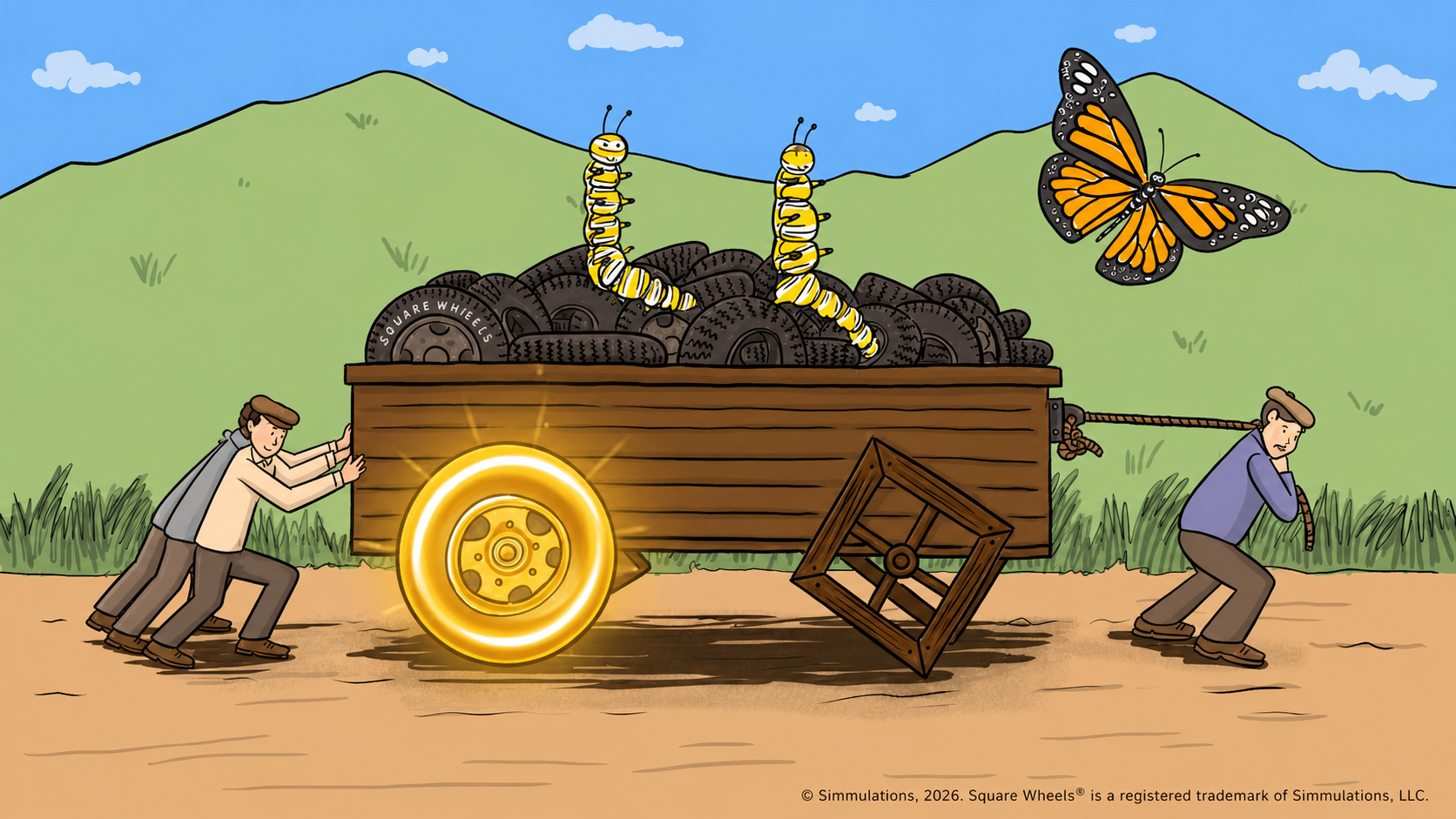
Positive imagining and neuroscience reinforce a truth: people are more creative when they mentally simulate better futures for workplace innovation..
If you want more innovation in a workplace, one of the best places to begin is not with a spreadsheet or a policy manual, but with imagination. This recent article on positive imagining and social neuroscience, for example, reinforces a powerful truth: people become more creative when they can mentally simulate better futures, share those simulations with others, and turn images into action.
That is exactly where Square Wheels® images and related tools can be so useful for your organizational improvement initiatives. And, they can easily be used by your supervisors to directly actively involve and engage their people. The use of these images give teams a simple, memorable, nonthreatening way to picture how work really happens today and how it might work better tomorrow.
The genius of Square Wheels has always been its absolute simplicity. A wagon rolling on Square Wheels is obviously inefficient, but that’s why it works so well as a metaphor: inefficiencies are everywhere. Everyone instantly sees that something is not right and that initial general observation shifts to their workplaces. Yet the point is not blame. The point is to open a conversation about improvement. The images help engage people to move from complaint to curiosity, from frustration to possibility, and from possibility to practical ideas. That is the bridge between organizational life and positive imagining.
And cognitive dissonance between perceived current reality and possibilities becomes a driving motivation for change and improvement.
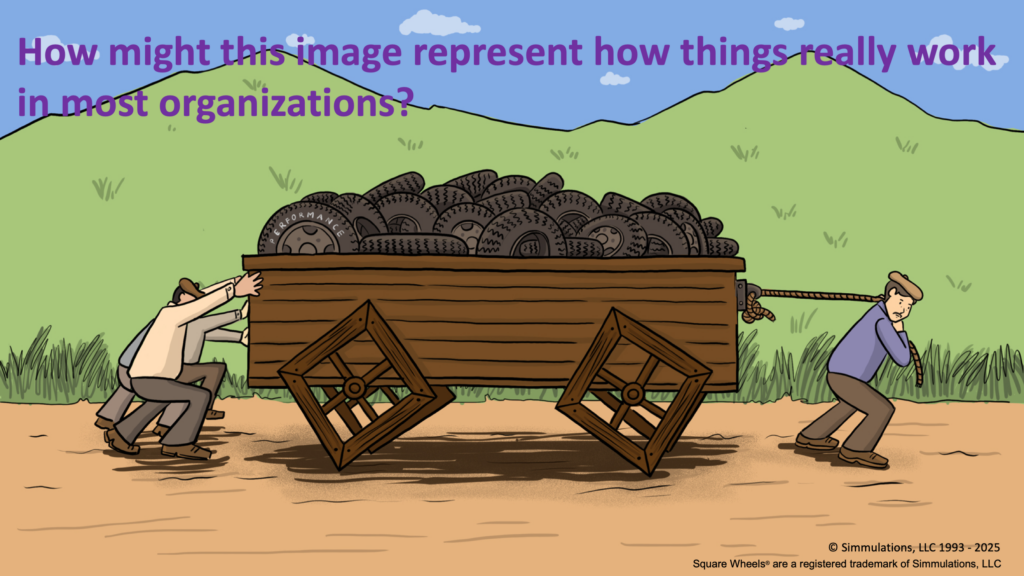
Click on this image to download Square Wheels One for your use in involving and engaging your people for workplace innovation.
Why images matter, and why they work so well
The neuroscience of imagination is increasingly clear: when people vividly imagine a better state, the brain is not just daydreaming. It is rehearsing, simulating, and preparing. Positive mental imagery can help people notice opportunities, organize attention, and increase motivation. In workplace terms, that means a team that can picture a better process is more likely to talk about it, test it, and build it.
Square Wheels images work because they provide a concrete visual anchor for that kind of imagining. Instead of asking, “How do we improve innovation?” in the abstract, you can ask, “What are the Square Wheels in our current system?” That simple shift changes the conversation. People are no longer debating personalities or defending turf. They are observing a system and imagining alternatives. The image makes improvement visible.
This matters because many workplaces struggle not from a lack of intelligence, but from a lack of shared images and stories. People often know that something is off, but they do not have a common language to describe it. Square Wheels tools gives them that language. It creates a safe frame for saying, “This is clunky,” “That process wastes time,” or “We could make this smoother,” without making the discussion feel like an attack.
From problems to possibilities and creative divergent thinking
Traditional problem-solving often begins with what is broken. That can be useful, but it also tends to narrow thinking. People get stuck in diagnosis, blame, or compliance. They get one solution. Positive imagining does something really different: it invites people to picture a better outcome first, then work backward to the possibilities and steps required to get there.
That is where the visually unique Square Wheels tools becomes especially useful. The image of the wagon and its wheels naturally suggests two questions at once:
-
What is slowing us down?
-
What round wheels are already in the wagon, waiting to be used?
- How can we start rolling downhill?
The first question generates the thought that things can be improved.
That second question is critical. It shifts the group’s attention toward assets, ideas, and hidden resources. Every organization already contains knowledge, suggestions, workarounds, and local innovations. Best practices already exist and the question can generate considered alternatives. The Square Wheels metaphor helps surface them. It invites people to imagine that the solution may already be partly present, just not yet in use.
The third question is about imagining a different near-term future, one that involves change and improvement with perceived benefits for all.
This aligns well with the neuroscience idea that positive imagery can bias attention toward opportunity. When people imagine a better process, they become more likely to notice what supports it. They see possibilities they had overlooked before. They develop some active ownership involvement to implement some solutions. That is one of the most valuable functions of facilitation with visual imagery: helping groups see what they could not see alone.
Social imagination in groups
One of the strongest points in the above-referenced neuroscience article is the idea that imagination is social. Most people do not innovate well in isolation. Creativity expands when people build on one another’s ideas. That is one reason Square Wheels has lasted so long as a facilitation tool: it creates a shared object around which people can think together. And it continues to evolve.

Here is the evolution of the images since 1993…
In a team setting, the image becomes a conversational focal point. A facilitator might ask:
-
What do you see here?
-
What does this remind you of in our workplace? What is not rolling smoothly?
-
What would a round wheel version look like?
-
What would need to change for that to happen?
These are not just questions. They are invitations to co-create meaning. People begin to combine observations, stories, frustrations, and hopeful ideas into something larger than any one person’s insight. That is social imagination at work.
And because the images are playful rather than threatening, it lowers the social risk of speaking up. People who might hesitate to criticize a process directly will often talk freely about a cartoon wagon. That lowers defensiveness and opens creativity. The metaphor creates emotional distance just enough to make honest conversation possible.
A tool for psychological safety
Innovation depends on more than good ideas. It depends on whether people feel safe enough to offer them. Square Wheels can support that safety because it externalizes the issue. The problem is not “you” or “your department”; the problem is the Square Wheel. That distinction matters.
When people are invited to point to something outside themselves, they can engage without feeling personally exposed. That makes it easier to share incomplete thoughts, half-formed suggestions, or surprising observations. And in innovation work, those rough ideas are often exactly what a group needs. The first idea is rarely the best one. But it can trigger the second, third, and fourth ideas that lead to real improvement.
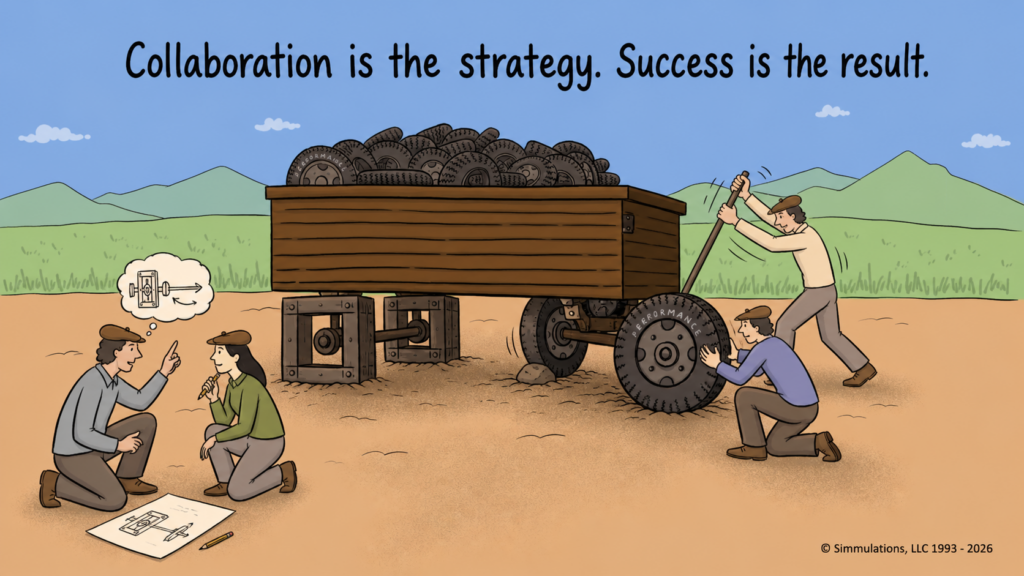
This is where the image becomes more than a cartoon. It becomes a container for collective thought. The facilitator’s role is to keep the discussion focused on the system, the work, and the possibilities. Done well, the conversation becomes energizing rather than judgmental.
Practical ways to use Square Wheels
Square Wheels and related tools can be used in many settings: staff meetings, leadership retreats, onboarding, improvement teams, culture workshops, and innovation sessions. The key is to keep the use simple and participative.
Here are a few effective possible ways to apply the tools:
-
Use the image as a meeting opener. Show the Square Wheels image and ask what it suggests about current work patterns. This immediately shifts the room into reflection and shared observation.
-
Invite people to identify one Square Wheel in their own work. Ask for a process, meeting habit, communication pattern, or workflow that is unnecessarily bumpy.
-
Ask for round wheels already available in the wagon. This changes the tone from complaint to capability and surfaces existing strengths. And you can do this regularly for continuous continuous impovement.
-
Use pairs or small groups. People often think more creatively when first talking with one or two others before reporting to the full group. Use in coaching situations, the one-on-ones for sharing positive feedback and discussing future possibilities.
-
Close with action. Ask each group to name one improvement idea that could be tested within the next week or month.
These steps are simple, but that simplicity is one of the strengths. The tools do not require a long training curve or technical explanation. They work because they create a clear, shared metaphor that helps people think and talk.
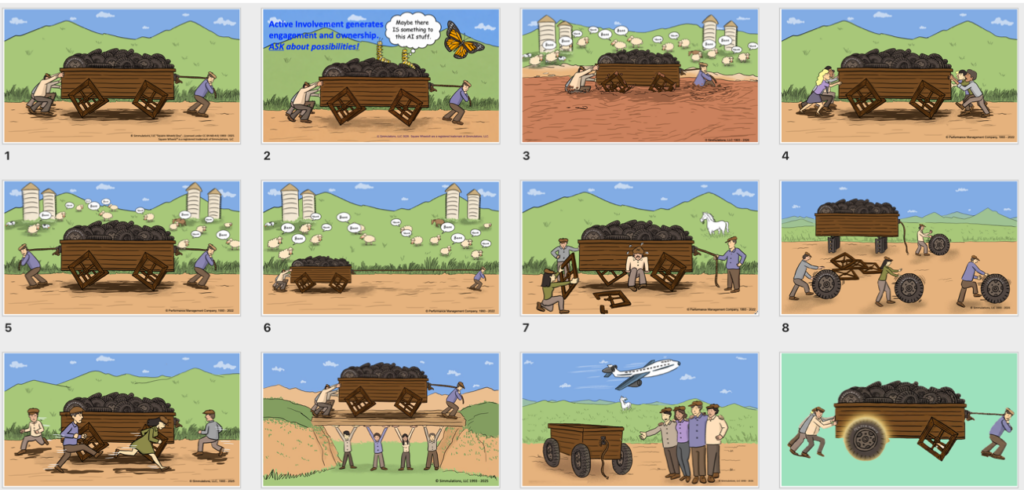
And note that we have many images that anchor to all sorts of organizational developmental and cultural change opportunities, Here are a few:
Why creativity grows
Creativity in organizations is often treated as if it were a special event reserved for brainstorming sessions. In reality, it is a social process. People create when they notice patterns, reframe problems, and imagine alternatives together. Think of the old days of The Water Cooler and casual conversations around issues and opportunities. Square Wheels helps all three.
First, it highlights patterns. The image makes inefficiency visible. Second, it encourages reframing. The discussion moves from “What’s wrong?” to “What could be better?” Third, it stimulates alternatives. Once people can picture round wheels in a square-wheeled world, they can start inventing ways to replace friction with flow (more on flow here and here).
This is also why the tool is so useful across levels of the organization. Frontline employees WILL ABSOLUTELY see practical key process barriers that executives never notice. Managers may see policy barriers that frontline employees cannot change alone. The image gives everyone a common frame. It helps different perspectives meet in the same conversation.
Conversations around issues and opportunities will smoke out the mud, give the Spectator Sheep a voice, and help identify the silos needing improvement.

That matters for innovation, because many of the best ideas are not radical inventions. They are small improvements discovered by the people closest to the work. Square Wheels helps those ideas surface.
A positive imagining discipline
One of the most important lessons from the neuroscience of imagination is that imagining a better future is not just wishful thinking. It is a discipline. Teams can practice it. They can build the habit of seeing what could work better and then talking about how to make it real.
Square Wheels supports that discipline if it is used consistently, not just once. Over time, teams begin to develop a pattern:
-
Notice a Square Wheel.
-
Name it without blame.
-
Imagine the round wheel possibilities.
-
Test a better option.
-
Learn from the result.
That cycle is both creative and practical. It turns imagination into improvement. It also reinforces a culture in which people are expected to think, contribute, and innovate.
In that sense, Square Wheels are not merely a clever series of illustrations for communicating. The images and metaphors are a facilitation system for positive organizational imagining. It helps people visualize friction, identify better possibilities, and build collective commitment to improvement.
Final thought
The most innovative workplaces are not those that never encounter problems. They are the ones that know how to convert friction into conversation and conversation into action. Square Wheels images and related tools do exactly that. They make it easier for people to imagine a better way, talk about it together, and take the first step toward it.
The neuroscience of positive imagining reminds us that the brain responds to the future we rehearse. Square Wheels gives that rehearsal a shape, a metaphor, and a group process. Used well, it can help any workplace move from square wheels to round ones — from stuck to moving, from complaint to creativity, and from everyday frustration to shared innovation.
Lastly, I am wide open to playing with collaborative improvement opportunities. Message me, because the possibilities are endless!
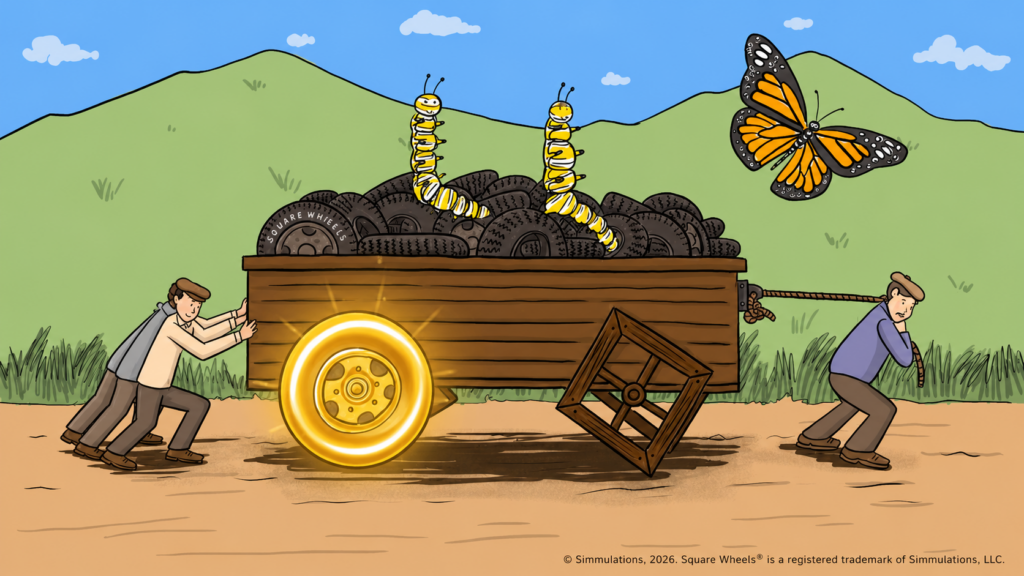
Implementing a round wheel is that GOLD we are looking for in our organizational improvement.
—
For the FUN of It!
 Dr. Scott Simmerman is a designer of team building games and organization improvement tools.
Managing Partner of Performance Management Company since 1984, he is an experienced presenter and consultant who is trying to retire!! He now lives in Cuenca, Ecuador.
You can reach Scott at scott@squarewheels.com
Learn more about Scott at his LinkedIn site.
Note that I often use Perplexity AI to help research and generate ideas for my posts.
Square Wheels® are a registered trademark of Simmulations, LLC
and images have been copyrighted since 1993,
© Simmulations, LLC 1993 – 2026
Note: Please do not take my images and think about using them. It can generate a whole heap of problems given international copyright law and trademark law. Read this article for more information.
What I’m About:
My Square Wheels blog and website exist to help leaders, trainers, and facilitators make work smoother, more engaging, and more human. I focus on practical tools for process improvement, organizational change, and workplace collaboration that spark insight and deliver measurable results.
And I am convinced, after 30+ years of using Square Wheels®, that it is the best facilitation toolset in the world. One can use it to involve and engage people in designing workplace improvements and building engagement and collaboration. It is a unique metaphorical approach to performance improvement and we can easily license your organization to use these images and approaches.
By blending proven facilitation methods, creative problem-solving, and engaging team activities, my mission is to support organizations in building energized, sustainable cultures of involvement and innovation.
Through accessible — and often free — resources and virtual facilitation tools, I aim to help teams everywhere collaborate more effectively, innovate continuously, and take ownership of their improvement journey.
#SquareWheels #InnovationAtWork #TeamEngagement #FacilitationTools #WorkplaceImprovement #EmployeeEngagement #CreativeProblemSolving #OrganizationalDevelopment #LeadershipTools #collaboration #leadership #motivation #communications #enablement #leadership #CreativeCommons #enablingperformance #teamwork #storytelling #storyasking

0 Comments