
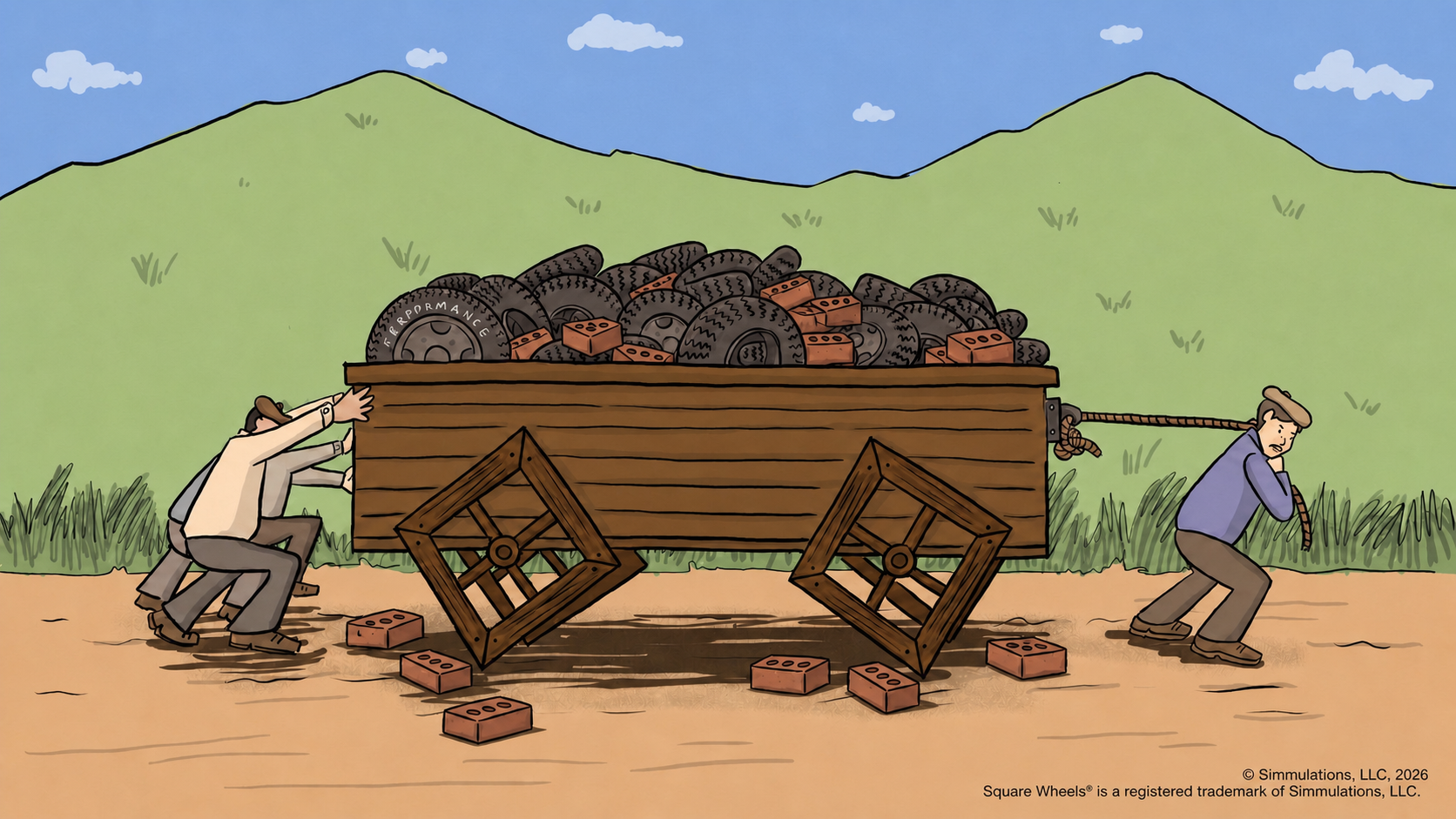
How Square Wheels and Donna McGeorge’s “Red Brick Thinking” can deepen conversations about personal growth and workplace improvement
Most personal and organizational improvement efforts begin with an assumption: if something is not working well, we need to add something. Add a new system. Add a meeting. Add a metric. Add training. Add another priority.
But what if the better first question is not, “What should we add?” but “What can we remove?”
That is the central and refreshing contribution of Donna McGeorge’s “Red Brick Thinking®: Make Space. Find Focus. Move Forward.” Her framework challenges our common “addition bias,” our normal impulse to address complexity, overload, and uncertainty by piling more onto an already overloaded life or organization. Instead, she invites us to identify the red bricks we carry: things that add weight without helping us move forward.
And, I love simple and clear metaphors that can push us to Think Different. Only then will we recognize ideas for actual improvement.
The Red Bricks idea also connects naturally with the Square Wheels® metaphor for workplace improvement: a wagon moving laboriously on Square Wheels while perfectly good round wheels sit unused in our wagon. Square Wheels represent current practices that function, but not smoothly; Round Wheels represent better methods, resources, and ideas that people have not yet chosen to use.
Put the two metaphors together and a powerful questioning framework emerges:
Are we struggling because we are pushing Square Wheels or because we are hauling unnecessary red bricks or both?
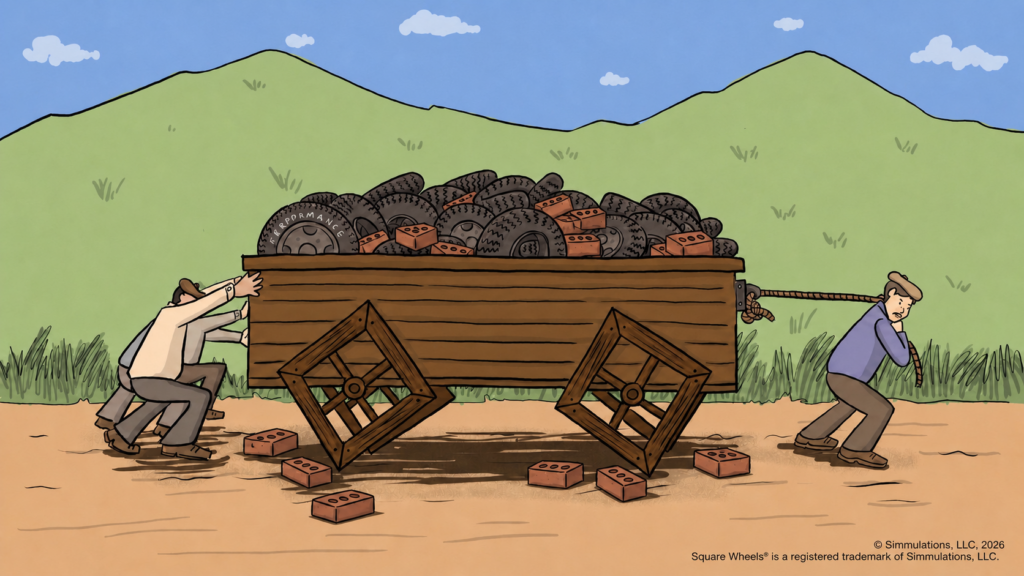
Like Square Wheels, the Red Bricks can be found everywhere.
The Difference Matters
Square Wheels® and the Red Bricks idea are related, but they are not the same way of looking at problem or improvement opportunity..
A Square Wheel is something that is done inefficiently. It may be a customer-response process, an approval procedure, a staff meeting, a production handoff, or a way of sharing information. The work has value, but the process is bumpy, slow, frustrating, and unnecessarily difficult. Square Wheels thump and bump and are always noticeable.
A Red Brick is something that does not belong on the wagon at all. It may once have served a purpose, but now it creates weight without meaningful value. It can be an obsolete report, an automatic meeting, a duplicated spreadsheet, an unnecessary perfection standard, an old policy, a commitment made out of guilt, or an expectation no one has questioned for years. I’ll add some red bricks to the road that we are on, since they can also make our journeys more difficult.
This distinction is important because organizations routinely make wrong interventions.
They try to improve a report that nobody reads. They automate a meeting that nobody needs. They streamline a process whose outcome no longer matters. They ask employees to work harder at work that should simply stop.
In 2017, I shared a blog about The Hubcap Report that is most certainly a Red Brick Details are here but here is the essence:
So, early for a scheduled meeting and sitting in the District Manager’s office and talking with his secretary, I spy what looks to be an interesting series of notebooks labeled “Hubcap Report.” So, I ask her about them and she pulls the latest one down. Inside are a series of bi-weekly reports from all 12 garages listing the trucks with a check mark if they have hubcaps. Years of reports.
Digging down, one of the former DMs in visiting a garage noted that some of the vehicles were missing hubcaps so he had asked the garage managers to get them fixed and to send him a report. That request became a process, done by each supervisor every two weeks, signed off by their manager and forwarded to the District Office where they were stored in this notebook. The current DM never even knew they existed and the secretary simply filed them, not knowing how silly they were to keep doing.
And note that this only took the supervisor 15 minutes to walk around their trucks and fill out the form every two weeks. Maybe it DID have some useful value but shouldn’t the drivers be done these checks anyway?
That is not of any positive impact. But it is making a red brick look organized.
A Better Improvement Sequence
The usual organizational improvement conversation often starts with Round Wheels: “What new tool, best practice, dashboard, training course, or software should we install?”
There is nothing wrong with Round Wheels, but it is about the process of reflecting. The Square Wheels metaphor has always emphasized the importance of involving people in identifying better ways of working, sharing best practices and recognizing resources that may already be available. It is a participative approach: let people closest to the work help identify the bumps and generate practical improvements.
And Red Brick Thinking® suggests that we should begin one step earlier.
-
Stop pushing long enough to look at the wagon.
When everyone is busy, overloaded, and reacting to the next urgent demand, few people have time to question the overall load. Pause before launching the next improvement project. -
Name the Square Wheels.
Ask: “What work causes friction, delay, rework, confusion, frustration, or unnecessary effort?” These are things that may need redesign. -
Identify any Red Bricks.
Ask: “What are we carrying that adds effort but does not advance our purpose?” These are candidates to stop, reduce, combine, defer, delegate, or eliminate. -
Separate what must be redesigned from what can be removed.
A customer-support process may need a Round Wheel. A redundant weekly report may simply need to disappear. -
Use the capacity that is released deliberately and effectively.
Do not remove three red bricks and immediately replace them with five new initiatives. Use the space for better thinking, customer attention, innovation, recovery, learning, relationship building, or genuinely valuable work.
Personal Growth: Examine Your Wagon
Metaphors work just as well for personal development as it does for organizational development.
Most of us have some Square Wheels in our personal lives: routines that technically work but create unnecessary effort. Perhaps we answer every message as it arrives, say yes before checking our calendar, try to remember everything rather than use one trusted capture system, or treat every task as equally urgent.
And most of us carry Red Bricks, too. These might include:
-
Commitments maintained from obligation rather than purpose
-
Habits of perfectionism that turn a 30-minute task into a three-hour burden
-
Information consumption that creates noise rather than insight
-
A belief that being busy proves that we are important
-
Possessions, projects, relationships, or memberships that consume energy without returning value
-
Internal expectations inherited from parents, past employers, or earlier versions of ourselves
McGeorge’s work usefully broadens the idea of simplification beyond calendars and to-do lists. Red bricks can be cultural, structural, and emotional: the pressure for “more,” the noise of constant stimulation, the habit of urgency, the pull of overcommitment, or the tendency to respond automatically rather than thoughtfully.
A personal Square Wheels question might be:
“What in my life is genuinely important but unnecessarily difficult?”
A Red Bricks question is different:
“What am I continuing to carry that no longer deserves a place in my wagon?”
The first question leads to redesign. The second gives permission to let go.
Workplace Improvement: Stop Adding Before You Add
Consider the familiar weekly status meeting.
The meeting lasts 90 minutes. Twelve people attend. Everyone gives an update. Information is read aloud from slides or a spreadsheet. Few decisions are made. Several people leave with new action items, although most of the information could have been shared asynchronously.
The Square Wheels are easy to see:
-
A meeting design that relies on one-way reporting
-
Too many attendees
-
No distinction between information-sharing and decision-making
-
No preparation or decision protocol
-
Repeated discussion of issues that belong elsewhere
But the Red Bricks may be even more important:
-
The assumption that everyone must attend
-
The slide deck that duplicates the spreadsheet
-
The practice of reading updates aloud
-
The belief that visibility requires a live meeting
-
The rule that every project must be reported in the same way, every week
A Round Wheel response might be a short, decision-focused meeting attended only by those needed for dependencies or choices. Updates could be posted in advance. The team could use a visible decision log. The meeting could be reduced to 25 minutes.
But the most important move may be subtraction: remove the duplicate reporting, the unnecessary attendees, and the ritualized updates. Then use the recovered time for real problem solving.
This is the marriage of the two models: remove the load first; then improve the movement.
The Human Side of Change
There is a deeper reason these metaphors work well together. Neither one treats people as the problem.
When performance is poor, leaders often focus on motivation: “People need to be more accountable.” “They need to work harder.” “We need better execution.”
Square Wheels shifts the conversation away from blaming people and toward examining the system and the processes in which people work. Instead of asking why the people pushing the wagon are not trying harder, it asks what makes the wagon so hard to move. The metaphor encourages employees to surface the workplace realities they see and to help generate solutions.
Red Brick Thinking® makes a similarly humane intervention. It asks whether people are overloaded because of insufficient effort or because they are carrying too much unnecessary weight. Not every burden can be removed, of course. But many can be questioned.
This creates a healthier leadership stance:
-
Do not assume capacity is unlimited.
-
Do not confuse activity with contribution.
-
Do not preserve a practice merely because it is familiar.
-
Do not automate or optimize work until you have confirmed that it should exist.
-
Do not ask people to push harder when the wiser response is to lighten the load.
A Simple Team Exercise
There is no one way in which to use these tools but here is a simple framework you can readily adapt to your situation. Consider using this as a 30- to 45-minute discussion activity with a work group.
Display a Square Wheels One image (You can get for FREE here) or simply describe the wagon, its Square Wheels, and the unused round wheels in the wagon. Then ask people to work in small groups on three questions:
-
What are the Square Wheels in our work?
Identify current processes, practices, handoffs, tools, policies, or routines that work but do not work smoothly. -
What are the Red Bricks we are carrying?
Identify work, reports, meetings, approvals, assumptions, rules, or commitments that could be removed without harming the customer, mission, or team. -
What Round Wheel could we test in the next 30 days?
Choose one small, visible, practical improvement—not a grand transformation—that would reduce friction or increase value.
Then ask each group to complete one final sentence:
“If we removed a red brick and used this round wheel, we would free up so that we could better.”
That last blank is essential. Simplification is not an end in itself. We remove what does not matter so we can invest more fully in what does.
The Core Idea
Donna McGeorge deserves credit for putting strategic subtraction at the center of the improvement conversation. Her Red Brick Thinking® idea reminds us that more is not automatically better—and that moving forward often requires removing what holds us back.
The Square Wheels metaphor extends that insight into the everyday reality of personal and organizational change. Some things we carry should be removed. Some things we do should be redesigned. And many of the better solutions may already be within reach, waiting for us to stop, look honestly at the wagon, and involve people in choosing a better way forward.
The practical challenge is simple:
Do not ask people to push Square Wheels faster while carrying Red Bricks they never needed. Remove the unnecessary weight, engage people in improving the work, and make room for the Round Wheels that help everyone move forward.
This post is independent commentary and is not affiliated with or endorsed by Donna McGeorge.
—
For the FUN of It!
 Dr. Scott Simmerman is a designer of team building games and organization improvement tools.
Managing Partner of Performance Management Company since 1984, he is an experienced presenter and consultant who is trying to retire!! He now lives in Cuenca, Ecuador.
You can reach Scott at scott@squarewheels.com
Learn more about Scott at his LinkedIn site.
Note that I often use Perplexity AI to help research and generate ideas for my posts.
Square Wheels® are a registered trademark of Simmulations, LLC
and images have been copyrighted since 1993,
© Simmulations, LLC 1993 – 2026
Note: Please do not take my images and think about using them. It can generate a whole heap of problems given international copyright law and trademark law. Read this article for more information.
What I’m About:
My Square Wheels blog and website exist to help leaders, trainers, and facilitators make work smoother, more engaging, and more human. I focus on practical tools for process improvement, organizational change, and workplace collaboration that spark insight and deliver measurable results.
And I am convinced, after 30+ years of using Square Wheels®, that it is the best facilitation toolset in the world. One can use it to involve and engage people in designing workplace improvements and building engagement and collaboration. It is a unique metaphorical approach to performance improvement and we can easily license your organization to use these images and approaches.
By blending proven facilitation methods, creative problem-solving, and engaging team activities, my mission is to support organizations in building energized, sustainable cultures of involvement and innovation.
Through accessible — and often free — resources and virtual facilitation tools, I aim to help teams everywhere collaborate more effectively, innovate continuously, and take ownership of their improvement journey.
#SquareWheels #InnovationAtWork #TeamEngagement #FacilitationTools #WorkplaceImprovement #EmployeeEngagement #CreativeProblemSolving #OrganizationalDevelopment #LeadershipTools #collaboration #leadership #motivation #communications #enablement #leadership #CreativeCommons #enablingperformance #teamwork #storytelling #storyasking #redbrickthinking #collaboration #licensing


0 Comments