
This is a short blog about Frederick Taylor and his thoughts on MANAGEMENT (1911), something I believe we need more than “better leadership.” The graphics speak pretty clearly for themselves.
For the past year or so, I have been complaining that there is way too much focus on leadership and not nearly enough on management. In my response to a post on “leadership” in LinkedIn this morning, I asked Perplexity to generate an infographic about the 1911 book, “Principles of Scientific Management” by Frederick Taylor with a focus on MANAGEMENT.
We really seem to lack good workplace management practices. Perplexity gave me this.
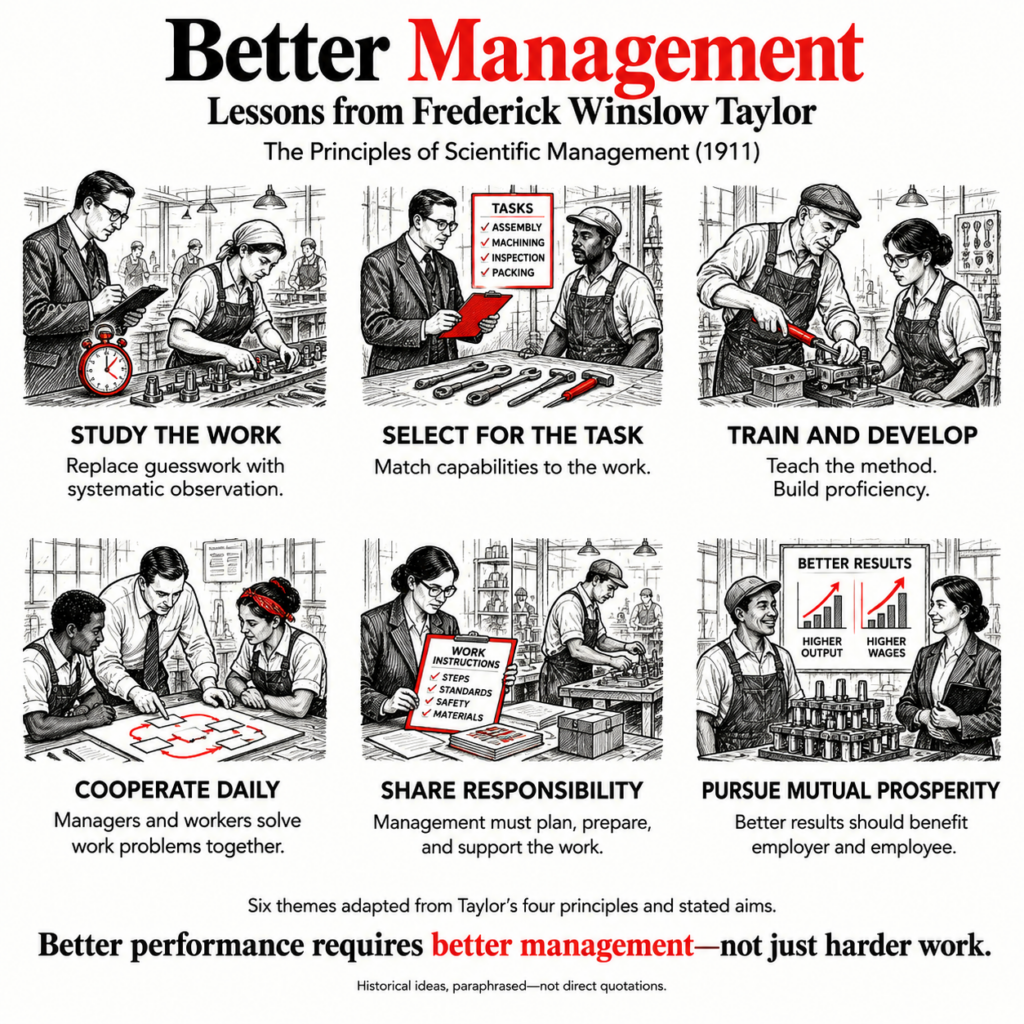
Pretty good and pretty simple — and this supported most of my earlier Perplexity-researched blog on what the man would probably do if he had my Square Wheels images to use to improve organizational performance back in the day. (Click on Frederick Taylor’s image to go to that blog post.)
But as a new user of Gemini and AI in general, and with my belief that we need to look critically from different perspectives, I asked it to evaluate the above Perplexity infographic and give some suggestions about improving it.
Gemini’s review said this:
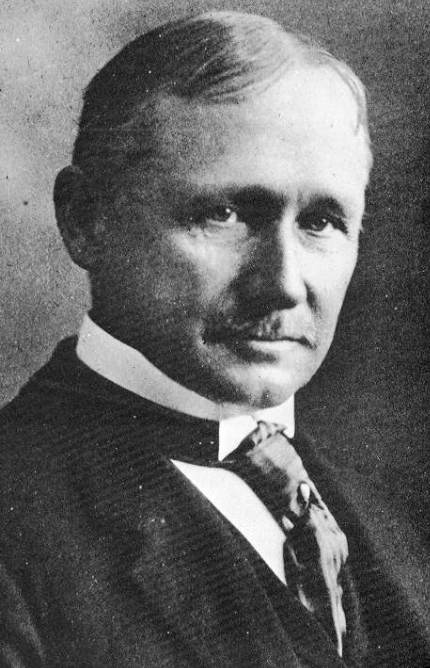
Graphic from Wikipedia
This infographic(above) translates Frederick Winslow Taylor’s The Principles of Scientific Management (1911) into a clean, digestible visual format. While it accurately captures Taylor’s stated goals, it significantly modernizes and softens his actual historical practices, making his rigid, top-down philosophy look much more collaborative and egalitarian than it truly was.
1. Historical & Conceptual Evaluation: What It Gets Right
- Accurate Mapping of the Core Framework: The graphic explicitly notes at the bottom that it presents “Six themes adapted from Taylor’s four principles and stated aims”. This is a smart disclaimer:
Panels 2 & 3 (Select for the Task and Train and Develop) split Taylor’s second principle (scientifically selecting, training, and developing the workman) into two logical steps.
Panel 6 (Pursue Mutual Prosperity) reflects the very first sentence of Taylor’s 1911 book: “The principal object of management should be to secure the maximum prosperity for the employer, coupled with the maximum prosperity for each employé.”
- Core Thesis: The bottom tagline (“Better performance requires better management—not just harder work”) accurately reflects Taylor’s belief: inefficiency was primarily a failure of management systems rather than simple worker laziness.
- Visual Symbolism: Placing the red stopwatch in Panel 1 (Study the Work) immediately anchors the graphic in Taylor’s famous time-and-motion studies.
Key Criticisms & Historical Distortions
- Anachronistic “Collaboration” (Panel 4 – Cooperate Daily): The caption “Managers and workers solve work problems together” paired with an illustration of a manager and workers brainstorming around a flowchart is historically inaccurate. To Taylor, “cooperation” meant strict compliance—management ensured workers followed the exact scientific method designed by engineers. Taylor explicitly believed shop-floor workers lacked the education or capacity to analyze and plan their own work processes.
- Misleading Terminology (Panel 5 – Share Responsibility): While the subtext is accurate (“Management must plan, prepare, and support the work”), the header “Share Responsibility” implies joint decision-making to a modern reader. Taylor actually advocated for a strict separation of planning from execution: management took over 100% of the thinking and planning, leaving workers strictly with physical execution. (We see much of that today, IMHO)
- Omission of the “One Best Way” & Standardization: Taylorism wasn’t just about studying work (Panel 1); it was about codifying the single fastest method and standardizing every tool and motion.
- Sanitized Legacy: Presenting Taylorism purely as a recipe for “Better Management” without acknowledging its well-documented flaws—extreme worker alienation, deskilling, repetitive strain, and the reduction of humans to mechanical cogs (which famously triggered massive labor union pushback and a 1911–1912 U.S. Congressional investigation)—leaves the viewer with an overly rosy view of Taylorism.
So, I asked Gemini to redo that Perplexity infographic and THAT is interesting:
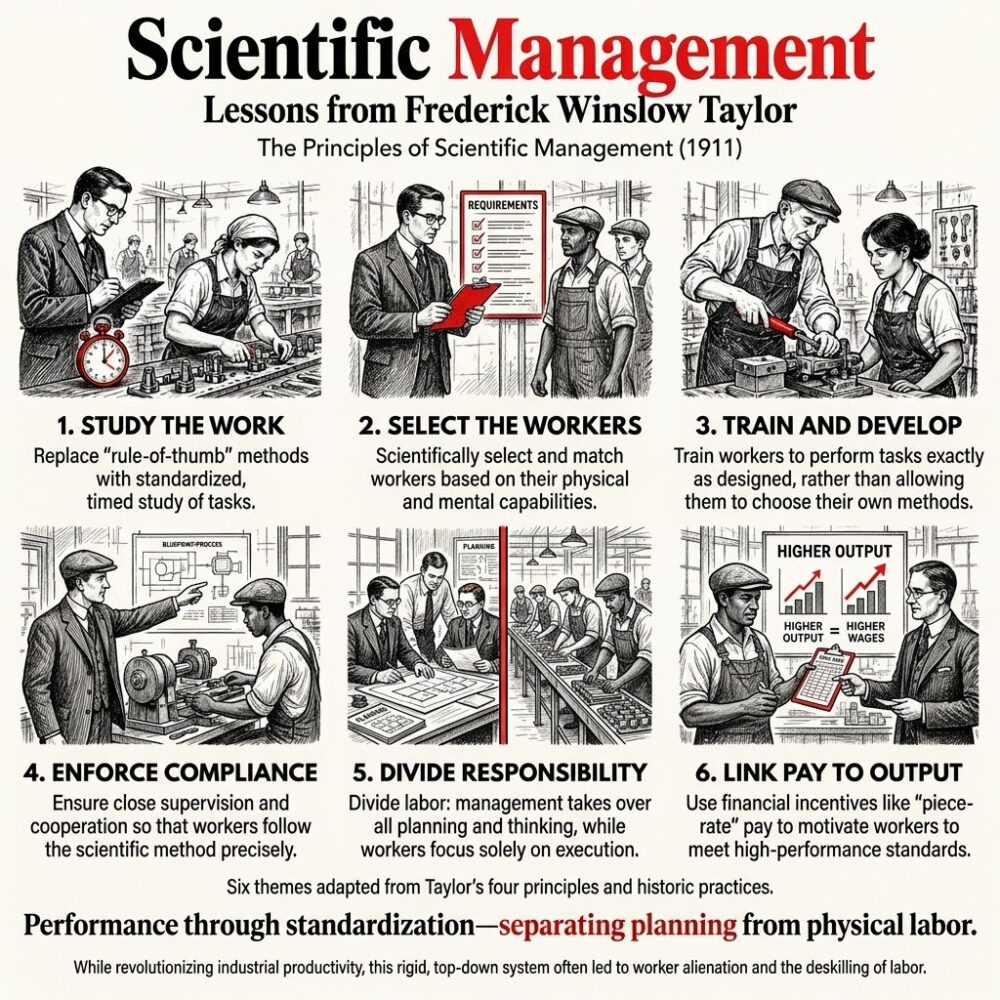
This latter infographic is more complicated but also more accurate in reflecting Taylor’s approach to organizational performance. It seems that we have not learned a lot of lessons in the past 115 years, and improvements can be made in terms of how we manage and lead people.
There are an estimated 5000 leadership books published in English every year. Maybe we really need a few good books on how to manage people in workplaces as we implement AI and other new tools.
And, while I personally disagree about Taylor’s beliefs in the capabilities of workers to generate best practices and different, better ways to accomplish workplace tasks and on the real need for more collaboration between managers and workers, I also think that organizations really need to look much more closely at their basic management practices.
I KNOW that I do NOT have “All the Answers” but I do know that improving performance feedback and involving and engaging people with the changes that are happening to them will benefit the workers, the supervisors, the customers and the organizations.
Some additional thoughts on implementing AI here
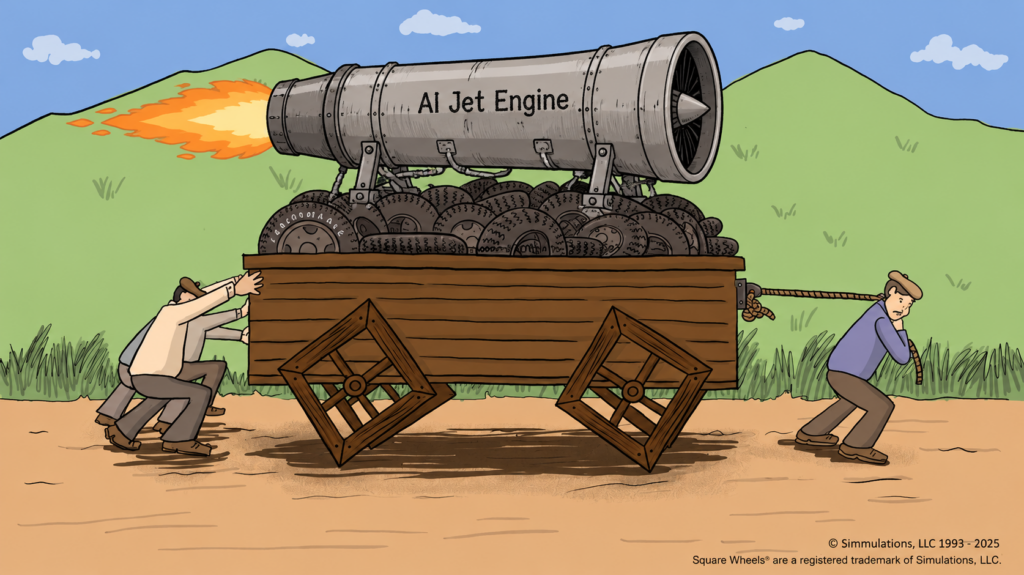
Some thoughts on implementing AI
—
For the FUN of It!
 Dr. Scott Simmerman is a designer of team building games and organization improvement tools.
Managing Partner of Performance Management Company since 1984, he is an experienced presenter and consultant who is trying to retire!! He now lives in Cuenca, Ecuador.
You can reach Scott at scott@squarewheels.com
Learn more about Scott at his LinkedIn site.
Square Wheels® is a registered trademark of Simmulations, LLC
and images are © Simmulations, LLC 1993 – 2026
Note: Please do not take my images and think about using them. It can generate a whole heap of problems given international copyright law and trademark law. Read this article for more information.
See a detailed overview of my tools, background and experiences by clicking here.
What I’m About:
My Square Wheels blog and website exist to help leaders, trainers, and facilitators make work smoother, more engaging, and more human. I focus on practical tools for process improvement, organizational change, and workplace collaboration that spark insight and deliver measurable results.
And I am convinced, after 30+ years of using Square Wheels®, that it is the best facilitation toolset in the world. One can use it to involve and engage people in designing workplace improvements and building engagement and collaboration. It is a unique metaphorical approach to performance improvement and we can easily license your organization to use these images and approaches.
By blending proven facilitation methods, creative problem-solving, and engaging team activities, my mission is to support organizations in building energized, sustainable cultures of involvement and innovation.
Through accessible — and often free — resources and virtual facilitation tools, I aim to help teams everywhere collaborate more effectively, innovate continuously, and take ownership of their improvement journey.
#SquareWheels #InnovationAtWork #TeamEngagement #FacilitationTools #WorkplaceImprovement #EmployeeEngagement #CreativeProblemSolving #OrganizationalDevelopment #LeadershipTools #collaboration #leadership #motivation #communications #enablement #leadership #CreativeCommons #enablingperformance #teamwork #storytelling #storyasking #enablement #disruptiveengagement #un-dis-engagement #un-dis-empowerment #innovation
© 2026 Simmulations, LLC. Please note that “Square Wheels®” is a registered trademark of Simmulations, LLC. and materials, original wagon line art, text, and visual designs are protected. Original line art by Roy Sabean, used under rights owned by Simmulations, LLC and formerly Performance Management Company, a sole-proprietorship of Dr. Scott J. Simmerman. Original concept and source artwork © Simmulations, LLC; derivative visuals sometimes created with assistance from Perplexity Pro AI.


0 Comments