
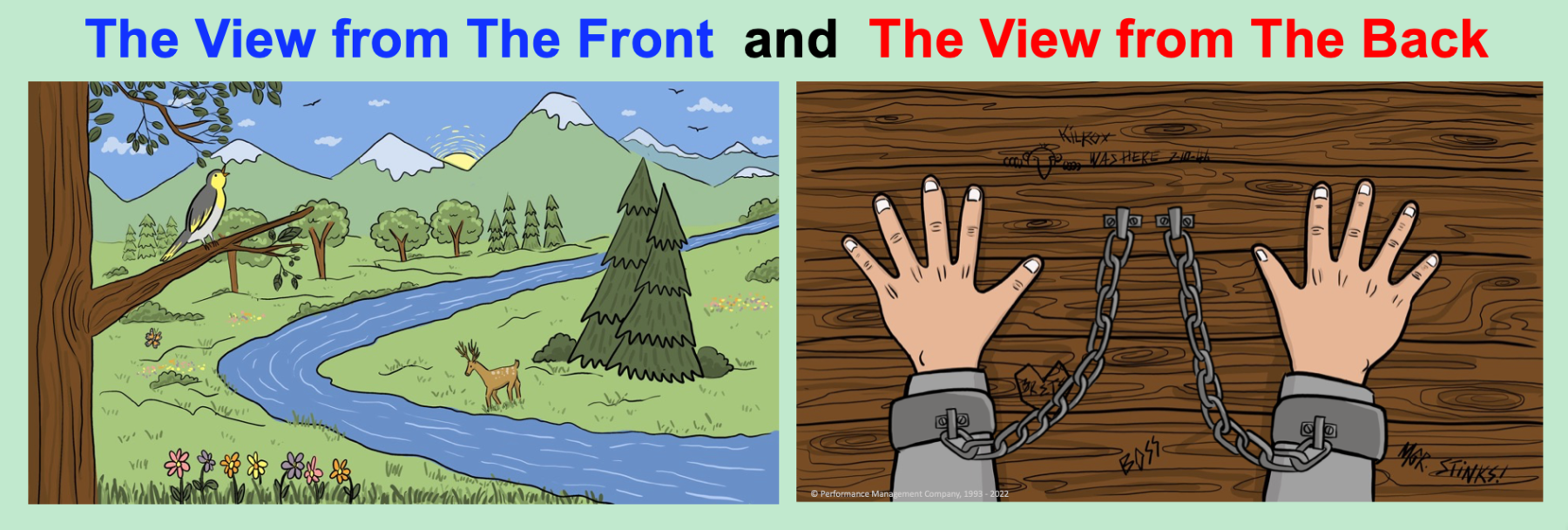
Stop asking supervisors to pull harder and give them better wheels like AI tools and help them implement to impact results.
Organizations keep asking supervisors to deliver more. More productivity. More engagement. More innovation. Better service. Faster implementation. And now, help everyone adapt to artificial intelligence while keeping the work moving and the people motivated. Right. And have we provided them with the training and support needed to be successful? Change, by the way, is Really Hard!
Change, by the way, is Really Really Hard!
Apparently, we expect supervisors to accomplish all this somewhere between the staffing problem, the customer complaints, the reporting deadlines, and the next meeting about improving performance while keeping within the boundaries set by HR.
My question is simple:
What are we doing to make peoples’ jobs more doable?
And by people, we are talking workers and front-line managers, team leaders and everyone trying to positively influence their workplace.
— Not what are we asking them to accomplish.
— Not what competencies have we added to their job descriptions.
What practical support, authority, time, and tools are we giving these human beings to improve the workplaces they supervise?
We cannot keep putting more weight in the wagon and calling for stronger leadership from the person pulling it and expecting any real improvement. At some point, we need to look at the wheels that make everything work and at how things are really working.
And AI can provide so many tools people can use to impact their workplace — and give them many more metrics to positively support and influence performance in the workplace.
(People get pretty bad performance feedback in actuality. See a simple checklist / analysis here)
The Supervisor Is Where Organizational Intent Meets Workplace Reality
Senior leaders can announce a strategy. They can approve a technology investment, launch an engagement initiative, or describe a new organizational culture. And they do. They are hopefully always providing directions as to what their organizations should be doing. They are controlling the mission and vision at the top.

The View at The Front
But someone must help people understand what those decisions mean on Tuesday morning.
That someone is often the supervisor.
“What does this change mean for my job?”
“Are we supposed to work faster?”
“Who checks the AI-generated output?”
“What happens when the new system gets something wrong?”
“Are we actually being asked for input, or has everything already been decided?”
These are not unreasonable questions. They are the practical questions people ask when organizational plans encounter the realities of doing the work. They represent the actuality of The View at The Back of the wagon.

Yet a supervisor may be expected to provide clear answers without having received clear answers. They may be asked to build commitment to a change they had little opportunity to influence.
This is a good recipe for what I call the Supervisor Hellscape: responsibility for results, limited control over the conditions, and pressure arriving from every direction.
Before we criticize supervisors for failing to engage their people, we might examine how effectively leadership is engaging and supporting its supervisors.
Support Is More Than Encouragement
“Keep communicating.”
“Be positive.”
“Get your people on board.”
These statements might be well intended. They are not much of a toolkit. Neither is sending someone to a leadership workshop and returning them to the same workload, conflicting priorities, and unresolved obstacles.
We can define meaningful supervisory support much more concretely:
- Clear priorities, including what can stop when something new begins.
- Honest information about proposed changes and their implications.
- Authority to make appropriate local improvements.
- Time to involve employees in solving problems.
- Simple tools for facilitating useful conversations.
- Access to decision-makers when an issue exceeds local authority.
- Follow-through when supervisors bring concerns upward.
The common element is agency: the ability to influence what happens, rather than merely absorb responsibility for it.
If we want supervisors to create better workplaces,
we need to give them practical ways and better tools
to change the conditions of work.
Give Them Tools for Conversations, Not Just Instructions for Announcements
This is where I see a useful role for Square Wheels in most every organization and workplace.
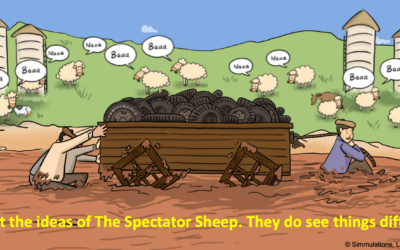
The main Square Wheels One image provides a conversational and engaging starting point: a wagon rolling on Square Wheels, people pushing and pulling, and Round Wheels already available.
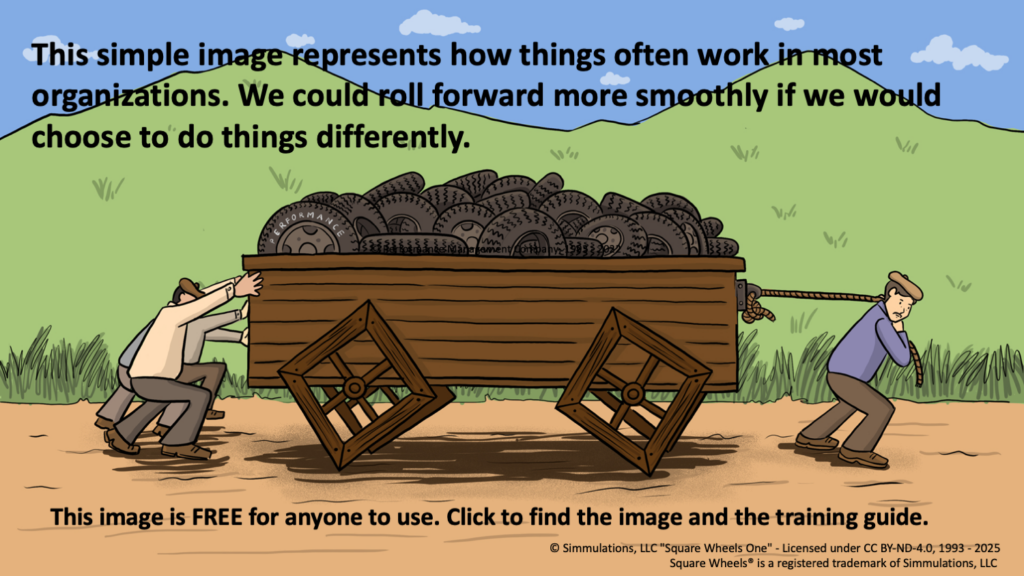
Instead of beginning with a lecture or “motivational talk” about resistance, motivation, or productivity, a supervisor can ask:
“How might this image represent what is happening in most workplaces?”
Then listen.
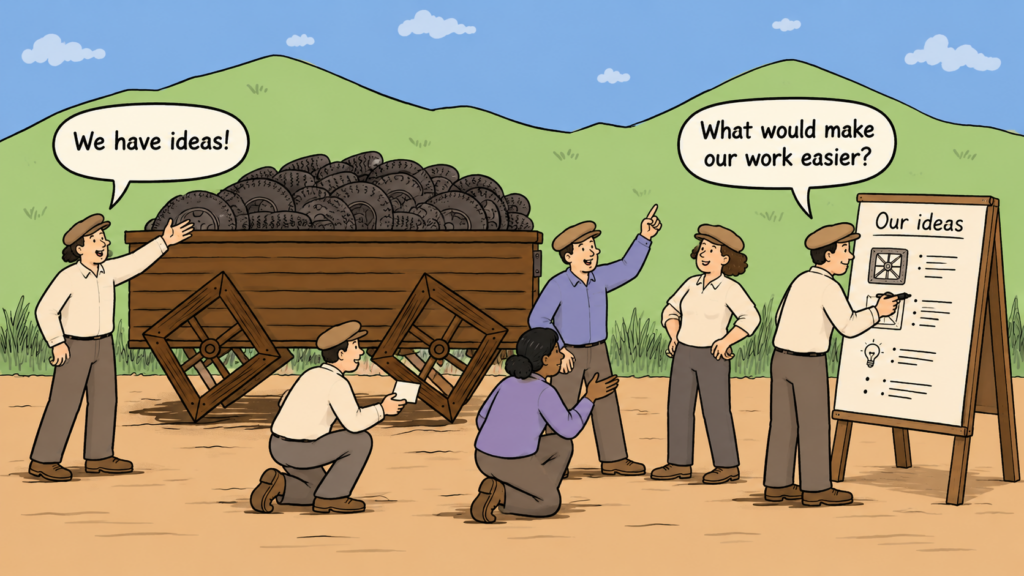
Where are we bumping along? What makes the work unnecessarily difficult? What do the people pushing see that the person pulling might miss? What possibilities are already available but not being used? These and many other questions need to be asked and addressed by the people doing the work. THIS is reality.
Your people do not need another explanation of why improvement matters. They need an opportunity to describe what needs improving. We need to get them to choose to act differently where they can.
The discussion also changes the supervisor’s role. Instead of having to arrive with every answer, the supervisor can help the group identify problems, explore alternatives, and choose a practical next step.
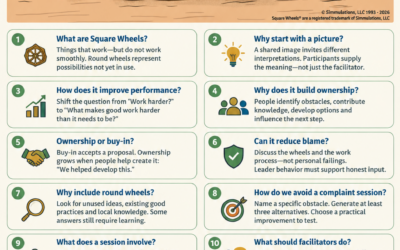
That is the facilitation approach built into the Square Wheels tools: use a shared image to generate observations, connect those observations to the workplace, and move toward action.
But leadership has a responsibility here, too.
Do not encourage supervisors to ask for ideas unless the organization is prepared to consider them.
A suggestion process without a response process is an unfinished promise.
AI Makes These Conversations More Important
The recent Truthout discussion about AI and workers offers a sharp reminder that people may experience technological change as a question of power, security, surveillance, and the value of their expertise—not simply as an opportunity to become more productive.
Leadership does not have to agree with every argument in that discussion to recognize the importance of the questions.
When employees express concern, the supervisor should not automatically be expected to “overcome resistance.”
Sometimes the concern is the information we need.
Perhaps employees can see that the proposed tool creates extra checking and correction. Perhaps they are concerned about sensitive information. Perhaps they want to know whether time saved will improve the work or simply trigger higher targets.
A supervisor needs permission and tools to explore those possibilities.
And AI should not automatically be labeled a Round Wheel.
It is a proposed wheel. We still need to examine whether it fits the wagon, the road, and the work.
That means asking:
“What will this improve? What new problems might it create? Who benefits? Who carries the additional work or risk?”Those are responsible management questions, not evidence of a negative attitude.
Do Not Give Supervisors Promises They Cannot Keep
There is another important boundary.
A supervisor can facilitate a conversation about job security without having the authority to guarantee anyone’s job. They can document concerns about monitoring without controlling the organization’s data policies.
Leadership must not leave them to manufacture reassurance.
Instead, equip supervisors to say:
“Here is what we can decide as a team. Here is what I can recommend. Here is what requires a decision elsewhere. I will take those questions forward and report back.”Then make sure there is somewhere for those questions to go.
An escalation process should produce more than another meeting. It needs a decision owner, a response date, and an explanation.
Otherwise, we have made the supervisor the face of organizational uncertainty without giving them a way to resolve it.
Start Small, but Finish Something
I would rather see a supervisor facilitate one useful improvement than conduct six discussions that disappear into a reporting system.
A practical starting point is straightforward:
- Show the Square Wheels image and invite observations.
- Identify one recurring difficulty in the work.
- Explore possible improvements with the people doing it.
- Separate local actions from issues requiring approval.
- Agree on one change, an owner, and a review date.
- Return to the group with what happened.
This is consistent with the action-oriented sequence in the Square Wheels facilitation approach.
The review matters.
Did we reduce unnecessary work? Did quality improve? Did we move a problem somewhere else? What did we learn?
A useful measure is not simply how many suggestions people submitted. It is whether employees can point to something that changed because someone listened.
And if nothing could change, they deserve an explanation—not silence.
Leadership Needs to Look at Its Own Wheels
It is easy to ask supervisors to become better communicators, coaches, facilitators, and change leaders.
It is more demanding to examine the organizational conditions under which we expect them to perform those roles.
Are priorities coherent? Can supervisors challenge an unrealistic target? Do they have time to develop people? Does raising a problem lead to help, or to being labeled difficult?
These are leadership’s Square Wheels. We need to manage ideas better.
We should not expect supervisors to create openness below them while experiencing defensiveness above them.
Nor should we expect them to build trust through conversations that the organization has no intention of honoring.
My recommendation is to treat supervisory support as part of the operating system of the organization—not as an occasional training event.
Give supervisors a practical facilitation toolkit. Give them room to use it. Help them distinguish what they can change from what they need to escalate. Respond when they ask for help.
Then judge the effort by whether work actually gets better.
Supervisors do not need another speech about pulling harder.
They need leadership willing to help change the wheels.
—
For the FUN of It!
 Dr. Scott Simmerman is a designer of team building games and organization improvement tools.
Managing Partner of Performance Management Company since 1984, he is an experienced presenter and consultant who is trying to retire!! He now lives in Cuenca, Ecuador.
You can reach Scott at scott@squarewheels.com
Learn more about Scott at his LinkedIn site.
Square Wheels® is a registered trademark of Simmulations, LLC
and images are © Simmulations, LLC 1993 – 2026
Note: Please do not take my images and think about using them. It can generate a whole heap of problems given international copyright law and trademark law. Read this article for more information.
See a detailed overview of my tools, background and experiences by clicking here.
What I’m About:
My Square Wheels blog and website exist to help leaders, trainers, and facilitators make work smoother, more engaging, and more human. I focus on practical tools for process improvement, organizational change, and workplace collaboration that spark insight and deliver measurable results.
And I am convinced, after 30+ years of using Square Wheels®, that it is the best facilitation toolset in the world. One can use it to involve and engage people in designing workplace improvements and building engagement and collaboration. It is a unique metaphorical approach to performance improvement and we can easily license your organization to use these images and approaches.
By blending proven facilitation methods, creative problem-solving, and engaging team activities, my mission is to support organizations in building energized, sustainable cultures of involvement and innovation.
Through accessible — and often free — resources and virtual facilitation tools, I aim to help teams everywhere collaborate more effectively, innovate continuously, and take ownership of their improvement journey.
#SquareWheels #InnovationAtWork #TeamEngagement #FacilitationTools #WorkplaceImprovement #EmployeeEngagement #CreativeProblemSolving #OrganizationalDevelopment #LeadershipTools #collaboration #leadership #motivation #communications #enablement #leadership #CreativeCommons #enablingperformance #teamwork #storytelling #storyasking #enablement #disruptiveengagement #un-dis-engagement #un-dis-empowerment #innovation
© 2026 Simmulations, LLC. Please note that “Square Wheels®” is a registered trademark of Simmulations, LLC. and materials, original wagon line art, text, and visual designs are protected. Original line art by Roy Sabean, used under rights owned by Simmulations, LLC and formerly Performance Management Company, a sole-proprietorship of Dr. Scott J. Simmerman. Original concept and source artwork © Simmulations, LLC; derivative visuals sometimes created with assistance from Perplexity Pro AI.

0 Comments