
Our Supervisor Hellscapes are Getting Worse and our Supervisors Cannot Fix these wicked problems without leadership support.
“The Supervisor Hellscape” is the workplace condition in which front-line leaders are accountable for results, engagement, retention, quality, and change—but are denied the authority, time, information, staffing, cross-functional support, and practical tools needed to succeed.
And these supervisors and front-line managers, with the greatest day-to-day influence on engagement, are themselves increasingly disengaged, overloaded, undertrained and trapped in systems they do not control. Here is how Square Wheels can help turn those pains into practical improvement.
The Supervisor Hellscape is not simply a picture of a stressed supervisor dealing with difficult wagons. It is the bigger picture of an organizational design failure across many systems and from many perspectives. It is a wicked problem, in the classic sense, absolutely. But there are some butterflies out there, too.
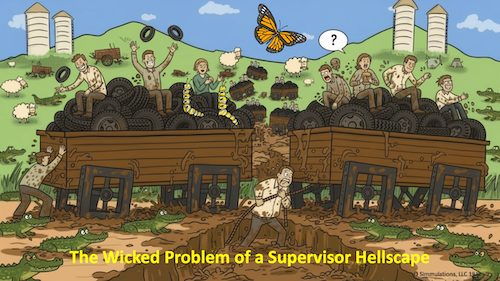
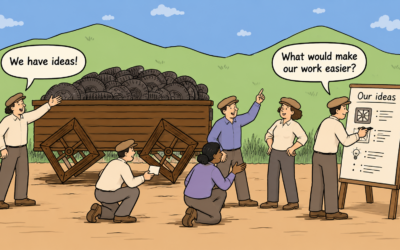
The Supervisor Hellscape might look something like this.
Supervisors are expected to deliver the numbers, explain the strategy, introduce new technology, enforce policies, resolve conflict, coach performance, protect well-being and somehow keep everyone engaged. Yet many are given too little time, too little authority, too little preparation and too little support to do those things well.
That is the central contradiction: organizations place enormous responsibility for people and performance on supervisors while surrounding them with conditions that make good supervision difficult.
The Square Wheels images and metaphors help make this contradiction visible.
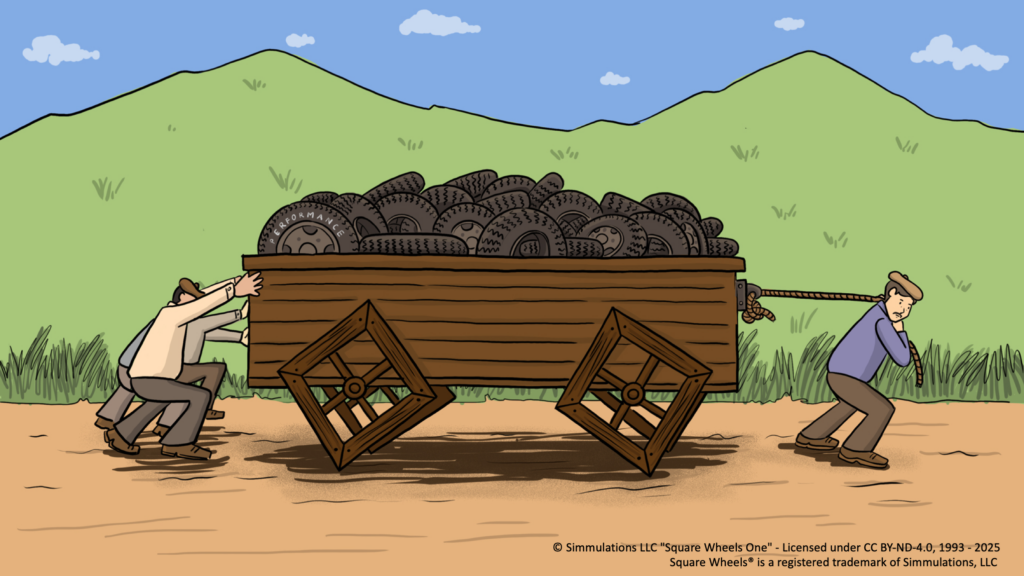
The wagon represents the work at hand, anything that needs to be accomplished. The wooden Square Wheels® are the processes, policies, habits, handoffs and leadership practices that create drag. The pushers and pullers around the wagon represent everyone affected by the work, including those pushing, pulling, watching, criticizing or waiting for somebody else to act. The unused Round Wheels as the cargo of the wagon represent ideas and better practices that may already exist but have not been discussed, tested or supported. The possibilities for improvement exist.
The numbers have worsened, and there are a LOT of numbers…
Gallup’s 2026 global data make the problem harder to dismiss. In 2025, only 20% of employees worldwide were engaged; 64% were not engaged and 16% were actively disengaged. That means four out of five workers were not engaged.
The most important development is what is happening to managers. Global manager engagement fell from 31% in 2022 to 22% in 2025, while engagement among individual contributors was 19% in 2025. Gallup concludes that declining manager engagement accounts for much of the recent fall in the global employee engagement. And Gallup is but one source of data. The bibliography lists others and the data are quite consistent for something as critically important as people and performance.
At the same time, Gallup and others continue to estimate that managers account for at least 70% of the variance in engagement across teams. That does not mean that supervisors personally cause 70% of every employee’s engagement or that senior leadership and work design do not matter. It means that the local manager is an exceptionally powerful channel through which employees experience priorities, feedback, recognition, workload and organizational culture.
The local managers are an exceptionally powerful channel
through which employees experience the workplace.
Put all the findings together and the Hellscape of supervisors becomes obvious: the organizational role with the greatest influence on team engagement is itself becoming severely disengaged.
The wicked Supervisor Problem, described
A good supervisor can influence different things than those requiring organizational intervention.
Supervisors have a vital role, but they should not be made the sole owners of systemic outcomes.
Here are some of the issues:
• Promoted without preparation
Many supervisors are promoted because they are technically capable, dependable or available and not because anyone has prepared them to lead others. A Chartered Management Institute and YouGov study of more than 4,500 UK workers and managers found that 82% of people entering management roles had received no formal management or leadership training. The finding is UK-specific, so it should not be presented as a universal global rate, but it clearly illustrates the accidental-manager problem.
The damage does not remain with the unprepared manager. In the same research program, ineffective management was associated with lower employee motivation and a greater likelihood of leaving. Training also made managers more likely to challenge bad or toxic behavior.
This is a first Square Wheel: organizations change the title but do not build the capability. The new supervisor inherits performance targets, personnel issues and administrative responsibilities while still being expected to remain a top technical contributor.
• Responsibility without capacity
Supervisors are not merely asked to manage people. They are asked to manage people in addition to everything else they are required to do.
Gallup reports that 97% of managers have individual-contributor responsibilities and that managers spend a median 40% of their time on that work. Engagement is generally higher when managers stay below that 40% threshold; when individual work rises while spans of control expand, their engagement deteriorates.
CIPD research similarly found that only half of line managers believed they had enough time to manage people well. Managers who felt adequately trained were much more likely to believe they had sufficient management time—71%, compared with 21% among those dissatisfied with their preparation.
A separate evidence review found that team performance worsens as managers spend more time doing work that should be performed by their teams. It recommends adequate time, sensible spans of control, access to advice and broad access to management development—not development reserved for a chosen few.
This is a second Square Wheel: people management is treated as an extra task rather than as real work. Coaching is postponed, one-to-ones are cancelled and improvement conversations disappear because today’s operational fire always seems more urgent.
• More people, fewer managers, less engagement
The Hellscape is also becoming flatter and wider. Gallup found that the average number of people reporting to a manager rose from 10.9 in 2024 to 12.1 in 2025, nearly 50% above its 2013 level. Thirteen percent of managers now oversee 25 or more people. It is an interesting report.
Larger teams are not automatically dysfunctional. Gallup’s analysis of more than 92,000 teams found that engaged, well-managed large teams can thrive. The danger appears when organizations widen spans of control without reducing managers’ individual workloads, improving communication or providing managers with the talent and support required for the work.
Research summarized by Deloitte reaches a similar conclusion: managers can sometimes absorb more direct reports operationally, but coaching and people development suffer, followed by lower engagement and higher turnover.
This is a third Square Wheel: organizations remove management layers but leave the coordination, coaching and emotional work behind. The boxes disappear from the organization chart; the work lands on the survivors.
• Conflicting priorities of most supervisors in most organizations
Supervisors live between competing demands. They translate executive goals downward, carry operational reality upward and negotiate dependencies sideways across silos.
Gallup research found that 42% of managers strongly agreed they faced multiple competing priorities, compared with 27% of individual contributors. Fewer than half of managers, 41% in actuality, strongly agreed that their formal job descriptions matched the work they actually performed.
The resulting behavior often looks like weak leadership but is really overloaded choice-making. The supervisor keeps changing priorities because senior leaders keep changing priorities. The supervisor avoids delegating because a late or imperfect result feels personally risky. The supervisor says “everything is important” because nobody above has made the trade-offs clear.
This is the fourth Square Wheel: supervisors are accountable for choices they are not authorized to make.
ª Fragmented attention and focus
The modern workday adds continuous digital interference. Microsoft’s 2025 analysis of knowledge work found that employees using Microsoft 365 were interrupted, on average, every two minutes during core working hours. Fifty-two percent of leaders described work as chaotic and fragmented, and 57% of meetings were ad hoc calls without calendar invitations. (References 17 and 18 in the bibliography.)
These findings should not be generalized to every frontline workplace, but the pattern is familiar across settings: constant messages, schedule changes, escalations, forms, approvals and meetings consume the attention needed for thoughtful leadership. Sound familiar?
Deloitte’s 2025 research found that managers reported spending only 13% of their time developing people, while just 26% of organizations said their managers were very or extremely effective at enabling team performance. We are definitely missing a lot of organizational development opportunities, with impacts on things like innovation.
This is a fifth Square Wheel: the supervisor is always in contact but rarely has time for a meaningful conversation.
• Emotional labor without support
Supervisors absorb frustration from above and below. They communicate unpopular decisions, handle interpersonal conflict, respond to personal crises and try to maintain calm while managing their own uncertainty.
DDI’s Global Leadership Forecast 2025, drawing on 10,796 leaders, found that 71% reported substantially higher stress after entering their current role. Only 30% believed they had enough time to do their jobs well, and stressed and burned-out leaders were 3.5 times more likely to leave their positions to improve their well-being. Delegation could reduce some of the burden, but DDI’s assessment data found strong delegation capability in only 19% of more than 70,000 management candidates. Can I hear some thumping and bumping of lots of wooden wheels?
This is the sixth Square Wheel: supervisors become the organization’s shock absorbers without being given recovery time, peer support or practical methods for distributing the load.
• Voice without safety
Teams often know where the Square Wheels are. They live with the rework, workarounds, missing information, outdated forms and contradictory rules every day. The problem is whether speaking up feels safe, and whether speaking up produces any visible response.
The American Psychological Association’s 2024 survey of 2,027 employed U.S. adults found that workers with higher psychological safety reported more positive workplace experiences and fewer burnout-related outcomes. Employees with higher psychological safety were ten times less likely to characterize their workplace as toxic than those with lower psychological safety — 3% versus 30%.
Psychological safety does not mean avoiding standards or uncomfortable conversations. It means people can ask questions, acknowledge mistakes, challenge a process and offer an idea without expecting humiliation or retaliation.
This is a seventh Square Wheel: organizations ask for ideas while teaching people that candor is dangerous or pointless.
• Change without translation, with implications about AI
AI and other technology changes add another layer. Senior leaders can announce a transformation, but supervisors must explain what it means on Monday morning: where the tool should be used, what remains a human judgment, what good performance now looks like and how employees will be evaluated. (See more on dealing with resistance to AI here.)
Gallup’s 2026 U.S. data found an 18-point engagement difference between employees who said their managers actively supported team AI use and those who did not — 48% versus 30%. Gallup recommends explicit expectations by role, practical guidance for managers and discussion of AI in normal performance conversations.
This is an eighth Square Wheel: transformation is announced at the top but implementation is deposited in the supervisor’s wagon.
Why training alone fails to solve the wicked Hellscape problem?
The answer is not to blame supervisors, and it is not to push
every supervisor through another generic leadership event.
Training can work. A meta-analysis covering 335 independent samples found positive effects on learning, workplace behavior and organizational results. The stronger programs used needs analysis, multiple delivery methods, practice, feedback and spaced learning rather than relying on passive content delivery. And Gallup reports that managers receiving coaching-focused development have shown up to 22% higher engagement, their teams up to 18% higher engagement and their performance metrics improvements of 20% to 28% over nine to 18 months
But capability cannot compensate indefinitely for poor job design. A skilled supervisor with 25 direct reports, a full technical workload, conflicting targets and no decision authority is still pulling a wagon through mud. Development must be paired with enablement.
Some Square Wheels-framed operational responses
Square Wheels tools should not become just another training program loaded onto the wagon. Its value is that it gives ordinary supervisors a simple visual, a memorable and low-risk conversational tool and a connective approach to directly involve people in improving the work they already do. (And I have shared many approaches to do this over at least a dozen previous blogs.)
The image becomes a neutral third thing in the room. Instead of saying, “You created this problem,” people can say, “This part of our wagon is thumping.” Instead of defending the present process, they can look together for different round wheels. It is a visually engaging metaphor subject to many different interpretations.
Using the image to ask for ideas is straightforward and simple. It is not rocket surgery to ask people for their ideas about what and how to improve things:
- Make the friction visible. Identify the specific Square Wheel rather than complaining generally.
- Separate symptoms from systems. Ask what process, priority, handoff, resource or rule keeps producing the problem.
- Find existing Round Wheels. Look for ideas, workarounds and better practices that people already know.
- Test one small change. Run a safe, time-limited experiment instead of demanding a perfect solution.
- Review what happened. Keep, adapt or stop the experiment based on evidence.
- Escalate what the team cannot control. Turn complaints into clear requests for decisions, resources or policy changes.
• The 10-minute huddle
This is the smallest useful intervention and the easiest place to begin. It fits inside a meeting that already exists.
- Show the Square Wheels One image.
- Ask: “Where are we feeling the thumps and bumps this week?”
- Record answers without defending the current process.
- Ask: “What Round Wheels do we already have but are not using?”
- Select one idea the team can test within seven days.
- Name an owner, a success measure and a review date.
The supervisor’s job is not to supply all the answers. It is to make the work discussable, keep the conversation specific and help the team convert one complaint into one experiment. Existing Square Wheels guidance uses this same pattern: name local roadblocks, identify one or two possible Round Wheels, test quickly and return to review what happened.
• Use a 30-minute Wagon Review:
- The wagon: “What are you and your team being asked to deliver?”
- The load: “Which priorities are competing, and what should be reduced or stopped?”
- The wheels: “Where are process, policy, staffing or handoff problems creating drag?”
- The people: “Who needs coaching, recognition, clarity or support?”
- The Round Wheel: “What is one experiment you want to run?”
- The support: “What decision, protection or resource do you need from me?”
The last question is critical. Without it, Square Wheels risks becoming a clever way for senior leaders to ask overloaded supervisors to solve systemic problems alone. The purpose is not to make supervisors more tolerant of the Hellscape. The purpose is to help the organization redesign it.
• A 30-day start
Week one: See the wagon
Ask every supervisor to run one 10-minute Square Wheels conversation. Capture only specific obstacles—not labels such as “bad communication” or “low morale.” A useful Square Wheel describes an observable condition: duplicated data entry, three approvals for a routine purchase, a shift handoff with no standard information or priorities changed twice in one week.
Week two: Sort the wheels
Group the findings into three categories:
- Control: The team can change this itself.
- Influence: The team needs cooperation from another person or group.
- Escalate: The issue requires a policy, budget, staffing or leadership decision.
Select one quick Round Wheel from the first category and one systemic issue from the third. This prevents the exercise from becoming either a trivial suggestion scheme or an unmanageable list of complaints.
Week three: Test and support
Run the local experiment. Give the supervisor an explicit leadership sponsor for the escalated issue. Keep the measures simple: time saved, errors prevented, rework reduced, customer delay avoided, workload removed or employee confidence improved.
Week four: Review and recognize
Ask what improved, what did not and what was learned. Credit the people who contributed the idea. Decide whether to adopt, adapt or stop the experiment, and publish the status of the escalated issue.
Then repeat the cycle with another wheel.
• Measure enablement
Do not measure the initiative by counting meetings, images shown or people trained. Measure whether the wagon rolls better.
Useful indicators include:
- Percentage of supervisors receiving a meaningful weekly conversation with their own managers.
- Percentage of supervisor time spent coaching, coordinating and improving work versus filling individual-contributor gaps.
- Number and percentage of Round Wheel experiments adopted, adapted, stopped or awaiting leadership action.
- Median response time for escalated obstacles.
- Reduction in repeated errors, rework, unnecessary approvals and avoidable meetings.
- Team clarity about priorities and decision authority.
- Employee confidence that raising a problem or idea will produce a fair response.
- Supervisor engagement, burnout risk, regrettable turnover and internal promotion readiness.
The goal is not to create another measurement bureaucracy. Choose a few indicators tied to the wheels being changed.
• Stop blaming the person pulling the wagon!
Supervisors matter enormously, but that does not make every engagement problem their fault. The people pulling and pushing the wagon did not necessarily design the wagon, choose the road, create the silos or fill the mud hole.
The updated data tell a blunt story: only one in five employees is engaged globally, and managers themselves have suffered the sharpest recent engagement decline. Organizations are simultaneously widening many supervisory spans, preserving individual workloads and expecting managers to translate continuing technological and organizational change.
So, yes, develop supervisors. Teach them to clarify expectations, coach, delegate, recognize, facilitate and manage conflict. But also remove work, clarify priorities, redesign spans, provide authority, answer escalations and create space for genuine involvement.
The Supervisor Hellscape will not be fixed by asking supervisors to pull harder.
It improves when people stop the wagon together, identify what is square, uncover the Round Wheels that already exist and make it safer and easier to put those better wheels into use.
References
- Square Wheels Images of the Supervisor Hellscape – I wanted to share some Square Wheels images of the Supervisor Hellscape found in most organizations …
- Smart Supervisors Can Remove Square Wheels – Your best people are not broken caterpillars waiting for you to fix them—they’re capable butterflies…
- Global Data Summary — State of the Global Workplace 2026 – In 2025, 20% of employees worldwide were engaged at work. Twenty percent of employees globally are e…
- Global Employee Engagement Continues Decline – Manager engagement fell from 31% to 22%, while individual contributors shifted from 20% to 19%, a sm…
- State of the Global Workplace 2026 – In 2025, South Asia (primarily India) experienced an eight-point decline in manager engagement, the …
- Managers Account for 70% of Variance in Employee … – But not every team is led by a great manager. That’s why managers account for at least 70% of the va…
- Who’s Responsible for Employee Engagement – 70% of the variance in a team’s engagement is related to management. Managers create the conditions …
- Why UK plc needs better managers – CMI – Over eight out of ten (82%) of newly recruited managers are such “accidental managers”. … CMI_YouG…
- Better Management Report: Take Responsibility, Take Action – 82%. of managers who enter management positions have not had any formal management and leadership tr…
- New study: Bad managers and toxic work culture causing one … – CMI – A groundbreaking new study from the CMI exposes the damage that bad managers are inflicting on their…
- Get Hired by LinkedIn News Europe’s Post – In addition to finding that 28% of workers have left a job because of a negative relationship with t…
- Span of Control: What’s the Optimal Team Size for … – Managers who spend less than 40% of their time on individual contributor work tend to maintain highe…
- The importance of people management: Analysis of its … – The line manager is one of the key resources that can help prevent, or at least mitigate, the risk o…
- Effective people managers: An evidence review – There is strong evidence to show that leadership training programmes can have a positive impact on a…
- Is there still value in the role of managers? – Ironically, organizations can use AI itself to help support managers in their new role of optimizing…
- The Perks and Challenges of Management – We studied 50,000+ managers to discover the perks and challenges of the job. Learn what it’s like to…
- 2025: The year the Frontier Firm is born – The Work Trend Index survey was conducted … between February 6, 2025 and March 24, 2025. Work Meetin…
- Breaking down the infinite workday – In our recent 2025 Work Trend Index Annual Report, we charted the emergence of the Frontier Firm—pow…
- Employee performance management | Deloitte Insights – 2025 Global Human Capital Trends … The future of management is evolving, making now the perfect ti…
- DDI Data Reveals Delegation Is Top Factor in Preventing … – With nearly one in six leaders facing burnout, the data makes one thing clear: traditional wellness …
- How to Prevent Burnout in Leaders – According to the Global Leadership Forecast 2025, 71% of leaders say their stress has increased sinc…
- Psychological safety in the changing workplace – The 2024 Work in America Survey: Psychological Safety in the Changing … managers, appropriately in…
- S. workers adjust to the changing nature of employment – The American workplace is beginning to adjust to new norms after years of disruption, according to A…
- What is psychological safety at work? Here’s how to start … – The term refers to your ability to freely express your opinions at work without fear.
- Employee Engagement Remains Flat as AI Adoption … – In the first half of 2026, 49% of employees strongly agreed that they know what is expected of them …
- Leadership training design, delivery, and implementation – Recent estimates suggest that although a majority of funds in organizational training budgets tend t…
- gallup.com › workplace › 713372Rebuilding Indian Workplaces for the Future Report – gallup.com – “Quiet quitting” is India’s biggest engagement challenge and poses a major risk to India’s workplace…
- IMMEDIATE RELEASE: Media Contact:
- Enabling Front Line Supervisors with Square Wheels tools – Square Wheels tools exist to give those supervisors a simple way enable better performance and to dr…
- Enabling Supervisors to Perform – The supervisor Hellscape is a reality. Organizations CAN focus on enabling supervisors to perform at…
- investorsinpeople.com › insights › articlesWhy employee voice matters for performance and trust at work – Investors in People research shows many employees avoid speaking openly at work. Discover why employ…
FAQs
1. What is the “Supervisor Hellscape”?
The supervisor hellscape is the day-to-day reality in which front-line supervisors are held accountable for engagement, productivity, quality, retention, and culture, but where they lack the time, authority, staffing, clear priorities, training, and organizational support to deliver all of it. They are squeezed between senior-leadership demands and employee needs, often becoming message carriers and firefighters rather than leaders who can improve work. They often experience a lack of control.
2. Why can’t supervisors fix the problem by themselves?
Because most of the barriers are organizational, not personal. A supervisor cannot personally eliminate conflicting metrics, unclear strategy, excessive administrative work, broken cross-functional processes, poor staffing decisions, or leadership teams that introduce change without providing resources and follow-through. Better coaching and training matter, but they cannot compensate for a system that routinely creates obstacles and then expects supervisors to absorb the consequences.
3. Why should senior leaders care about supervisor engagement?
Supervisors have an outsized influence on the employee experience: Gallup estimates managers account for roughly 70% of the variation in engagement across business units. Yet manager engagement itself has fallen from 30% to 27% in the cited global data, meaning organizations are asking an increasingly stressed and disengaged group to create engagement for everyone else. That is a performance, retention, customer-service, quality, and culture risk and not merely an HR issue.
4. What should organizations do instead of simply telling supervisors to “be better leaders”?
Organizations should treat supervisor enablement as a shared leadership responsibility. That means removing recurring roadblocks, simplifying and aligning priorities, giving supervisors meaningful decision authority, improving information flow, providing usable coaching and recognition tools, and acting visibly on employee and supervisor feedback. A practical starting point is a regular team conversation that identifies “Square Wheels” — the work friction people experience — and separates what the team can control, influence, or must escalate for organizational action.
—
For the FUN of It!
 Dr. Scott Simmerman is a designer of team building games and organization improvement tools.
Managing Partner of Performance Management Company since 1984, he is an experienced presenter and consultant who is trying to retire!! He now lives in Cuenca, Ecuador.
You can reach Scott at scott@squarewheels.com
Learn more about Scott at his LinkedIn site.
Note that I often use Perplexity AI to help research and generate ideas for my posts.
Square Wheels® are a registered trademark of Simmulations, LLC
and images have been copyrighted since 1993,
© Simmulations, LLC 1993 – 2026
Note: Please do not take my images and think about using them. It can generate a whole heap of problems given international copyright law and trademark law. Read this article for more information.
See a detailed overview of my tools, background and experiences here.
What I’m About:
My Square Wheels blog and website exist to help leaders, trainers, and facilitators make work smoother, more engaging, and more human. I focus on practical tools for process improvement, organizational change, and workplace collaboration that spark insight and deliver measurable results.
And I am convinced, after 30+ years of using Square Wheels®, that it is the best facilitation toolset in the world. One can use it to involve and engage people in designing workplace improvements and building engagement and collaboration. It is a unique metaphorical approach to performance improvement and we can easily license your organization to use these images and approaches.
By blending proven facilitation methods, creative problem-solving, and engaging team activities, my mission is to support organizations in building energized, sustainable cultures of involvement and innovation.
Through accessible — and often free — resources and virtual facilitation tools, I aim to help teams everywhere collaborate more effectively, innovate continuously, and take ownership of their improvement journey.
#SquareWheels #InnovationAtWork #TeamEngagement #FacilitationTools #WorkplaceImprovement #EmployeeEngagement #CreativeProblemSolving #OrganizationalDevelopment #LeadershipTools #collaboration #leadership #motivation #communications #enablement #leadership #CreativeCommons #enablingperformance #teamwork #storytelling #storyasking #enablement #disruptiveengagement #un-dis-engagement #un-dis-empowerment #innovation
© 2026 Simmulations, LLC. Please note that “Square Wheels®” is a registered trademark of Simmulations, LLC. and materials, original wagon line art, text, and visual designs are protected. Original line art by Roy Sabean, used under rights owned by Simmulations, LLC and formerly Performance Management Company, a sole-proprietorship of Dr. Scott J. Simmerman. Original concept and source artwork © Simmulations, LLC; derivative visuals sometimes created with assistance from Perplexity Pro AI.

0 Comments