
Before you add AI, look at the wheels of your wagons. Turning the Flux 5 leadership mindsets into practical Square Wheels conversations…
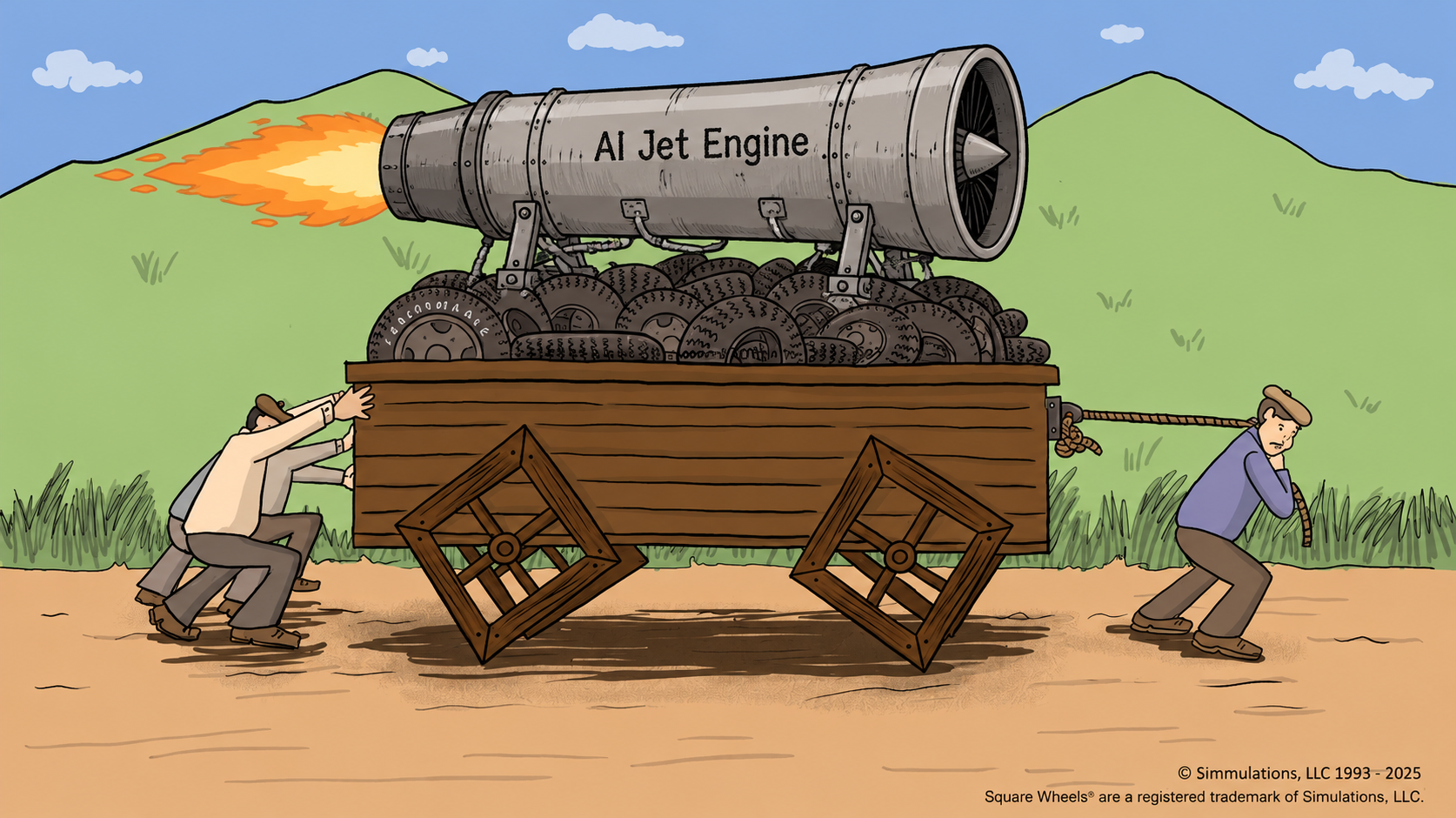
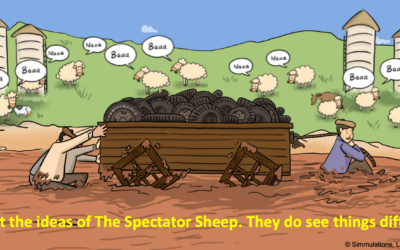
We could put an AI jet engine on a wagon with Square Wheels. It would look like this:
It might pull / push harder. It might generate impressive reports about the speed of the journey. It might impact the thumps and bumps and make them into simple vibrations. It might even predict which wheel will hit the next obstacle. It might cause the wagon to fly off into the air and crash into the mountainside. Zoom zoom.
But we would still have a wagon rolling on Square Wheels.
And people will probably still be involved in some way.
And what about The Customer?
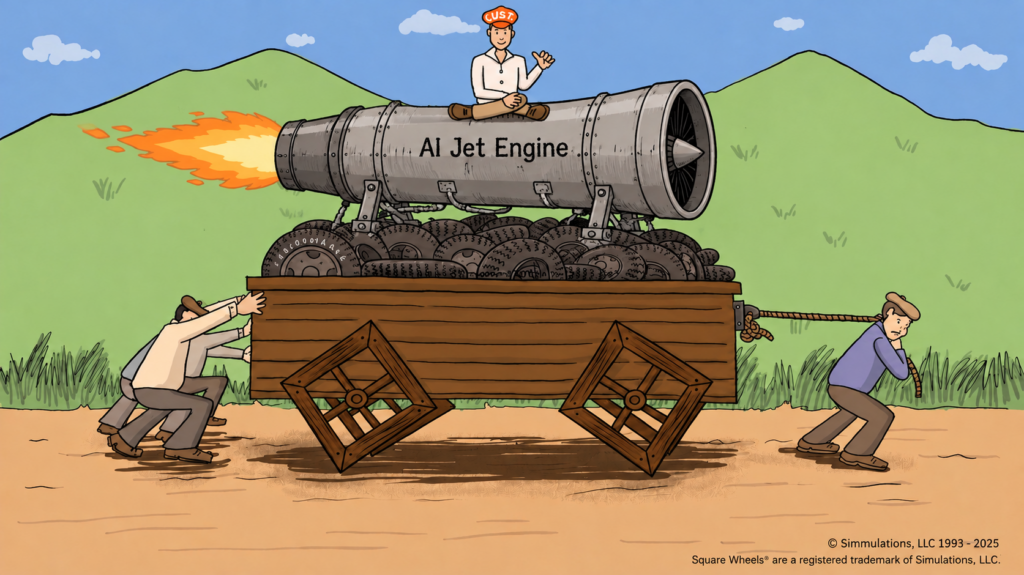
These are the questions worth putting in front of a team before launching another technology initiative: Are we using AI to improve how work happens — or are we simply adding power to a process that needs rethinking?
In their November 2, 2026, Chief Learning Officer article, “Adaptive before algorithmic: 5 leader mindsets for the AI era,” Dr. Sharon M. Ravitch and Liza Herzog argue that adopting AI requires more than technical implementation. People must also learn, exercise judgment, reconsider assumptions and participate in redesigning their work. Their Flux 5 framework identifies five leadership mindsets for that challenge: inquiry, humanizing, systems, entrepreneurial and equity.
Those are useful ideas. The practical challenge is making them usable in a supervisor’s next team meeting.
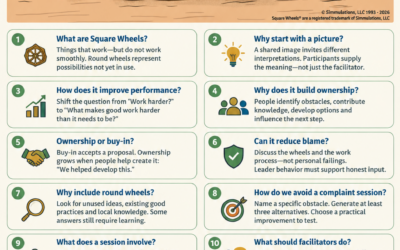
My proposed approach is to translate those five mindsets into five conversations around a familiar picture: people pushing and pulling a wagon on Square Wheels, with round wheels already available inside.
One theme. Five questions. One improvement to test. Then, repeat.
(The goal is not to replace Flux 5 or claim that Square Wheels images are part of the authors’ framework. My goal is to reframe things a bit, to add some visual projective image tools to help generate discussions around possibilities for improvement. It is to offer a practical facilitation adaptation—one that helps people move from discussing leadership concepts to changing something about their behaviors at work and their beliefs and choices around change.)
The wagon idea gives us a place to begin conversations to generate considered alternatives
Start by showing the Square Wheels One image without explaining what everyone should see. You should ask:

Give people a little time to think independently before opening the discussion. Note that we are using the Praxis LIVE interactive brainstorming tools to help generate and collect ideas from interactive sessions.
For this kind of engaging exercise, the image becomes a shared workspace and discussions around issues and opportunities becomes paramount:
-
The wagon represents the works we are trying to accomplish.
-
The Square Wheels represent practices, assumptions, systems and obstacles that make progress harder.
-
The people represent those doing the work, directing it and experiencing its consequences.
-
The Round Wheels represent possibilities worth exploring—not automatically proven solutions.
-
The road represents the conditions in which the work must happen.
AI is certainly one of the Round Wheels. So might things like a clearer decision rule, a better handoff, improved coaching or eliminating an unnecessary approval. But there can also be active resistance to any AI imposed on the workers – after a decade, people can become very skilled at resisting change done TO them. (read about engagement ideas here)
That distinction matters. The question isn’t, “Where can we insert AI?” It is, “What is making worthwhile work unnecessarily difficult, and what could improve it?” AI may be one of the greatest tools ever, if we use it well. And Five mindsets become five practical questions…
| Flux 5 mindset | Square Wheels question | Practical output |
|---|---|---|
| Inquiry | Why are we rolling this way? What can we consider changing? | One assumption to investigate |
| Humanizing | What is the journey like for the people pushing and pulling the wagons? | One concern or learning need to address |
| Systems | What happens to the whole wagon on this journey? | A simple end-to-end workflow map |
| Entrepreneurial | Which Round Wheel could we test and evaluate and what opportunities exist? | One bounded improvement experiment |
| Equity | Who benefits, who carries the load, and who is missing? Who loses? What about the customer? | An access, participation and risk check |
The five mindset names come from Ravitch and Herzog; the questions and activities here are my proposal for a Square Wheels translation. At some point, I would like to generate a specific image for each of the 5.
1. Inquiry: Why are we rolling this way?
The inquiry mindset asks leaders to question both AI outputs and the assumptions behind using AI in the first place. It is not enough to ask whether an answer looks plausible. We must also ask whether we are solving the right problem.
In Square Wheels language, there are many questions:
“Which bumps have we accepted as normal?”
Invite people to identify a recurring frustration. Then explore it:
-
What actually happens?
-
What do we know, and what are we assuming?
-
Why does this step exist?
-
What would we need to verify before changing it?
-
If AI gives us an answer, who can judge whether that answer fits our situation?
Consider a team that wants AI to write its weekly reports faster. A useful inquiry question comes before choosing a tool:
“Who uses these reports, and what decisions do they support?”
Perhaps the team needs faster writing. Perhaps it needs a shorter report. Perhaps it no longer needs three versions of the same information.
2. Humanizing: What is the journey like for the people, how does it feel?
Ravitch and Herzog’s humanizing mindset addresses the relationship between technology, professional identity, trust and development. They also warn that automating foundational work can remove experiences through which people learn judgment and build expertise.
The Square Wheels conversation brings those issues back to the people around the wagon. Ask something like:
“What burdens are we asking people to carry—and what might this change take away?”
Then explore:
-
Which parts of the work are exhausting or frustrating?
-
Which parts help people learn?
-
What worries people about the proposed change?
-
What support would make experimentation reasonable?
-
What can leadership honestly say about its intentions?
Imagine using AI to draft customer responses. That might reduce repetitive writing. But if newer employees simply approve drafts without understanding them, the team could lose an important learning opportunity.
A proposed safeguard would be to ask employees to explain why they accepted, changed or rejected selected drafts, with coaching from an experienced colleague. The workers actually know this, and the managers need to know what they know. Peer support and collaboration are really important factors in the workplace.
The aim is not merely to remove effort. It is to remove unnecessary effort while preserving worthwhile learning.
3. Systems: What happens to the whole wagon?
The systems mindset challenges local optimization: making one task faster without improving the larger workflow. Ravitch and Herzog recommend mapping work end to end and measuring outcomes such as quality, cycle time, customer experience and employee capacity—not simply tool usage. And many people focus on the wagon as a tool to discuss options to improve systems and processes.
A Square Wheels question is straightforward:
“If this wheel turns more smoothly, what happens to the rest of the wagon?” What happens to the journey forward.
Suppose AI allows a team to produce proposals much faster. That sounds useful—until every proposal reaches the same overloaded approval queue and we get into the mud.

The writing improved. The customer’s waiting time did not.
We got out of the ditch and up on the road.
Ravitch and Herzog suggest we use a simple map:
Request → preparation → review → approval → delivery → feedback
Then ask:
-
Where does work wait?
-
Where does it come back for correction?
-
Who receives the output of the task we want to accelerate?
-
Where do people get feedback and develop judgment?
-
What measure would show that the whole process improved?
Do not stop at “We produced more.”
Ask whether the wagon reached its destination sooner, with less rework and an acceptable load on the people involved.
Square Wheels can simply be made part of the communications process. They can be used to involve and engage the people doing the job in sharing ideas for how we can improve how things get accomplished, finding the ideas for continuous continuous improvement of systems and processes.
4. Entrepreneurial: Which round wheel could we test?
The entrepreneurial mindset emphasizes disciplined experimentation rather than endless pilots or premature large-scale deployment. The source article recommends bounded experiments with clear hypotheses, success measures and stopping criteria. For a manageable Square Wheels program, the invitation is:
“We do not have to rebuild the wagon today. What is one change we can test responsibly?”
You might choose to use a short experiment card:
-
Square Wheel: What specific problem are we addressing?
-
Proposed Round Wheel: What will we change?
-
Prediction: What do we expect to improve?
-
Evidence: What will we compare before and after?
-
Boundaries: What must not be compromised?
-
Ownership: Who will coordinate the test?
-
Review: When will we decide whether to continue, revise or stop?
For example:
“We will test AI-assisted first drafts for one category of routine customer inquiries for 30 days. Staff will verify every response before sending it. We will compare handling time, corrections and escalations against a baseline.”
That is a proposed test—not a promise that AI will improve those measures.
A Round Wheel is a possibility until experience gives us evidence and proof.
5. Equity: Who benefits, who carries the load, and who is missing?
The equity mindset asks leaders to examine how access, opportunity, benefits and risks are distributed. Ravitch and Herzog emphasize that access to technology alone is insufficient: people also need relevant learning, support and protected time to experiment.
The wagon makes this a concrete discussion:
“Are we making the journey better for everyone—or making it easier for some by shifting the strain to others?”
Ask:
-
Who helped define the problem?
-
Who has access to the tool and training?
-
Can all shifts participate?
-
Who checks the output and corrects mistakes?
-
Who is accountable when something goes wrong?
-
Whose workload might increase?
-
Who could be disadvantaged by the resulting decisions?
For the customer-response experiment, include newer staff, experienced staff and the people handling escalations—not only the manager sponsoring the tool.
A seemingly faster process is not necessarily an improvement if someone else quietly absorbs the cleanup. We cannot just change things willy-nilly but need the advice of the people who do the hands on work to act and advise and to collaborate across departmental boundaries to insure that the approaches are working to benefit the organization. We need to open the silos and deal with the mud.
A manageable program: one meeting, one experiment, one review
Below are some general ideas around implementation. They do NOT represent The Answer; this section is included to generate possibilities and ideas that you might choose to try. Understand that AI is simply a tool that we can use well to accomplish different things. But we must use the right tool for the right job and the people who are using the tools are probably best qualified to choose what to use.
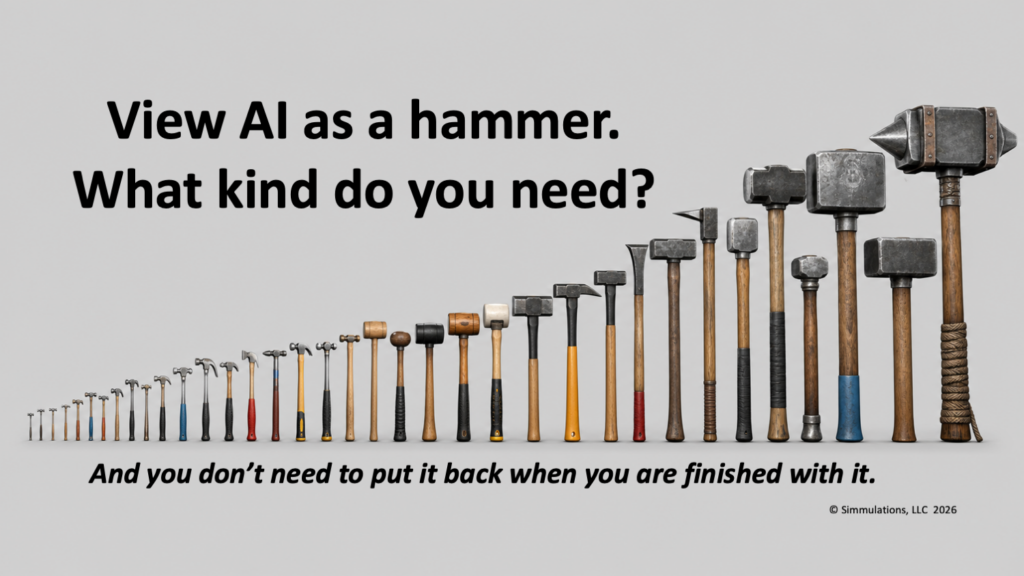
Rather than turning five mindsets into five separate training courses, I suggest we start with a small inclusive working cycle.
The opening meeting: 60 minutes
1 — Explore the Square Wheels One image — 10 minutes.
Ask what people notice and how it connects to their work. Start with individual observations so the first speaker does not define the whole discussion.
2 — Select one Square Wheel — 10 minutes.
Choose a recurring problem that the team can influence. Avoid trying to solve “our culture” in one sitting.
(Note that you can freely download Square Wheels One here.)
3 — Apply the five questions — 25 minutes.
Examine assumptions, people, workflow, experimentation and fairness. Capture concerns as well as opportunities.
4 — Design one test — 15 minutes.
Agree on the change, owners, baseline, safeguards, measures and review date within 2 weeks (probably).
The proposed meeting output is a one-page record, not a presentation deck. Get people thinking and talking about the workplace and possibilities for actual improvement. Do this WITH them rather than TO them!
The Experiment: 30 days
Allow the people to choose a low-risk, appropriately authorized test small enough to observe and reverse. Keep required privacy, security and organizational approvals in place. Make sure that they know that you will support them.
Hold a brief weekly check-in:
-
What happened?
-
What surprised us?
-
Who experienced an unexpected difficulty?
-
What needs adjusting?
For higher-risk applications, a team meeting is only a starting point—not a substitute for the necessary expert review.
The very critical learning review: 30 minutes
Return to the same image and ask:
-
Which bump became smaller?
-
Did we move the problem somewhere else?
-
What happened to quality and workload?
-
What did people learn?
-
Should we continue, change, expand or stop?
Document the learning even if the experiment stops. That preserves the emphasis Ravitch and Herzog place on pilots producing reusable knowledge, rather than merely a deployment decision.
Lastly, Leadership: Your Personal Leadership Upgrade comes first
What I appreciate about Ravitch and Herzog’s article is that it brings the discussion back to learning, judgment, trust and participation. Reflection is a key to better understanding the reality. The AI technology will certainly keep changing; the organization needs the capacity to keep learning and adapting with it to optimize its usefulness.
“Nobody ever washes a rental car.”
Help THEM develop active ownership involvement.
For me, generating ownership is the real leadership challenge. It’s not simply getting people to adopt the tool. And, it’s not simply getting people involved in deciding how the tool can help them do better work.
An AI license is not a round wheel, nor is a training completion certificate. Implementing the round wheels is about DOING things impact-fully using the available tools. Improvement happens when people connect a useful capability to a real problem, test it thoughtfully and change how the work gets done.
That requires participation and the building of trust.
So, before announcing the next acceleration initiative, stop beside the wagon.
— Listen to the people pushing and ask for their ideas.
— Look at the wheels together and ask about implementation
Because artificial intelligence should help us do more than pull harder. It should help us stop doing things the hard way and it should help support our efforts for improvement.
Keep your workplace picture simple—and the conversation honest
The strength of this proposed adaptation is not that a cartoon supplies the answers. It’s that the picture gives people something concrete to examine together.
There is also an important facilitation boundary: Square Wheels should describe conditions and practices, not become a label for people. “Our approval process is a Square Wheel” invites investigation. “That department is a Square Wheel” invites blame.
Likewise, the leader should not display the picture and then announce which Round Wheel everyone must embrace. That turns participation into decoration.
The more useful role is to ask, listen, clarify constraints and help people test an improvement they have helped shape.
Flux 5 provides five perspectives on adaptive leadership. Square Wheels can provide a proposed way to bring those perspectives into an ordinary working conversation.
Before asking people to pull harder—or giving them a more powerful algorithm—pause long enough to look at the wheels.
And always ask:
“What is one more thing we could change together that would make this work better?”
—
For the FUN of It!
 Dr. Scott Simmerman is a designer of team building games and organization improvement tools.
Managing Partner of Performance Management Company since 1984, he is an experienced presenter and consultant who is trying to retire!! He now lives in Cuenca, Ecuador.
You can reach Scott at scott@squarewheels.com
Learn more about Scott at his LinkedIn site.
Square Wheels® is a registered trademark of Simmulations, LLC
and images are © Simmulations, LLC 1993 – 2026
Note: Please do not take my images and think about using them. It can generate a whole heap of problems given international copyright law and trademark law. Read this article for more information.
See a detailed overview of my tools, background and experiences by clicking here.
What I’m About:
My Square Wheels blog and website exist to help leaders, trainers, and facilitators make work smoother, more engaging, and more human. I focus on practical tools for process improvement, organizational change, and workplace collaboration that spark insight and deliver measurable results.
And I am convinced, after 30+ years of using Square Wheels®, that it is the best facilitation toolset in the world. One can use it to involve and engage people in designing workplace improvements and building engagement and collaboration. It is a unique metaphorical approach to performance improvement and we can easily license your organization to use these images and approaches.
By blending proven facilitation methods, creative problem-solving, and engaging team activities, my mission is to support organizations in building energized, sustainable cultures of involvement and innovation.
Through accessible — and often free — resources and virtual facilitation tools, I aim to help teams everywhere collaborate more effectively, innovate continuously, and take ownership of their improvement journey.
#SquareWheels #InnovationAtWork #TeamEngagement #FacilitationTools #WorkplaceImprovement #EmployeeEngagement #CreativeProblemSolving #OrganizationalDevelopment #LeadershipTools #collaboration #leadership #motivation #communications #enablement #leadership #CreativeCommons #enablingperformance #teamwork #storytelling #storyasking #enablement #disruptiveengagement #un-dis-engagement #un-dis-empowerment #innovation
© 2026 Simmulations, LLC. Please note that “Square Wheels®” is a registered trademark of Simmulations, LLC. and materials, original wagon line art, text, and visual designs are protected. Original line art by Roy Sabean, used under rights owned by Simmulations, LLC and formerly Performance Management Company, a sole-proprietorship of Dr. Scott J. Simmerman. Original concept and source artwork © Simmulations, LLC; derivative visuals sometimes created with assistance from Perplexity Pro AI.


0 Comments