
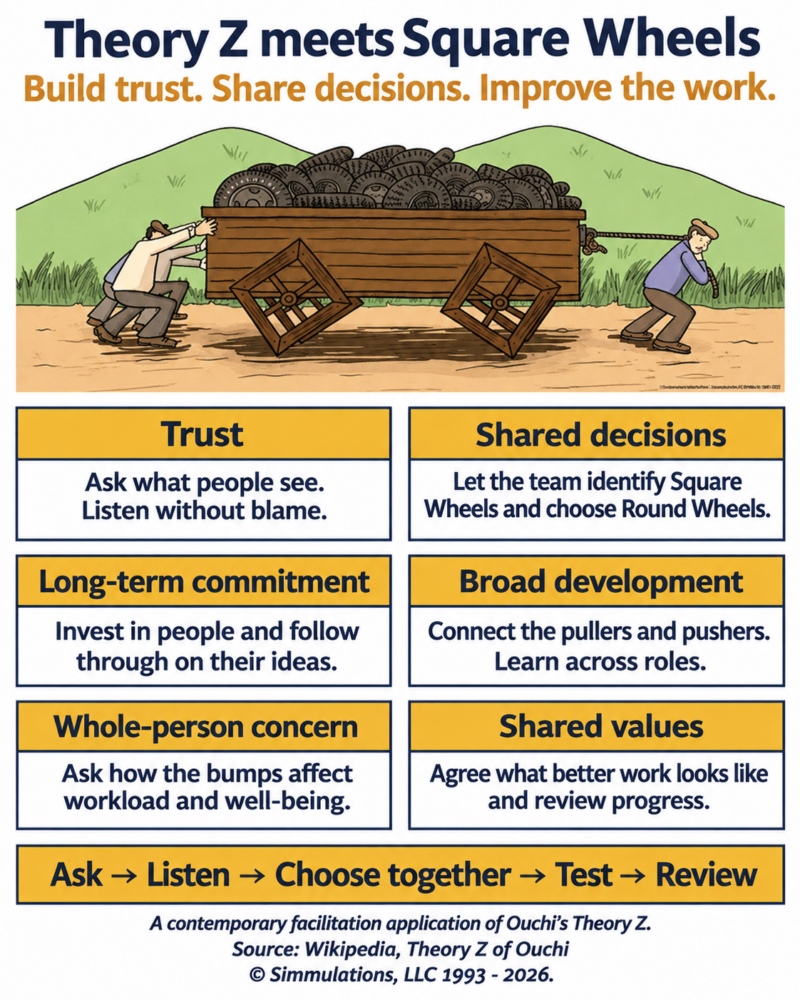
Theory Z meets Square Wheels: Building a culture where people can improve the work with a focus on what the managers can do to support the work.
Here, we focus on what William Ouchi, the author of Theory Z, would think and say about using Square Wheels® to build a more productive organizational culture. He was an organizational thinker and was very influential on me in my early years in working closely with senior managers in two organizations.
My interpretation is that Ouchi would recognize a practical way to put several of his central ideas to work if he was doing organizational development today: involve people in decisions, build trust through working relationships, develop shared commitment, and support individual responsibility within a cooperative organization. Those are important elements of his approach to management with less of a focus on the Japanese companies of the late 70s and early 80s.
That is my interpretation of Ouchi’s work, not a claim that he reviewed or endorsed Square Wheels. But the connection is worth exploring because it brings a management philosophy down to the level where culture actually happens, where people are talking about their work and deciding what to do differently.
A philosophy describes the organization we want. A useful facilitation tool helps people begin creating it.
We Do Not Need More Enthusiasm for Pushing Square Wheels
The basic Square Wheels One illustration shows a wagon rolling on wooden Square Wheels, and these wheels work. A leader pulls from the front while other people push from behind without much of a view. Inside the wagon are round wheels, those rubber tires represent possibilities for improvement that already exist but not yet being used. The Square Wheels represent things that work, but do not work smoothly. Welcome to how organizations really work!
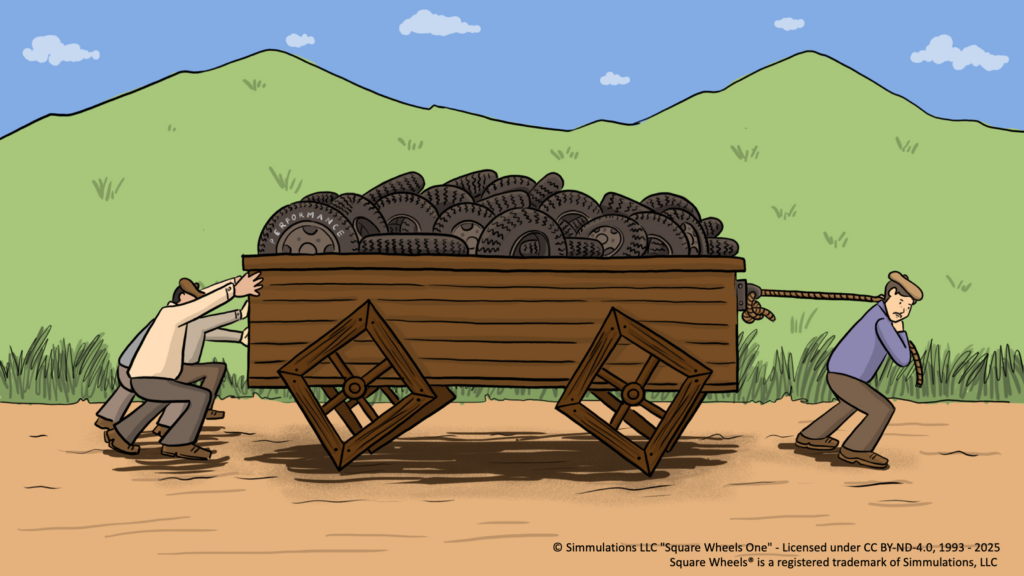
The wagon is moving. Work is getting done. People are making an effort. Things are good.
But movement is not the same as improvement, even though they rhyme.
When I show the illustration to managers and workers, I do not need to explain everything it means other than anchor it to how organizations really work. The more useful approach is to ask people for their thoughts and perceptions, in general, and give them time to discuss their observations. That open question has long been central to how I facilitate with these tools and how we can build a shared understanding of issues and opportunities.
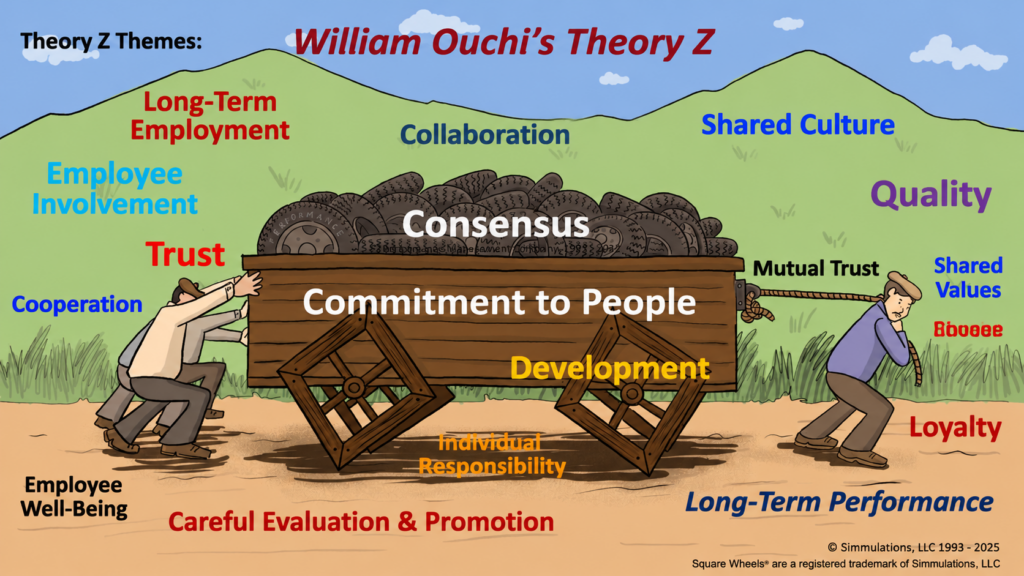
Ouchi would drive us to ask: Where are we making work unnecessarily difficult? What have we learned to tolerate? What ideas are sitting unused in our wagon? What could we do differently if we stopped pushing long enough to talk?
This is where I see a natural connection with that framework. Rather than treating employees simply as people who execute management’s decisions, Theory Z encourages their active, engaged participation in organizational decisions and recognizes their contributions within the larger team and bigger organization.
In Square Wheels framework, people pushing the wagon
should have something to say about its wheels.
Theory Z Is About the Relationship, Not Just the Suggestions
William Ouchi published Theory Z: How American Business Can Meet the Japanese Challenge in 1981. His work explored how lessons from Japanese management could be applied in an American setting.
His framework goes beyond asking employees for occasional suggestions. It emphasizes long-term relationships, cooperative decision-making, trust, and concern for employees as whole people. Collective participation sits alongside individual responsibility; involving the group does not eliminate personal accountability.
That distinction matters.
We can collect suggestions without changing the relationship between managers and employees. We can hold an engagement meeting while leaving all meaningful decisions somewhere else. We can invite people to identify problems and then explain why nothing can change.
That is not the organizational culture I want to help organizations create.
My reading of Ouchi is that participation needs to be part of how an organization operates, not an occasional event added to an otherwise controlling system. Applied to Square Wheels themes, the objective is not simply to produce an interesting discussion. It is to help establish a working relationship in which people can examine the work together and influence what happens next.
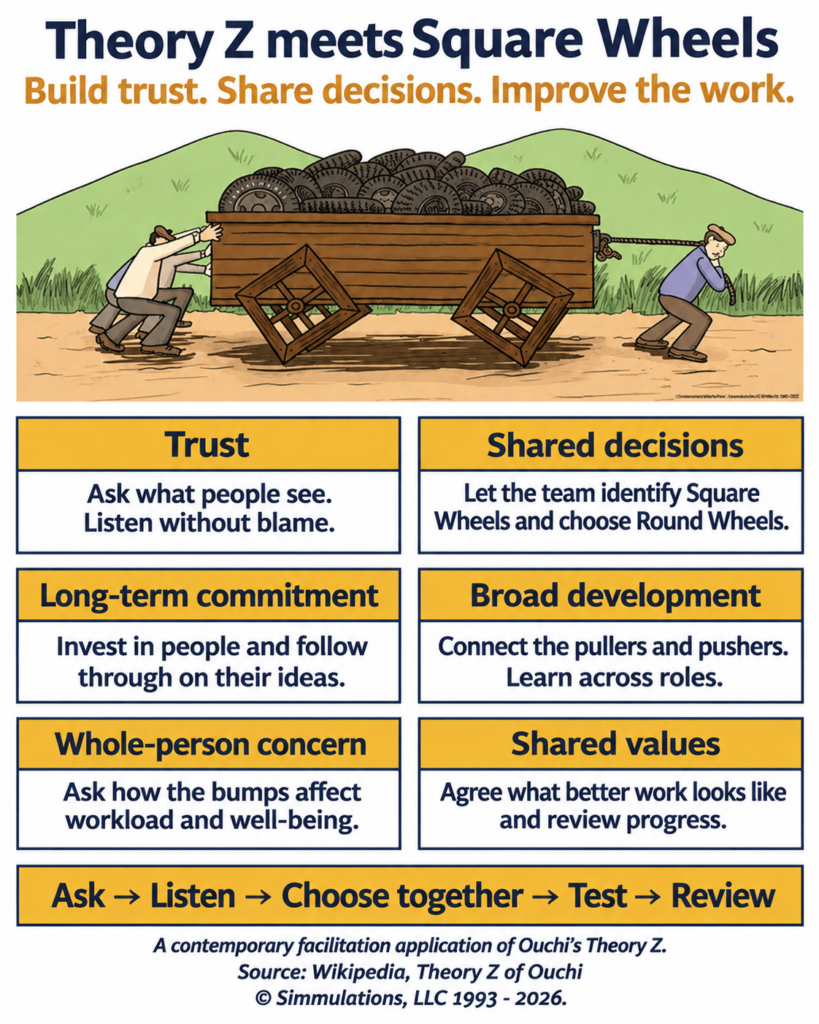
The image and framework opens the conversation. Leadership behavior determines whether the conversation matters.
From Storytelling to StoryAsking
There is a big difference between telling people that their ideas are important and asking questions that allow their ideas to shape the discussion.
With Square Wheels One and the other images about how organizations really work, I would rather begin with, “What do you see happening here?” and let everyone project their beliefs onto the images than deliver a presentation explaining all the things management believes are wrong with the wagon and the journey.

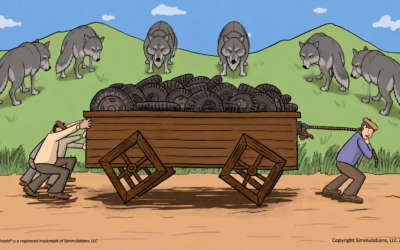
A different view of how some organizations seem to really work, with Spectator Sheep and Silos. You can talk about the mud, the glop that makes the journey difficult. There are the uninvolved with different perceptions and the common isolation between operating groups.
These images provide a shared starting point and a connection to reality. People can discuss the metaphors, compare perspectives, and then connect those observations to their own workplace. The tools are designed around this interactive process of stepping back, generating ideas, and involving people in their improvement.
I call the approach StoryAsking.
We Ask instead of Tell. We Involve and we Engage.
Instead of giving people my interpretation and asking them to agree, I want them to develop and discuss their own. This is a big difference. One person may see communication problems. Another may see outdated procedures. Someone else may notice that the leader cannot see what the pushers are experiencing.
Those opinion differences are useful material for a conversation, not errors to correct.
Through a Theory Z lens, I would treat that conversation as an opportunity to practice cooperative decision-making: listen to the people affected, develop a fuller understanding, and work toward a course of action they can support. That fits Ouchi’s emphasis on participation and cooperative relationships.
The point is not to get everyone to describe the picture the same way. The point is to help people understand the work—and one another—more clearly.
Involved, Engaged, and Enabled Are Not the Same Thing
For practical purposes, I find it useful to distinguish three things.
People are involved when they participate in identifying issues and considering possibilities. They are engaged when they see value in contributing and care about the outcome. They are enabled when they have the authority, resources, information, skills, and support needed to act.
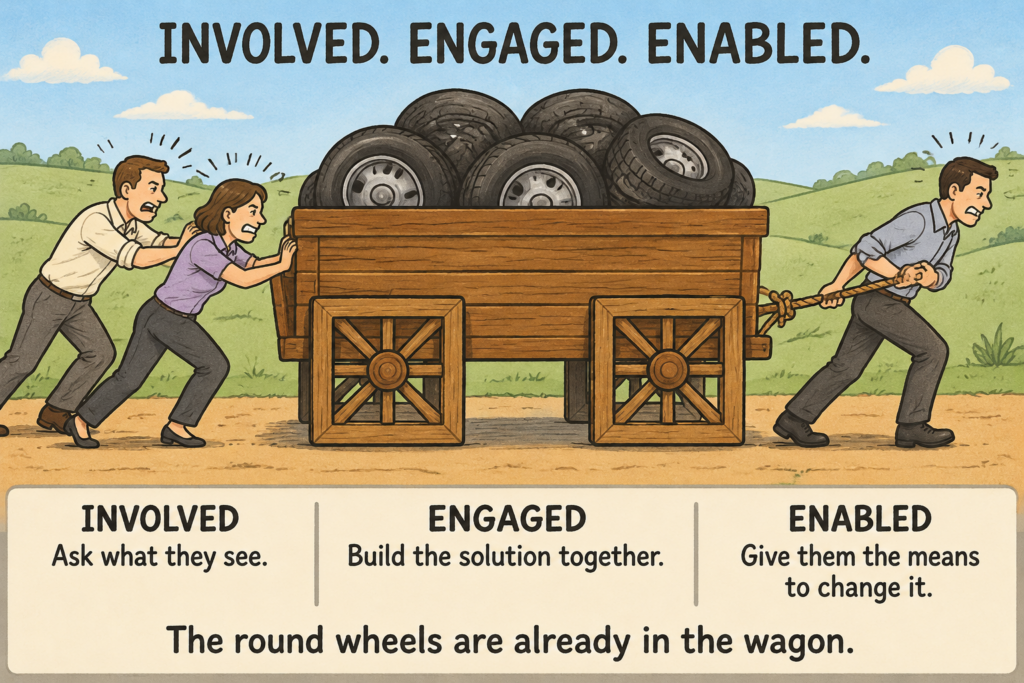
These are working distinctions, not a quotation or framework from Ouchi. But they help clarify what we should be trying to accomplish as we work to improve performance in our organizations.
A Square Wheels discussion can begin with involvement: “Here is where our wagon thumps and bumps.” It can invite engagement and personal commitment: “This is an improvement worth making.” But the critical next question is about enablement: “What do we need in order to try it?”
Imagine a team identifying duplicate data entry as one of its Square Wheels. People agree that it wastes time and creates avoidable errors. They propose a small test of a simpler process.
If the supervisor then says, “Good idea, but you cannot change the form, contact the other department, or spend any time testing it,” we have identified a problem without enabling an improvement.
We have not installed a Round Wheel. We have organized a discussion about one.
This is where the management commitment becomes visible and solid. Ouchi’s framework assumes that employees can be trusted to contribute and that management will provide appropriate support. The relationship works in both directions.
Asking people to care more is not a substitute for helping them accomplish something they care about.
Trust Is Tested After the Meeting
A colorful image cannot generate trust. Neither can a facilitator’s opening statement.
My practical test would be what happens after someone identifies an inconvenient Square Wheel.
Does the manager become curious or defensive? Can people question a process that a senior leader introduced? Are suggestions acknowledged? Are decisions explained? When a test does not work, do we examine the result or look for someone to blame?
Theory Z places trust and cooperative relationships near the center of organizational life. My application of that principle is straightforward: if we want honest participation, we need to respond honestly and constructively when people actually participate.
That does not mean every suggestion must be implemented. Some ideas will be impractical. Some will create difficulties elsewhere. Some will need evidence before they deserve a larger investment. But I would make the response clear: what we will try, what we will not try, what we still need to learn, and why. People want to be informed.
The most important part of a Square Wheels session may be the next conversation, when the manager returns and says, “Here is what happened with the ideas you raised.”
Innovation Needs More Than Permission to Speak
In the Square Wheels metaphor, the Round Wheels represent possibilities already present in the organization. That makes the image particularly useful for discussing overlooked improvements, not just dramatic inventions.
For this purpose, I would start with practical changes: a cleaner handoff, a simpler approval, better access to information, or a different way to coordinate work.
Then I would connect the discussion to a manageable experiment.
Which Square Wheel matters enough to address? What Round Wheel might help? Who needs to be involved? What can we test without creating unacceptable risk? How will we know whether the change helped?
Notice that this is not an argument for endless consensus.
Ouchi’s model combines collective decision-making with individual responsibility. Participation should improve the decision, while responsibility and active engagement makes it clear who will carry the work forward.
For a Square Wheels conversation, I would translate that into a simple discipline: agree on the issue, choose a bounded test, identify an owner, provide the necessary support, and schedule a review.
Everyone can contribute without everyone having to manage every detail.
One Improved Wagon Is Not Yet an Improved Culture
There is another issue worth considering: what happens when one team installs its Round Wheels and the surrounding organization does not support the change?
My Square Wheels wagon-train materials explore this problem directly. Teams can develop improvements while organizational practices—and resistance from other parts of management—make implementation and collaboration difficult. The message is that improvement needs active support from middle and senior managers, not just enthusiasm within a single workgroup. And one wagon CAN encourage other wagons to make improvements through peer support and collaborative innovation.
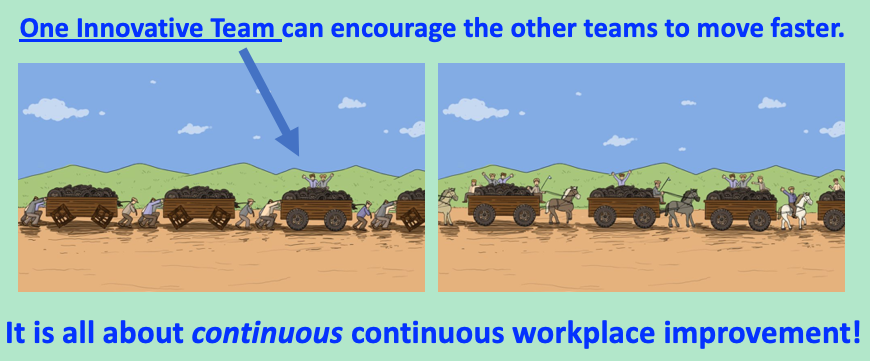
That suggests a broader application of Theory Z.
I would not stop with asking whether people cooperate inside their own department. I would ask whether the organization supports cooperation between and among departments.
Can a team get help from the people who control the next step? Can it share what it learns? Are supervisors willing to adapt when another group discovers a better approach? Are we improving the whole wagon train, or simply asking each wagon to meet its own targets?
A productive culture needs more than local initiative.
In the approach I am proposing, it needs shared responsibility
for making those initiatives useful to the larger organization.
Make Improvement a Way of Working
If I were applying Theory Z through Square Wheels, I would not begin by announcing a major culture transformation, I would begin with the Square Wheels One beginning image and a useful conversation around issues and opportunities..
Then I would help the group select one meaningful improvement, identify what support it needs, and arrange a small test. At the next meeting, we would review what happened—not simply whether the task was completed, but what we learned and what should happen next.
I would also track a few practical measures: how many ideas receive a response, how many tests are completed, how long decisions take, and whether the changes improve something that matters, such as rework, waiting time, or service reliability. These would be measures for managing the process, not promises about what the tools will produce.
Over time, I would want the routine to become familiar: people identify friction, discuss possibilities, test improvements, and share the learning.
That is the connection I would make between Ouchi’s philosophy and the Square Wheels tools. Theory Z offers a workable framework of trust, participation, commitment, and responsibility. Square Wheels offers a practical way to begin conversations about how those principles could change everyday work.
My conclusion is not that a cartoon creates a productive culture.
It is that a simple picture, used with good questions and backed by consistent management action, can give people a way to help create one.
The goal is not to make people more enthusiastic about pushing the same old wagon.
The goal is to improve the wagon WITH them—and make doing so part of everyone’s work.
I hope you found the above interesting and actionable,
—
For the FUN of It!
 Dr. Scott Simmerman is a designer of team building games and organization improvement tools.
Managing Partner of Performance Management Company since 1984, he is an experienced presenter and consultant who is trying to retire!! He now lives in Cuenca, Ecuador.
You can reach Scott at scott@squarewheels.com
Learn more about Scott at his LinkedIn site.
Square Wheels® is a registered trademark of Simmulations, LLC
and images are © Simmulations, LLC 1993 – 2026
Note: Please do not take my images and think about using them. It can generate a whole heap of problems given international copyright law and trademark law. Read this article for more information.
See a detailed overview of my tools, background and experiences by clicking here.
What I’m About:
My Square Wheels blog and website exist to help leaders, trainers, and facilitators make work smoother, more engaging, and more human. I focus on practical tools for process improvement, organizational change, and workplace collaboration that spark insight and deliver measurable results.
And I am convinced, after 30+ years of using Square Wheels®, that it is the best facilitation toolset in the world. One can use it to involve and engage people in designing workplace improvements and building engagement and collaboration. It is a unique metaphorical approach to performance improvement and we can easily license your organization to use these images and approaches.
By blending proven facilitation methods, creative problem-solving, and engaging team activities, my mission is to support organizations in building energized, sustainable cultures of involvement and innovation.
Through accessible — and often free — resources and virtual facilitation tools, I aim to help teams everywhere collaborate more effectively, innovate continuously, and take ownership of their improvement journey.
#SquareWheels #InnovationAtWork #TeamEngagement #FacilitationTools #WorkplaceImprovement #EmployeeEngagement #CreativeProblemSolving #OrganizationalDevelopment #LeadershipTools #collaboration #leadership #motivation #communications #enablement #leadership #CreativeCommons #enablingperformance #teamwork #storytelling #storyasking #enablement #disruptiveengagement #un-dis-engagement #un-dis-empowerment #innovation
© 2026 Simmulations, LLC. Please note that “Square Wheels®” is a registered trademark of Simmulations, LLC. and materials, original wagon line art, text, and visual designs are protected. Original line art by Roy Sabean, used under rights owned by Simmulations, LLC and formerly Performance Management Company, a sole-proprietorship of Dr. Scott J. Simmerman. Original concept and source artwork © Simmulations, LLC; derivative visuals sometimes created with assistance from Perplexity Pro AI.

0 Comments