
 Douglas MacGregor, an MIT management professor and author of the influential 1960 book The Human Side of Enterprise, challenged leaders to reconsider their assumptions about people.
His Theory X and Theory Y contrasted management built on direction and control with management that creates conditions for responsibility, initiative, and self-direction. His work helped shape modern thinking about employee motivation and participative leadership.
Although he wrote long before today’s AI tools, his central challenge offers a useful starting point: are we trying to make employees accept change, or creating the conditions in which they can help shape it?
So, using his models for a post on dealing with resistance to AI in the workplace and how do we lead such endeavors, I wondered how MacGregor would view the use of my Square Wheels® tools to help organizations, and especially the front-line managers deal with many of the problems faced in today’s organizations and more specifically, how tio better implement AI within the workplaces. The output is worth considering… What Perplexity AI produced, with lots of edits from me.
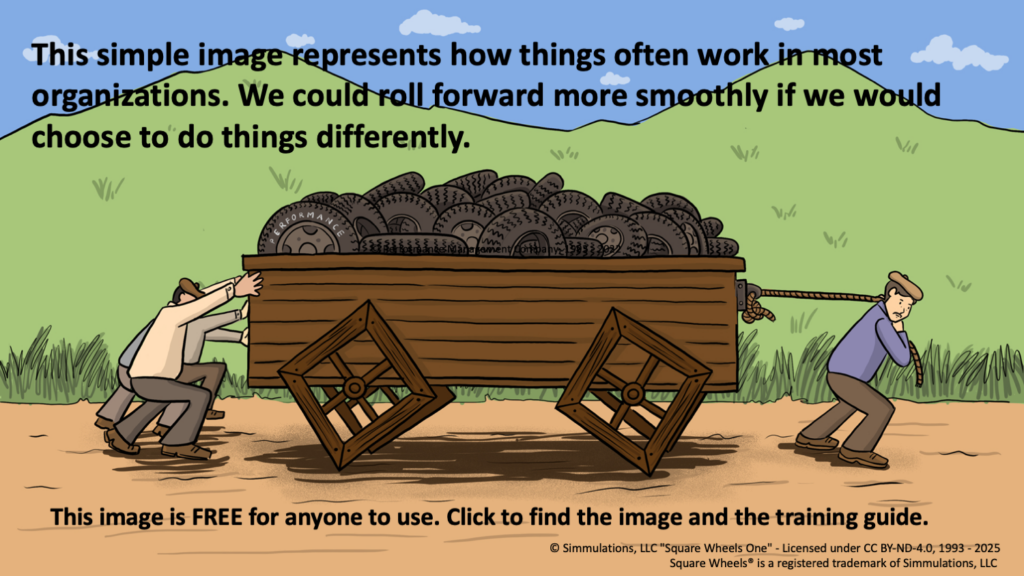
Douglas McGregor would likely see Square Wheels tools as a practical way to put Theory Y into action: involve people in understanding the work, trust their capacity to improve it, and provide the leadership, coaching, and resources that make responsible change possible. Applied to AI, his starting question would probably not be, “How do we overcome employee resistance?” but, “What are we doing—or failing to do—that makes resistance a reasonable response?” That is an interpretation of his management philosophy, not a historical statement about AI or Square Wheels.
The central connection is this: Square Wheels can turn an AI initiative from something management does to employees into an improvement process leaders undertake with them. This is an important distinction when it comes to enabling people to choose to do something differently. The Square Wheels metaphor provides a shared picture of the work; McGregor provides a lens for examining the assumptions leaders bring to the conversation. And active engagement becomes the tool to support change.
Start with management’s assumptions, not employees’ supposed deficiencies
McGregor’s Theory X and Theory Y describe contrasting managerial assumptions—not two permanent categories of employees. Theory X emphasizes the need to direct and control people; Theory Y emphasizes the potential for self-direction, responsibility, and contribution under appropriate conditions. His challenge was to management: create conditions that allow people’s capabilities to emerge.
An AI rollout can expose that difference immediately.
A Theory X approach begins with a conclusion: management has selected the technology, employees must use it, and reluctance is a compliance problem. This seems very common when one looks at how organizations are doing their AI rollouts; very tops-down.
A Theory Y approach begins with inquiry: what work needs improving, what do employees know about it, where could AI help, and what conditions would enable people to use it responsibly? These are contemporary applications of McGregor’s contrasting assumptions.
Through that lens, the Square Wheels image offers a useful opening. Rather than asking employees to defend their attitudes toward AI, a facilitator can invite them to examine the wagon:
-
Where does our work bump along unnecessarily?
-
What do the people pushing know that the person pulling may not see?
-
Which round wheels are already available but unused?
-
Could AI help with this problem—or would another change work better?
-
What would make changing the wheels practical and worthwhile?
Those questions build on the inquiry-centered enablement use of Square Wheels you have been describing and building out in the many writings about its use. Importantly, they leave open the possibility that the best improvement is clearer priorities, a better handoff, or more effective coaching rather than AI.performancemanagementcompany
Treat resistance as information, not insubordination
A McGregor-informed interpretation would distinguish unwillingness to contribute from unwillingness to accept an uncertain or poorly supported change. Concern about job security, increased monitoring, loss of professional judgment, or additional workload is not automatically evidence of a bad attitude. MIT researchers identify these as substantive issues in workplace AI implementation and emphasize addressing them directly.
Square Wheels can provide a less personally accusatory way to surface those concerns. Instead of asking, “Why are you resisting AI?” the leader can ask:
“What about this proposed change might make the wagon harder to move?”
That question allows the discussion to include issues and problems in the proposed solution, not just deficiencies in the people expected to implement it. My Square Wheels writing makes a related distinction: round wheels represent possibilities worth exploring, not automatically proven solutions.
The important qualification is that the Square Wheels One image does not, by itself, establish trust. If employees identify legitimate problems and leaders dismiss them — or solicit input after every consequential decision has already been made — the exercise becomes participation in appearance only. MIT’s work on AI implementation explicitly distinguishes early employee involvement from merely asking frontline workers to help implement a predetermined, intimidating change.
Leadership: establish direction without claiming all the answers
McGregor would likely support leadership that combines meaningful expectations with employee influence over how the work improves. Theory Y is not an argument for absent management; MIT’s account of his work emphasizes choosing appropriate means of influence for the circumstances.mitsloan.mit
For a Square Wheels–based AI initiative, I would translate that into three leadership responsibilities:
-
Clarify the destination. Define the work outcome: fewer errors, faster access to useful information, less repetitive administration, or better service—not simply “more AI use.”
-
Make the constraints explicit. Explain approved tools, data restrictions, review requirements, and which decisions remain human responsibilities.
-
Give people meaningful influence. Let those doing the work help select problems, shape the test, identify risks, and evaluate results.
These responsibilities connect the performance-centered use of Square Wheels with MIT’s recommendations on worker voice, clear AI parameters, and responsible experimentation.
Leadership also requires honesty about consequences. A manager should not promise that AI will never affect staffing unless the organization can honor that promise. What leaders can do is explain what is known, acknowledge uncertainty, and make concrete commitments about consultation, training, and fair transition support.mitsloan.mit
Coaching: develop judgment, not just tool proficiency
A McGregor-inspired coach would not confuse issuing instructions with developing capability. Applied to AI, the goal is not merely to teach employees how to obtain an answer; it is to help them judge whether that answer is useful, accurate, and appropriate for the situation. Research summarized by MIT shows why this matters: AI can improve performance on suitable tasks while worsening it when users rely on it outside its capabilities.
Square Wheels provides a recurring framework for that coaching conversation:
“Which wheel were you trying to change?”
“What did AI contribute? What did you check?”
“What did you reject? What will you do differently next time?”
For example, suppose a team tests AI-assisted customer-response drafting. The supervisor can coach employees to explain why they accepted, revised, or rejected a draft, rather than praising speed alone. That balance preserves the employee’s role as a thinking professional and creates an opportunity to develop newer employees’ judgment—an issue this recent Square Wheels article also raises.
Coaching should also make room for employees to teach one another and their managers. MIT’s research recommends an onboarding period for learning AI’s strengths and weaknesses, performance feedback, and recognition for employees who serve as peer trainers.
In the wagon metaphor, the coach is not simply shouting instructions about wheel-changing. The coach helps people examine the fit, try the change, assess the consequences, and become more capable of making the next improvement.
Support: make participation possible
The strongest practical implication of McGregor’s thinking is that leaders cannot demand initiative while withholding the conditions needed to exercise it. His emphasis was on management’s ingenuity in realizing human potential, rather than assuming the limits lie in human nature.
For AI implementation, I would make support visible through specific commitments:
-
Protected learning time, rather than training added on top of an unchanged workload.
-
Access to approved tools and realistic practice tasks.
-
Available coaching and peer assistance.
-
Clear responsibility for checking outputs and escalating problems.
-
Recognition for sharing learning, including discovering where AI does not work.
-
Follow-through on concerns about job design, workload, and employment consequences.
These are practical applications of the emphasis on training, peer support, accountability, worker involvement, and fair transitions in the MIT sources—not a claim that McGregor prescribed this particular checklist.mitsloan.mit+2
The Square Wheels question becomes especially powerful here in MacGregor’s thinking framework:
“What must management change so the team has the time, ability, and confidence to change the wheels?”
That keeps the improvement burden from falling entirely on the people already pushing and helps develop the needed trust in the workplace culture. Recognize that all this builds over time to generate a more productive workforce.
Put the approach into one small experiment
A practical application would begin with one supervisor and one team, one Square Wheels conversation, and one work problem to try to impact and not an organization-wide campaign to demonstrate enthusiasm for AI. This follows the small-test approach in my oft-published frameworks and the broader recommendation to involve workers in defining the problems technology should address.
Ask the team to select a recurring frustration it can influence. Compare AI with non-AI alternatives. If AI looks promising, agree on a limited trial with an owner, safeguards, coaching support, and a review date. Measure the actual result: time including checking and rework, quality, workload, and the team’s ability to explain and control the process. Those measures translate the discussion from technology usage into work improvement.
And at the review, return to the image and ask:
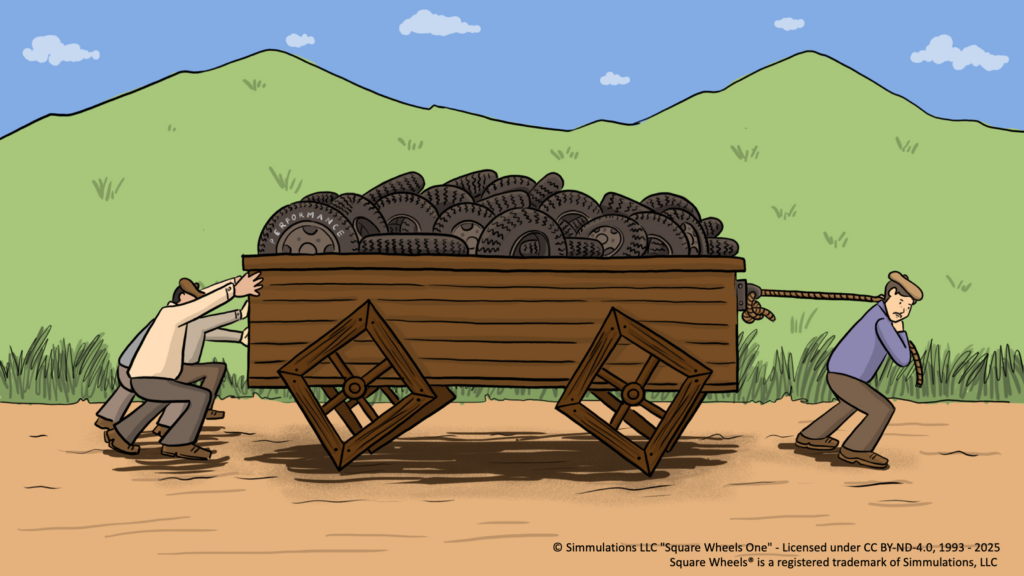
Note that by clicking on this image, you can get a FREE Square Wheels One toolkit you can use to “Be Like MacGregor!”
“Did we replace a Square Wheel—or just give everyone another box to carry?”
This reflection and the outcome might be broader adoption, a redesigned test, or a decision not to use AI for that task. Meaningful participation must allow all three; otherwise, the invitation to exercise judgment is not genuine. Improvement is a continuous process.
Overall: The message McGregor might leave with leaders
My synthesis of his thinking, and not a quotation from McGregor, would be:
Do not begin by trying to make people accept AI. Begin by creating conditions in which they can help determine how AI should improve their work. Use Square Wheels to make the obstacles discussable, coaching to build capability, and support to make improvement achievable.
That is the strongest connection between his philosophy and my tools. Square Wheels is not established here as a scientifically validated intervention for reducing AI resistance; its proposed value is as a facilitation method and a proven and effective approach for putting participation, inquiry, and shared problem-solving into practice. The independent research supports those underlying principles, while your framework supplies a concrete way to organize the conversation and move it toward action.
If you want to build out some tools for your organization, let’s connect. Simple, direct, useful, and not requiring much effort to actually implement,
—
For the FUN of It!
 Dr. Scott Simmerman is a designer of team building games and organization improvement tools.
Managing Partner of Performance Management Company since 1984, he is an experienced presenter and consultant who is trying to retire!! He now lives in Cuenca, Ecuador.
You can reach Scott at scott@squarewheels.com
Learn more about Scott at his LinkedIn site.
Square Wheels® is a registered trademark of Simmulations, LLC
and images are © Simmulations, LLC 1993 – 2026
Note: Please do not take my images and think about using them. It can generate a whole heap of problems given international copyright law and trademark law. Read this article for more information.
See a detailed overview of my tools, background and experiences by clicking here.
What I’m About:
My Square Wheels blog and website exist to help leaders, trainers, and facilitators make work smoother, more engaging, and more human. I focus on practical tools for process improvement, organizational change, and workplace collaboration that spark insight and deliver measurable results.
And I am convinced, after 30+ years of using Square Wheels®, that it is the best facilitation toolset in the world. One can use it to involve and engage people in designing workplace improvements and building engagement and collaboration. It is a unique metaphorical approach to performance improvement and we can easily license your organization to use these images and approaches.
By blending proven facilitation methods, creative problem-solving, and engaging team activities, my mission is to support organizations in building energized, sustainable cultures of involvement and innovation.
Through accessible — and often free — resources and virtual facilitation tools, I aim to help teams everywhere collaborate more effectively, innovate continuously, and take ownership of their improvement journey.
#SquareWheels #InnovationAtWork #TeamEngagement #FacilitationTools #WorkplaceImprovement #EmployeeEngagement #CreativeProblemSolving #OrganizationalDevelopment #LeadershipTools #collaboration #leadership #motivation #communications #enablement #leadership #CreativeCommons #enablingperformance #teamwork #storytelling #storyasking #enablement #disruptiveengagement #un-dis-engagement #un-dis-empowerment #innovation
© 2026 Simmulations, LLC. Please note that “Square Wheels®” is a registered trademark of Simmulations, LLC. and materials, original wagon line art, text, and visual designs are protected. Original line art by Roy Sabean, used under rights owned by Simmulations, LLC and formerly Performance Management Company, a sole-proprietorship of Dr. Scott J. Simmerman. Original concept and source artwork © Simmulations, LLC; derivative visuals sometimes created with assistance from Perplexity Pro AI.

0 Comments