
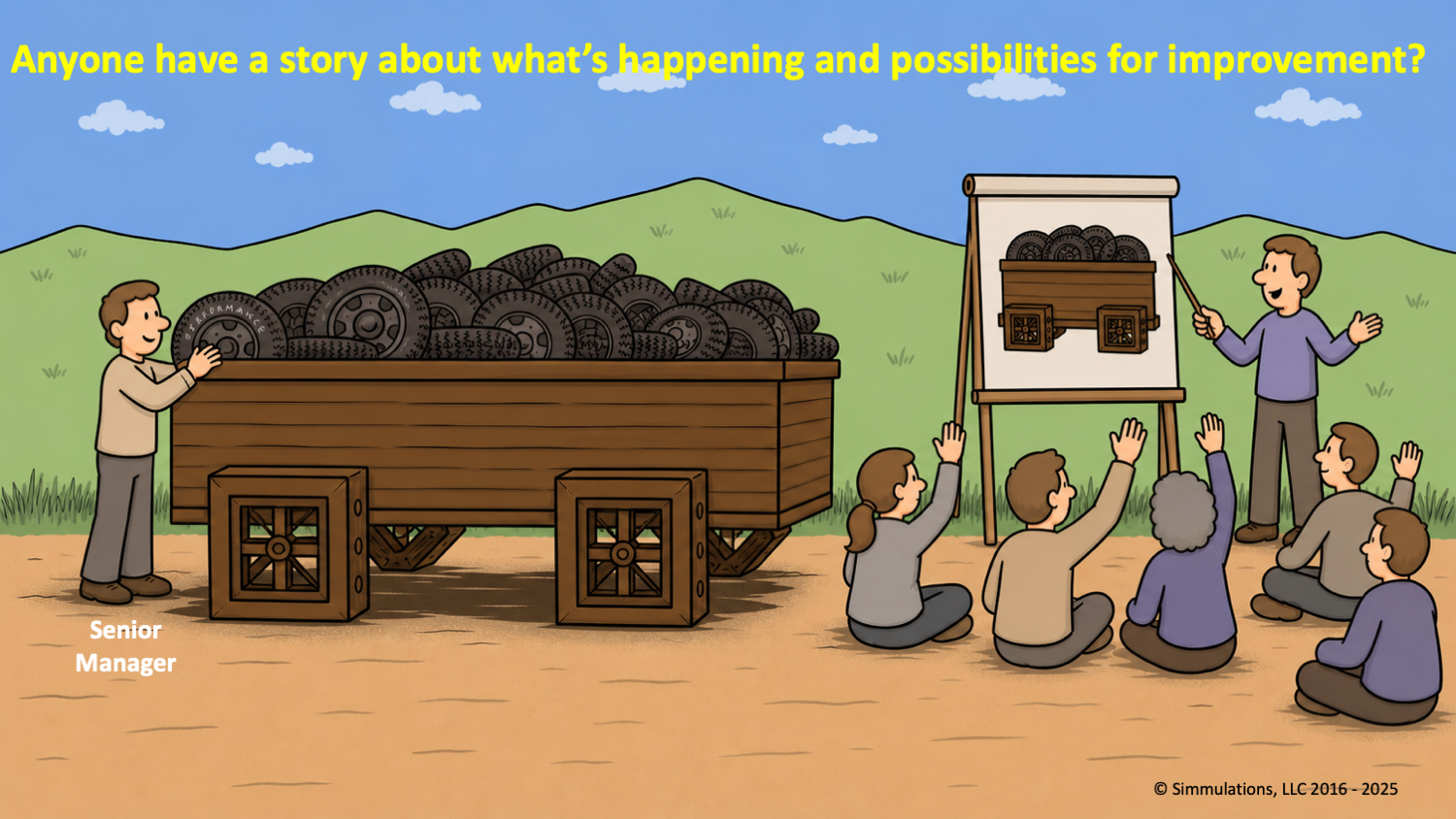
When people STOP pushing their wagon, supervisors can use a simple facilitation process to rebuild involvement and improve performance. They can generate conversations focused on making improvements and re-installing motivation among the teams.
Look again at the Square Wheels® One wagon, below. People are pushing it forward while it thumps and bumps along as usual. And in most workplaces, this is a reality of how things work, noting that things do not work smoothly but that round wheels are already in the wagon. This is a very common paradox about things working with everyone to busy to consider making changes. Many round wheels already exist in organizations in the form of best practices and high performing individuals already doing things differently, yet so many Square Wheels remain the “performance norm” and the expectations.
Now imagine what happens after months — or years — of pushing and pulling that wagon. Someone suggests trying a round wheel and hears, “That’s not how we do things.” (They sometimes get the same response after coming back from a training program where they learned a new process!) Another points out a problem and is told to be more positive. A third works hard to improve a handoff, only to watch the next department ignore the change. And the rest probably have similar stories…
Improvement comes not from doing things the same way but from identifying the considered alternatives that can improve how things really work.
Eventually, some people stop pushing with all their effort. They still show up but they go through the motions. Being average or slightly below average is not a problem for them. They do what is required. In meetings, they may seem quiet, passive, or unmotivated. But a supervisor cannot tell from that behavior alone whether the issue is motivation, exhaustion, unclear priorities, an unheard idea, a skill gap, or the belief that nothing will change. The behaviors and choices happening in most workplaces are pretty complicated, yet the better ideas do already exist.
That distinction matters. If we call every quiet employee “disengaged” and respond by telling them to push harder, we may miss an opportunity to improve both the work and the willingness to contribute.
Don’t Just DO Something, Stand There!
This is all about using ROUND Wheels that already exist.
Gallup reported that only 20% of employees worldwide were engaged in 2025. The report also distinguishes employees who are not engaged, those putting in time without much energy or enthusiasm, from those who are actively disengaged. Those are survey categories, not labels a supervisor can reliably assign by watching who speaks in a meeting.gallup. (Read more about the impacts outlined by Gallup here.) The supervisor’s better question is
“What would help more people WANT to help
their wagon move more better faster?”
Human dynamics are part of workplace performance
The Domain C approach brings an important perspective to that question. It is how The Facilitators Guild is addressing the framework of interpersonal needs, team roles, group dynamics, cultural competence, psychological safety, and systems thinking.
Domain C is part of our analysis and descriptions of different sets of facilitation skills as we are working through these ideas within the Facilitators Guild. Domain C is about Observation and Diagnosis (or Observation and Interpretation) of issues and opportunities.
The term “Domain C” also notes that teams benefit from complementary contributions: the person who generates possibilities, the person who evaluates them, the person who turns them into action, and the person who checks quality do not all help in the same way. We absolutely need more Complementary Contributions in our workplaces.
We absolutely need more Complementary Contributions in our workplaces.
Teams perform better when people bring different strengths to identifying
problems, evaluating ideas, implementing changes, and checking results.
A supervisor does not need to become a psychologist to use peoples’ ideas and apply them to workplace improvements. They do need to notice a few ordinary human realities:
-
People are more willing to contribute when they have some influence over how work is done.
-
People need a chance to use their strengths and see that their contributions matter.
-
Speaking up can feel risky, especially when the concern involves a decision made by someone with authority.
-
Silence does not always mean agreement, and disagreement does not always mean resistance.
-
A process problem can make a capable person appear ineffective.
Workplace research on self-determination theory associates employees’ experiences of autonomy, competence, and connection with stronger engagement and performance. Its practical lesson for a supervisor is not “make everyone happy.” It is to offer meaningful choice where possible, listen to employees’ perspectives, support their ability to do the work, and give them a part in improving it. The research also cautions against treating every association as proof of a simple cause-and-effect formula.
Facilitate; don’t just exhort
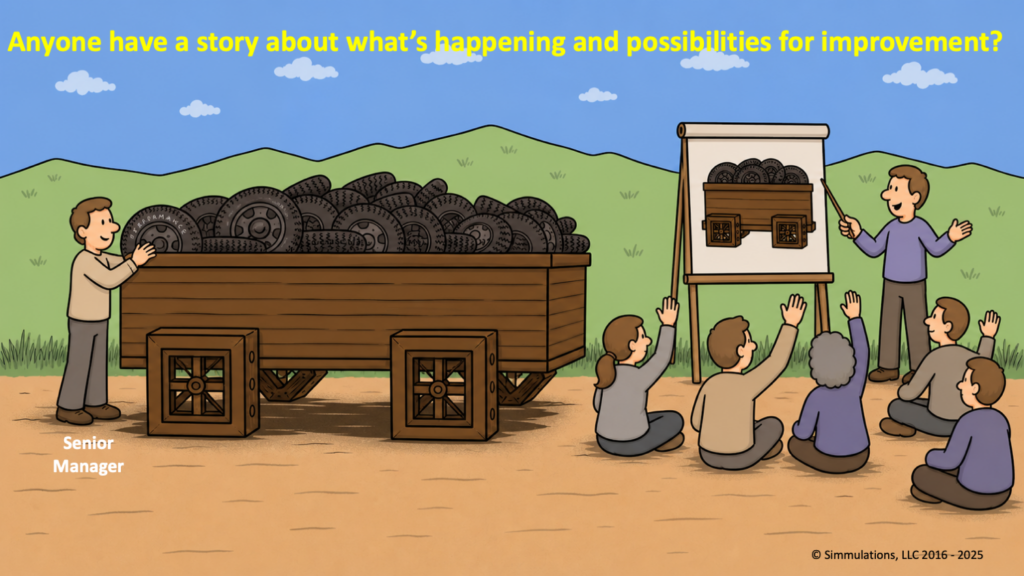
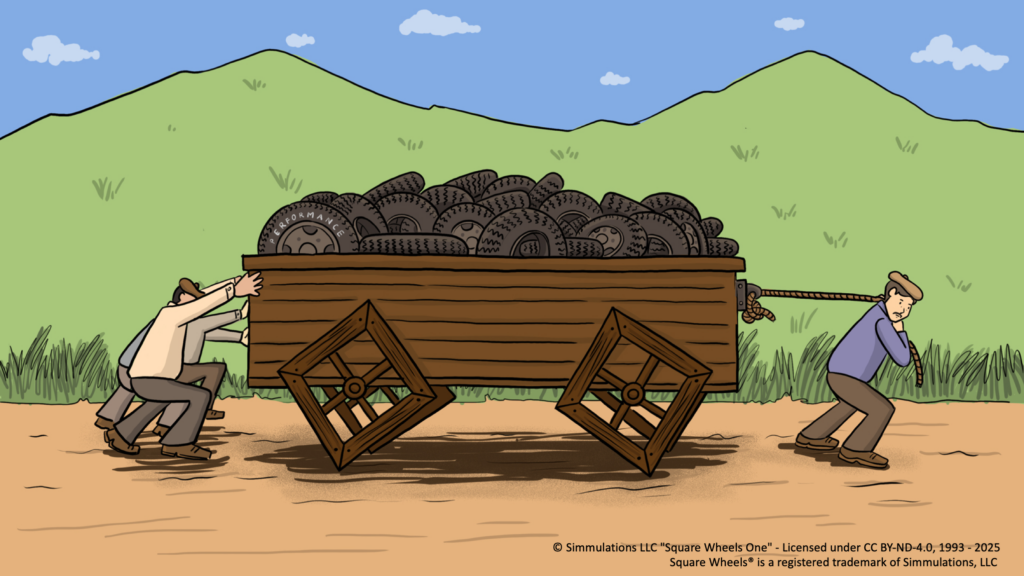
A supervisor can stand in front of the team and say, “I need everyone to be more engaged.” That instruction may be sincere, but it gives people little to act on. It does not tell the supervisor what is making effort difficult or why an employee’s useful idea has remained in the wagon.
The Square Wheels image offers a different opening. Put the picture where everyone can see it and ask:
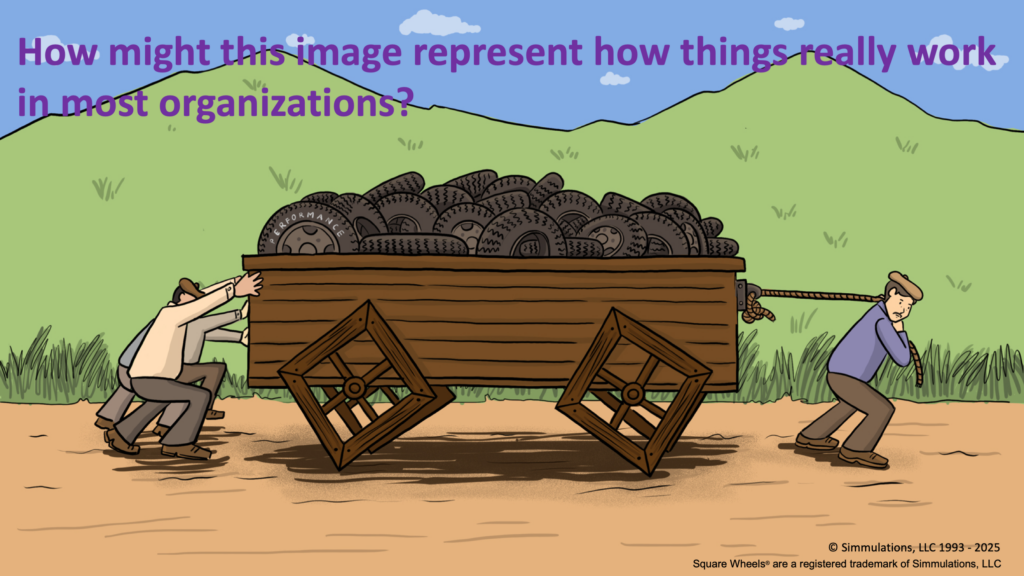
Click on this image to download Square Wheels One and instructors guide
Let people talk about the image in general before asking them to talk about themselves and their workplace. They may notice the awkward wheels, the unused round ones, the load, the direction of the rope, or the people doing the work. Different observations are useful: they show that even people looking at the same wagon may see different problems and possibilities. That is consistent with how Square Wheels has been used to invite multiple perspectives without beginning with blame.
There are many ways to continue the discussion and capture ideas. The ones below focus around the Domain C framework of interpersonal needs, team roles, group dynamics, cultural competence, psychological safety, and systems thinking if you find these ideas comfortable for discussing with your teams:
“Where does our work bump along like this?”
“What have we stopped questioning?”
“What ideas have we carried around but never tested?”
“Where have people stopped offering suggestions—and what happened?”
That last question takes care. A supervisor should not demand public confessions or assume that a quiet person has actually “quit pushing.” Give people time to write privately, discuss in pairs, or raise sensitive issues one-to-one. Listen without immediately defending the current process.
Psychological safety is relevant here: in Amy Edmondson’s study of 51 work teams, team psychological safety was associated with learning behavior, and learning behavior helped explain its relationship with team performance. An image cannot create that safety by itself. How the supervisor responds to an uncomfortable answer matters.
Turning observers into session co-designers
Your aim is not to make a meeting livelier. It is to give people a credible route from “I see a problem” to “We can try something different.”
Suppose a team regularly misses its response-time target. One employee says requests are duplicated across email and chat. Another says they stopped mentioning the problem because a previous suggestion went nowhere. A specialist explains why some cases genuinely require a second check and thus a delay. An implementer suggests a single intake queue for routine requests. And an exemplary performer may simply be bending the rules to make things work better for them and keeping it quiet.
A supervisor facilitating well would not declare a winner or promise to fix everything. They might ask the team to test one intake queue for routine requests for two weeks, retain the specialist’s check for exceptions, and compare response time and rework with the previous process. The people closest to the work help shape the change; the supervisor makes the test possible and reports back on what happened. The supervisor supplies a little position power to make things change.
This is how the Domain C ideas and a facilitation approach become operational. Team roles contribute different strengths. People get a safer opportunity to speak. The group looks at the system rather than blaming one slow responder. The supervisor gives employees a measure of choice and a chance to see whether their knowledge changes the outcome.
A supervisor’s 30-minute conversation
The truth is that supervisors can start small. They do not need a major program or an elaborate workshop to ask better questions. The supervisors can control everything in this conversation with little risk and some probability of building engagement and enabling people to choose to do things differently.
Show the Square Wheels One image. Ask everyone to write down what they notice before anyone — including the supervisor — explains anything about it.
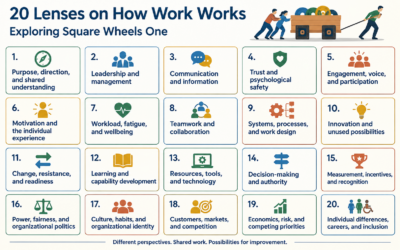
Invite different views. Have people compare observations in pairs, then hear several interpretations from the group. Maybe share some of the many themes that can be discussed, since most people will self-limit their views on things. (see the image of different Themes below)
Name some Square Wheels, specifically. Ask for specific delays, handoffs, rules, workarounds, or mixed messages. Record them without debating each one immediately. Record them so other outsiders not in the meeting would know what was meant by the item.
Notice the people around the wagon. Ask what makes it easier or harder to offer an idea, use a strength, ask for help, or take initiative.
Find some round wheels. Ask what the team already knows, has tried, or could test. Invite both creative ideas and practical concerns. But understand there is a tendency to jump on the first solution without considering other alternatives.
Choose one experiment to implement. Agree on an owner, a modest change, a measure, and a review date. Be clear about what the team can change and what needs a decision from elsewhere. Try to identify something with a high probability of success and not the most risky or difficult. (Do that one later!)
Followup! Return with a response. At the next meeting, say what happened, even if the idea did not work or could not be approved.
That final step is crucial. Asking for ideas and then disappearing with them can reinforce the very passivity the supervisor hopes to change. Visible follow-through gives people evidence that contributing is worthwhile.
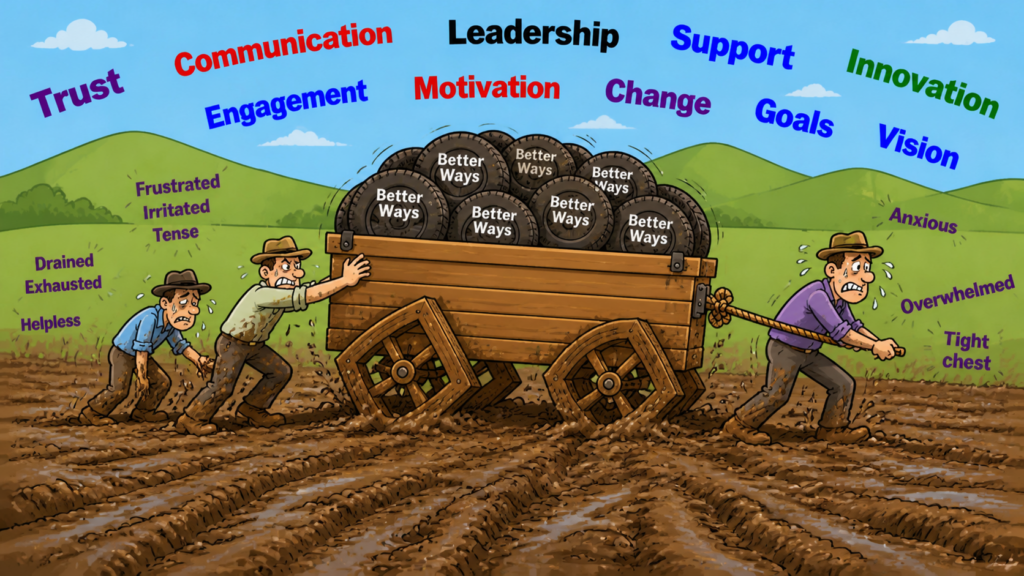
Some different Domain C themes and attributes
Make it easier to push (and pull!)
Some employees will be energized by an improvement conversation. Others may remain cautious, and with good reason. One useful meeting cannot undo a long history of ignored suggestions, excessive workload, or broken promises. Nor should a supervisor treat every instance of reduced effort as a problem that facilitation alone can solve.
But a supervisor can change the next interaction. They can replace “Why aren’t people more motivated?” with “What is happening in our work, and what have I not heard?” They can make room for different team strengths, examine the system, and help people test a better way. They can help people choose to be enabled to make changes of all types.
The Square Wheels image makes that conversation easier to begin. The supervisor’s facilitation — and, especially, their follow-through — makes it worth doing even though this is a new and novel approach for a supervisor. Facilitation is simply a great tool for engagement and UN-dis-empowerment.
The goal is not to persuade everyone to push a bad wagon harder.
The goal is to help the people who know the work put
a more efficient wheel on to their wagon.
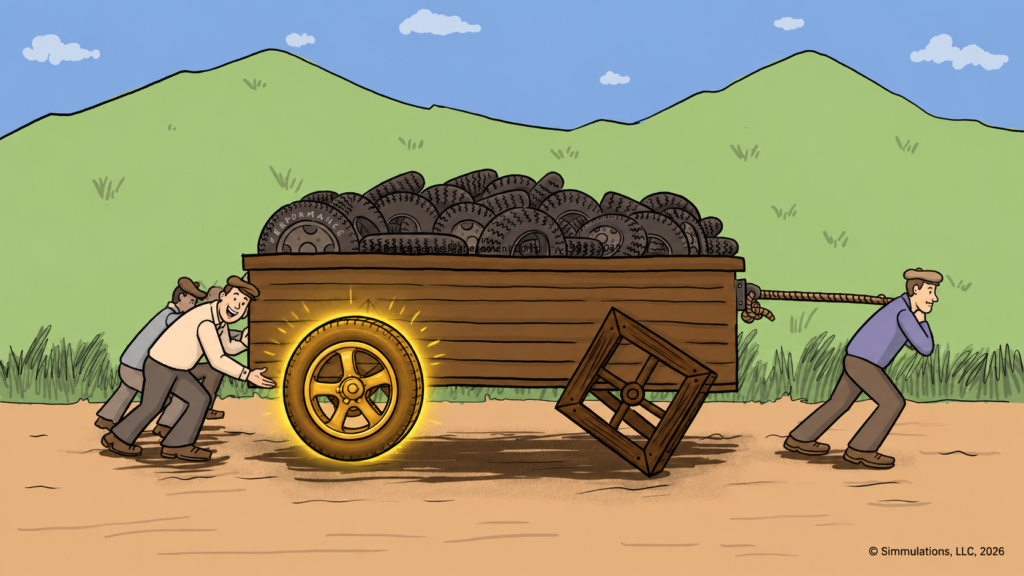
Engaging disengaged people is REAL Gold in its impacts
—
For the FUN of It!
 Dr. Scott Simmerman is a designer of team building games and organization improvement tools.
Managing Partner of Performance Management Company since 1984, he is an experienced presenter and consultant who is trying to retire!! He now lives in Cuenca, Ecuador.
You can reach Scott at scott@squarewheels.com
Learn more about Scott at his LinkedIn site.
Note that I often use Perplexity AI to help research and generate ideas for my posts.
Square Wheels® are a registered trademark of Simmulations, LLC
and images have been copyrighted since 1993,
© Simmulations, LLC 1993 – 2026
Note: Please do not take my images and think about using them. It can generate a whole heap of problems given international copyright law and trademark law. Read this article for more information.
See a detailed overview of my tools, background and experiences here.
What I’m About:
My Square Wheels blog and website exist to help leaders, trainers, and facilitators make work smoother, more engaging, and more human. I focus on practical tools for process improvement, organizational change, and workplace collaboration that spark insight and deliver measurable results.
And I am convinced, after 30+ years of using Square Wheels®, that it is the best facilitation toolset in the world. One can use it to involve and engage people in designing workplace improvements and building engagement and collaboration. It is a unique metaphorical approach to performance improvement and we can easily license your organization to use these images and approaches.
By blending proven facilitation methods, creative problem-solving, and engaging team activities, my mission is to support organizations in building energized, sustainable cultures of involvement and innovation.
Through accessible — and often free — resources and virtual facilitation tools, I aim to help teams everywhere collaborate more effectively, innovate continuously, and take ownership of their improvement journey.
#SquareWheels #InnovationAtWork #TeamEngagement #FacilitationTools #WorkplaceImprovement #EmployeeEngagement #CreativeProblemSolving #OrganizationalDevelopment #LeadershipTools #collaboration #leadership #motivation #communications #enablement #leadership #CreativeCommons #enablingperformance #teamwork #storytelling #storyasking #enablement #disruptiveengagement #un-dis-engagement #un-dis-empowerment #innovation

0 Comments