
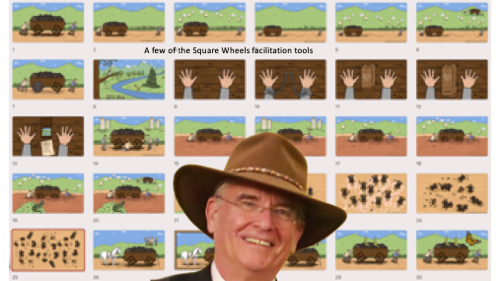
Who Is Dr. Scott J. Simmerman?
I’m Scott Simmerman, an organizational-development consultant, facilitator, and creator of the Square Wheels® visual tools and The Search for The Lost Dutchman’s Gold Mine team-building simulation. I founded Performance Management Company in 1984. My work helps supervisors, teams, and facilitators involve people in identifying what makes work harder than it needs to be—and in testing practical improvements.
Square Wheels begins with a simple image: people push a wagon on square wheels while round wheels sit unused in the wagon. The image gives a group a way to name frustrating processes without immediately blaming individuals. Participants identify the “round wheels” they could use, choose an improvement to try, and decide how they will follow through.
Lost Dutchman’s Gold Mine takes a different route. Teams make decisions about resources, routes, and coordination while pursuing a shared goal. The debrief connects their choices in the simulation to collaboration and competition at work. Both tools are designed to move people beyond an interesting conversation toward action.
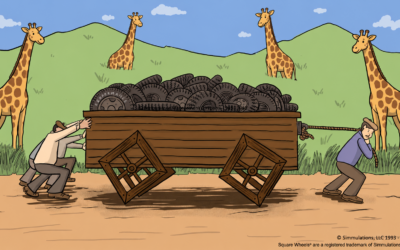
Some organizational-development professionals lead with a theory. I lead with an image (below): a wooden wagon rolling on wooden Square Wheels, people straining to push it forward, and round wheels already in the wagon, just not being used.
The image is simple, memorable, and disarmingly accurate. It captures a familiar workplace experience: capable people working hard inside systems, processes, habits, and assumptions that make their work harder than it needs to be. For more than four decades, I have built a career around sharing tools and helping people recognize those workplace and personal obstacles, having more productive conversations about them, and taking practical action to improve performance.

Scott J. Simmerman, Ph.D., CPF, CPT
My work is as an organizational-development consultant, facilitator, trainer, author, speaker, and learning-tool designer. I try to write a lot and share practical, operational ideas. More than that, I am a practitioner who has consistently translated complicated ideas about behavior, engagement, teamwork, and organizational improvement into accessible simple tools that people can actually use.
A Career Built Around People and Performance
Dr. Scott J. Simmerman, Ph.D., is the founder and managing partner of Performance Management Company since 1984. With doctoral training in behavioral neurophysiology / psychology, experience as a university professor, and a career devoted to consulting, facilitation, and learning design with corporations starting in 1978.
I am a Certified Professional Facilitator (IAF) and a Certified Professional Trainer (IAPPD) and an experienced presenter, sharing my ideas internationally in 49 countries. My work connects behavioral science and neurobiology with the realities of the workplace: how people collaborate, what motivates them, and why change is hard. It also addresses the obstacles that get in their way—unclear priorities, cumbersome processes, poor coordination, unnecessary competition, limited employee involvement, and changes that never quite become habits.
For decades, I have focused on a central practical question:
How can organizations make it easier for people to do good work?
That question has guided decades of work with managers, consultants, facilitators, trainers, and organizations around the world and hundreds of published articles.
The challenge is rarely a shortage of intelligent people or good intentions. More often, people need useful tools and processes to identify what is getting in the way, speak honestly without blaming one another, and decide together what to improve. That is the practical territory in which my world-class tools operate elegantly.
The “Square Wheels Guy”
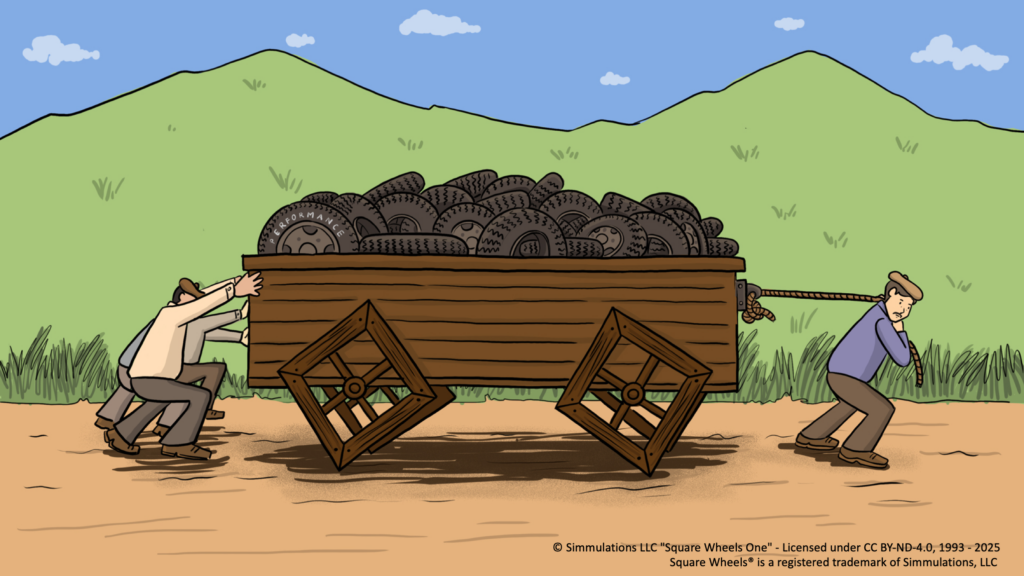
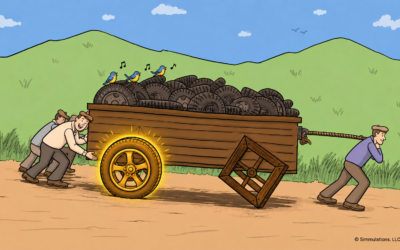
Square Wheels One is the main and original image in the collection of conversational tools. Ask yourself, “How might this represent how things really work in most organizations?”
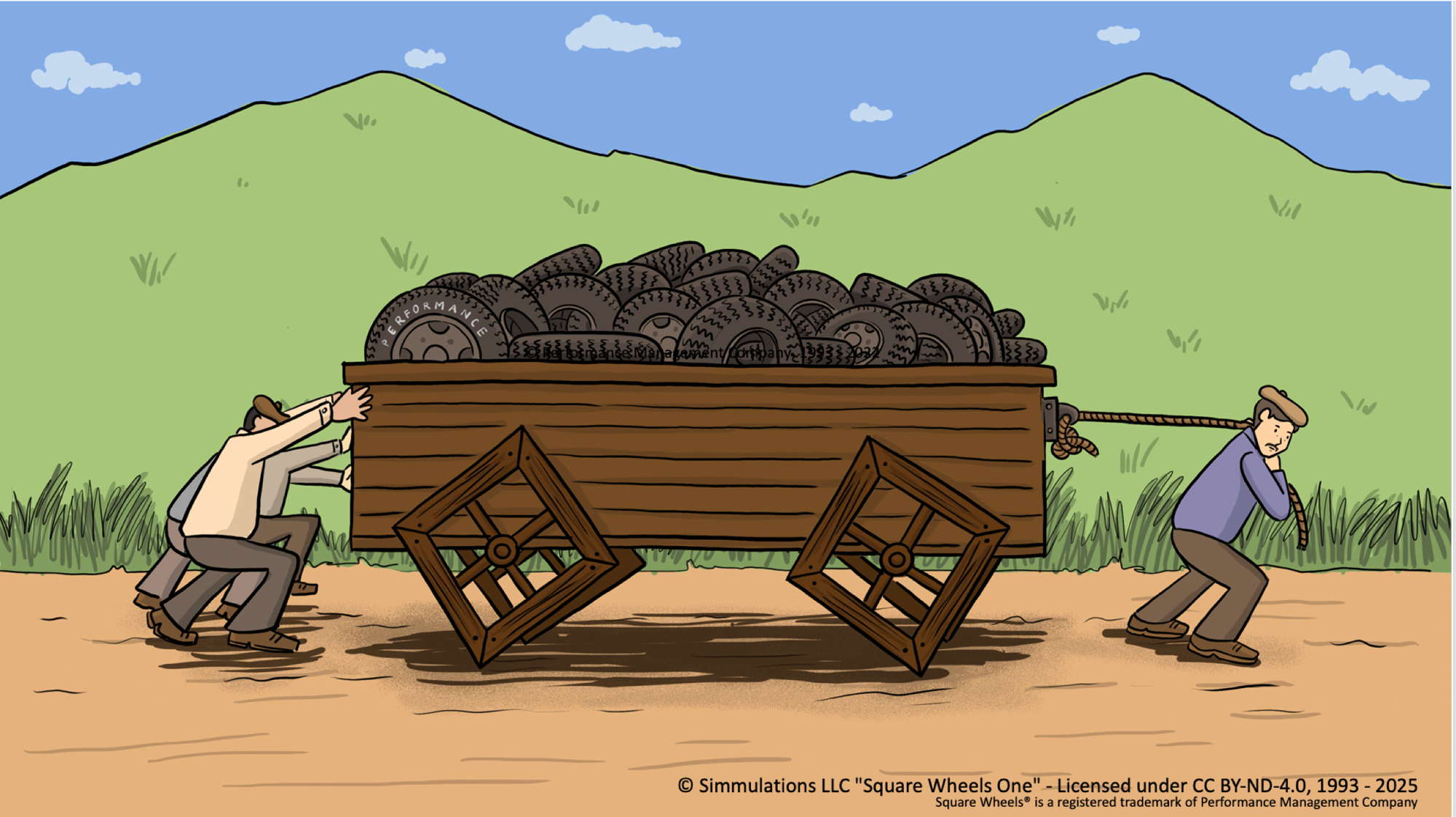
I’m widely known for creating Square Wheels® One and hundreds of other illustrations and visual-metaphor tools for organizational development and personal growth. The Square Wheels images are not merely cartoons but structured interactive tools that give people permission to discuss the realities of work in a way that is candid, constructive, and non-defensive. They are disruptive engagement tools for creating considered alternatives and the best tools in the world for creating the cognitive dissonance needed for motivating personal and organizational change.
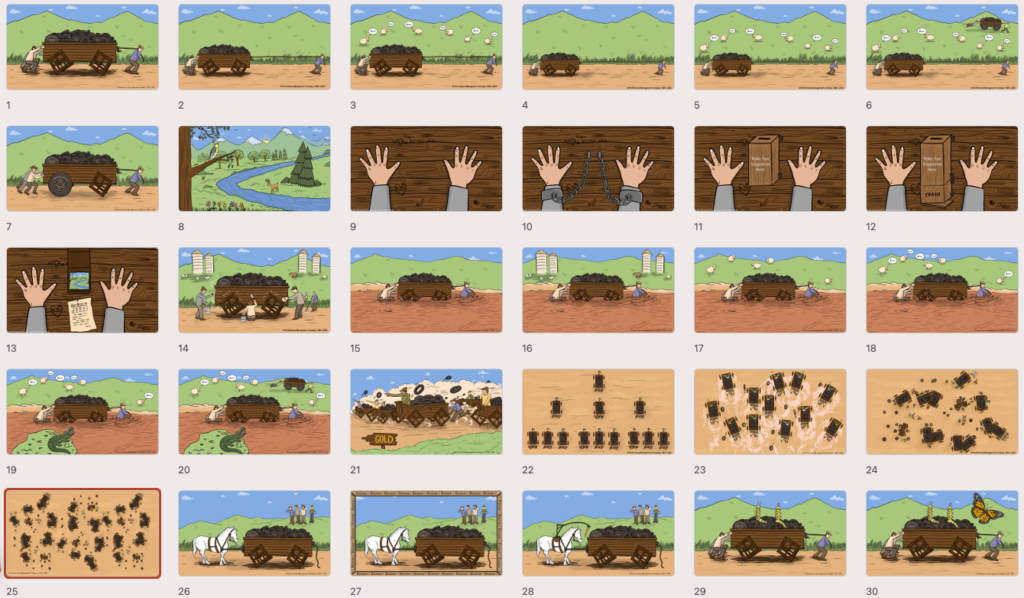
I have hundreds of images that anchor to improvement and cognitive dissonance about the workplace.
Looking at an image, ideas for improvement are immediately recognizable. The Square Wheels on the wagon represent the systems, procedures, practices, assumptions, and barriers that create drag. The paradox is that they work, but they do not work smoothly. The round wheels represent potential tangible improvements — often ideas, capabilities, or resources that are already in the wagon but ignored, inaccessible, under-supported, or not yet prioritized. The mud is the political and cultural crap and the horse is a paradigm shift. Silos represent isolation and non-collaboration and “boards and hands” represent the view of work of most employees. The list of actionable ideas goes on and on and the collective ideas represent real opportunities.
In a typical Square Wheels engagement process, participants:
- Look at a shared image and describe what they see and identify the themes they see and feel
- Identify specific “Square Wheels” that create friction, delay, frustration, or wasted effort
- Surface “round wheel possibilities”—ideas, resources, practices, or solutions that could help
- Prioritize a practical improvement process for implementing change, rather than merely collecting complaints
- Assign ownership and move toward actions and celebrate the successes.
This sequence is the point. The goal is not simply to generate energy, laughter, recognition, or a long list of frustrations. The goal is to create shared understanding, discussions of issues and opportunities, and the selection of a next step or steps, all with the goal of making work roll more smoothly.
Since beginning development of the Square Wheels tools in 1993, I’ve created a very extensive collection of more than 300 illustrations, metaphors and supporting materials. The tools have been used in discussions about employee engagement, teamwork, innovation, communication, leadership, change, customer service, strategic planning, and workplace improvement. And they have great implications for personal growth and change.
The Search for The Lost Dutchman’s Gold Mine: Learning by Doing
My contribution to teamwork extends far beyond a single Square Wheels visual metaphor. I am the original designer and an active, long-term developer of The Search for The Lost Dutchman’s Gold Mine, a flagship experiential team-building simulation from Performance Management Company.
For more than 30 years, we have continued to improve the game, its materials, its formats, and the ways it can be debriefed and applied to real organizational collaboration issues. The game is used globally by major corporations and a number of independent consulting and training companies. His role has not been limited to having an idea decades ago. It has included sustained attention to the design, delivery, refinement, user support, and learning impact of the experience, which continues even today.
The simulation places teams in a challenging, engaging environment in which they must make decisions about routes, resources, communication, and coordination in pursuit of a shared objective: to mine as much gold as WE can. It deliberately reveals the tension between narrow team competition and collective organizational success. And the game is really an excuse to do a powerful debriefing focused on organizational improvement. You can read more about Dutchman here.
Participants experience — and not just hear about — the negative consequences of:
- Competing with other groups rather than collaborating across boundaries
- Withholding information or failing to communicate clearly in trying to “win”
- Treating limited resources as something to protect rather than manage collectively
- Optimizing one team’s results at the expense of the larger system
- Losing sight of shared goals, alignment, and strategic cooperation
The value comes from the structured debrief. A powerful and engaging debriefing helps participants connect what happened in the simulation to what happens in their own organization: competition between teams, isolated silo behavior, departmental rivalry, misaligned incentives, resource conflicts, leadership choices, communication patterns, and opportunities for better collaboration.
The highly interactive program can be used with small groups or very much larger audiences, from 10 to 500, making it a flexible learning vehicle for team-development sessions, leadership programs, strategy discussions, off-sites, and organizational events. Its playful format makes the experience memorable; its carefully designed reflection process makes the learning transferable.
How the Two Tools Align, Purposely
Square Wheels® and The Search for The Lost Dutchman’s Gold Mine use different formats, but they reflect the same core philosophy: people learn more deeply when they are actively involved in making sense of an experience and applying that insight to their own work.
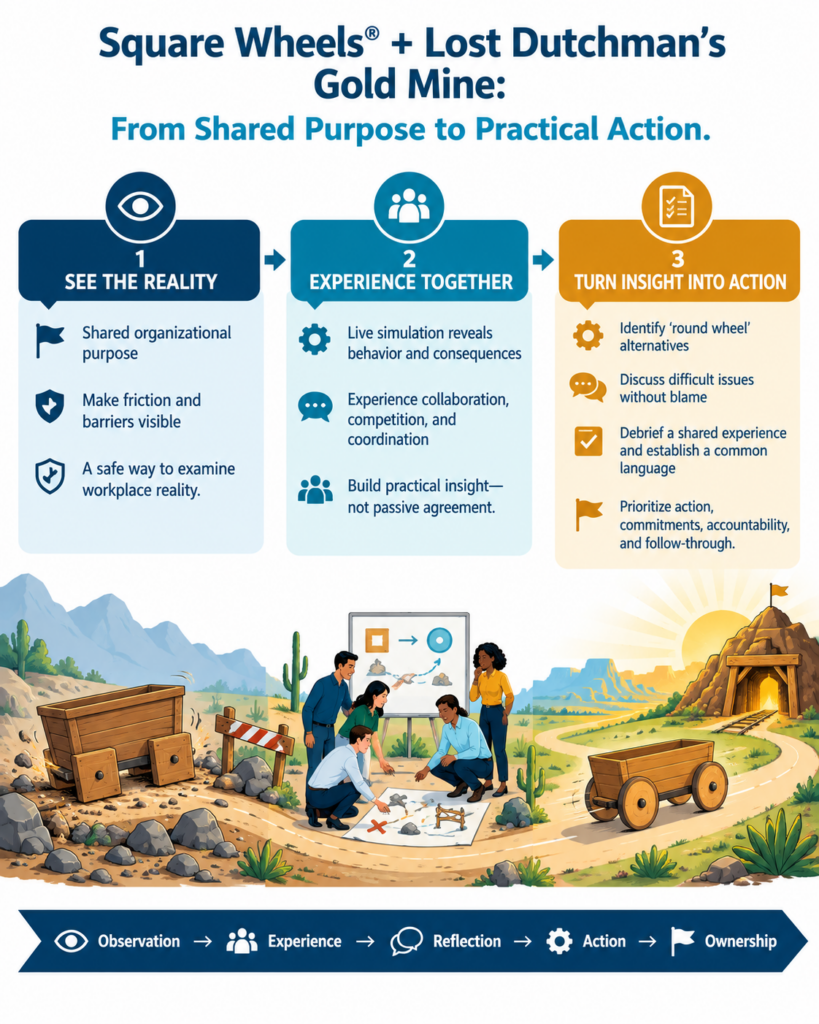
| Square Wheels® | Lost Dutchman’s Gold Mine | Shared organizational purpose |
| Uses a visual metaphor to make friction visible | Uses a live simulation to make behavior and consequences visible | Creates a safe way to examine workplace reality |
| Invites people to identify barriers and “round wheel” alternatives | Lets teams experience the effects of collaboration, competition, and coordination | Builds practical insight rather than passive agreement |
| Makes it easier to discuss difficult issues without immediately blaming people | Gives participants a common experience that can be openly debriefed | Establishes a shared language for improvement |
| Moves from observation and discussion to prioritized action | Moves from experience and reflection to changed commitments | Encourages ownership, accountability, and follow-through |
In other words, Square Wheels helps people see and name what is slowing their work down and their round wheels can represent best practices or innovative ideas to try. The process of working with the images is to define new considered alternatives as well as to create some cognitive dissonance between the way things are and the possibilities.
Lost Dutchman’s Gold Mine lets people experience the behavioral choices that either improve or impair collective performance. Both approaches are designed to engage people rather than lecture at them. Both are designed for interactive discussions and choices about what might be done differently.
That alignment is central to my work with organizational improvement. These learning experiences create involvement, generate insight, and encourage people to make better choices together with their considered alternatives to current realities.
Supervisors: The Daily Lever of Engagement
A major focus of my legacy thinking is strengthening the skills of supervisors, because they have direct, daily influence on how people experience the workplace. They shape whether people are listened to, whether ideas are surfaced, whether problems are addressed constructively, and whether improvement feels possible.
This is not an argument that supervisors must have all the answers but an awareness that they need better ways to involve the people doing the work.
Scott’s vision is for supervisors to use Square Wheels as a short, practical, regular facilitation process with their teams, with followup to generate implementation and support for continuous continuous improvement.
Rather than becoming “talking managers” who announce solutions, supervisors can become co-creators of traction: people who ask good questions, draw out useful observations, help the group distinguish real barriers from surface complaints, prioritize ideas, and build follow-through. These are simple skills.
(See this blog as an example of how to involve workers in using AI, for example.)
The aim is practical workplace engagement. Employees are more likely to become involved when they can see that their observations matter, their ideas are heard, and the group is willing to act on what it learns. Scott believes that the Square Wheels metaphors provide an approachable method for turning general dissatisfaction into constructive, visible, team-owned opportunities for improvement.
A Practical Philosophy of Facilitation
At the center of my work is a belief that people closest to the job often see both the problems and the possibilities. This is confirmed by his decades of experiences in working with people in organizations. Effective facilitation does not begin with the consultant, executive, or supervisor announcing the answer. It begins by creating conditions in which participants can describe their experience, think together, and claim ownership of a useful response.
The approach also carries an important caution for anyone who designs meetings, workshops, or team-building programs: participation is not the same as progress. A session becomes valuable when people leave with a more useful understanding of the issue, a realistic commitment to try to do things differently, and a way to learn from what happens next.
Focus Areas and Skills
The work and my thinking about people and performance brings together several complementary capabilities:
| Area | What my approach brings |
| Organizational Development | Practical tools and processes for improving the way work gets done |
| Facilitation | Question-driven conversations that help groups discover issues and take ownership of solutions |
| Employee Engagement | Methods for involving people in identifying barriers, opportunities, and improvements |
| Supervisor Development | Practical approaches that help front-line leaders listen, facilitate, involve, prioritize, and follow through |
| Team Development | Experiential simulations and debriefs that expose collaboration and decision-making patterns |
| Leadership and Communication | Approaches that help leaders create clarity, involvement, accountability, and better conditions for performance |
| Visual Communication | Memorable illustrations and metaphors that make complex workplace issues easier to discuss |
| Learning design | Turnkey training materials, games, exercises, and workshop processes with real-world application |
| Writing and thought leadership | Articles, blogs, stories, metaphors, and practical commentary on people and performance |
Frequently Asked Questions
Who is Dr. Scott Simmerman?
Dr. Scott J. Simmerman, Ph.D., is an organizational-development consultant, facilitator, trainer, author, and learning-tool designer. He founded and has managed Performance Management Company since 1984. He is best known for creating the Square Wheels® organizational-development tools and designing The Search for The Lost Dutchman’s Gold Mine team-building simulation. His LinkedIn profile is here: https://www.linkedin.com/in/scottsimmerman/
What is Dr. Simmerman’s professional focus?
His work focuses on employee engagement, organizational improvement, teamwork, collaboration, leadership and supervisory effectiveness, facilitation, communication, innovation, and practical performance improvement. His emphasis is on helping people see workplace barriers clearly and become involved in improving them. He develops powerful tools others can use built on simple models about people and performance.
What are Square Wheels®?
Square Wheels are visual metaphors and facilitated discussion tools that help people talk about “how things really work.” Square wheels symbolize the processes, habits, systems, and assumptions that make work difficult. Round wheels represent practical ideas and resources that can improve the way work is done. The Square Wheels tools are a totally unique and extremely effective conversational tool in the global marketplace. Scott is all about collaborating to support the broader use of these tools.
Are Square Wheels® simply cartoons or icebreakers?
No. The illustrations are intended to be a serious, accessible entry point into conversations about work, performance, and improvement. They can make difficult issues safer to discuss, but their value depends on facilitation, prioritization, action, and follow-through. They are very memorable as well as actionable in creating cognitive dissonance around how things really work.
How do Square Wheels® support employee engagement?
Involvement with the images and metaphors give employees a shared language and collaborative discussions around identifying obstacles and suggesting improvements. When leaders and supervisors use the process, everyone can see their experience acknowledged, their ideas collected, and their contributions connected to visible action.
What is The Search for The Lost Dutchman’s Gold Mine?
It is an experiential team-building simulation designed by Dr. Simmerman. Teams make decisions about routes, resources, coordination, and communication while working toward a collective outcome. Many see it as the best team building simulation in the world focused on issues of collaboration and organizational alignment. The debriefing focuses on the choices teams make and on doing things differently to optimize results. The activity creates a memorable way to explore teamwork, leadership, collaboration, alignment, strategic planning, and the organizational costs of siloed competition and is sold globally.
Why is Lost Dutchman’s Gold Mine more than a game?
The activity is designed around a structured debrief that connects participants’ choices in the simulation to their workplace behavior. The learning comes from examining what happened, why it happened, and what the group will do differently afterward and not merely from playing the game. It is an excuse to do a debriefing around considered alternatives.
How are Lost Dutchman’s Gold Mine and Square Wheels® related?
They use different methods but pursue the same outcome: active involvement in organizational learning, reflection on issues and opportunities and for implementing improvement ideas. Square Wheels helps people identify workplace friction and potential solutions; Lost Dutchman’s Gold Mine helps people experience the importance of collaboration, communication, alignment, and collective performance.
What makes these tools useful for supervisors?
Supervisors influence the day-to-day experience of work. Square Wheels gives them a practical structure for listening, facilitating discussion, collecting ideas, involving employees, setting priorities, and tracking follow-through. It helps shift the supervisor’s role from simply directing work to enabling productive team problem solving.
Do supervisors need to be expert facilitators to use Square Wheels®?
No. The tools are designed to make facilitation more accessible. Supervisors do need to be willing to ask open questions, listen carefully, avoid rushing to prescribe every answer, and help the group move toward a clear next action. The images are now supported by simple-to-use AI tools for capturing ideas and generating alternatives.
What types of organizations can use these tools?
The tools can be adapted for businesses, public-sector organizations, nonprofit groups, healthcare settings, educational institutions, operational teams, leadership groups, remote or hybrid teams, and consultant-led workshops. Their adaptability comes from the fact that every organization has processes, relationships, and performance issues worth examining.
What is the central message of Dr. Simmerman’s work?
People should not have to keep pushing on Square Wheels when better ways of working are already within reach. Good organizational development and active involvement help people see the friction, involve those closest to the work, surface practical round wheels, and build ownership for meaningful change.
The Bottom Line
I am best understood as an experienced organizational-development practitioner who has made improvement easier to see, easier to discuss, and easier to begin. Through Performance Management Company, Square Wheels®, The Search for The Lost Dutchman’s Gold Mine, supervisor-development ideas, and decades of facilitation and presentation work are focused on turning the often-complicated fields of engagement, teamwork, and organizational change into practical conversations and usable action.
My tools are engaging because they actively involve people. Their value is deeper than their simplicity: they help groups see how work really happens, recognize the consequences of their choices, and create better ways to move forward together.
My enduring message is straightforward:
People should not have to keep pushing on Square Wheels when better ways of working are already within reach. And the Goal is to mine as much gold as WE can.
Perplexity’s editorial note: This overview draws on biographical and program information published by Performance Management Company and on attached documents which describes the Square Wheels process as guided discovery: use a shared visual metaphor to surface workplace friction, identify viable “round wheels,” prioritize action, and build ownership for change.
—
For the FUN of It!
Dr. Scott Simmerman is a designer of team building games and organization improvement tools.
Managing Partner of Performance Management Company since 1984, he is an experienced presenter and consultant who is trying to retire!! He now lives in Cuenca, Ecuador.
You can reach Scott at scott@squarewheels.com
Learn more about Scott at his LinkedIn site.
Note that I often use Perplexity AI to help research and generate ideas for my posts.
Square Wheels® are a registered trademark of Simmulations, LLC
and images have been copyrighted since 1993,
© Simmulations, LLC 1993 – 2026
Note: Please do not take my images and think about using them. It can generate a whole heap of problems given international copyright law and trademark law. Read this article for more information.
What I’m About:
My Square Wheels blog and website exist to help leaders, trainers, and facilitators make work smoother, more engaging, and more human. I focus on practical tools for process improvement, organizational change, and workplace collaboration that spark insight and deliver measurable results.
And I am convinced, after 30+ years of using Square Wheels®, that it is the best facilitation toolset in the world. One can use it to involve and engage people in designing workplace improvements and building engagement and collaboration. It is a unique metaphorical approach to performance improvement and we can easily license your organization to use these images and approaches.
By blending proven facilitation methods, creative problem-solving, and engaging team activities, my mission is to support organizations in building energized, sustainable cultures of involvement and innovation.
Through accessible — and often free — resources and virtual facilitation tools, I aim to help teams everywhere collaborate more effectively, innovate continuously, and take ownership of their improvement journey.
#SquareWheels #InnovationAtWork #TeamEngagement #FacilitationTools #WorkplaceImprovement #EmployeeEngagement #CreativeProblemSolving #OrganizationalDevelopment #LeadershipTools #collaboration #leadership #motivation #communications #enablement #leadership #CreativeCommons #enablingperformance #teamwork #storytelling #storyasking

0 Comments