
Everything Is Fine. So Why Are We Rolling on Square Wheels? Personal growth, better questions, and a lesson from Chicago’s “Dialogue” about why we just keep rolling along.
Sometimes, the biggest obstacle to improvement is not that we cannot see a better way. It’s that we have become comfortable enough with the current way things are to stop looking for new ideas.
Our wagons move forward. Our work gets done. We make it through another week.
Sure, it often takes more effort than we would like. There are bumps, frustrations, and those familiar problems that keep showing up wearing slightly different clothes.
But we are moving. So, everything must be fine, right?
That is where the musical group Chicago’s “Dialogue (Part I & II)” offers an interesting soundtrack for personal and organizational growth, and thoughts about a wagon rolling on Square Wheels®.
Two great voices. One uncomfortable conversation. (And ya gotta actually Listen here – it is powerful stuff!!) (Repeating lyric = “We can make it happen.”) Because we can!
(Note: — I have just played it 4 times in a row and I am still listening as I write this! *edit – 8.)
 Written by keyboardist Robert Lamm and released on Chicago’s 1972 album Chicago V, “Dialogue” features an exchange between characters sung by Terry Kath (love that guy! Incredible lead guitar) and Peter Cetera (with his great vocals and bass). One asks searching questions about the world’s problems. The other responds with detachment, largely insulated from the concerns being raised. The song eventually shifts from that exchange toward a collective call for change.
The song addresses social issues, but there is another conversation inside it: Its the one we have with ourselves. Terry Kath sings, “Will you try to change things… Use the power that you have, the power of a million new ideas.”
And Peter Cetera sings, “Well, if you had my outlook your feelings would be numb You’d always think that everything was fine.”
These are quotations from the song, representing things happening in 1972 “as a feeling human being” and they are the everyday dialogue I imagine happening around my own Square Wheels images and metaphors when discussed in the workplaces. Some people want change but not everyone sees things as a problem. This needs discussion!
And sometimes, the reassuring voice wins that everything is fine before the questioning voice finishes its sentence. Sometimes, people aren’t seeing and listening.
The wagon is rolling. That does not mean the wooden wheels and other things are working well.
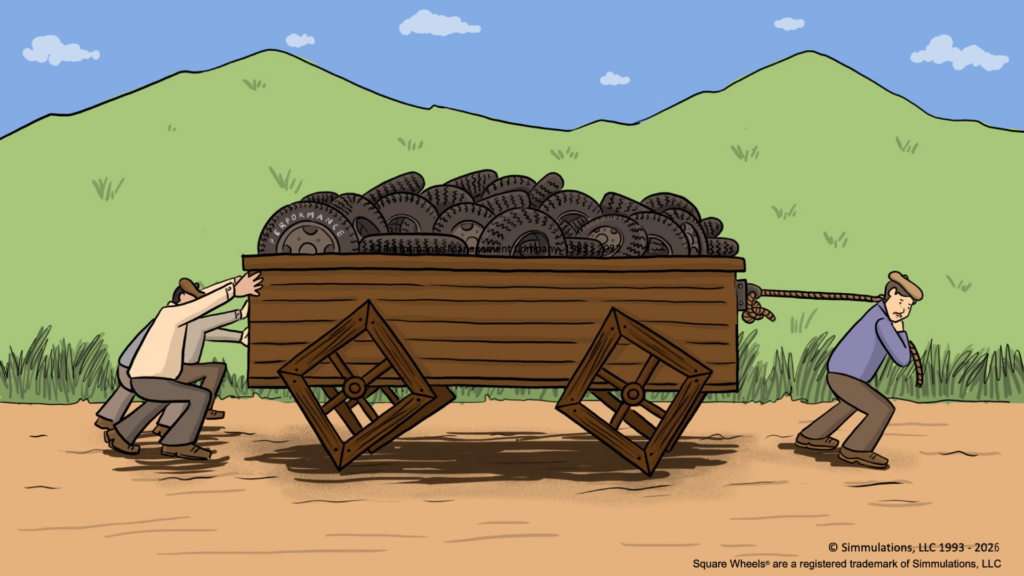
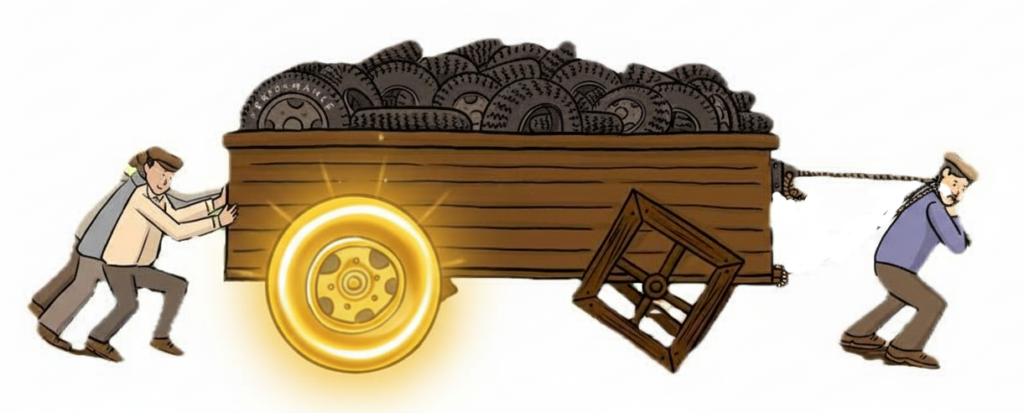
Look at the above and not that Inside the wagon are round wheels.
That is the central paradoxical contradiction of the Square Wheels metaphor: we can keep putting effort into moving forward while carrying possibilities that could make the journey easier. Or we can look for alternatives.
In personal growth, those Square Wheels might represent:
-
A habit we defend because it is familiar.
-
A reaction we excuse by saying, “That is just how I am.”
-
A goal we keep postponing until life becomes less complicated.
-
A way of working that once helped us but now holds us back.
-
An assumption we have repeated so often that we mistake it for a fact.
The round wheels are possibilities, not promises. They might be a different approach, a conversation, a skill to practice, or an idea we have not yet tested. Or so many other things that consider improving on the square ones.
But first, we have to notice the thumping and bumping.
And acknowledge that some of it might be avoidable.
Is everything fine—or merely familiar?
That is the question I would place beside Chicago’s song, playing in the background of the thinking.
Not every difficulty means something needs to change. Not every new idea is a round wheel. And a useful life does not require us to turn ourselves into an endless improvement project.
But there is a difference between being content and refusing to look.
“I am satisfied with this” is a choice.
“I have never really examined this” is something else.
Consider a few personal questions:
-
Where am I repeatedly frustrated by the same situation?
-
What do I keep explaining away rather than examining?
-
What feedback do I dismiss before I understand it?
-
Where have I confused being busy with making progress?
-
What am I waiting for someone else to change?
These are not invitations to find fault with ourselves. They are invitations to become curious about your journey. And the point is not to declare the whole wagon broken. It is to notice which wheel or which wheels deserve attention.
The dialogue for change benefits from different voices
The Square Wheels One image also raises a useful question: what can the people behind the wagon see that the person pulling it cannot?

Applied personally, that becomes:
What might someone else notice about my approach that I have stopped noticing?
We can invite that perspective without handing someone else control of our lives.
Try asking a trusted person:
“What is one thing you see me doing that seems to make things harder than they need to be?”
Then comes the difficult part. Listening and reflection, without immediately explaining why you do it. Listen and contemplate. Think different and divergently.
For this exercise, the task is not to agree with every observation.
It is to understand it before deciding what to do with it.
It is to contemplate and reflect.
You might hear something useful. You might discover a misunderstanding. Either way, you have opened a dialogue instead of simply replaying your own answer.
From a good conversation to one different action
Chicago’s song moves from contrasting perspectives toward an appeal for collective action. That transition is what makes it such a useful companion to this metaphor: noticing and talking are not the same as changing.
We can have a wonderful discussion about round wheels and still leave them sitting in the wagon.
So, make the next step small and specific.
-
Name one recurring bump. Describe the situation without turning it into a judgment about your character.
-
Identify the Square Wheel. What habit, assumption, or response might be contributing?
-
Choose one possible round wheel. What could you try differently?
-
Run a modest experiment. Try it in one conversation, one task, or one week.
-
Review what happened. Keep, adapt, or abandon the idea based on what you learn.
You do not have to redesign your entire life.
You do have to do something differently if you want to find out whether a different result is possible.
It’s a way better framework than “Everything is fine”
For me, the personal-growth lesson in “Dialogue” is not that we should worry more.
It is that we should be more willing to engage—with what we see, with what other people experience, and with our own capacity to respond.
Curiosity gives us a useful alternative to both complacency and self-criticism:
Some things are working. Some things are difficult.
And there may be a better way to move forward.
The wagon does not have to stop forever. And the round wheels are already in the wagon.
Perhaps we could pause long enough to look inside. And consider possibilities.
—
For the FUN of It!
 Dr. Scott Simmerman is a designer of team building games and organization improvement tools.
Managing Partner of Performance Management Company since 1984, he is an experienced presenter and consultant who is trying to retire!! He now lives in Cuenca, Ecuador.
You can reach Scott at scott@squarewheels.com
Learn more about Scott at his LinkedIn site.
Square Wheels® is a registered trademark of Simmulations, LLC
and images are © Simmulations, LLC 1993 – 2026
Note: Please do not take my images and think about using them. It can generate a whole heap of problems given international copyright law and trademark law. Read this article for more information.
See a detailed overview of my tools, background and experiences by clicking here.
What I’m About:
My Square Wheels blog and website exist to help leaders, trainers, and facilitators make work smoother, more engaging, and more human. I focus on practical tools for process improvement, organizational change, and workplace collaboration that spark insight and deliver measurable results.
And I am convinced, after 30+ years of using Square Wheels®, that it is the best facilitation toolset in the world. One can use it to involve and engage people in designing workplace improvements and building engagement and collaboration. It is a unique metaphorical approach to performance improvement and we can easily license your organization to use these images and approaches.
By blending proven facilitation methods, creative problem-solving, and engaging team activities, my mission is to support organizations in building energized, sustainable cultures of involvement and innovation.
Through accessible — and often free — resources and virtual facilitation tools, I aim to help teams everywhere collaborate more effectively, innovate continuously, and take ownership of their improvement journey.
#SquareWheels #InnovationAtWork #TeamEngagement #FacilitationTools #WorkplaceImprovement #EmployeeEngagement #CreativeProblemSolving #OrganizationalDevelopment #LeadershipTools #collaboration #leadership #motivation #communications #enablement #leadership #CreativeCommons #enablingperformance #teamwork #storytelling #storyasking #enablement #disruptiveengagement #un-dis-engagement #un-dis-empowerment #innovation
© 2026 Simmulations, LLC. Please note that “Square Wheels®” is a registered trademark of Simmulations, LLC. and materials, original wagon line art, text, and visual designs are protected. Original line art by Roy Sabean, used under rights owned by Simmulations, LLC and formerly Performance Management Company, a sole-proprietorship of Dr. Scott J. Simmerman. Original concept and source artwork © Simmulations, LLC; derivative visuals sometimes created with assistance from Perplexity Pro AI.


0 Comments