
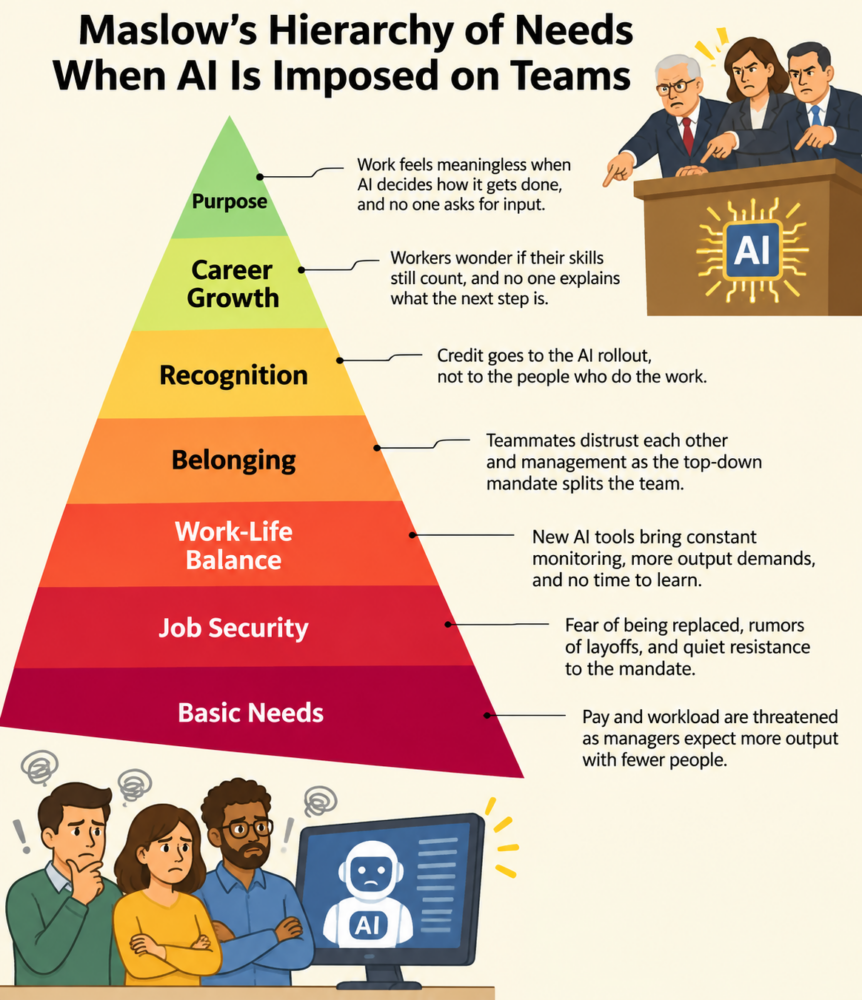
When AI Is IMPOSED, the well-known motivational model of Maslow suffers and his Pyramid cracks from the bottom up. Some thoughts about alternative behaviors.
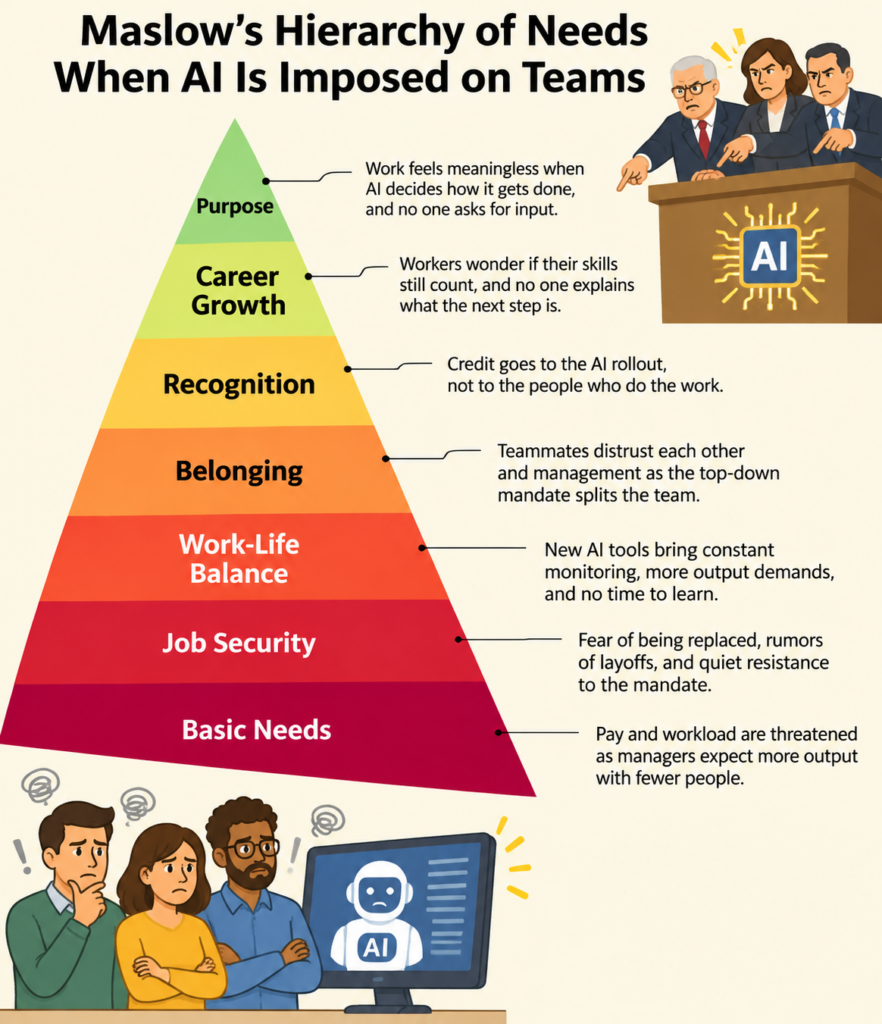
Justin Wright is right that the order matters in the Maslow motivational pyramid he shares below. If pay, security and belonging are shaky, people can’t give you growth and purpose. An imposed AI rollout hits the bottom levels first, so the top levels fail as a result. Let’s expand on this a little with his grephic below…
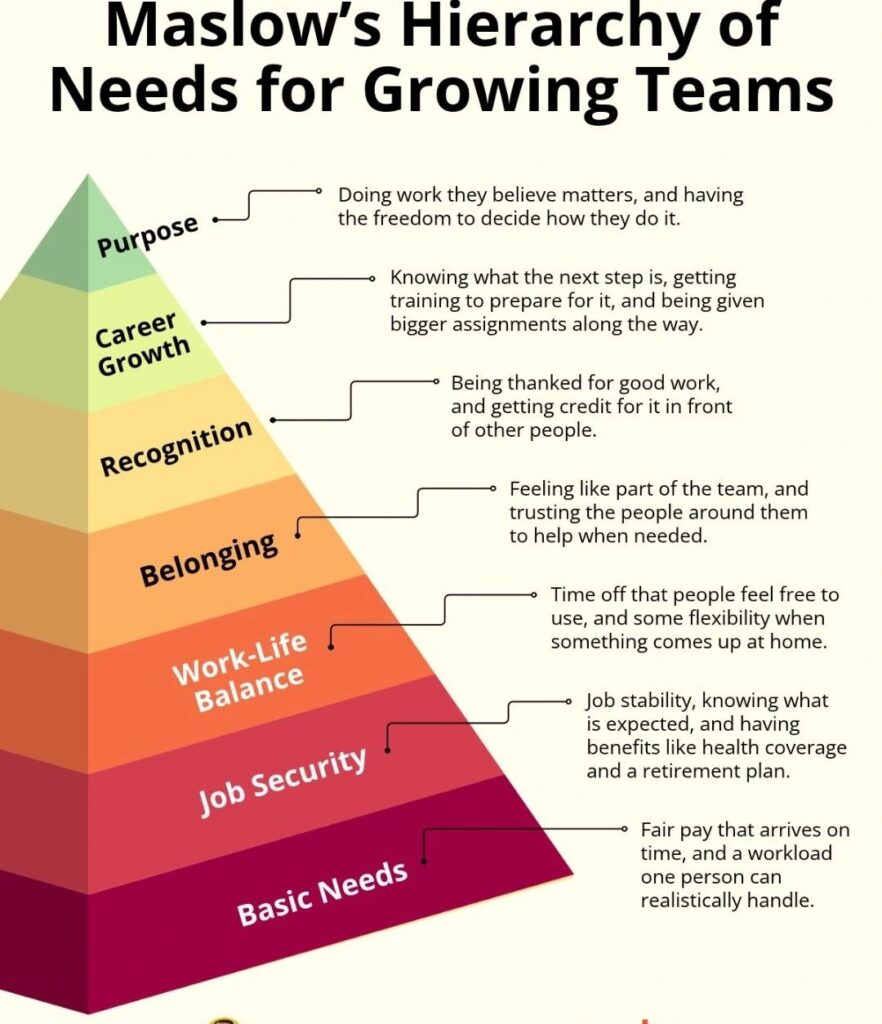
When imposing AI tops down, we “Ask for Growth. We Create Fear.”
Leaders ask people to take on more, learn faster, and care about the mission. Then they wonder why it isn’t happening.
Justin Wright, a former corporate leader at a global $4B company, put it simply on LinkedIn. When people worry about pay, security or belonging, they can’t think about anything higher. He saw this clearly only after he started his own company, because a large HR team had always covered the bottom of the pyramid for him. Once he owned payroll and benefits himself, he knew that talk of growth and purpose means little until the basics are in place.
I think that logic explains what happens when AI is imposed on a team. A top-down mandate usually pushes on the bottom of the pyramid first. So leaders who announce an AI strategy and then ask for “buy-in” are asking for Level 7 behavior from people who feel threatened at Level 1. More on that in a bit.
When the Bottom of the Pyramid Cracks, Helplessness Fills the Gap
Justin Wright’s point is that pay, security and belonging have to come first, and most AI mandates tend to shake all three at once. Psychologist Martin Seligman explains what happens next. In the 1960s, he and Steven Maier found that dogs given shocks they couldn’t control later stopped trying to escape, even when escape was possible. What mattered was not the pain but the lack of control. Animals that could stop the same shocks did not become passive. Researchers later found the same motivational deficit in humans, and called it learned helplessness. (Personally, I have always used the term “conditioned helplessness” to describe this because it is a conditioned response that is also learned.)
Now picture a typical tops-down AI rollout. Senior managers pick the tool, set the usage expectations and ask few people for input. The sales people say it will work as might the IT people. The work teams learn (again) that its skills, concerns and suggestions don’t change what happens. Workplace research shows that jobs with high demands and little control are linked to helplessness and poorer health outcomes. And the isolation of senior managers and IT from the workplace has its expected outcomes.
On the surface it looks like there is compliance, since people click the buttons and attend the training and nod their heads in meetings. Underneath, however, initiative and creativity fade. Leaders often misread this as resistance to change or a skills gap. Wright would likely say the bottom levels of the pyramid are shaky, so people can’t think about growth or purpose. I call it un-empowerment.
There is good news if we were paying attention. In 2016, Maier and Seligman revised the helplessness theory, arguing that passivity is the brain’s default response to prolonged adversity, and that what people actually learn is control.
So the fix to this apparent resistance and compliance is to restore control and enable people to actually make intelligent choices. Give teams real authority over how AI fits into one process, track what changes, and report back. Be careful with the label, though. If employees’ ideas keep disappearing without a reply, going quiet can be a sensible choice and not a psychological flaw. As Wright says, cover the bottom of the pyramid first. In an AI rollout, that means certainty, fairness and a voice for the people who do the work. Remember that people can be really adaptable and use this to your benefit.
Walking up Maslow’s Pyramid, Level by Level – the basics
Level 1, Basic Needs. Wright’s version shown in the graphic above is fair pay on time and a workload one person can realistically handle. In the imposed-AI version, pay and workload feel threatened because managers expect more output with fewer people. Gallup found that AI-related job anxiety is linked to lower engagement (0.20 standard deviations lower) and higher burnout (0.18 higher).
Level 2, Job Security. Wright describes stability, clear expectations, health coverage and a retirement plan. With imposed AI, people fear replacement, hear layoff rumors, and quietly resist the mandate. Mercer reports that global employee concern about AI job loss rose from 28% in 2024 to 40% in 2026. Gallup puts the share of U.S. workers who think AI will likely eliminate their job within five years at 18%. Fear also grows with use. Gallup found that frequent AI users are more than twice as likely to fear job elimination as occasional users. The one exception is workers exposed to well-structured management practices that enable them to use the tools effectively.
Level 3, Work-Life Balance. Wright’s version is time off that people feel free to use, plus flexibility when home life intrudes. Imposed AI brings constant monitoring, more output demands, and no time to learn. A 2026 systematic review found that AI monitoring and algorithmic control were generally associated with more burnout and strain, through time pressure and reduced autonomy. After all, who wants to be monitored and thus controlled? Assistive AI was generally associated with less burnout. The same technology helps or hurts depending on how it is used. (And there is a LOT of research happening around all this.)
Level 4, Belonging. Wright describes feeling part of the team and trusting others to help as very important to enablement. A mandate splits that team, so teammates distrust each other and management. Fast Company reports that 48% of employees now worry about being judged for not using AI enough, against 20% who worry about being judged for using it. That is peer pressure created by the mandate itself.
Level 5, Recognition. Wright’s version is being thanked and getting credit in front of others. When AI is imposed, the credit goes to the AI rollout and not to the people doing the work.
Level 6, Career Growth. People want to know the next step, get training for it, and receive bigger and better assignments. Under imposed AI, workers wonder whether their skills still count, and no one explains what comes next. Gallup’s advice points the other way. Direct manager conversations, mentorship and visible investment in development produce the highest returns.
Level 7, Purpose. Wright’s top level is doing work that matters, with freedom over how to do it. It is the first level to go when the tool decides how work gets done and nobody asks for input. The work feels meaningless to the people doing it.
Things change for the pyramid when AI is being imposed. I simply share this reframe of the reality:
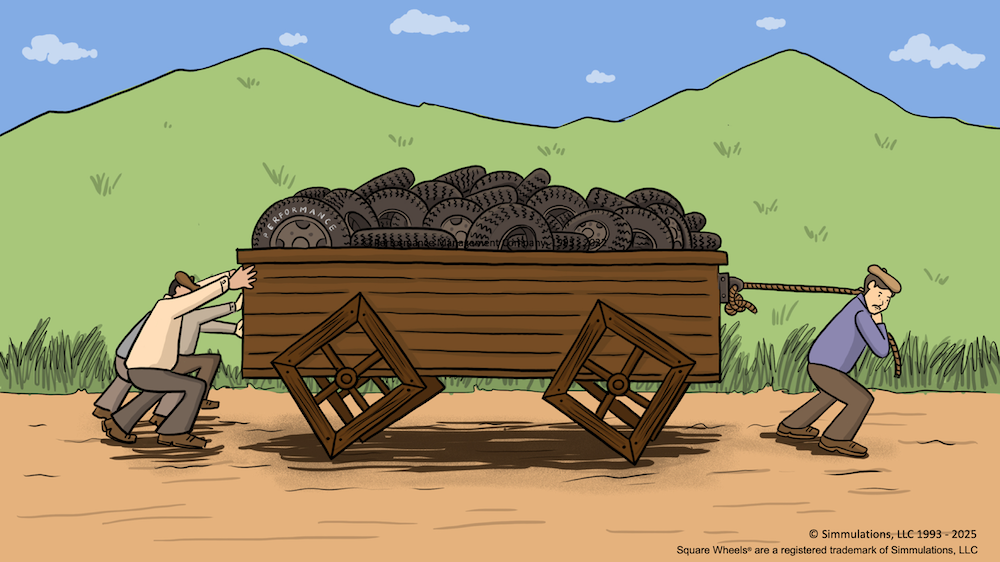
The Square Wheels Connection
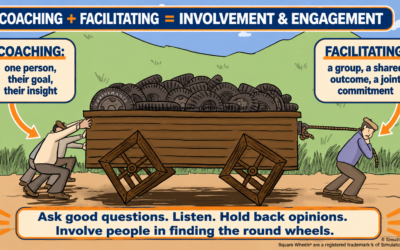
This is the classic Square Wheels One picture below. Leadership sees a better way to move the load, and the people pulling the wagon aren’t consulted. The “round wheels” of AI may already be in the wagon. Yet workers feel the mandate, the monitoring and the unanswered questions, and they stop engaging, causing some wagon pullers to ask, “Are the people at the back pushing or pulling?”
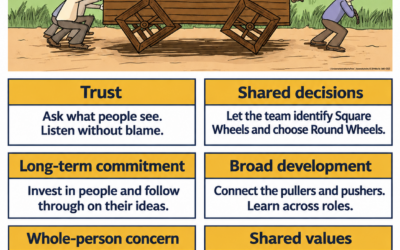
What Leaders Can Choose to Do Differently to implement AI with their people
Involvement starts with “where our wagon thumps and bumps,” engagement comes from personal commitment, and the key question becomes what people need in order to try an improvement and be enabled in their workplaces.
One – Settle the bottom first. State plainly what AI means for jobs, pay and workload. Silence gets filled with rumors. Be real and be honest and, if you do not know, ask upwards for some answers.
Two – Protect learning time. Training should be paid time on the clock, not an extra duty added to a full load. Show it is important and pay people for their development time.
Three – Use assistive AI, not surveillance. Where monitoring is unavoidable, offer transparent rules, employee voice, and a way to appeal.
Four – Give credit to people. Name the individuals who made the AI work, not just the project. Make it personal, because individuals were involved and they made the choice to support the initiative.
Five – Ask the team. Let the people doing the work help decide how AI fits in, which protects purpose and autonomy. Teams are a much better way to approach apparently risky ventures, but also support those individuals responding to the challenges. You will have both.
Six – Track engagement as an early warning. Gallup says falling engagement can signal rising AI anxiety before turnover starts.And the reality is that some percentage of the disengaged will be actively disengaged, sometimes actually working to sabotage improvement initiatives for many different reasons. Involve, engage and enable.
Does Maslow Still Hold Up?
Wright ended his post by asking if a 1943 theory still holds 83 years later. I’d say the order of the pyramid isn’t the only thing that holds up. Its main use today is as a diagnostic for analysis of change and improvement. When an AI rollout stalls, don’t ask why people lack vision or why they do not get it. Check which level of the pyramid you may have broken.
Your turn: Where is your team in the pyramid right now, and what did your last AI announcement do to the bottom two levels?
—
For the FUN of It!
 Dr. Scott Simmerman is a designer of team building games and organization improvement tools.
Managing Partner of Performance Management Company since 1984, he is an experienced presenter and consultant who is trying to retire!! He now lives in Cuenca, Ecuador.
You can reach Scott at scott@squarewheels.com
Learn more about Scott at his LinkedIn site.
Square Wheels® is a registered trademark of Simmulations, LLC
and images are © Simmulations, LLC 1993 – 2026
Note: Please do not take my images and think about using them. It can generate a whole heap of problems given international copyright law and trademark law. Read this article for more information.
See a detailed overview of my tools, background and experiences by clicking here.
What I’m About:
My Square Wheels blog and website exist to help leaders, trainers, and facilitators make work smoother, more engaging, and more human. I focus on practical tools for process improvement, organizational change, and workplace collaboration that spark insight and deliver measurable results.
And I am convinced, after 30+ years of using Square Wheels®, that it is the best facilitation toolset in the world. One can use it to involve and engage people in designing workplace improvements and building engagement and collaboration. It is a unique metaphorical approach to performance improvement and we can easily license your organization to use these images and approaches.
By blending proven facilitation methods, creative problem-solving, and engaging team activities, my mission is to support organizations in building energized, sustainable cultures of involvement and innovation.
Through accessible — and often free — resources and virtual facilitation tools, I aim to help teams everywhere collaborate more effectively, innovate continuously, and take ownership of their improvement journey.
#SquareWheels #InnovationAtWork #TeamEngagement #FacilitationTools #WorkplaceImprovement #EmployeeEngagement #CreativeProblemSolving #OrganizationalDevelopment #LeadershipTools #collaboration #leadership #motivation #communications #enablement #leadership #CreativeCommons #enablingperformance #teamwork #storytelling #storyasking #enablement #disruptiveengagement #un-dis-engagement #un-dis-empowerment #innovation
© 2026 Simmulations, LLC. Please note that “Square Wheels®” is a registered trademark of Simmulations, LLC. and materials, original wagon line art, text, and visual designs are protected. Original line art by Roy Sabean, used under rights owned by Simmulations, LLC and formerly Performance Management Company, a sole-proprietorship of Dr. Scott J. Simmerman. Original concept and source artwork © Simmulations, LLC; derivative visuals sometimes created with assistance from Perplexity Pro AI.


0 Comments