
This post is about the “UN” word and the global worker and how to add DIS to them… So many things can be removed or changed that would make a significant impact on people and performance.
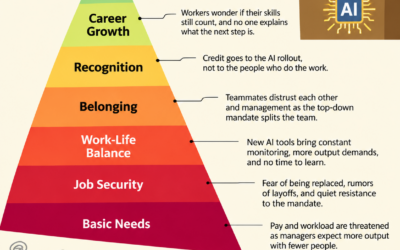
I was working on my blog with a theme of UN-dis-empowerment and I asked Perplexity for a list of “UN” words as they apply to the front-line worker. And, boy, I was surprised. There are a LOT of things getting in the way of people and their performance. SO, I had to blog about this! Here are some of them, almost all representing things that can be improved in the workplace:
Voice and power of the people
-
Unempowered: decisions are made far above the people doing the work.
-
Unheard: suggestions go into a void.
-
Unconsulted: change is announced rather than discussed.
-
Unrepresented: union membership is low, and most workers have no formal voice.
-
Unlistened-to: surveys are run, but nothing visibly changes.
Engagement and motivation of the people
-
Unengaged: the Gallup-style term for people who put in time without energy.
-
Uninspired: the work is done, but nobody feels pulled toward it. It is not improved, just completed.
-
Unmotivated: this often results from the system rather than the person.
-
Uninvolved: people are present but not participating.
-
Unchallenged: their skills go underused. People coast.
-
Unfulfilled: the job pays but doesn’t mean much.
Recognition and development
-
Unappreciated: the thanks never come.
-
Unrecognized: good work goes unnoticed. Even bad work can go unnoticed.
-
Underdeveloped: this is an “under” word, but it fits. Training budgets are the first to be cut.
-
Untrained: supervisors are promoted without being taught to lead.
-
Unmentored: nobody guides them.
-
Unpromoted: they stay stuck in the same role doing the same things with less and less involvement.
Economic security
-
Unemployed / Underemployed: these cover people with no job and people with too few hours or too little use of their skills.
-
Underpaid / Unrewarded: pay hasn’t kept up with productivity or living costs.
-
Unsecured: there are no pensions or reliable benefits.
-
Uninsured / Underinsured: health coverage is tied to the job.
-
Unstable: schedules and gig work vary week to week.
-
Unprepared: they have little saved for retirement.
Wellbeing
-
Unbalanced: work and life are out of proportion.
-
Unrested: they are tired and burned out.
-
Unwell: stress shows up as health problems.
-
Unsupported: they lack backup from managers and the organization.
-
Unhappy / Uncommitted: these lead to quiet quitting and turnover.
I mean, WOW, right? And my guess is that this same list would apply to the average supervisor out there since the situational dynamics sure seem to be the same. Don’t we as influences of organizational culture want to make some improvements in many or most of these?
Don’t we want to make some improvements
in many or most of these for our people?
The Square Wheels Approach to removing the “un”
Since workers are often unleveraged, meaning their ideas and capabilities go unused, we can start the “Dis” process by more actively involving them in discussions about possibilities. I imagine that they are also unaligned with goals that are unclear.
Here is The Short answer
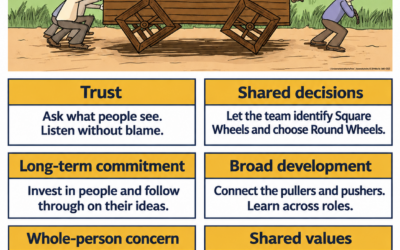
Square Wheels images, metaphors and conversations work on the “un” (unengaged, unmotivated, unaligned, uninvolved) because it gives people a safe, visual way to name what gets in their way and talk about considered alternatives. Managers can then act on what they hear and mentor and coach and facilitate team improvement. Asking for ideas and then acting on them is what turns a disengaged workplace into an enabled one.
The Longer Answer: Using Square Wheels on the “UN” in a facilitative environment
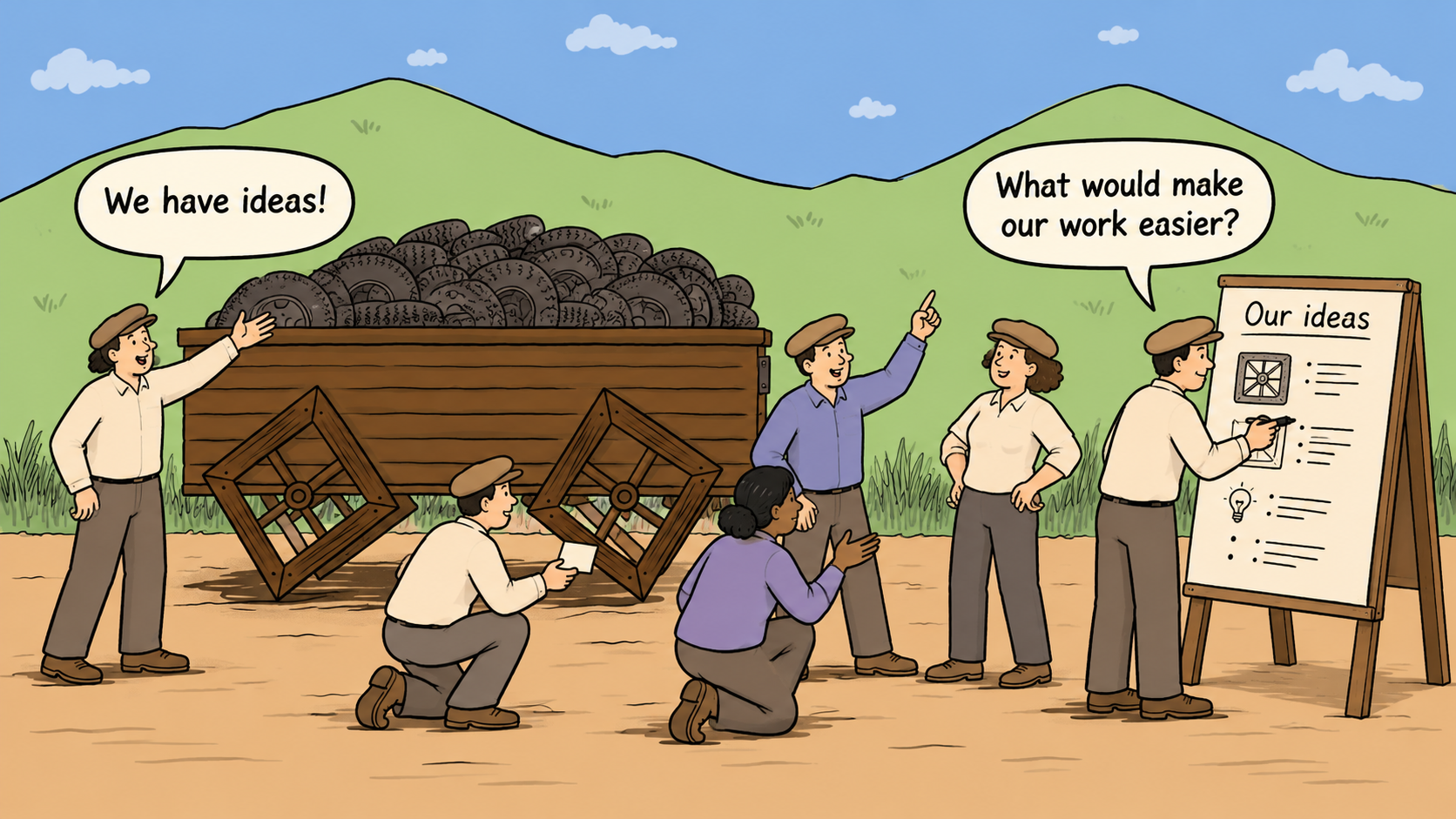
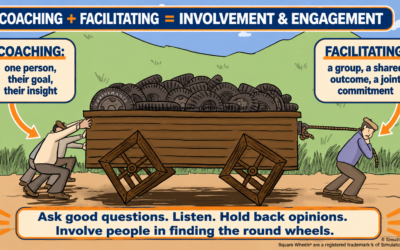
The core image shows a wagon on wooden Square Wheels, hauling a cargo of round rubber tires. It invites everyone to offer a view or reaction and an opportunity to comment without anyone being blamed. The standard prompt asks groups, “How might this reflect how organizations really work?” and lets small groups talk it through. That makes the image a projective tool, so people describe “the wagon” and not their boss.
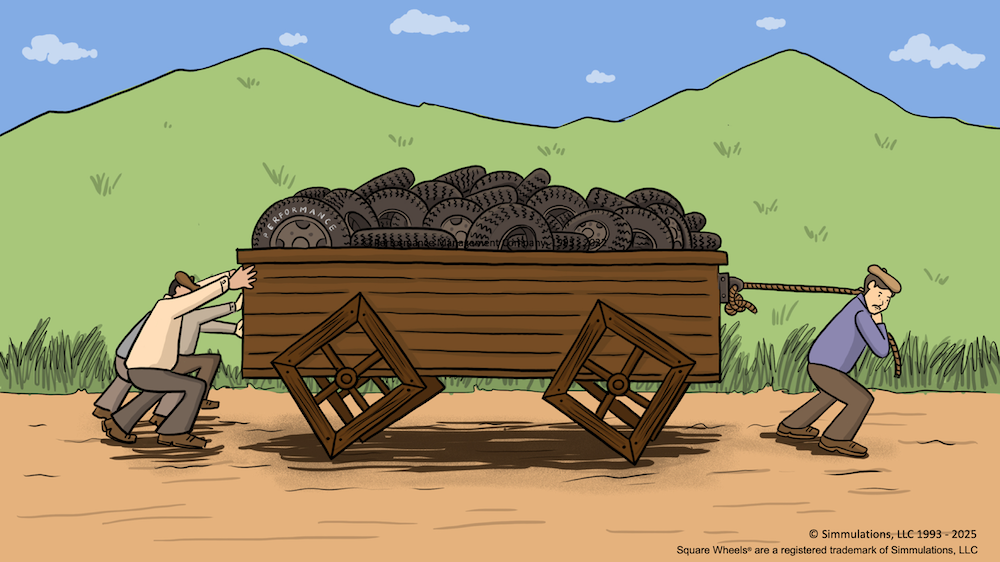
In practice the image does four things:
-
It breaks down barriers to open discussion in a non-confrontational way.
- It generates peer support that is an underpinning of change
-
It draws in people of any background or position and builds ownership of next steps.
- It can create a different vision of the future and a reflection on issues and opportunities
-
It turns observations into co-created action plans that build momentum.
-
It supports your “Managing Workplace Roadblocks” process: people name what disengages them, and the team works to remove it.
What managers can remove with coaching and facilitating
The data shows how much of the “un” sits with managers:
-
Managers account for about 70% of the variance in team-level engagement.
-
Only 47% of employees strongly agree they know what is expected of them. Weak culture, unclear expectations and limited recognition add to the detachment.
-
A supervisor seen as blocking growth is the strongest predictor of turnover intent.
-
Less than half of managers worldwide have had management training, and trained managers are less likely to be actively disengaged.
-
Bad managers add stress through unclear expectations, micromanagement and unreasonable workloads.
-
Other common drivers include too little autonomy, recognition and feedback, and a weak link to the organization’s vision.
-
Engagement costs are large. Low engagement was estimated to cost the global economy $8.8 trillion a year.
A practical sequence for managers:
-
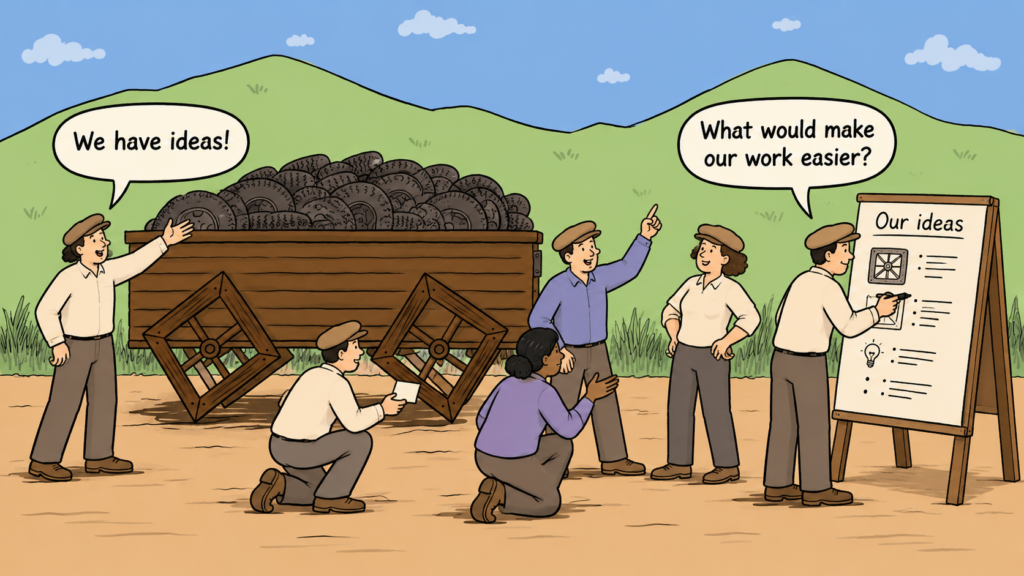
Run a Square Wheels One session and have the team list any and all of its roadblocks.
-
Sort the roadblocks into those the manager can fix now, those needing escalation, and those that can’t change.
-
Fix a few visible ones fast, using individuals, teams, or management.
-
Clarify expectations and priorities for rolling forward down the road.
-
Have people report back on what happened.
Why asking for ideas enables people
Gallup’s Q12 Survey Instrument includes “At work, my opinions seem to count.” Its advice is to solicit ideas in meetings and then take action on them is a solid way to improve active involvement and generate some ownership. Highly engaged teams show 14% higher productivity and 10% higher customer loyalty.
(You can read a nice overview of the Q12 Survey here,)
Eagle Hill reports that when employees see their ideas valued and acted on, engagement rises and productivity gains follow. Several other sources add that how you ask questions and generate active involvement matters, including my own experience over the past 40+ years.:
-
Open questions: These beat yes/no questions because they require thinking, not just compliance.ideawake
-
Documentation: If you ask but don’t record the answers, you are performing engagement, not facilitating it.ideawake
-
Structure and feedback: Clear submission and evaluation processes, plus transparency about what happens next, keep ideas from disappearing “into the abyss.”
The enabling loop
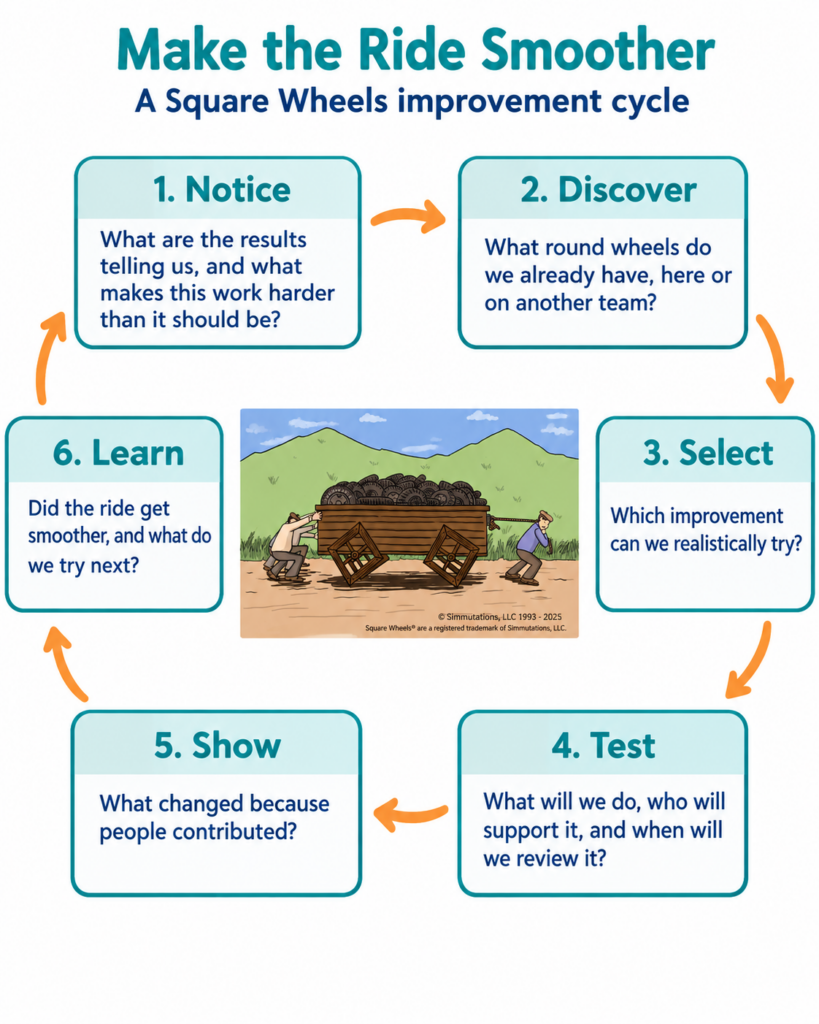
The simple cycle is: ask with a neutral visual, listen, record, act on a few items, report back. Then, ask again. You can read more about these engagement cycles in many other of my blogs. Frame up a question in your AI:
“What are some ways that my people and I can use the Square Wheels tools to impact XYZ?”
You can easily build on that out put to generate some simple plans. You can get Square Wheels One for free from a number of websites and you do not need any extensive training to just go do it.
Each pass of the loop shows people that their opinions and ideas count. Every pass can improve something relevant to them. That builds trust, which makes the next round of ideas richer. Gallup likewise advises showing that feedback leads to action. If managers skip the “act and report back” step, people learn that ideas are pointless, and the “un” gets worse. If you are going to promise action, demonstrate that promise in your actions.
You could open with “Un” as the headline stat: 47% unclear on expectations, 70% manager influence, and Square Wheels as the simple, low-cost, engaging and impactful way to start.
There are literally dozens of blogs around these ideas of using images to generate active involvement, commitment to action, ownership and change. Let me know if I can help,
—
For the FUN of It!
 Dr. Scott Simmerman is a designer of team building games and organization improvement tools.
Managing Partner of Performance Management Company since 1984, he is an experienced presenter and consultant who is trying to retire!! He now lives in Cuenca, Ecuador.
You can reach Scott at scott@squarewheels.com
Learn more about Scott at his LinkedIn site.
Square Wheels® is a registered trademark of Simmulations, LLC
and images are © Simmulations, LLC 1993 – 2026
Note: Please do not take my images and think about using them. It can generate a whole heap of problems given international copyright law and trademark law. Read this article for more information.
See a detailed overview of my tools, background and experiences by clicking here.
What I’m About:
My Square Wheels blog and website exist to help leaders, trainers, and facilitators make work smoother, more engaging, and more human. I focus on practical tools for process improvement, organizational change, and workplace collaboration that spark insight and deliver measurable results.
And I am convinced, after 30+ years of using Square Wheels®, that it is the best facilitation toolset in the world. One can use it to involve and engage people in designing workplace improvements and building engagement and collaboration. It is a unique metaphorical approach to performance improvement and we can easily license your organization to use these images and approaches.
By blending proven facilitation methods, creative problem-solving, and engaging team activities, my mission is to support organizations in building energized, sustainable cultures of involvement and innovation.
Through accessible — and often free — resources and virtual facilitation tools, I aim to help teams everywhere collaborate more effectively, innovate continuously, and take ownership of their improvement journey.
#SquareWheels #InnovationAtWork #TeamEngagement #FacilitationTools #WorkplaceImprovement #EmployeeEngagement #CreativeProblemSolving #OrganizationalDevelopment #LeadershipTools #collaboration #leadership #motivation #communications #enablement #leadership #CreativeCommons #enablingperformance #teamwork #storytelling #storyasking #enablement #disruptiveengagement #un-dis-engagement #un-dis-empowerment #innovation
© 2026 Simmulations, LLC. Please note that “Square Wheels®” is a registered trademark of Simmulations, LLC. and materials, original wagon line art, text, and visual designs are protected. Original line art by Roy Sabean, used under rights owned by Simmulations, LLC and formerly Performance Management Company, a sole-proprietorship of Dr. Scott J. Simmerman. Original concept and source artwork © Simmulations, LLC; derivative visuals sometimes created with assistance from Perplexity Pro AI.

0 Comments