
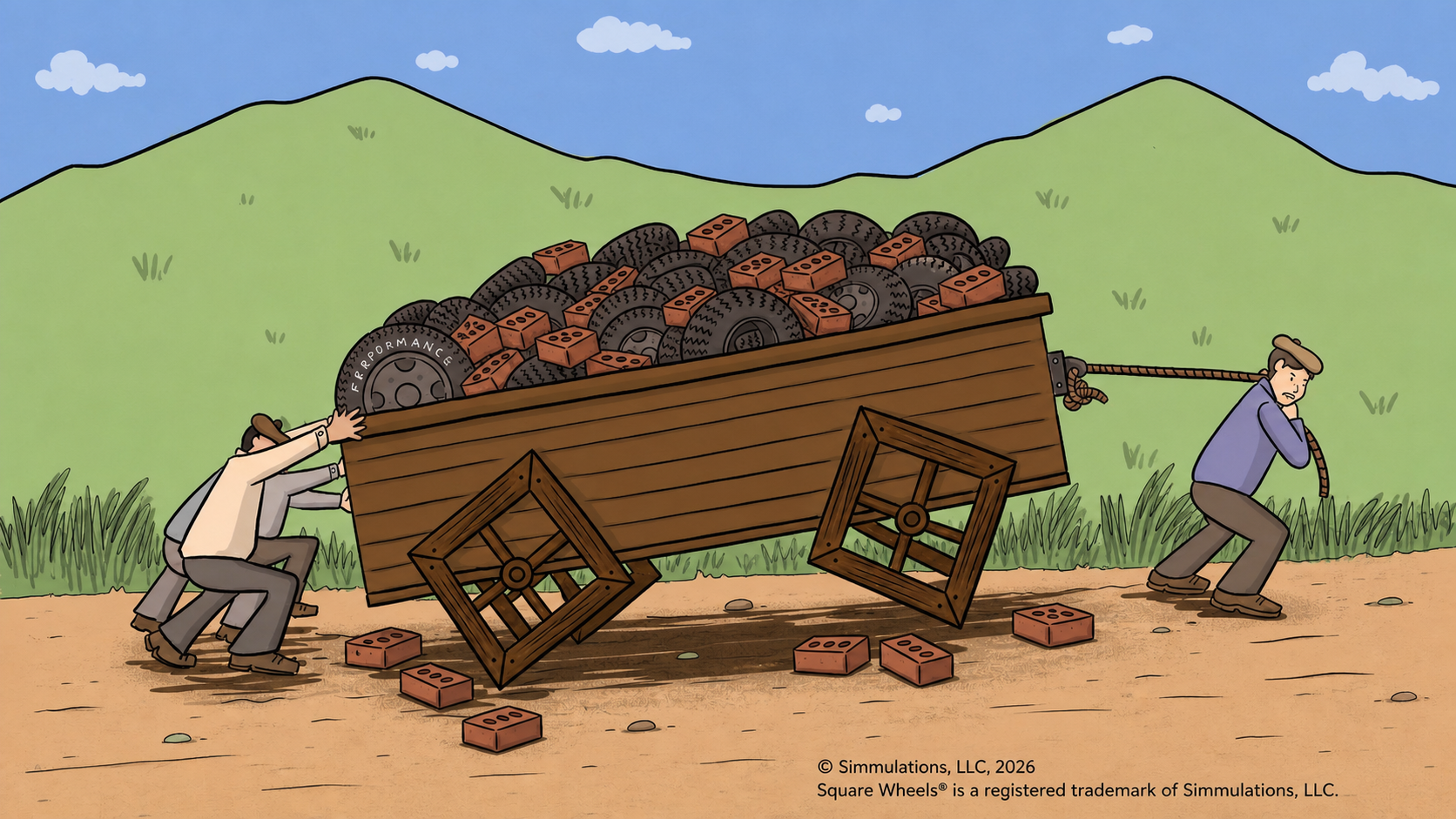
Find my first blog on Red Brick Thinking® here. This blog extends that initial work and adds some additional perspective, merging bricks and wheels.
Red Brick Thinking and Square Wheels fit together unusually well: Donna McGeorge’s Brick move is to subtract what weighs people down, while Square Wheels® turns the newly created space into participative, practical improvement. The combined message is: stop adding work to compensate for a flawed system; remove the unnecessary friction, then involve the people doing the work in selecting and testing better ways to move forward.
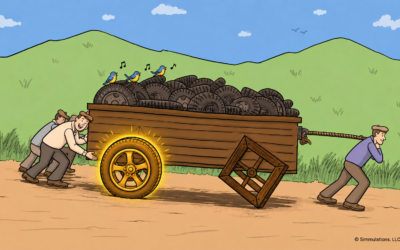
Red Brick Thinking frames the issue as an “addition bias,” while the Square Wheels® image makes visible the exhausting consequences of continuing to push and pull ineffective and inefficient practices.
The combined metaphor– Think of the organization’s wagon as working with two related burdens:
“If it didn’t go thump thump, how would we know
we were making progress, right?”
The key distinction matters. A Square Wheel may be doing something useful badly and simply needs redesign or a different innovation. A red brick may be adding no meaningful value and needs to be removed. Many organizations confuse the two: they try to “improve” a report nobody needs, rather than stop producing it.
We are all familiar with bricks and wheels not working smoothly. A team might spend hours each week creating a detailed operations report that no one reads because the data is already available on a dashboard. Or ten people might attend a recurring status meeting where everyone simply repeats updates that could have been shared in a written note. The work feels official because it is familiar, but it produces no decision, action, customer benefit, or meaningful reduction in risk.
This is where a Square Wheels or Brick idea applies: do not just push harder or try to make the unnecessary process more efficient. Ask, “What would actually happen if we stopped doing this for a month?” If no one can identify a real negative consequence, the organization has found an opportunity to eliminate work and not merely streamline it. Removing an unused report can return hours to an analyst team every month; replacing a status-only meeting with a shared update can give a whole team time back for real problem-solving. Sometimes the most effective improvement is not a new program, tool, or meeting. It is simply having the courage to stop doing something that no longer makes sense.
Square Wheels facilitation already makes the crucial point that people are often so busy pushing and pulling that they lack time and perspective to see possibilities. The visual also assumes that useful resources—round wheels—may already be available but unused. Red Brick Thinking adds a prior question: Before searching for or installing a round wheel, what can we take off the wagon?
Why not ASK?
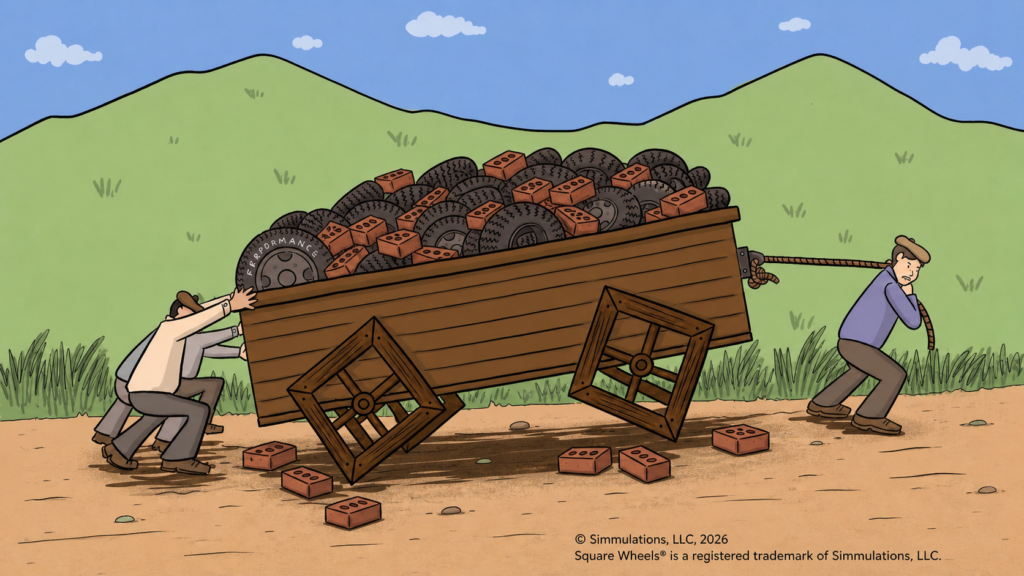
The road is now uphill with even more red bricks as part of the cargo!
A Square Wheels® / Red Brick sequence
A useful integrated improvement model would be:
-
Stop the wagon briefly.
Do not begin with, “How can we get more done?” Begin with, “What is making this journey unnecessarily hard?” This is the Square Wheels pause for reflection rather than immediate action. -
Identify the thumps.
Ask people closest to the work: “Where do we waste time, create rework, wait, chase approvals, duplicate effort, or become frustrated?” These are candidate Square Wheels. -
Sort each issue: remove, redesign, or retain.
The Red Brick question is: “If we stopped doing this, what would actually break?” If the answer is “not much,” it is likely a removable red brick. If a real outcome would suffer, it may be a needed function with a square-wheel process that needs redesign. -
Generate at least three Round Wheel alternatives.
This directly extends the Square Wheels practice of having groups generate three possible round-wheel solutions rather than seize the first familiar answer. The discipline prevents “simplification” from becoming a simplistic cost cut or a leader’s unilateral preference. -
Run a small experiment.
Remove one red brick or try one round wheel for a defined period. Measure effects on time, quality, customer impact, coordination, and employee energy—not merely activity volume. -
Make the improvement visible and repeatable.
Keep what works, discard what does not, and repeat. The aim is not a one-time decluttering event; it is an organizational habit of strategic subtraction plus continuous improvement.
A diagnostic canvas
For a team discussion, consider using this simple worksheet:
This corresponds well with the book’s grouping of red bricks into cultural issues such as “more,” hustle, accumulation and perfectionism; structural issues such as friction, complexity, noise, stimulation and urgency; and emotional issues such as reactivity, overcommitment, obligation and relationships.
Example Use: Reframing your weekly status meeting
Suppose a cross-functional team spends 90 minutes every Monday in a status meeting. Everyone attends; much of the information is read aloud from a shared spreadsheet; decisions rarely occur; and people leave with more follow-up work.
-
The Square Wheel is the meeting design: one-way updates, overlarge attendance, no decision protocol, and no preparation structure.
-
The red bricks may be the full-attendance rule, the slide deck, reading status aloud, duplicate reporting, and the assumption that all work deserves synchronous discussion.
-
Possible round wheels include an asynchronous update posted by Friday afternoon, a 25-minute decision-and-exception meeting, attendance only for people with decisions or dependencies, and a visible decision log.
The mistake would be adding a new project-management platform, a new dashboard, and another coordination meeting. That is addition bias. The better intervention is to remove redundant work first and then redesign the small amount of coordination that truly needs human conversation.
Facilitation questions
For a Square Wheels session shaped by Red Brick Thinking, I would use prompts such as:
-
“What burdens are people carrying that do not move the wagon?”
-
“Which of our hardest pushes are caused by a necessary activity designed badly?”
-
“Which activities would simply disappear if we stopped confusing busyness with contribution?”
-
“What might we stop doing for 30 days without damaging the customer, mission, or team?”
-
“What Round Wheels do we already possess—ideas, skills, practices, technology, or local workarounds?”
-
“What are people protecting because of habit, fear, identity, perfectionism, or obligation?”
-
“If we removed this brick, what valuable capacity would be released—and what would we deliberately do with it?”
That final question prevents a common failure: simplifying work and then immediately filling the freed capacity with more work. Red Brick Thinking is not only about efficiency; it is about making room for focus, judgment, relationships, recovery, and the work that matters most. Its stated premise is that strategic subtraction can counter complexity, overcommitment, and the reflex to solve problems by adding more.
The resulting combined principle could be stated this way:
Do not ask people to push Square Wheels faster while carrying Red Bricks they never needed. Remove the load, involve the people nearest the work, and install the simplest Round Wheels that reliably move the mission forward.
Download the FREE Square Wheels® One image and instructor’s guide under a Creative Commons license
Note: “Red Brick Thinking” is a term used by Donna McGeorge which she is registering as a trademark.
This post is independent commentary and is not affiliated with or endorsed by Donna McGeorge.
—
For the FUN of It!
 Dr. Scott Simmerman is a designer of team building games and organization improvement tools.
Managing Partner of Performance Management Company since 1984, he is an experienced presenter and consultant who is trying to retire!! He now lives in Cuenca, Ecuador.
You can reach Scott at scott@squarewheels.com
Learn more about Scott at his LinkedInsite.
Note that I often use Perplexity AI to help research and generate ideas for my posts.
Square Wheels® are a registered trademark of Simmulations, LLC
and images have been copyrighted since 1993,
© Simmulations, LLC 1993 – 2026
Note: Please do not take my images and think about using them. It can generate a whole heap of problems given international copyright law and trademark law. Read this article for more information.
What I’m About:
My Square Wheels blog and website exist to help leaders, trainers, and facilitators make work smoother, more engaging, and more human. I focus on practical tools for process improvement, organizational change, and workplace collaboration that spark insight and deliver measurable results.
And I am convinced, after 30+ years of using Square Wheels®, that it is the best facilitation toolset in the world. One can use it to involve and engage people in designing workplace improvements and building engagement and collaboration. It is a unique metaphorical approach to performance improvement and we can easily license your organization to use these images and approaches.
By blending proven facilitation methods, creative problem-solving, and engaging team activities, my mission is to support organizations in building energized, sustainable cultures of involvement and innovation.
Through accessible — and often free — resources and virtual facilitation tools, I aim to help teams everywhere collaborate more effectively, innovate continuously, and take ownership of their improvement journey.
#SquareWheels#InnovationAtWork#TeamEngagement#FacilitationTools#WorkplaceImprovement#EmployeeEngagement#CreativeProblemSolving#OrganizationalDevelopment#LeadershipTools #collaboration #leadership #motivation #communications #enablement #leadership #CreativeCommons #enablingperformance #teamwork #storytelling #storyasking #redbrickthinking #collaborating #facilitating

0 Comments