
Supervisors: Turn AI feedback and information into engagement and improved results. Use simple tools to better manage workplaces and generate improvements.
Supervisors receive information all day every day: production numbers, customer complaints, staffing updates, safety reports, employee comments, quality issues, absenteeism data, rumors, email directives, and new corporate initiatives. The problem is rarely a lack of information and with AI tools abounding, there is more data than ever.
The real challenge is deciding what that information means, what to do with it, and most importantly how to involve employees in making things better. The workers need good data to improve and they also benefit with more peer support to help implement new ideas.
Too many supervisors are human “information routers.” They pass messages downward, send updates upward, and spend the rest of their time reacting to whatever problem is loudest. That is understandable. It is also a series of missed opportunities. They are not bad bosses but they are not good ones either.
Note: I have become quite tired of talking about “leadership.” Leadership is a great “trainer’s word” and ait is fine for selling companies programs that surely sound impressive. But there is a so much greater need for that simple thing we can call management. It is not glamorous, but it sure seems to be missing in so many workplaces. Sorry if I fail and include it somewhere in this post by accident. Using the word is an old habit…
Good supervision and management is about turning information into shared understanding, meaningful involvement, practical innovation, and, as I call it, continuous continuous improvement. We all know this but we often feel we lack the tools for improvement.
That is where Square Wheels® tools will help. The basic idea is simple. People know that things are not moving smoothly but they also know that improvements are needed and necessary. And who doesn’t have ideas for improvement? So, below are some simple ideas for generating involvement.
Information Is Not Comprehension
A supervisor will generally know when a department is behind schedule, experiencing turnover, receiving customer complaints, or struggling with morale. But knowing that something is an issue is different from understanding the root cause(s) of why it is happening and how to address it.
Numbers and reports tell us that performance is changing. And workers and supervisors often know the day-to-day reasons behind the numbers not meeting goals:
-
The process has an unnecessary handoff.
-
A piece of equipment or other bottleneck creates repeated delays.
-
A policy sounds good but does not work in practice.
-
One team is overloaded while another is waiting.
-
A customer requirement is unclear.
-
A supervisor’s communication is inconsistent.
-
People have stopped offering ideas because they don’t find anyone will listen.
The people closest to the work usually possess valuable information that is not found in dashboards, spreadsheets, or formal reports. Supervisors need ways to uncover that information without putting employees on the defensive.
The key shift is simple:
Do not ask only, “What is wrong?”
Ask, “What are we learning from what is happening?”
That question changes the conversation from blame and complaint to learning and improvement.
Supervisors Need Better Conversations
When employees bring concerns to a supervisor, the supervisor has choices. They can explain, defend, correct, dismiss, promise action, or simply defer and say, “I’ll look into it.”
Sometimes those responses are necessary. But when they become the normal and regular pattern, employees learn that the supervisor owns the problem and they own neither the solution nor the responsibility to help improve things.
A more effective supervisor uses workplace information as the beginning of a conversation about improvement.
For example, instead of saying:
“We are missing our quality targets. Everyone needs to pay more attention.”
We can try something like this:
“Our quality data shows a pattern. Before we decide what to do, I would like us to look at what’s getting in the way of doing good work the first time.”
This kind of wording does several important things:
-
It presents the information without attacking people.
-
It assumes employees have useful insight.
-
It focuses attention on work processes rather than personal blame.
-
It invites people to participate in diagnosis and solution-building.
-
It establishes improvement as a shared responsibility.
Supervisors build credibility when they communicate openly about what they know, what they do not know, and what they need help understanding.
Employees do not need a supervisor who has all the answers. They need a supervisor who can ask good questions, listen carefully, clarify priorities, remove barriers, and follow through.
Square Wheels: A Better Way to Discuss Frustration
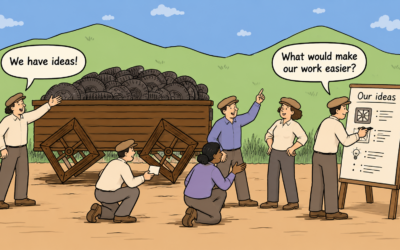
My Square Wheels illustrations and metaphors are powerful tools because they give people a safe and familiar visual language for talking about work issues and problems.

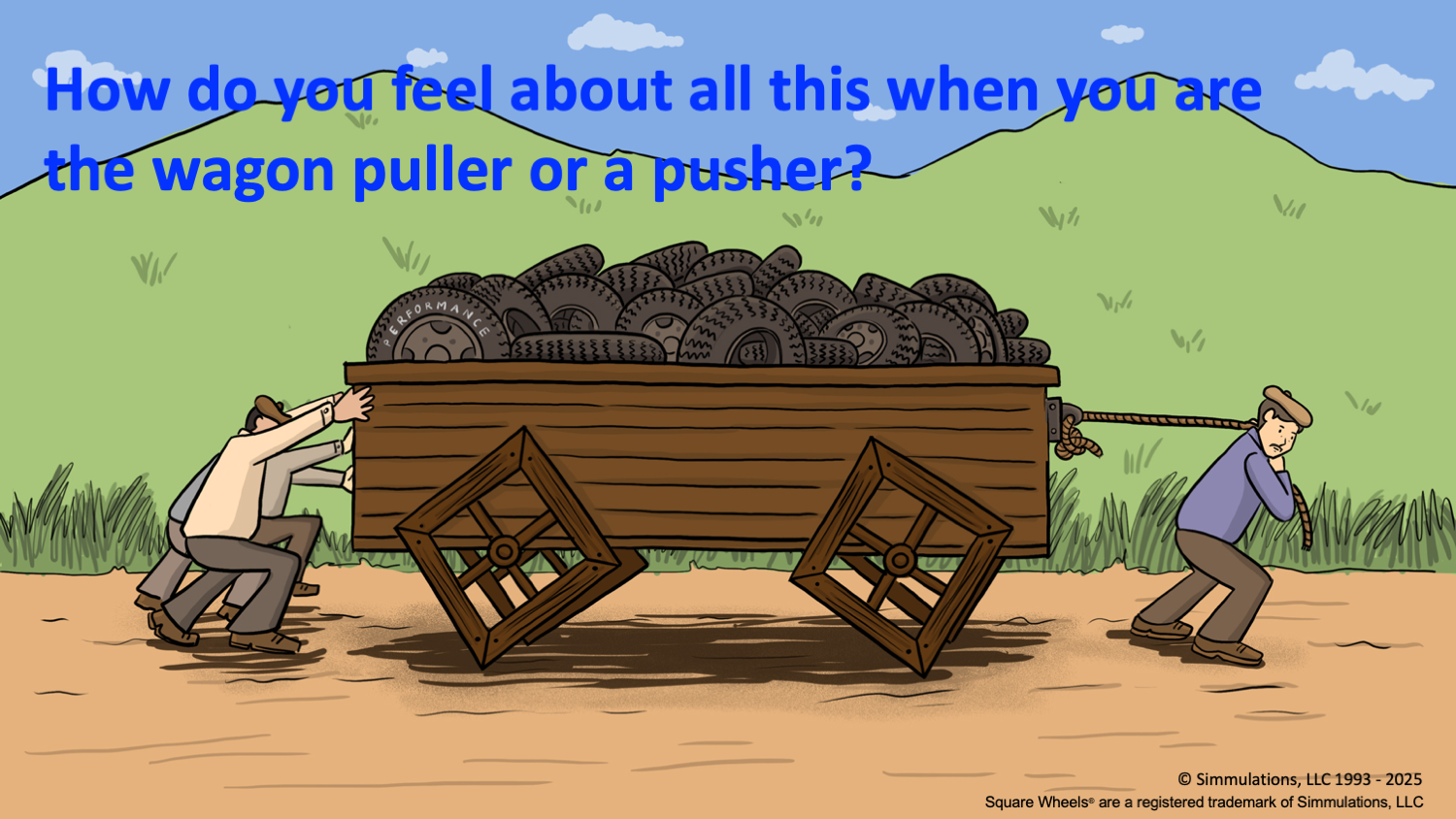
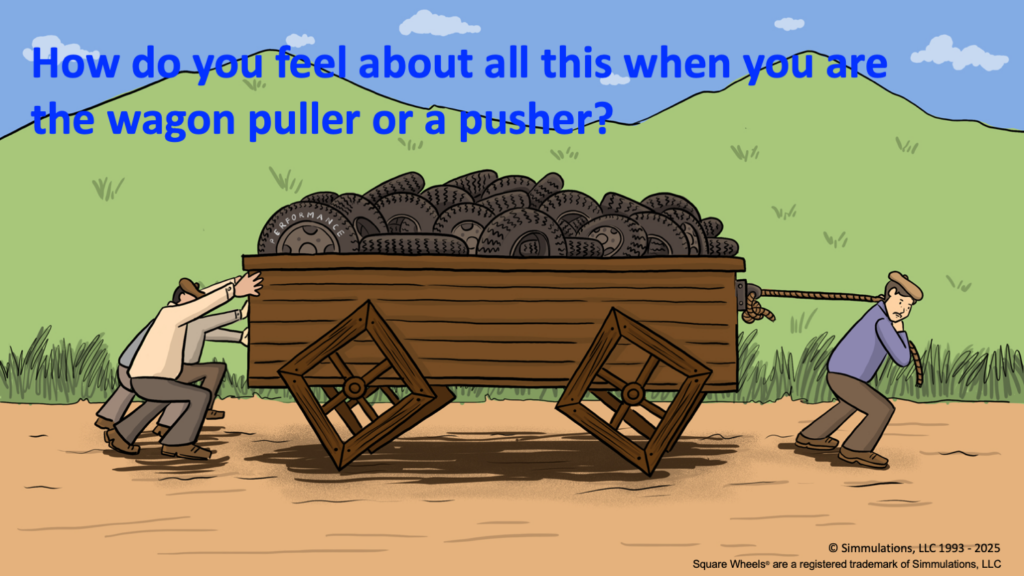
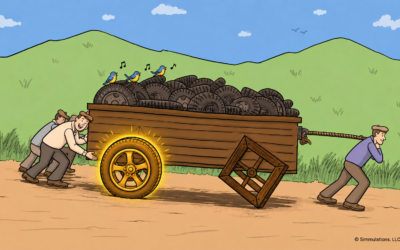
Most people recognize the image issues immediately: people are working hard to pull a wagon with Square Wheels and often in the mud, even though round wheels are available, already in the wagon. Playing with the visual and the metaphor raises important questions:
-
What are the “Square Wheels” in our workplace? (And what are the red bricks? This is another useful metaphor about removing things…)
-
What makes our work harder than it needs to be?
-
What are people doing that adds effort without adding value?
-
What “round wheels” already exist but are not being used?
-
What ideas do employees have that could improve the process?
-
What prevents us from trying those ideas?
This matters because employees often avoid raising concerns directly. They may worry about sounding negative, complaining, criticizing management, or creating conflict with coworkers.
But almost everyone is willing to talk about “Square Wheels.”
The metaphor shifts the discussion away from “Who is at fault?” toward “What is making work unnecessarily difficult?” It makes the conversation less personal, more constructive, and easier to begin. And people always have ideas.
A supervisor can say:
“Every workplace has Square Wheels like the ones we are talking about, those things that consume energy, slow people down, frustrate customers, or make it harder to do quality work. Let’s identify a few of ours and decide which one we can improve first.”
That is not merely a team-building activity. It is a practical and pragmatic management conversation.
Turn Information Into Employee Involvement
A supervisor’s job is not to solve every problem personally. It is to create the conditions in which employees can help solve the right problems.
Here is a simple process supervisors can use with almost any kind of workplace information.
1. Share the Relevant Information
Start with facts and realities, not just assumptions and generalities..
For example:
-
“Customer callbacks have increased over the past month.”
-
“We are losing time at the start of each shift.”
-
“Our rework level is higher than it was last quarter.”
-
“We have had three safety near-misses in the same area.”
-
“The employee survey suggests people do not feel informed about changes.”
-
“We are getting mixed messages about priorities.”
The goal is not to overwhelm people with data. The goal is to provide enough information so the team understands why the conversation matters.
Caution: Supervisors should avoid using information as a weapon. When data is presented as proof that people are failing, employees become defensive. When it is presented as a shared challenge, employees become more willing to participate.
2. Ask What the Team Sees and Feels
Then ask employees for their observations.
Useful questions include:
-
“What is happening behind these numbers?”
-
“What do you think is contributing to this?”
-
“Where does the process become difficult?”
-
“What makes it feel harder to serve customers well?”
-
“What frustrates you most about trying to do this job effectively?”
-
“What have we tried before?”
-
“What is working better than people may realize?”
-
“What information am I missing?”
This step is where supervisors often discover the gap between official procedures and actual work.
Employees may be following a process that looks efficient on paper but creates confusion, delays, duplication, or frustration in real life. A supervisor who listens learns far more than one who simply announces a solution.
3. Identify the Square Wheels, noting that Square Wheels are everywhere!
Use the Square Wheels image that you can get free below and use the metaphorical framework to make the issues visible.
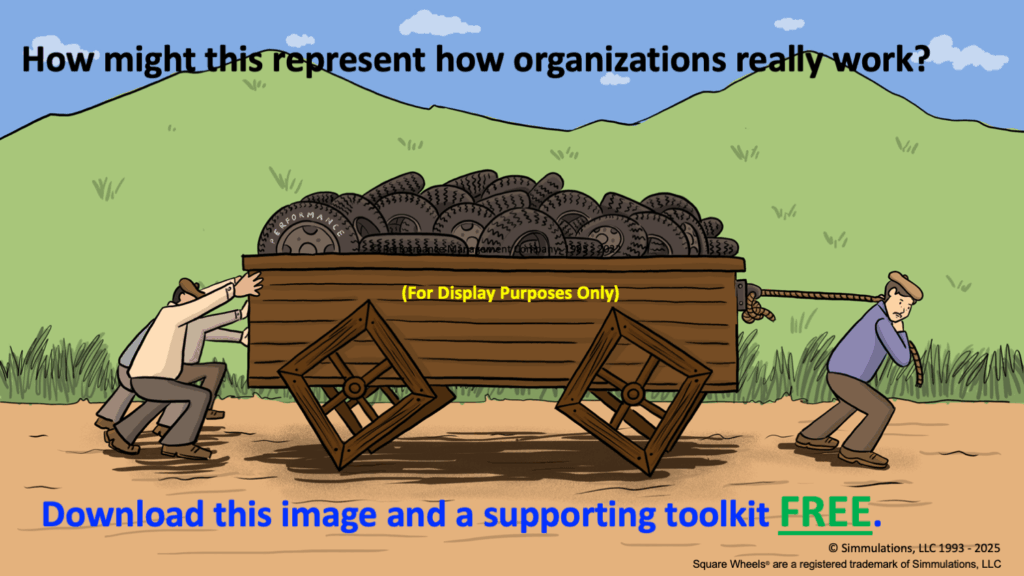
Download the FREE Square Wheels® One image and instructor’s guide under a Creative Commons license
Ask the group to identify specific square wheels—barriers, frustrations, delays, waste, unclear expectations, unnecessary rules, poor handoffs, or communication breakdowns.
Keep the discussion concrete. “Communication is bad” is too broad to improve. More useful Square Wheels might be defined as:
-
“We do not know schedule changes until the last minute.”
-
“The customer-service team is not told when a product is unavailable.”
-
“We enter the same information in two different systems.”
-
“People do not know who has authority to make an exception.”
-
“We spend ten minutes every morning looking for supplies.”
-
“Ideas disappear after they are mentioned in meetings.”
Wooden Square Wheels are things you can grasp. They are tangible and observable. They can be identified and addressed, while general complaints usually cannot.
4. Look for Round Wheels; they already exist most likely
The Square Wheels One illustration shown above is not about criticizing what is wrong. It is about discovering usable ideas for moving forward.
Consider asking:
-
“What would a round wheel look like?”
-
“What small change would make this easier?”
-
“Who is already doing this well?”
-
“What practice could we borrow or adapt?”
-
“What could we test for two weeks?”
-
“What is within our team’s control?”
-
“What support do we need from another department or manager?”
Often, the team already has workable ideas they can try. The missing ingredient is permission, attention, coordination, or a supervisor willing to sponsor a small experiment.
Innovation does not always mean a major new technology, expensive project, or corporate initiative. In many workplaces, innovation means finding a better way to schedule work, share information, organize supplies, respond to customers, train new employees, or handle recurring problems. AI is giving us all kinds of new tools and selecting and trying them is that first step toward innovation and implementation. Innovation may be that AI tool that could work to improve things if the team are willing to try.
Pushing innovation is often a guarantee for generating resistance. (See this blog)
Make Innovation Small, Safe, and Visible
Employees become more actively innovative when they believe that
their ideas can be tested without excessive risk or possible punishment.
Supervisors can create that more workable environment by treating improvement as experimentation rather than demanding perfect solutions.
Instead of asking, “What is the answer?” try asking:
“What is one small experiment we could run to see whether this works better?”
A useful improvement experiment has four parts:
This approach is helpful because it reduces resistance: we are doing things WITH people rather than TO them and we are testing and trying things out. Employees do not have to commit forever to a new system. They only have to agree to test an idea, learn from it, and adjust.
Supervisors should then make the learning visible. At the end of a trial, one could ask:
-
“What improved?”
-
“What did not improve?”
-
“What unexpected problems did we create?”
-
“What should we keep, change, or stop?”
-
“What have we learned that can help another team?”
That is how everyday problem-solving becomes a culture of innovation and enablement. It is about continuous continuous improvement.
The Supervisor’s “Management Improvement Loop”
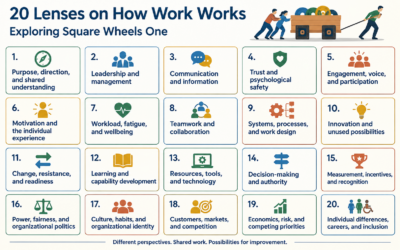
These Square Wheels tools are also useful for helping supervisors examine their own management practices. And we have over 200 different images to fine-tune discussions and frame issues and opportunities.
Every supervisor most likely has routines that may have become one of these Square Wheels:
-
Holding meetings that provide information but do not create dialogue.
-
Giving answers too quickly.
-
Solving problems employees could help solve.
-
Focusing only on mistakes instead of recognizing progress.
-
Communicating changes after decisions are already made.
-
Asking for input but failing to report what happened to it.
-
Treating employee resistance as a people problem rather than useful feedback.
-
Spending more time on urgent interruptions than on coaching and prevention.
A supervisor does not need to be perfect to more effectively manage people and performance. But effective supervisors regularly ask themselves questions such as:
“What am I doing that may unintentionally make it harder for people to succeed?”
That is a powerful management question.
Frameworks and Opportunities:
Consider the difference between these two approaches:
The second column does not make a supervisor weak. It makes the supervisor more effective. It improves information flow, ownership, trust, and the quality of decisions.
Close the Loop or Lose the Trust
One of the fastest ways to negatively impact employee engagement is to ask for ideas and then let those ideas disappear into a black hole. Trust is the residue of promises fulfilled.
Employees do not expect every suggestion to be adopted. They do hope to know what happened. They do want credit for good ideas and they want to improve..
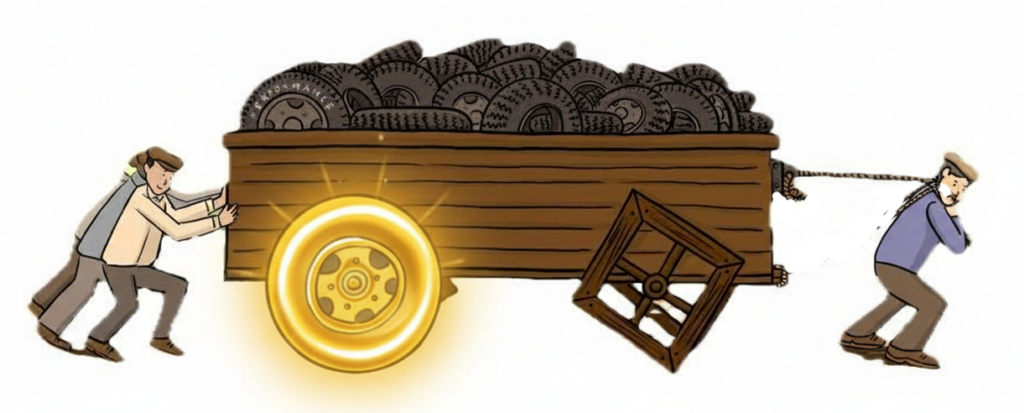
When a team identifies some actionable Square Wheels or proposes potential round-wheel solutions, the supervisor should close the loop. We all know this, I think:
-
Explain what will be acted on immediately.
-
Identify what needs more information or approval.
-
Be honest about what cannot be changed right now.
-
Give a date for an update.
-
Recognize people whose observations or ideas helped.
-
Share the results of improvement experiments.
Even a simple follow-up makes a major difference:
“Last week, you identified the duplicate approval step as a Square Wheel. We checked it with Finance, and we can eliminate one signature for purchases under the approved limit. We will start Monday and review the impact after thirty days. Good job!”
That message tells employees that speaking up matters, that they do have ideas.
The opposite message— silence —teaches people that participation is wasted unworthy effort.
A Practical Team Meeting Activity
A supervisor can use a short Square Wheels discussion in a staff meeting, shift meeting, or team huddle.
A 20-minute process:
-
Set the purpose.
Say: “We are not here to blame people or complain. We are here to identify one or two things that make work harder than necessary and find practical ways to improve them.” -
Share a piece of workplace information.
Use a customer complaint trend, a safety concern, a delay, a quality issue, an employee-survey result, or another meaningful fact. -
Introduce the Square Wheels image and a question.
Ask: “What square wheels are contributing to this issue?” (Get the image and toolkit for free) -
Generate ideas.
Have each person identify one barrier or frustration. Encourage specific, observable examples. -
Select one priority.
Ask: “Which of these is both important and within our ability to influence?” -
Design a round-wheel experiment.
Decide what small change to test, who will participate, when it will begin, and how the team will know whether it helped. -
Schedule the follow-up.
Put the review date on the calendar before the meeting ends.
The goal is not to solve every issue in one meeting. The goal is to establish a repeatable habit: share information, involve people, test improvements, learn, and communicate the results.
Better Information Leads to Better Management
The best supervisors are not those who control the most information. They are the ones who help people make sense of information and use it to improve the work.
They create conversations where employees can say what they see. They use data to focus attention rather than assign blame. They turn frustrations into visible square wheels, invite people to develop round-wheel ideas, and support small experiments that build confidence and momentum.
When supervisors work this way, employees are more likely to feel respected, informed, and involved. They are also more likely to contribute the ideas that improve quality, service, safety, efficiency, and morale.
The workplace already contains enormous amounts of information. Much of the most valuable information is in the experience of the people doing the work every day.
A supervisor’s opportunity is to unlock it.
And the most useful question may be this:
“What Square Wheel is making it harder for us to do great work—and what round wheel can we try next?”
SWs —
For the FUN of It!
 Dr. Scott Simmerman is a designer of team building games and organization improvement tools.
Managing Partner of Performance Management Company since 1984, he is an experienced presenter and consultant who is trying to retire!! He now lives in Cuenca, Ecuador.
You can reach Scott at scott@squarewheels.com
Learn more about Scott at his LinkedIn site.
Note that I often use Perplexity AI to help research and generate ideas for my posts.
Square Wheels® are a registered trademark of Simmulations, LLC
and images have been copyrighted since 1993,
© Simmulations, LLC 1993 – 2026
Note: Please do not take my images and think about using them. It can generate a whole heap of problems given international copyright law and trademark law. Read this article for more information.
What I’m About:
My Square Wheels blog and website exist to help leaders, trainers, and facilitators make work smoother, more engaging, and more human. I focus on practical tools for process improvement, organizational change, and workplace collaboration that spark insight and deliver measurable results.
And I am convinced, after 30+ years of using Square Wheels®, that it is the best facilitation toolset in the world. One can use it to involve and engage people in designing workplace improvements and building engagement and collaboration. It is a unique metaphorical approach to performance improvement and we can easily license your organization to use these images and approaches.
By blending proven facilitation methods, creative problem-solving, and engaging team activities, my mission is to support organizations in building energized, sustainable cultures of involvement and innovation.
Through accessible — and often free — resources and virtual facilitation tools, I aim to help teams everywhere collaborate more effectively, innovate continuously, and take ownership of their improvement journey.
#SquareWheels #InnovationAtWork #TeamEngagement #FacilitationTools #WorkplaceImprovement #EmployeeEngagement #CreativeProblemSolving #OrganizationalDevelopment #LeadershipTools #collaboration #leadership #motivation #communications #enablement #leadership #CreativeCommons #enablingperformance #teamwork #storytelling #storyasking

0 Comments