
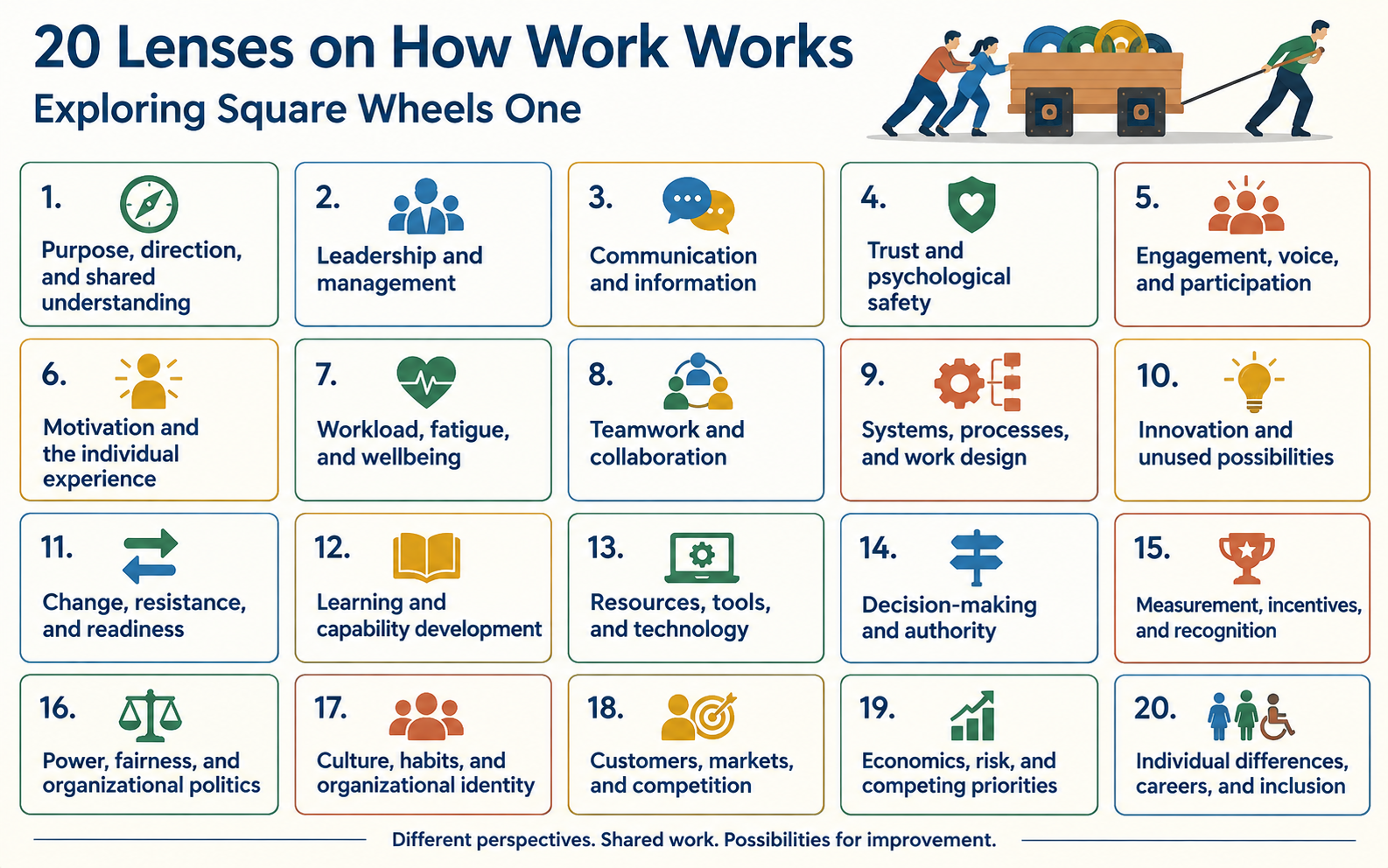
My image about “how things really work” is called Square Wheels One and it’s about Problems to Fix and actively involving people in generating solutions. It is about consideration of all the different dynamics common to the workplace experiences. And it is about motivation and vision and innovation and change.
I’ve been working with the image since Roy Sabean helped develop the visual in 1993. That first image became many and we’ve expanded on the tools for three-plus decades now.

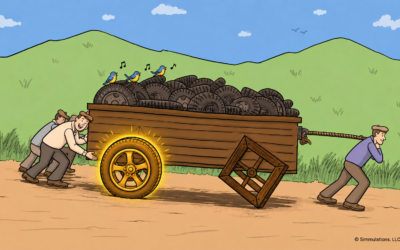
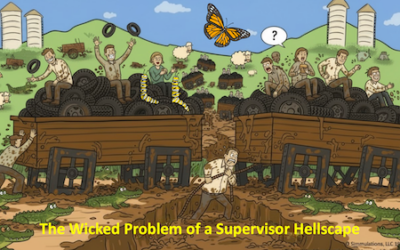
Here is the evolution of the Square Wheels images since 1993…
I’ll keep this post short, but with a long tail. And I will simply allow you to wander around within the metaphor of the wooden wagon, the wooden wheels and the cargo of round rubber tires that you see below.
The real beauty of these images, metaphors and themes they anchor to is that they allow for really solid discussions between workers and front-line managers about the issues they face in their workplaces and the opportunities they have for engagement, innovation and change. They can discuss workplace realities without any Blame Frame and the metaphor naturally leads toward identifying Round Wheel Solutions.
Remember that it is far better to do things WITH people than TO them and getting their active involvement in discussing the round wheel possibilities is all about generating workplace enablement and improvement.
Here are a list of key themes and possibilities. These were developed from my session-generated list and expanded to include other related organizational realities, competing business priorities, and the different experiences of individuals doing the work. The wagon rolls, people make the existing system work, and possibilities for improvement remain unused inside it until they choose to act differently.
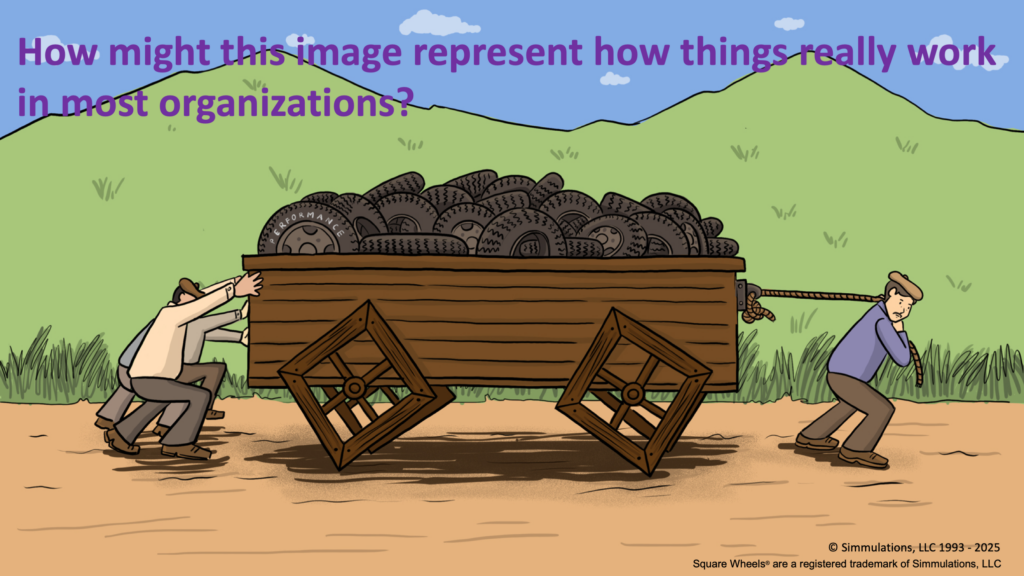
So, here is the Key Idea for YOU as you investigate the ease at which these images and themes in the image above can relate to helping to solve workplace issues. Discussions around the image can open up new pathways for implementing round wheel solutions. We have the tools! They need The Perspective.
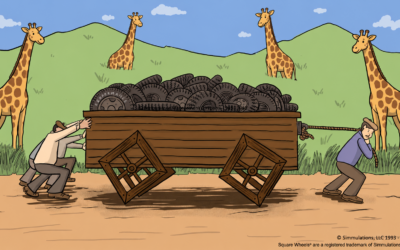
“Be Like the Giraffe” and look to see the issues
and opportunities that already exist!
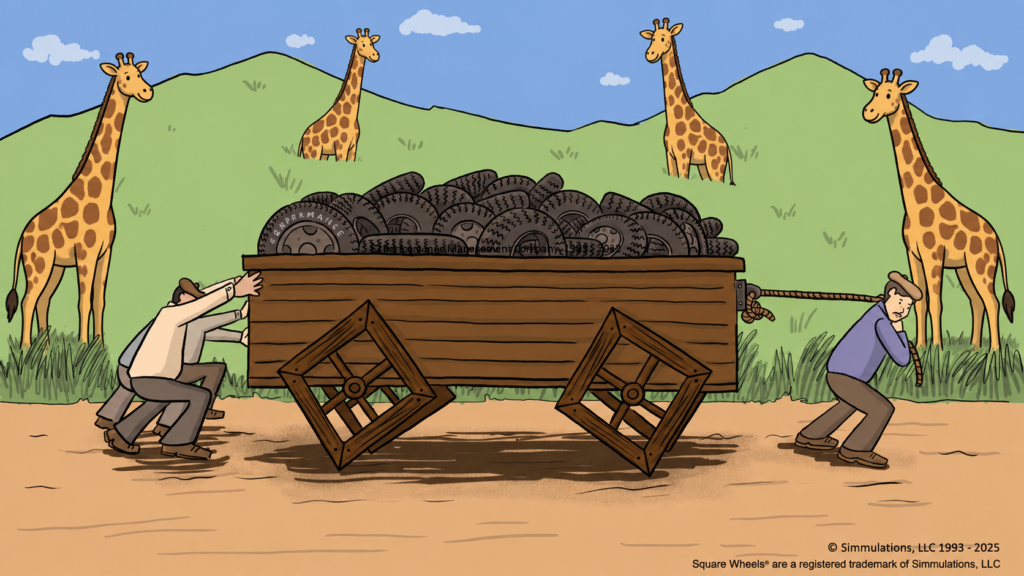
Each bold heading below is a lens, a viewpoint on organizational reality; the short descriptions afterward gives an underlying issue to explore.
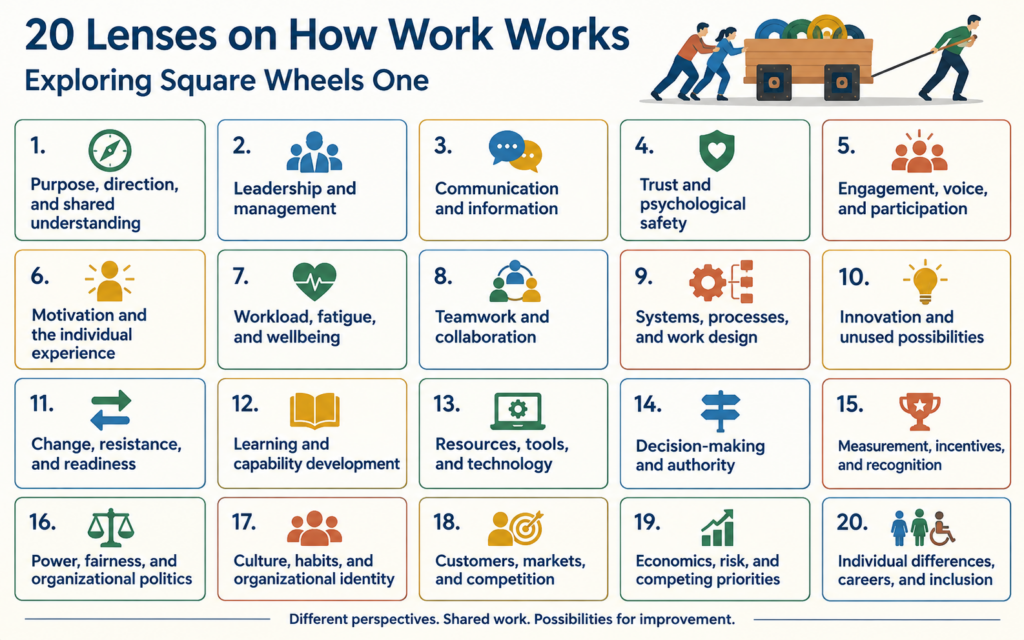
…and this new one, intentionally overwhelming and complicated and expansive. The number of ideas and frameworks that the image can elicit in conversations is amazing to me, even after 36 years of playing with Square Wheels One:
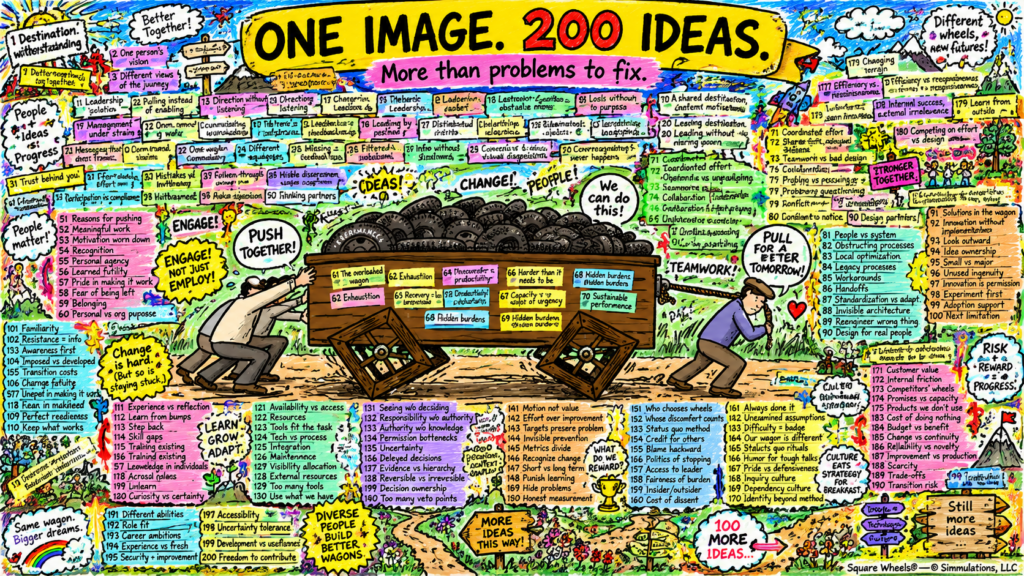
Purpose, Direction, and Shared Understanding
- Destination without understanding — People know what to do next but not why it matters.
- One person’s vision — The leader’s picture of success has not become the team’s picture.
- Different views of the journey — People at the front and back experience the same work differently.
- Movement mistaken for progress — The wagon is moving, but is it getting somewhere worthwhile?
- The wrong road — Efficient execution cannot compensate for an unsuitable direction.
- Unspoken assumptions about the goal — Everyone assumes everyone else understands the destination.
- Changing destinations — People keep working while priorities shift without explanation.
- Lost connection to purpose — The daily struggle obscures the value of the work.
- Goals without context — People receive targets but not the reasoning behind them.
- A shared destination, different motives — Individuals can support the same outcome for very different reasons.
Leadership and Management
- Leadership isolation — Being out front can separate a leader from the experience of the team.
- Pulling instead of enabling — The leader supplies effort rather than improving the conditions for performance.
- Direction without listening — Leadership decides where to go without hearing what makes movement difficult.
- The heroic leader — Progress depends too heavily on one person’s stamina.
- Leadership as obstacle removal — The most useful contribution may be making the wagon easier to move.
- Leading by position — Being at the front does not necessarily mean having the best understanding.
- Management under strain — The person pulling may also feel unsupported, pressured, or trapped.
- Distributed leadership — Different people could lead different parts of the journey.
- Succession and continuity — What happens when the wagon puller leaves?
- Leading without turning around — A leader can remain committed to the destination while losing contact with the people.
Communication and Information
- Messages that do not travel — Useful information stays at one end of the wagon.
- Communication drowned out by work — The effort of moving leaves little room for conversation.
- One-way communication — Instructions travel backward; experience does not travel forward.
- Different organizational languages — Leaders, specialists, and workers describe the same problem differently.
- Missing feedback loops — Nobody checks whether messages were understood or useful.
- Filtered bad news — Problems become less visible as they move toward decision-makers.
- Informal knowledge networks — People learn how things really work from colleagues rather than official instructions.
- Information without relevance — People receive plenty of updates but little that helps them act.
- Silence interpreted as agreement — Nobody objects, so leadership assumes commitment.
- The conversation that never happens — Everyone notices something, but nobody starts the discussion.
Trust and Psychological Safety
- Trust in the people behind you — Leadership must rely on work it cannot directly see.
- Trust in the person ahead — Employees must follow decisions whose reasoning they may not understand.
- Speaking up without punishment — Can someone question the wheels without becoming the problem?
- Mistakes versus blame — Does a failed improvement produce learning or accusations?
- Credibility through follow-through — What happens after someone offers an idea?
- Vulnerability at the front — Can the leader admit not knowing how to improve the wagon?
- Trust after broken promises — Previous disappointments shape reactions to new initiatives.
- Safe disagreement — People can support the journey while challenging the method.
- Mutual suspicion — Leaders question effort while employees question intentions.
- Trust as a shared responsibility — Neither leadership nor employees can build it entirely alone
Engagement, Voice, and Participation
- Effort without influence — People contribute energy but have no say in how the work is organized.
- Participation versus compliance — Pushing the wagon does not necessarily mean endorsing the journey.
- Ideas without an invitation — People may see possibilities without knowing that suggestions are welcome.
- Consultation without consequences — Employees are asked for input that never affects a decision.
- Ownership of improvement — People help shape the changes they will use.
- Unequal voice — Some people’s interpretations receive attention while others disappear.
- Withdrawal after being ignored — Silence may follow earlier attempts to contribute.
- Engagement through visible impact — People can see how their contribution changes the work.
- Permission to notice — Identifying a problem is treated as useful participation rather than disloyalty.
- From hired hands to thinking partners — The organization values judgment as well as physical or procedural effort
Motivation and the Individual Experience
- Different reasons for pushing — Pride, pay, loyalty, fear, ambition, and necessity can coexist.
- Meaningful work in a frustrating system — People can care deeply about the outcome and dislike the process.
- Motivation worn down by friction — Repeated obstacles make enthusiasm harder to sustain.
- Effort without recognition — Contributions become invisible when results look routine.
- Personal agency — How much choice does an individual have about the way they work?
- Learned futility — People stop offering ideas because they expect nothing to change.
- Pride in making it work — Overcoming difficulty becomes part of someone’s professional identity.
- Fear of being left behind — People keep pushing because stopping feels personally risky.
- Belonging through shared effort — The work can create connection even when the system is inefficient.
- Personal purpose versus organizational purpose — The journey may serve the business while failing to serve an individual’s goals.
Workload, Fatigue, and Wellbeing
- The overloaded wagon — Responsibilities accumulate without corresponding changes in capacity.
- Exhaustion disguised as commitment — Continuing to push is praised even when people are depleted.
- Uneven distribution of effort — A few people carry more than their share.
- Recovery treated as lost productivity — Stopping to recover looks like falling behind.
- Emotional labor — People manage frustration, reassure others, and maintain morale while doing the work.
- Work made unnecessarily difficult — Job design creates strain that effort alone cannot solve.
- Capacity versus willingness — Someone may be committed but unable to keep pushing at the expected pace.
- The cost of constant urgency — Every bump becomes an emergency.
- Hidden personal burdens — Individuals bring health, family, financial, or other pressures to the journey.
- Sustainable performance — Can the wagon keep moving without wearing out its people?
Teamwork and Collaboration
- Coordinated effort — Pushing and pulling must work together.
- Shared effort, unequal influence — Everyone contributes, but not everyone helps decide.
- Teamwork compensating for bad design — Cooperation makes an inefficient system function.
- Collaboration across viewpoints — Different positions reveal different parts of the problem.
- Mutual dependence — Nobody can accomplish the journey entirely alone.
- Helping versus rescuing — Supporting colleagues can become permanently carrying their work.
- Collective problem-solving — Improving the wagon becomes a shared task rather than someone else’s assignment.
- Team norms that discourage questioning — Belonging depends on not challenging the familiar method.
- Conflict beneath cooperation — People can work together while disagreeing about fairness or direction.
- Team capability beyond individual strength — Better coordination may matter more than adding effort.
Systems and Processes, and work design
- People versus the system — Is the difficulty caused by effort, ability, or the way work is organized?
- Processes that obstruct their purpose — The method makes the intended result harder to achieve.
- Local optimization — One part improves its performance while making the whole wagon less effective.
- Legacy processes — Yesterday’s solution becomes today’s constraint.
- Workarounds as normal operations — Informal fixes keep an unsuitable process functioning.
- Friction at handoffs — Work becomes harder where responsibility changes hands.
- Standardization versus adaptability — Consistency helps until the circumstances require a different approach.
- The invisible architecture of work — Rules, permissions, and dependencies shape what people can do.
- Reengineering the wrong thing — The organization perfects square wheels instead of considering alternatives.
- Designing work around real people — The process must fit the people who actually use it.
Innovation and Unused Possibilities
- Solutions already in the wagon — Useful ideas or capabilities exist but remain unused.
- Innovation without implementation — Possibilities are recognized but never put into practice.
- Looking outward while ignoring inward — The organization searches elsewhere for what its people already know.
- Idea ownership barriers — A solution is discounted because it came from the wrong person or department.
- Small improvements versus major redesign — Some bumps need adjustment; others require a different wheel.
- Unused employee ingenuity — People have more ideas than the system can receive.
- Innovation as permission — Seeing a possibility is different from being allowed to act on it.
- Experimentation before commitment — Can the group try one round wheel before replacing everything?
- Innovation without adoption support — A good idea arrives without training, time, or implementation help.
- The next limitation — Round wheels may solve one problem without solving every problem.
Change, Resistance, and Readiness
(no clue as to why the numbers shift — Square Wheels are Everywhere!)
- Familiarity as comfort — People understand the square wheels even when they dislike them.
- Resistance as useful information — Objections may reveal costs, risks, or overlooked needs.
- Awareness before willingness — People cannot consider an alternative they have not recognized.
- Change imposed versus change developed — Who gets to shape the replacement wheels?
- Transition costs — Improving the wagon may temporarily interrupt its movement.
- Change fatigue — Another promised transformation meets people already tired of unfinished initiatives.
- Unequal gains and losses — The improvement helps some people more than others.
- Identity threatened by improvement — Expertise in managing square wheels may lose value.
- Waiting for perfect readiness — The group delays until every uncertainty has disappeared.
- Keeping what still works — Improvement need not require rejecting everything about the existing wagon.
Learning and Capability Development
- Experience without reflection — Repeating the journey does not automatically improve the method.
- Learning from the bumps — Difficulties become evidence for redesign rather than merely complaints.
- Time to step back — People need distance from the work to examine it.
- Skill gaps mistaken for resistance — Someone may need help rather than persuasion.
- Training for the existing system — People become more proficient at using square wheels.
- Learning the replacement system — Round wheels require new knowledge, habits, or maintenance.
- Knowledge trapped in individuals — The wagon depends on what only a few people know.
- Learning across roles — Leaders and workers teach one another what their positions reveal.
- Unlearning obsolete practices — Improvement includes letting go of once-useful habits.
- Curiosity versus certainty — Asking “What else could this mean?” keeps possibilities open.
Resources, Tools, and Technology
- Availability versus accessibility — A resource exists but cannot readily be used.
- Resources without deployment — Possession is mistaken for effective utilization.
- Tools that do not fit the task — New equipment may add complexity rather than reduce effort.
- Technology without process change — A new tool is added to the same inefficient workflow.
- Compatibility and integration — Will the round wheels fit this wagon?
- Maintenance and reliability — An improved tool still needs care and support.
- Resource allocation by visibility — The most obvious problem receives resources while a deeper constraint remains.
- External resources under internal restrictions — Help is available, but rules prevent its use.
- Too many tools — The wagon carries more solutions than people can evaluate or apply.
- Readiness to use what is available — Access, skills, authority, and time must come together.
Decision-making and Authority
- Seeing without deciding — Recognizing the problem does not identify who can authorize a solution.
- Responsibility without authority — Employees are accountable for progress but cannot change the wheels.
- Authority without local knowledge — Decision-makers do not experience the obstacles directly.
- Permission bottlenecks — Small improvements wait for distant approval.
- Decisions under uncertainty — Nobody knows exactly how the alternative will perform.
- Delayed decisions as hidden decisions — Not acting preserves the current method.
- Evidence versus hierarchy — Does the better argument or the higher-ranking person prevail?
- Reversible versus irreversible choices — A small trial may not require the same approval as a permanent change.
- Decision ownership — Who is accountable for choosing, implementing, and reviewing the change?
- Too many veto points — Many people can stop an improvement, but few can move it forward.
Measurement, Incentives, and Recognition
- Counting motion instead of value — Activity becomes the main evidence of success.
- Rewarding effort over improvement — People receive credit for pushing hard rather than removing friction.
- Targets that preserve the problem — Meeting today’s quota leaves no time to improve tomorrow’s process.
- Invisible prevention — Avoided bumps receive less recognition than heroic recoveries.
- Metrics that divide the team — Individuals meet their targets while the wagon struggles.
- Recognition for contributors to change — Idea originators, implementers, and supporters all matter.
- Short-term results versus long-term capability — Today’s output competes with investment in better methods.
- Punishing the learning period — Performance dips during a transition are treated as failure.
- Incentives to conceal problems — Reporting smooth progress matters more than describing reality.
- Measuring improvement honestly — Did the new wheels improve outcomes, or simply make a better presentation?
Power, Fairness, and Organizational politics
- Who chooses the wheels — Control over the system is not evenly distributed.
- Whose discomfort counts — Some people’s bumps matter more to decision-makers than others’.
- Status attached to the old method — Changing the wheels challenges someone’s authority or reputation.
- Credit for other people’s ideas — Recognition moves toward the front even when insight came from the back.
- Blame moving backward — Failure is attributed to execution rather than design or direction.
- The politics of stopping — Asking to pause can be interpreted as obstructing the mission.
- Access to the leader — Some people can raise concerns directly while others cannot.
- Fairness of the burden — Is effort distributed according to capacity, role, or convenience?
- Insider and outsider perspectives — A newcomer notices what experienced people have normalized.
- The cost of dissent — Questioning the wagon may affect opportunities, relationships, or reputation.
Culture, Habits, and Organizational Identity
- “We have always done it this way” — History becomes the reason for continuing.
- Shared assumptions nobody examines — The wheels are accepted as part of reality rather than a choice.
- Difficulty as a badge of honor — Hard work becomes proof that the organization is serious.
- “Our wagon is different” — Exceptionalism is used to dismiss other possibilities.
- Rituals that reinforce the status quo — Meetings and routines repeat the same assumptions.
- Humor as a route into difficult issues — The image makes uncomfortable observations easier to express.
- Pride versus defensiveness — Commitment to the organization can support or obstruct honest examination.
- Culture of inquiry — Questions are treated as contributions rather than threats.
- Culture of dependency — People wait for the front to solve what they could help address.
- Organizational identity beyond the method — Replacing the wheels need not mean abandoning who we are.
Customers, Markets, and Competition
- Customer value versus internal activity — What does moving this wagon accomplish for the customer?
- The cost of internal friction — How might the bumps affect delivery, quality, or service?
- Competitors with different wheels — Other organizations may use methods this group has not considered.
- Customer promises versus operating capacity — Expectations exceed what the current wagon can reliably deliver.
- Products we sell but do not use — The organization offers improvements it has not adopted itself.
- Changing terrain — Market conditions shift while the wagon remains unchanged.
- Efficiency versus responsiveness — A smoother wagon still needs to respond to customer needs.
- Internal success, external irrelevance — The organization meets its measures but misses what customers value.
- Learning from outside without copying blindly — Another wagon’s solution may need adaptation.
- Competing on effort versus competing on design — Working harder is different from creating a better operating model.
Economics, Risk, and Competing Priorities
- Cheap wheels, expensive journey — Purchase price and operating cost tell different stories.
- Sunk-cost bias — Past investment makes replacement emotionally or politically difficult.
- The cost of doing nothing — Keeping the wheels is also a consequential choice.
- Budget ownership versus benefit ownership — One department pays for a change while another receives the savings.
- Risk of change versus risk of continuity — The familiar method is not necessarily the safest.
- Reliability versus novelty — The proven wagon has strengths the new design must preserve.
- Improvement time versus production time — Stopping to change wheels competes with immediate output.
- Scarcity as reality or assumption — Does the team lack resources, or lack access to existing resources?
- Trade-offs that cannot be eliminated — Speed, cost, quality, safety, and flexibility may pull in different directions.
- Who bears the transition risk — Leaders, workers, customers, and owners may face different consequences.
Individual Differences, Careers, and Inclusion
- Different abilities, different burdens — The same task is not equally easy for everyone.
- Role fit — Someone may be pushing when their greatest contribution would be redesigning or navigating.
- Career ambitions on a shared journey — Individuals want different futures while doing the same work.
- Experience versus fresh perspective — Veterans and newcomers notice different possibilities.
- Employment security and improvement — Making work more efficient may raise personal fears about redundancy.
- Inclusion in problem-solving — People affected by the wheels are not always invited to discuss them.
- Accessibility of the work — The wagon, tools, pace, or communication may exclude some participants.
- Different tolerances for uncertainty — Some welcome an experiment while others need clearer safeguards.
- Personal development versus immediate usefulness — Learning a new role may temporarily reduce someone’s contribution.
- The freedom to contribute differently — Not everyone needs to push in the same way to help the wagon progress.
Any and all these possibilities can come from a discussion of Square Wheels One in a workplace and every discussion can have value insofar as allowing people to see different considered alternatives and help create some cognitive dissonance around closing the gaps.
Remember, the Round Wheels are already in the wagon,
—
For the FUN of It!
 Dr. Scott Simmerman is a designer of team building games and organization improvement tools.
Managing Partner of Performance Management Company since 1984, he is an experienced presenter and consultant who is trying to retire!! He now lives in Cuenca, Ecuador.
You can reach Scott at scott@squarewheels.com
Learn more about Scott at his LinkedIn site.
Note that I often use Perplexity AI to help research and generate ideas for my posts.
Square Wheels® are a registered trademark of Simmulations, LLC
and images have been copyrighted since 1993,
© Simmulations, LLC 1993 – 2026
Note: Please do not take my images and think about using them. It can generate a whole heap of problems given international copyright law and trademark law. Read this article for more information.
See a detailed overview of my tools, background and experiences here.
What I’m About:
My Square Wheels blog and website exist to help leaders, trainers, and facilitators make work smoother, more engaging, and more human. I focus on practical tools for process improvement, organizational change, and workplace collaboration that spark insight and deliver measurable results.
And I am convinced, after 30+ years of using Square Wheels®, that it is the best facilitation toolset in the world. One can use it to involve and engage people in designing workplace improvements and building engagement and collaboration. It is a unique metaphorical approach to performance improvement and we can easily license your organization to use these images and approaches.
By blending proven facilitation methods, creative problem-solving, and engaging team activities, my mission is to support organizations in building energized, sustainable cultures of involvement and innovation.
Through accessible — and often free — resources and virtual facilitation tools, I aim to help teams everywhere collaborate more effectively, innovate continuously, and take ownership of their improvement journey.
#SquareWheels #InnovationAtWork #TeamEngagement #FacilitationTools #WorkplaceImprovement #EmployeeEngagement #CreativeProblemSolving #OrganizationalDevelopment #LeadershipTools #collaboration #leadership #motivation #communications #enablement #leadership #CreativeCommons #enablingperformance #teamwork #storytelling #storyasking #enablement #disruptiveengagement #un-dis-engagement #un-dis-empowerment #innovation
© 2026 Simmulations, LLC. Please note that “Square Wheels®” is a registered trademark of Simmulations, LLC. and materials, original wagon line art, text, and visual designs are protected. Original line art by Roy Sabean, used under rights owned by Simmulations, LLC and formerly Performance Management Company, a sole-proprietorship of Dr. Scott J. Simmerman. Original concept and source artwork © Simmulations, LLC; derivative visuals sometimes created with assistance from Perplexity Pro AI.

0 Comments