
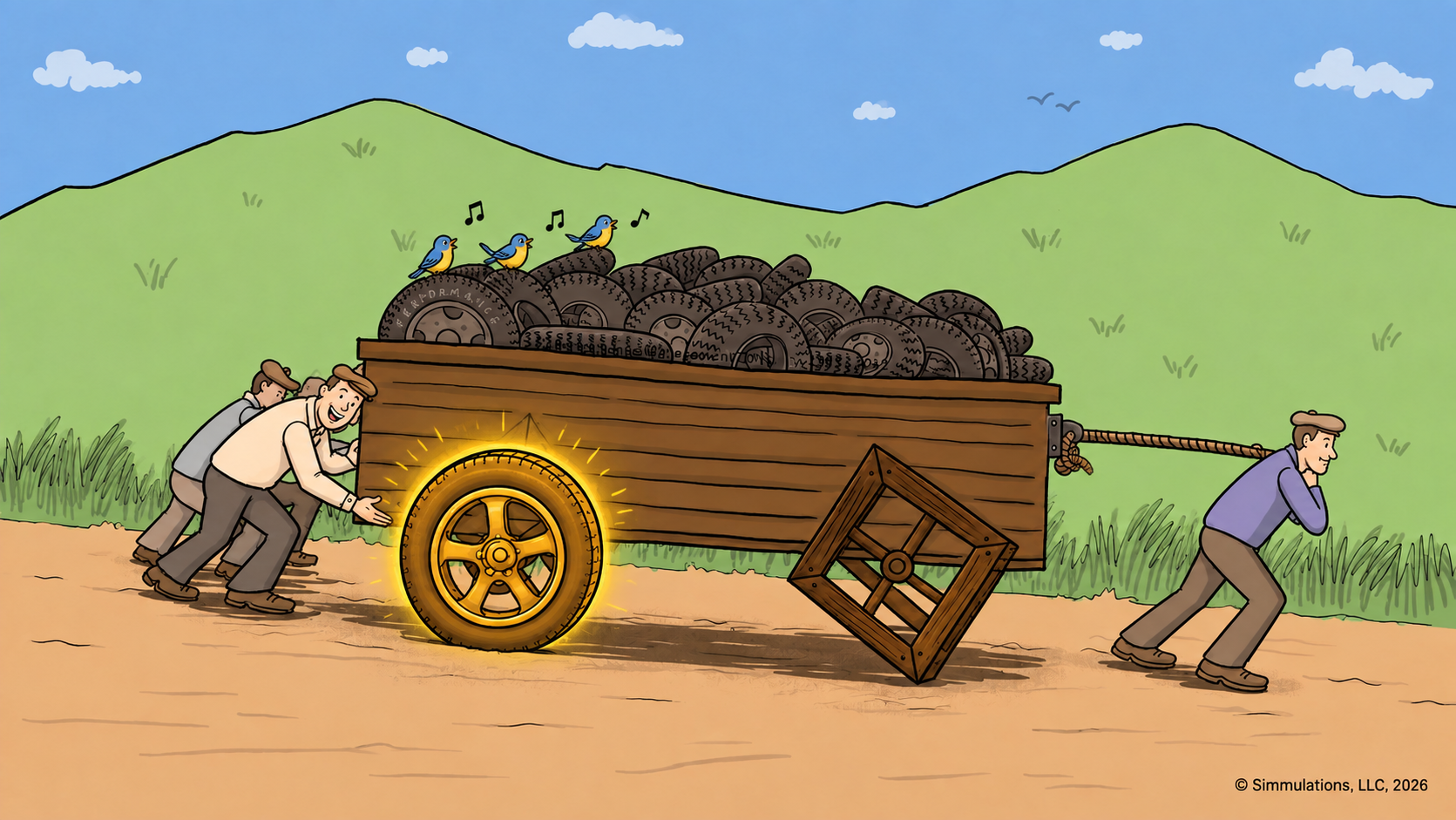
Gen Z workplace challenges often reflect an expectations mismatch, not motivation problems. Supervisors can use Square Wheels, teamwork, peer support, and clear coaching to build communication, initiative, professionalism, and stronger performances.
Some ideas on rolling downhill more better faster with round wheels
A company makes significant and costly efforts to recruit new workers to fill employment gaps but there are often issues around the retention and performance of these younger workers. Onboarding will be the job of the supervisor, something they are not trained for in most organizations.
Gen Z employees are not failing because they are a “problem generation.” Many are entering workplaces where the real rules of success: how to communicate, show initiative, manage priorities, receive feedback, and solve problems are assumed rather than taught. That expectations mismatch creates unnecessary friction for new employees, supervisors, and teams.
A supervisor can use Square Wheels® not as a clever “Gen Z teaching tool,” but as a shared, non-blaming way to make invisible workplace expectations visible, and then also help a new employee practice the behaviors that make work go smoothly with support from their peers. That matters because many of the issues outlined in this article’s underlying complaints about Gen Z people in the workplace are not mainly technical-skill gaps; they concern initiative, professionalism, communication, feedback, problem solving, organization, and managing workload; teachable and coachable things…
Start with the right frame and avoid The Blame Frame
We do not have a broken generation. We have some wheels that can work better, the normal workplace things like unclear expectations, unspoken norms, uneven onboarding, insufficient practice, and sometimes habits that get in the way of results. The role of supervisors is to identify the Square Wheels and find ways to use the round wheels already available.
The above is especially important because many of the survey-derived claims are perceptions reported by employers, not proof that an entire generation lacks work ethic. The survey around Gen Z people show concerns including things like low initiative (50%), poor professionalism (46%), communication problems (39%), difficulty accepting feedback (38%), and problem-solving limitations (34%). Those results are a leadership agenda: supervisors need to define “good,” demonstrate it, create low-risk practice, and give fast, specific coaching.
Map the problems to address with Square Wheels discussions
Use the images in conversations
A powerful Square Wheels conversation is concrete, brief, and collaborative. Rather than saying, “You need to act more professionally,” a supervisor might say:
“Let’s look at this wagon. Where is the work thumpy and bumpy for you, the team, or the customer? Which wheels are square: the task definition, the deadline, the communication, the quality check, or something else? What round wheel do we already have that could help this improve?”
This changes the interaction from judgment to joint diagnosis. It makes it easier for a newer employee to acknowledge a gap without feeling labeled as lazy, entitled, or incapable.
A supervisor can use the familiar Square Wheels imagery in three ways:
During onboarding: Ask each new employee to identify likely workplace “square wheels”—unclear priorities, unfamiliar software, meeting etiquette, customer communication, decision authority, or workload planning.
During weekly one-to-ones: Have the employee name one bumpy experience, one thing that worked, and one round wheel to try during the next week. This creates reflection, initiative, and accountability without requiring a long performance conversation. Any needed process training can happen at this point.
After mistakes or missed commitments: Treat the event as a learning review, not a character indictment. Identify the behavior, consequence, contributing conditions, corrective action, and follow-up date.
Make expectations observable
“Professionalism,” “initiative,” and “good communication” are often too vague to coach. The supervisor needs behavioral definitions.
For example, instead of telling a new person to “take more initiative,” define it as:
-
Bring two possible options when escalating a problem.
-
Tell the supervisor about a likely missed deadline at least 24 hours before it is due.
-
End every assignment conversation by confirming deliverable, deadline, quality standard, and first step.
-
Send a short update when an important task is halfway complete or blocked.
-
Ask for clarification early rather than silently making an assumption.
-
After receiving feedback, state the adjustment to be made and show it in the next work product.
Those behaviors turn the abstract “round wheel” into something the employee can practice, the supervisor can observe, and both can discuss fairly.
Build a 30-day “round wheels” onboarding plan
There is no rocket surgery here, just a basic focus on setting the stage for a new employee to generate their alignment into the work team. Having a new hire might also be a good excuse to run some Sauare Wheels conversations. A supervisor could turn the metaphor into a simple first-month operating system:
The central leadership shift is from “Why don’t these new employees already know this?” to “What working behaviors have we made explicit, modeled, rehearsed, reinforced, and coached?” Commentary on the survey itself points toward clearer onboarding and stated organizational expectations as part of the remedy, rather than relying solely on assumptions about young workers.allwork+1
For Square Wheels work, this is a natural fit: the supervisor’s role is not to drag people faster with square wheels. It is to help them see the system, find the round wheels already available, remove avoidable barriers, build capability through practice, and give credit when the cart begins moving more smoothly.
These are just some general ideas. Your AI can probably be used to generate more particular ideas that will support your decision-making about using Square Wheels images and metaphors and helping you roll things better faster. Note that I have published almost 900 blog posts on themes of people and performance. Let your AI do some rolling around,
—
For the FUN of It!
 Dr. Scott Simmerman is a designer of team building games and organization improvement tools.
Managing Partner of Performance Management Company since 1984, he is an experienced presenter and consultant who is trying to retire!! He now lives in Cuenca, Ecuador.
You can reach Scott at scott@squarewheels.com
Learn more about Scott at his LinkedIn site.
Note that I often use Perplexity AI to help research and generate ideas for my posts.
Square Wheels® are a registered trademark of Simmulations, LLC
and images have been copyrighted since 1993,
© Simmulations, LLC 1993 – 2026
Note: Please do not take my images and think about using them. It can generate a whole heap of problems given international copyright law and trademark law. Read this article for more information.
See a detailed overview of my tools, background and experiences here.
What I’m About:
My Square Wheels blog and website exist to help leaders, trainers, and facilitators make work smoother, more engaging, and more human. I focus on practical tools for process improvement, organizational change, and workplace collaboration that spark insight and deliver measurable results.
And I am convinced, after 30+ years of using Square Wheels®, that it is the best facilitation toolset in the world. One can use it to involve and engage people in designing workplace improvements and building engagement and collaboration. It is a unique metaphorical approach to performance improvement and we can easily license your organization to use these images and approaches.
By blending proven facilitation methods, creative problem-solving, and engaging team activities, my mission is to support organizations in building energized, sustainable cultures of involvement and innovation.
Through accessible — and often free — resources and virtual facilitation tools, I aim to help teams everywhere collaborate more effectively, innovate continuously, and take ownership of their improvement journey.
#SquareWheels #InnovationAtWork #TeamEngagement #FacilitationTools #WorkplaceImprovement #EmployeeEngagement #CreativeProblemSolving #OrganizationalDevelopment #LeadershipTools #collaboration #leadership #motivation #communications #enablement #leadership #CreativeCommons #enablingperformance #teamwork #storytelling #storyasking #enablement #disruptiveengagement #un-dis-engagement #un-dis-empowerment #innovation
© 2026 Simmulations, LLC. Please note that “Square Wheels®” is a registered trademark of Simmulations, LLC. and materials, original wagon line art, text, and visual designs are protected. Original line art by Roy Sabean, used under rights owned by Simmulations, LLC and formerly Performance Management Company, a sole-proprietorship of Dr. Scott J. Simmerman. Original concept and source artwork © Simmulations, LLC; derivative visuals sometimes created with assistance from Perplexity Pro AI.


0 Comments