
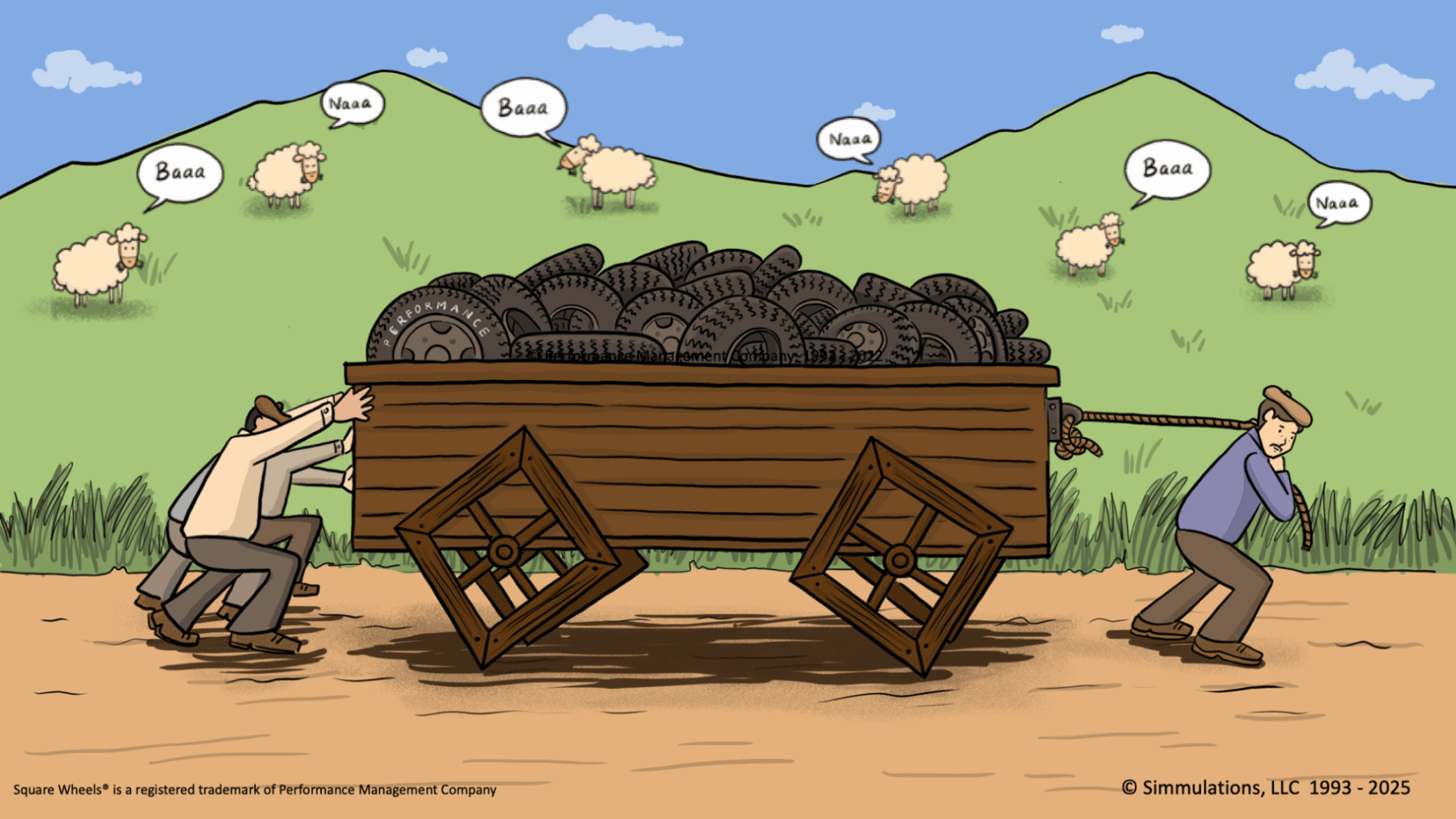
This post meshes a Fast Company article about Theory Y and Square Wheels Engagement for workplace innovation and motivation. It is about leadership. It is about change.
Square Wheels images, paired with a facilitation approach, provide a powerful way to motivate and engage employees in direct alignment building on the themes explored in the Fast Company article, “In leadership, you get what you expect.”
The core message from this Fast Company article, that a manager’s expectations shape real, measurable workplace behaviors. meshes perfectly with the hands-on, reflective nature of Square Wheels® discussions, where employees participate in identifying obstacles and envisioning improvements.
The Square Wheels Approach: Active Engagement
Square Wheels illustrations build around a simple metaphor: a wagon rolling on square wheels, with a cargo of round wheels always available. These visuals quickly ignite conversation around how things really work in organizations, prompting participants to reflect on inefficiencies and imagine better alternatives. The motivational goal is to enable people to implement their own ideas for improvement.

Celebrate the implementation of round wheels
Managers facilitate their team members to share their views on what might not be working smoothly, which generates collaboration along with the realization that other choices are available. The facilitation process of asking for ideas is thus transforming passive groups into active contributors who are invested in creating desired changes.
People are much more likely to try to implement
their ideas than your ideas!
The above mirrors the article’s assertion that leaders’ expectations fundamentally alter team behaviors. When supervisors facilitate Square Wheels discussions, they are demonstrating their confidence in the employees’ creativity and insights, setting expectations that everyone has valuable perspectives and can be contributors.
Teams thus feel respected and trusted to think critically and propose innovative solutions, reinforcing self-efficacy and engagement.
Turning Expectations into Measurable Engagement
Fast Company’s article highlights the lasting influence of Douglas McGregor’s Theory X and Theory Y: managers either believe people are naturally motivated and seek responsibility (Theory Y) or assume they require strict supervision (Theory X). Square Wheels facilitation embodies Theory Y management. It positions employees as natural problem-solvers with untapped talent and firsthand knowledge of workplace realities.
Rather than dictating change that is mostly resisted, facilitating managers can use these Square Wheels image tools to prompt discussion around possibilities:
-
“What Square Wheels show up in our work?”
-
“Where are some round wheels—what solutions are already within reach that we can implement?”
-
“What’s stopping us from using those round wheels tomorrow?”
By setting a positive expectation that improvement is both possible and a shared responsibility, leaders surface solutions that might remain hidden in a top-down environment. Employees take ownership because they are seen as the architects of progress, not just passive drivers of someone else’s plan.
Creating Psychological Safety for Candid Input and Outputs
For engagement to take root, people must feel psychologically safe to voice concerns, critique the status quo, and suggest new directions. Using the Square Wheels metaphor offers a gentle, fun, and depersonalized way to discuss problems and generate active involvement: the wagon’s “square wheels” are the organization’s issues, not any individual’s fault. This removes blame from the conversation and replaces it with an open invitation to collaborate.
One begins with the simple question, “How might this image represent how things really work?” and generate overall discussions of things in general, doing this before one moves on to one’s own workplace. Anyone can say anything because they are talking about workplaces in general. As people become involved, the conversations can move to “Our Workplace” with relative safely and group involvement. Our toolkits come with extensive facilitation ideas any manager can use.
And because the images are metaphorical, employees feel more comfortable speaking up and sharing their perceptions. There’s less risk of reprisal or embarrassment. And even the Spectator Sheep can be involved; they are those who tend to be more disengaged but who also have different viewpoints.
Click on this image to download a FREE copy you can use.
Over time, these candid discussions redefine what leaders expect: instead of silence or compliance, managers expect open dialogue, critical thinking, and constructive dissent. I call the process, Disruptive Engagement. Employees rise to meet these expectations, building a more resilient and engaged culture.
Ownership: From Insight to Action
Ownership is central to motivation. I’ve been saying this for decades:
“Nobody ever washes a rental car”
People care more when they feel responsible for outcomes. Square Wheels sessions empower participants to suggest and select improvements, building intrinsic motivation and pride in results. They share their perspectives and ideas.
Facilitated conversations lead groups to co-create action plans for moving from square wheels to round wheels. Because the ideas emerge from within the team, commitment to change skyrockets. Leaders reinforce this by acknowledging effort, providing resources, and celebrating progress. This thus doubles down on the positive expectation that people are capable, resourceful, and engaged.
Building a Culture of Continuous Continuous Improvement
Fast Company’s piece connects high expectations with a growth mindset and continuous improvement. Square Wheels images makes these concepts tangible and shared, Each session is a cycle of reflection, idea generation, prioritization, and experimentation. Teams are encouraged to revisit the metaphor regularly, measuring what’s improved and identifying new opportunities for “round wheels” to be rolled out. You build a simple language of performance improvement.
The Round Wheels of Today become the Square Wheels of Tomorrow. Improvement needs to be continuous.
Facilitating managers leverage worksheets, mind maps, and round wheels handouts and other tools to track commitments and outcomes. This creates accountability loops and institutionalizes a culture where people expect problems to be solvable and innovation to be ongoing. The process becomes self-reinforcing: success with one “round wheel” builds confidence and energy for the next challenge. Again, the below is how we generate intrinsic motivation for personal and workplace improvement.
Celebrate the implementation of round wheels
Data and Results: Why Square Wheels Works to Engage
Research and decades of application show that good engagement tools unlock dramatic improvements in teamwork, satisfaction, and performance. When people are actively involved in diagnosing and redesigning processes, organizations see:
-
Higher levels of engagement and discretionary effort
-
More creative solutions and rapid identification of barriers and roadblocks
-
Lower resistance to change and stronger momentum for improvement
-
Increased communication, trust, and collaboration across levels
These changes are measurable and sustained because they are driven by the teams, not imposed by above. Square Wheels’ simplicity is its superpower: powerful visuals and easy facilitation make it accessible to all, regardless of organizational size or complexity.
Practical Steps for Effective Leaders
To activate the power of expectations with Square Wheels:
-
Signal curiosity and optimism: Open meetings with Square Wheels visuals, signaling trust in your team’s ability to solve problems creatively.
-
Invite broad participation: Use small groups or large sessions to gather diverse perspectives; no idea is too small or silly.
-
Depersonalize problems: Frame challenges as “Square Wheels”—shared and solvable, not personal failings or fixed realities.
-
Prioritize action: Guide the group in selecting one or two “round wheels” to test, ensuring accountability and follow-through.
-
Reinforce expectations: Acknowledge effort, highlight improvements, and remind everyone that continuous improvement is the norm—not the exception.
Alignment with “You Get What You Expect”
Expectations are living things—the more leaders believe in their teams’ potential, the more those teams deliver. Square Wheels provides not only a language, but also a tangible process for setting high expectations for engagement, initiative, and continuous growth. It brings Theory Y management to life in every meeting, with every team, in every industry.
By embracing Square Wheels facilitation, leaders transform their hopes for engagement into a concrete reality—driven by images, reinforced by group discovery, and made sustainable through shared ownership and clear expectations. Whether you’re a manager, HR leader, or consultant, Square Wheels tools are a proven, fun, and effective way to turn good intentions into game-changing results.
Read another post about Douglas McGregor and his probably reaction to using Square Wheels here:
If you’re looking to foster a culture where motivation and engagement aren’t just buzzwords but lived experiences, get your teams rolling with Square Wheels and set your sights on what’s possible when you expect the best from people, every day. We have dozens of images you can use to keep the themes of continuous continuous improvement real.
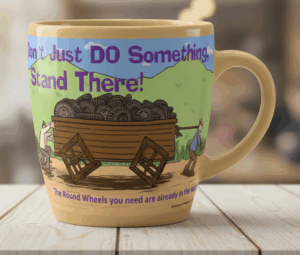
Customize a coffee cup with our images and your message
—
For the FUN of It!
 Dr. Scott Simmerman is a designer of team building games and organization improvement tools.
Managing Partner of Performance Management Company since 1984, he is an experienced presenter and consultant who is trying to retire!! He now lives in Cuenca, Ecuador.
You can reach Scott at scott@squarewheels.com
Learn more about Scott at his LinkedIn site.
Square Wheels® are a registered trademark of Simmulations, LLC
and images have been copyrighted since 1993,
© Simmulations, LLC 1993 – 2025
#SquareWheels #InnovationAtWork #TeamEngagement #FacilitationTools #WorkplaceImprovement #EmployeeEngagement #CreativeProblemSolving #OrganizationalDevelopment #LeadershipTools #collaboration #leadership #stormz



0 Comments