
Combining Conscious Competence and Square Wheels® to drive awareness and workplace enablement and improvement. Ideas and Actions.
When people become consciously aware of their “Square Wheels,” real improvement can begin because awareness and discomfort are the first steps toward enabling change. Knowing of Square Wheels drives the need to implement round ones. And having the intention to improve is a powerful driving force.
Why? Seeing the wagon rolling on Square Wheels and seeing that the cargo of that wagon are round wheels, better alternatives, helps generate cognitive dissonance, which is the driving force to close the gap.
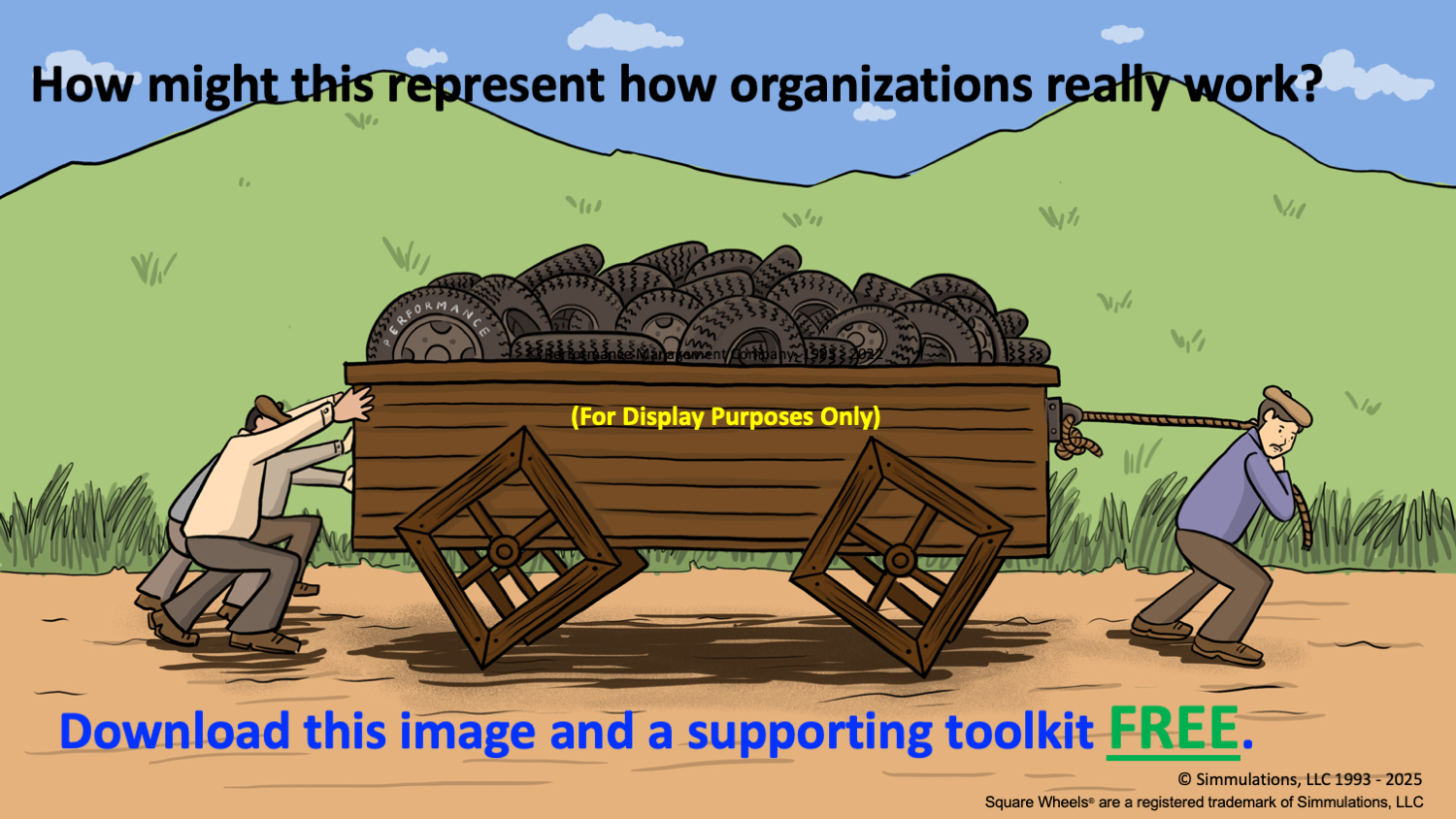
Download the FREE Square Wheels One image under a Creative Commons license allowing broad use.
Most organizations run on good intentions and half-formed habits. People are busy, processes are entrenched, and everyone’s doing their best to keep things rolling. The Conscious Competence model should remind us that real improvement begins with awareness. And change goes from moving away from unconscious incompetence to conscious competence and beyond into FLOW..
When you pair that mindset with the visual metaphor of Square Wheels, you enable powerful tools for seeing the organization’s realities, identifying friction points, and consciously developing smoother, more effective ways of working and engaging your people in meaningful change.
At its heart, this combination is about enablement: helping teams recognize what’s working, what’s not, and where energy is being wasted. By linking awareness to action, leaders can turn everyday operations into opportunities for learning and innovation. The journey starts by helping people see their “Square Wheels,” understand their role in moving things forward, and develop the conscious competence to replace them with round ones.
Enablement is the actionable act of
effectively engaging people.
This approach transforms “doing your job” into “improving how we work”—a shift that elevates active involvement, strengthens accountability, and creates a culture of continuous continuous improvement.
Leaders talk a lot about “continuous improvement,” but teams often feel stuck in the same old ruts of firefighting, rework, and frustration. The reality of this is often just a one-time improvement of something; the continuous improvement is not continuous.
The Square Wheels metaphor and the Conscious Competence learning model fit together beautifully as a graphic, story, and facilitation tool to shift people from stuck to proactive. When combined visually, they give you a simple way to show where a team is on its improvement journey—and what it will take to move forward.
Let’s begin here and roll forward:
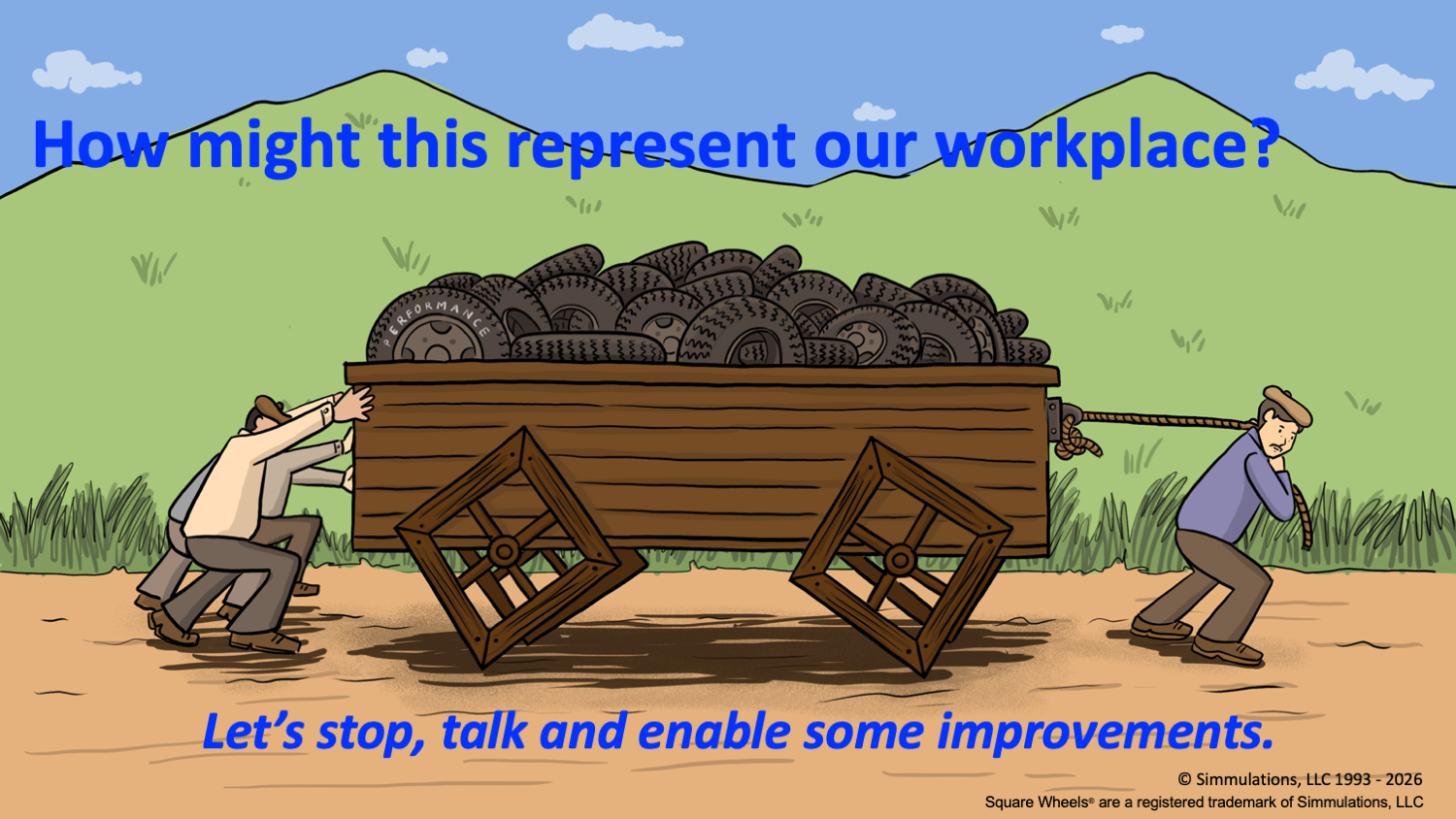
The core idea: a Learning Journey rolling on Square Wheels
Imagine a road running left to right, maybe even slightly uphill and somewhat muddy to suggest effort and progress. On our road is our Square Wheels wagon: front-facing puller / leader and people behind (hopefully1) pushing. Square Wheels on the axles, with unused Round Wheels in the wagon as cargo.
The metaphor is simple: every workplace has Square Wheels® (inefficient processes, goofy policies, legacy habits and other things that go thump-thump in operation), and round wheels (better ideas, tools, process improvements) already exist but are not in use.
1 – I say “hopefully” because Gallup (2025) data shows that 79% of workers are disengaged in their workplaces. Hopefully they are pushing and not pulling…
Now let’s divide that road into four clear zones and label them with the stages of the Conscious Competence model (see note):
-
Unconscious Incompetence – “We don’t know our wheels are square.”
-
Conscious Incompetence – “We now see the Square Wheels and the unused Round Wheels.”
-
Conscious Competence – “We deliberately replace Square Wheels with round wheels.”
-
Unconscious Competence – “Round wheels are now the default, and people keep improving them as part of how we work.”
The trick is that the wagon and metaphor always stay the same, while the context and behavior around the wagon evolve across our four stages as we develop our culture, our egregaore. That’s what makes the graphic easy to teach and re-use in a wide variety of workplace conversations.
Note: The “conscious competence” model is usually credited to Noel Burch at Gordon Training International in the early 1970s. However, the earliest clearly documented version of the idea appears in a 1969 article by Martin M. Broadwell titled “Teaching for Learning,” which lays out essentially the same four levels of competence.
Stage 1: Unconscious Incompetence – “What Square Wheels?”
In Stage 1, the team is rolling along on Square Wheels and treating the bumpy ride as normal. The graphic above shows:
-
The wagon riding on four Square Wheels, with Round Wheels inside the wagon barely visible.
-
A wagon puller facing forward, eyes fixed on the road, saying something like, “This is how we’ve always done it.”
-
Spectator Sheep standing off to the side, quietly observing but not yet engaged.
-
Dust clouds or jagged lines around the wheels labeled with things like “rework,” “firefighting,” or “frustration.” We move forward. Thump Thump.
From a leadership standpoint, this is the land of no questions. People normalize the bumps as reality. Complaints are shrugged off as “just the way it is.”
The graphic above and an open discussion of perceptions helps make the invisible visible; you are literally seeing the pain that has become background noise. The key move here is to create a safe, shared image that allows people to talk about friction without blaming individuals.
Stage 2: Conscious Incompetence – “We do have Square Wheels”
In Stage 2, someone notices that they are indeed rolling on Square Wheels—and that Round Wheels already exist. Awareness increases, and with it comes both discomfort and hope. Visually, this stage shifts in several ways:
-
The wagon still rides on Square Wheels, but team member or the Spectator Sheep standing around see that round wheels exist.
-
The puller might look back over their shoulder, surprised, starting to realize that the current way is not the only way; alternatives exist.
-
Team members have a mix of question marks and exclamation points over their heads: “Why are we doing it this way?” “Could that round wheel actually work for us?”
-
The Spectator Sheep become visible symbolizing that observers and “quiet knowers” can contribute to the conversation.
-
A small road sign reads, “Aha! Square Wheels!”
Facilitatively, this is where honest conversations start. People acknowledge gaps in skills, processes, or systems. They become aware that improvement is possible, yet they may also feel overwhelmed or slightly threatened. The managers roles are to legitimize both the discomfort and the opportunity:
-
Normalize the tension: “Of course we feel awkward; we’re recognizing problems we’ve lived with for years.”
-
Capture Round Wheel ideas that people have been sitting on.
-
Help the group prioritize a few visible, high-leverage wheels to work on first, rather than trying to fix everything.
Stage 3: Conscious Competence – “We’re changing the wheels”
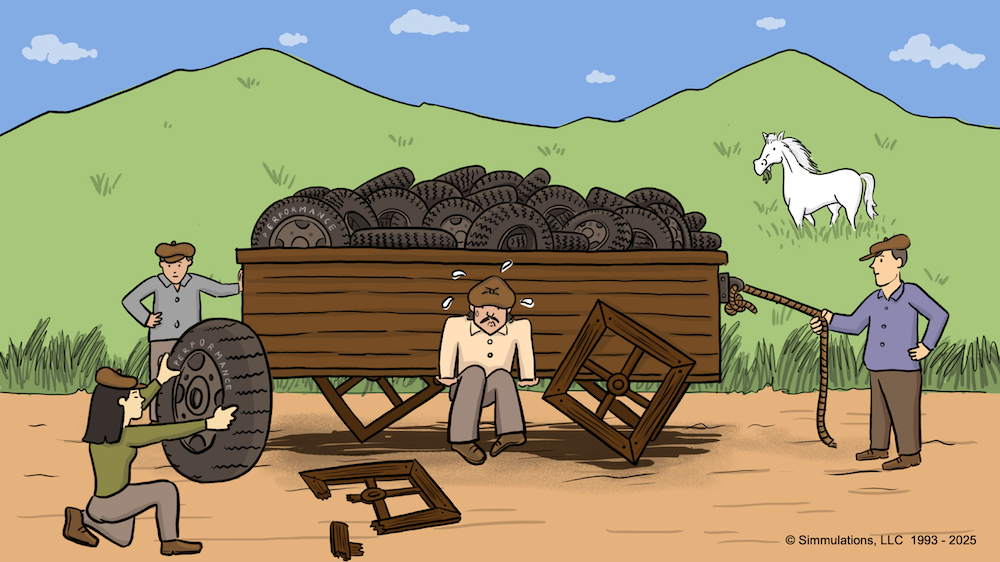
Stage 3 is where learning and change become deliberate and things really begin. The team is actively replacing Square Wheels with round ones, but it still takes effort, attention, and support. But there are only minor impacts on the journey with only one or two improvements.
- The puller and team need to work together to implement the round wheels and be working together to make improvement. This is the role of all of those involved.
-
A back wheel of the wagon has been replaced with a Round Wheel, while the front wheels remain square, illustrating that change often starts unevenly and in pockets. But these changes are impactful. It begins.

-
A signpost might read “Experimenting, learning, practice.”
This stage is the heart of performance improvement – it involves changing many beliefs about leadership, change and improvement and about generating better communications and collaboration.
-
Teams run pilots and experiments with new processes or behaviors.
-
They consciously practice new skills and intentionally apply new tools.
-
They sometimes slip back to old habits, which is entirely normal.
As a manager, your best moves at this stage include:
-
Providing structure for experimentation: clear goals, timelines, and feedback loops.
-
Ensuring that people get coaching, not just “training and hope.”
-
Helping the group define simple success metrics: cycle time, error reduction, customer response, or engagement indicators linked to the “Round Wheel” changes.
You want to reinforce that the bumps and missteps are signals of learning, not signs that the Round Wheels “don’t work.”
Stage 4: Unconscious Competence – “We implement round wheels early and often”
In Stage 4, implementing the round wheels is the norm and people are always adjusting and the mindset of continuous improvement is embedded in how work is analyzed and done. The wagon now runs much more smoothly and quickly, but the metaphor continues to evolve:
-
All wheels on the wagon are round ones.
-
The pullers and pushers are more relaxed but still alert to possibilities for improvement, and things flow, representing better enabling of shared leadership, cooperation and distributed capability.
-
The former Spectator Sheep now join with the team and adding their different perspectives, symbolizing that people who once observed aloof and passively are now actively engaged.
-
People also envision next-generation round wheels, understanding that today’s round wheels will become tomorrow’s Square ones.

This stage represents a mature improvement culture:
-
People proactively scan for emerging Square Wheels as conditions change and improvement is the goal.
-
Improvement is not a project; it is simply “how we do things here.”
-
Stories of successful Round Wheels travel laterally across the organization, not just top-down.
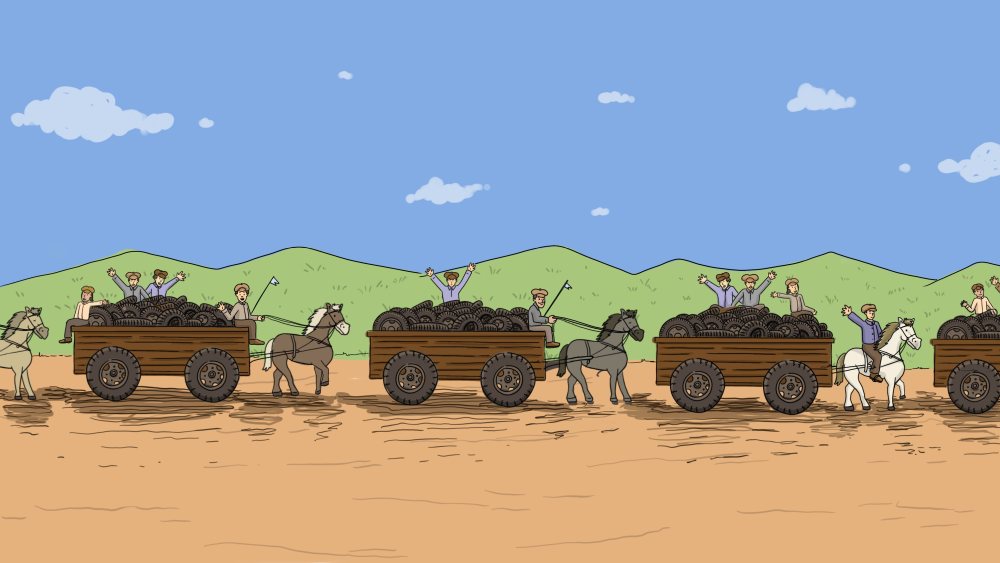
Ideas can be shared once things get rolling.
As a manager, your job shifts from driving change to enabling, protecting and amplifying it:
-
Create space for reflection so teams can regularly ask, “Where might new Square Wheels be hiding?”
-
Celebrate stories of local innovation and peer-to-peer learning.
-
Guard against complacency by reminding people that every Round Wheel will eventually need an upgrade.
A practical comparison
Here is a simple table to help people connect the picture to real behavior and choices:
| Competence stage | How the team sees Square Wheels | Typical workplace behavior | Facilitator’s best move |
|---|---|---|---|
| Unconscious Incompetence | “What Square Wheels? This is normal.” | Defends status quo; accepts firefighting and rework as inevitable. | Use the image to surface friction safely and invite stories about the “bumpy ride.” |
| Conscious Incompetence | “We actually have Square Wheels.” | Feels frustrated yet hopeful; ideas start surfacing. | Legitimize discomfort, collect Round Wheel ideas, and focus on a few high-impact changes. |
| Conscious Competence | “We’re actively changing the wheels.” | Runs pilots, practices new ways, occasionally slips back. | Provide structure, coaching, and measures; reinforce that missteps are part of learning. |
| Unconscious Competence | “We naturally spot and fix Square Wheels.” | Improvement is habitual; people share and spread better ways. | Protect time for reflection, celebrate stories, and help teams anticipate the next Square Wheels. |
Sharing the Competence Model with people usually generates a motivation to improve, that the desired goal is to work through the four stages to reach Mastery. The challenges are straightforward and this IS about building skills and awareness. These factors are all important to having an effective workplace and to allow people to evolve and grow.

Note that this journey is continuously uphill. I did that just for you to show that I understand the reality!
—
For the FUN of It!
 Dr. Scott Simmerman is a designer of team building games and organization improvement tools.
Managing Partner of Performance Management Company since 1984, he is an experienced presenter and consultant who is trying to retire!! He now lives in Cuenca, Ecuador.
You can reach Scott at scott@squarewheels.com
Learn more about Scott at his LinkedIn site.
Square Wheels® are a registered trademark of Simmulations, LLC
and images have been copyrighted since 1993,
© Simmulations, LLC 1993 – 2026
What I’m About:
My Square Wheels blog and website exist to help leaders, trainers, and facilitators make work smoother, more engaging, and more human. I focus on practical tools for process improvement, organizational change, and workplace collaboration that spark insight and deliver measurable results.
And I am convinced, after 30+ years of using Square Wheels®, that it is the best facilitation toolset in the world. One can use it to involve and engage people in designing workplace improvements and building engagement and collaboration. It is a unique metaphorical approach to performance improvement and we can easily license your organization to use these images and approaches.
By blending proven facilitation methods, creative problem-solving, and engaging team activities, my mission is to support organizations in building energized, sustainable cultures of involvement and innovation.
Through accessible — and often free — resources and virtual facilitation tools, I aim to help teams everywhere collaborate more effectively, innovate continuously, and take ownership of their improvement journey.
#SquareWheels #InnovationAtWork #TeamEngagement #FacilitationTools #WorkplaceImprovement #EmployeeEngagement #CreativeProblemSolving #OrganizationalDevelopment #LeadershipTools #collaboration #leadership #motivation #communications #enablement #leadership #CreativeCommons #enablingperformance #teamwork #consciouscompetence #flow


0 Comments