

Driving FLOW and decreasing Friction through the Power of a Simple Image: How Square Wheels One Conversations Drive Peak Performance
Why Talking About an Image Can Create FLOW
Flow is that sweet spot where work feels absorbing, meaningful, and almost effortless—what athletes call being “in the zone.” Research syntheses of work‑related flow show that people are most likely to experience it when four conditions line up: clear goals, unambiguous feedback, a strong sense of control, and a good balance between challenge and skill.
So, how might a discussion around this image below generate some active involvement and some new perspectives and create some gaps between what is happening and what should be happening. Look at it for a few seconds. How can you not see issues and opportunities you might address. The same dynamic plays out with anyone, anywhere for anything.
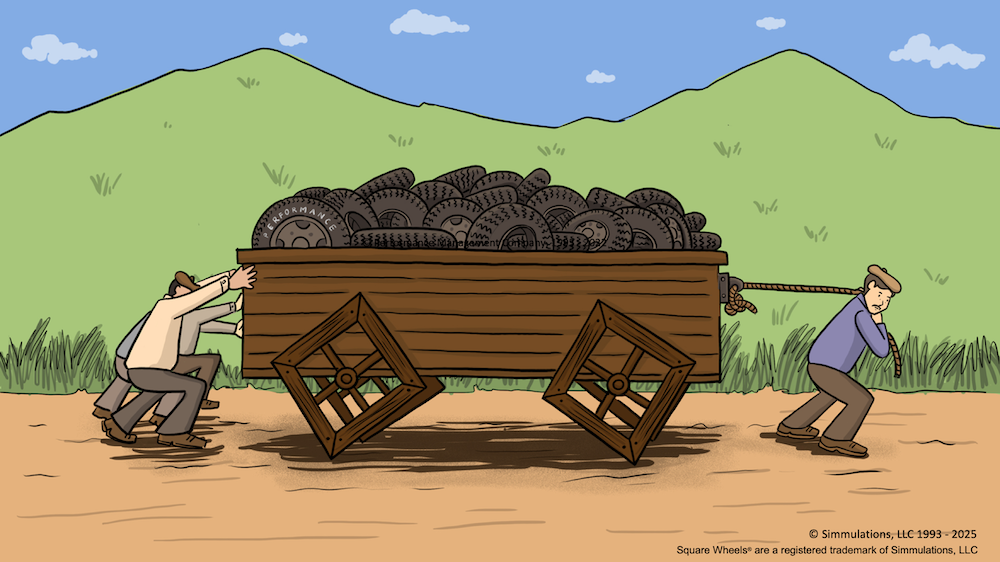
A simple group discussion around the Square Wheels One image can activate all four of those conditions. The wagon, the thumping Square Wheels®, and the unused round wheels in the wagon give people a safe, visual language to diagnose what’s dragging performance and what could release more “flow” into the way they work together.
What the Science Says About FLOW at Work
Meta‑analytic studies of flow in workplaces and performance contexts consistently find that flow is a short‑term peak state marked by absorption, enjoyment, and intrinsic motivation, and that it shows up frequently in work when the environment is designed well.
One large meta‑analysis found moderate to strong correlations between flow and four job resources: feedback, sense of control, clear goals, and especially challenge–skill balance, the strongest predictor of all. When those resources are present, people are more likely to judge their work lives positively, learn faster, and deliver high performance while avoiding burnout.
How Square Wheels Conversations Mirror FLOW Conditions
When a group sits around Square Wheels One and is asked, “How might this represent how things really work here?”, they are doing a live, low‑risk diagnostic of those same flow enablers. The image invites people to talk about:
-
Fuzzy or conflicting goals (Where is the wagon going? Why are we pushing this way?)
-
Clumsy processes and bottlenecks (What are our “Square Wheels” that make everything thump and bump?)
-
Underused strengths and resources (What “round wheels” are already in the wagon that we’re not using?)
That shared conversation clarifies direction, surfaces immediate feedback about what is and isn’t working, and lets people propose changes they themselves believe are doable—creating more control and better challenge–skill balance. In other words, the group is building the conditions that the meta‑analysis says make flow more likely.
From Anti‑Flow to “We’ve Got This Rolling!”
If FLOW feels like “we’ve got this,” anti‑flow is “why does this have to be so hard?”—hard‑working people pushing badly designed wheels and a wagon up a rough road. Anti‑flow shows up as quiet resistance, sarcasm, fatigue, or people just going through the motions even while they keep apparently pushing.
Square Wheels® conversations are designed for impacting that exact situation. The metaphor externalizes blame (“the problem is the wheels, not the people”), validates effort (“the wagon does move”), and then invites autonomy (“what wheels could we swap?”). Psychological research on autonomy‑supportive environments suggests that this kind of discussion reduces reactance, increases intrinsic motivation, and restores the sense of control that underpins both engagement and flow.
Mindfulness, Attention, and Looking at the Wagon
A meta‑analysis of 17 studies and over 10,000 people (Schutte & Malouff (2023) in Personality and Individual Differences) found that greater mindfulness is reliably associated with higher levels of flow, with a moderate overall effect size. Mindfulness here means present‑moment awareness of what is happening, rather than distracted or automatic behavior.
Talking through Square Wheels One is, functionally,
a guided mindfulness exercise about work.
People pause, really look at the picture, notice details, and then connect those details to their lived experience—What are our square wheels? What permissions or capabilities are “round wheels” we’re not using? That reflective attention to the actual system, rather than just reacting to each day’s crises, aligns with the kind of awareness that the mindfulness–flow research identifies as a foundation for more frequent flow states.
A Simple Process That Feels Like Game Playing
Systematic reviews of gamification in learning and performance settings report that game‑like elements—clear structure, feedback, goals, and appropriate challenge—tend to improve motivation and outcomes when used thoughtfully. A Square Wheels session has those same design features, even though it looks deceptively simple:
-
There is a “game board”: the Square Wheels One image.
-
There are clear rules: interpret the picture, list Square Wheels, play with round wheel ideas, propose possibilities.
-
There is immediate feedback: the group reacts, refines ideas, and spots which “round wheels” have the most potential for positive impacts.
-
There is an appropriate challenge: people focus on issues they can influence, not impossible mandates. All of them will be successful in generating possibilities.
That structure makes the conversation feel safe, slightly playful, and undoubtedly productive, conditions that the evidence suggests increase enablement and the likelihood of people experiencing pockets of FLOW as they design and test improvements.
What Happens When Teams Play with Square Wheels Repeatedly
Innovation and change are all about implementation, one wheel at a time. And it is about building organizational momentum for change.
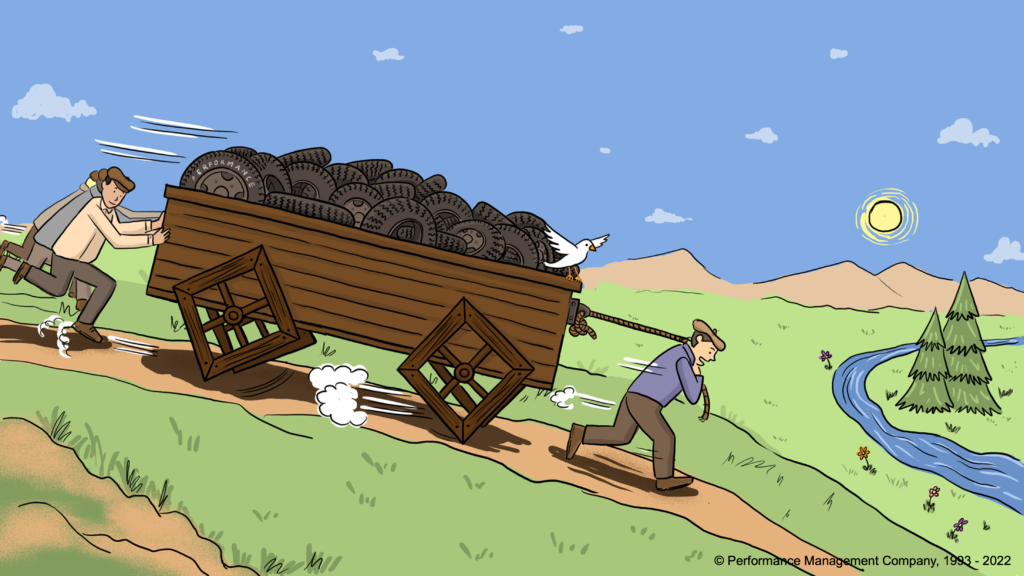
When organizations make Square Wheels discussions a recurring practice—at project kick‑offs, retrospectives, or strategy sessions—the benefits compound. Each cycle reinforces three shifts that map cleanly onto the flow research:
-
From helplessness to agency. People see that they can redesign work, not just endure it, strengthening the sense of control that predicts flow.
-
From complaint to problem‑solving. The shared language of “square wheels” and “round wheels” channels frustration into constructive, high‑quality information exchange—exactly the kind of team interaction associated with better team flow and performance.
-
From scattered effort to focused momentum. As obvious obstacles are removed and work is better aligned with strengths, attention can narrow, feedback loops shorten, and tasks feel more like being “in the groove.”
In short: a group of people discussing Square Wheels One is not just having a clever conversation about a cartoon. They are, in a compact, visual way, building the very conditions—clear goals, feedback, control, challenge–skill balance, and mindful attention—that meta‑analyses link to more frequent flow, higher performance, and more sustainable engagement at work.
You can enable Flow by enabling people with enabling processes
—
For organizations with multiple stuck teams, book a short conversation to design a program using Square Wheels across your organization, We can easily build some really great tools and courses and support systems,
For the FUN of It!
 Dr. Scott Simmerman is a designer of team building games and organization improvement tools.
Managing Partner of Performance Management Company since 1984, he is an experienced presenter and consultant who is trying to retire!! He now lives in Cuenca, Ecuador.
You can reach Scott at scott@squarewheels.com
Learn more about Scott at his LinkedIn site.
Square Wheels® are a registered trademark of Simmulations, LLC
and images have been copyrighted since 1993,
© Simmulations, LLC 1993 – 2025
What I am about:
My Square Wheels blogs and website exist to equip leaders, trainers, and facilitators with practical process improvement tools along with effective organizational change tools. My purpose is to facilitate engagement and active involvement to help make work smoother and more human.
By blending change management facilitation with proven workshop facilitation techniques, team collaboration activities, and creative problem solving activities, my mission is to support organizations in designing employee engagement strategies that are both energizing and sustainable. Through accessible, sometimes free team building resources and virtual facilitation tools, my focus is on helping teams everywhere discover better ways to collaborate together, innovate continuously, and own their path to improvement.
#SquareWheels #InnovationAtWork #TeamEngagement #FacilitationTools #WorkplaceImprovement #EmployeeEngagement #CreativeProblemSolving #OrganizationalDevelopment #LeadershipTools #collaboration #leadership



0 Comments