

Unlocking Better Problem Solving: How Square Wheels Images Transform Thinking and Workplace Results
Square Wheels® gives leaders and teams a very simple and practical way to see problems differently, talk about them safely, and design better solutions collaboratively. The different images become a visual language for continuous continuous improvement and sharper thinking skills in everyday work and workplaces. And, at the end, we will wrap the tools around TRIZ and general organizational use, and how one can reengage lost people…
Why Pictures Beat PowerPoints for Problem Solving
People do not change because they are told to; they resist change being done TO them. But they WILL change when they are actively involved in problem solving and when they see and feel that a better way is possible.
Square Wheels images hit that sweet spot. A simple cartoon of a wagon rolling on square wheels with unused round wheels in the wagon triggers a mix of humor, discomfort, and recognition. And these simple emotions drives them to close the gap, to do something differently to solve the thumps and bumps caused by the things that do not work smoothly.
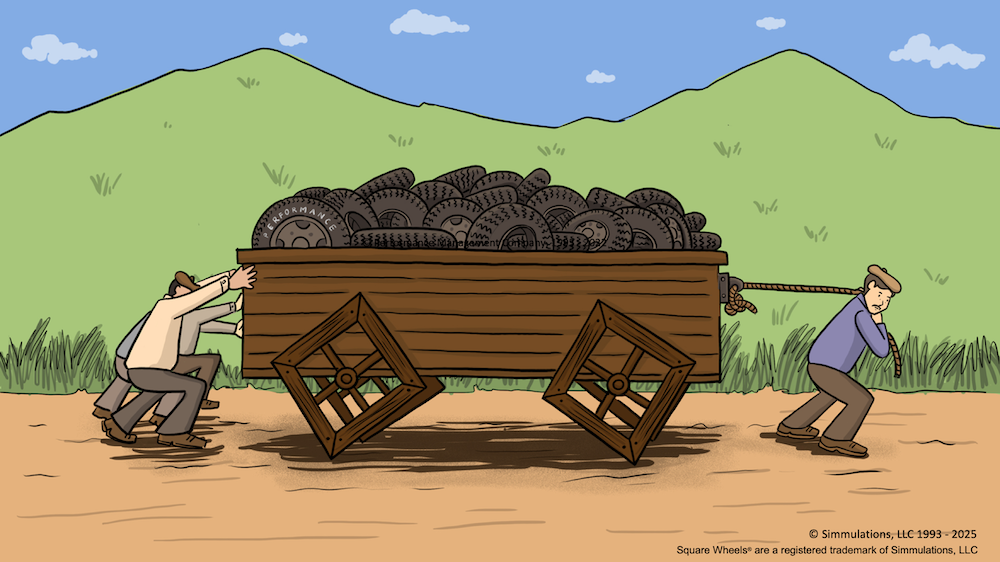
Seeing the image and reflecting for a few seconds, people intuitively grasp three big ideas:
-
Things “work,” but they do not work smoothly.
-
Better ideas already exist, but they are not being used.
-
People are pushing hard on a system that fights them every step of the way, all day and every day..
That moment of cognitive dissonance opens the door to better problem solving. People want to close the gap between the clunky present and the obvious potential for improvement.
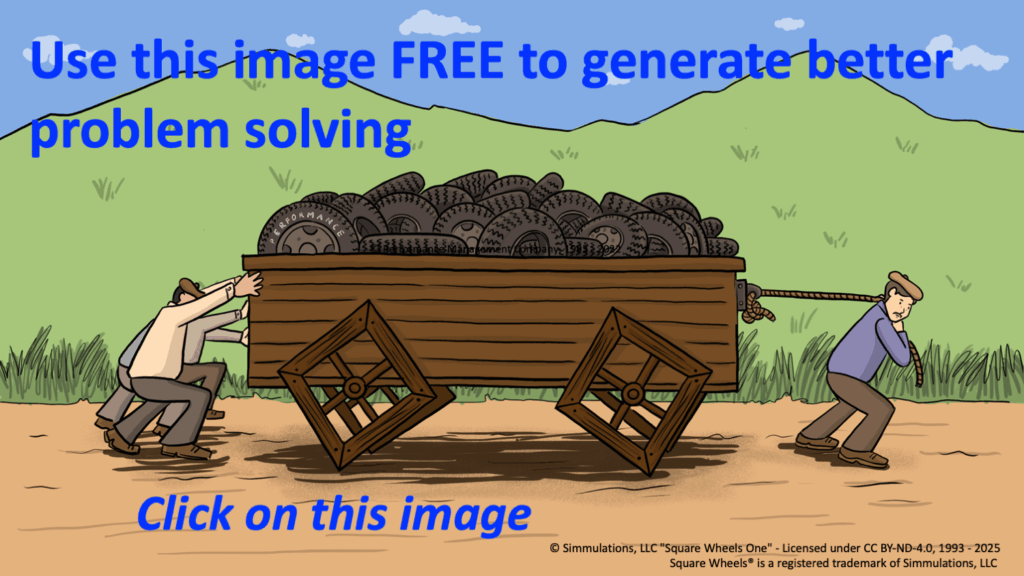
So, grab that image for FREE:
The Classic Wagon Reality: Core Problem-Solving Skills
The main Square Wheels One wagon image is the best place to start. Shown above and available free under a Creative Commons license, It is the foundational exercise for building thinking skills and team-based problem solving.
Typical uses:
-
Kickoff for any improvement initiative – ask, “How does this picture represent how we really work?” Participants identify their own Square Wheels (processes, delays, bureaucracy, rework and other issues) and start listing the round wheels they know are available but unused (tools, ideas, best or better practices).
-
Teaching better problem framing – instead of vague complaints (“communication is bad”), participants are encouraged to name specific frictions, bottlenecks, and misalignments they see in the picture and in their real work. This strengthens cause–effect thinking and observation skills. Many tools can be added into the approach for problem-solving uses.
-
Moving from blame frames to systems thinking – the images all focus attention on the wagon, wheels, mud and road, spectator sheep, silos and many other actual things that do not work smoothly or contribute positively to the journey forward, not on personalities. It becomes natural to say “this process is square” rather than “this person is the problem.”
The result is a group that can articulate problems clearly, see patterns, and separate symptoms from causes—core abilities for any advanced problem-solving method. One that anchors an ongoing reality of the language of improvement becomes more common within the organization.
The Wagon from Different Angles: Building Perspective
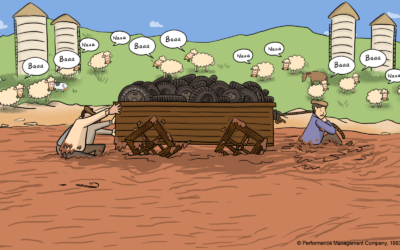
Variants of the wagon image show the situation from different viewpoints and in different realities. For example, the wagon up to its axles in mud, or the views from different angles or even a customer’s take on how things are rolling. These are powerful tools for teaching perspective-taking and reframing.
Applications:
-
Front vs. back of the wagon – one image may highlight the leader pulling hard in front while the people in the back push without seeing the road ahead. Different perspectives become developmental prompts for questions like:
-
Who actually sees the goal of this journey?
-
Who feels the thumps and bumps?
-
Where do we have blind spots?
- How can we be more engaged and motivated?
-

-
Stakeholder thinking – ask different functions (operations, sales, IT, HR) to interpret the same image and operations. Peoples’ divergent views demonstrate how “reality” changes with vantage point and why cross-functional problem solving matters. Are we working in alignment?
- Customer thinking – step back and have a discussion about how the customers perceive the journey with the team. This could be an external customer or an internal one. Often, issues lead to the development of silos and non-interaction between departments.
Metaphorically, your customers ride on top of the wagons in that they can feel every thump and bump but they do not really understand the causes. Making the journey smoother has impacts on perceived value.

Customers can feel every thump and bump in their journey without understanding the systems and processes and how they actually work.
This teaches people that good problem solving is not just about having the right answer; it is about seeing the system through multiple eyes and making improvements as necessary.
Overloaded Competing Wagons: Prioritization and Focus
In these days and times, I think that most everyone thinks there are too many wagons, way too many wheels and far too few hours needed to get things done. People often suggest that the Square Wheels wagons are too overloaded with boxes, clutter, or too many people trying to push and pull at once. These perceived problems are ideal for improving teamwork and collaboration, prioritization and decision-making skills.

The TRIZ Thinking Frameworks
If you are into the Scrum kinds of problem solving, which I will admit I am not all that competent, you might readily see where the TRIZ thinking approach comes into play. My friend Perplexity helped me polish some of this content.
Use these images and patterns when:
-
Teams are overwhelmed by “too many projects” or “too many priorities.”
-
Leaders want to teach the tradeoffs between doing everything and doing the most important things. Note that there are a lot of linkages to producing FLOW (here and here and here).
Facilitation moves you can make:
-
Ask, “What is weighing this wagon down?” and have people label each wheel as a project, meeting, report, or policy.
-
Then ask, “If we had to take three wheels off to get moving, which would they be?” and “What happens if we keep them all?”
This turns abstract talk about “focus” into a concrete visual exercise and trains teams to think in terms of constraints, capacity, and strategic choice.
Different Roads and Terrains: Context-Aware Thinking
Other images place the wagon on rough roads, hills, muddy tracks, or smoother terrain. These images help people connect problem solving to context—an essential but often neglected thinking skill.
Ways to apply:
-
Match the road to your reality – have groups choose which road image best represents their current environment (stable, muddy, uphill, peaceful, chaotic, potholed, regulated, etc.).
-
Ask what “round wheels” work where – some improvements are perfect for flat roads but fail in rough terrain, and vice versa. This leads to discussions about scalability, risk, and situational leadership.
People begin to understand that a “good idea” is not universally good; its value depends on conditions. That nuance is exactly what sophisticated problem solving requires.
Multiple Wagons: Systems and Interdependencies
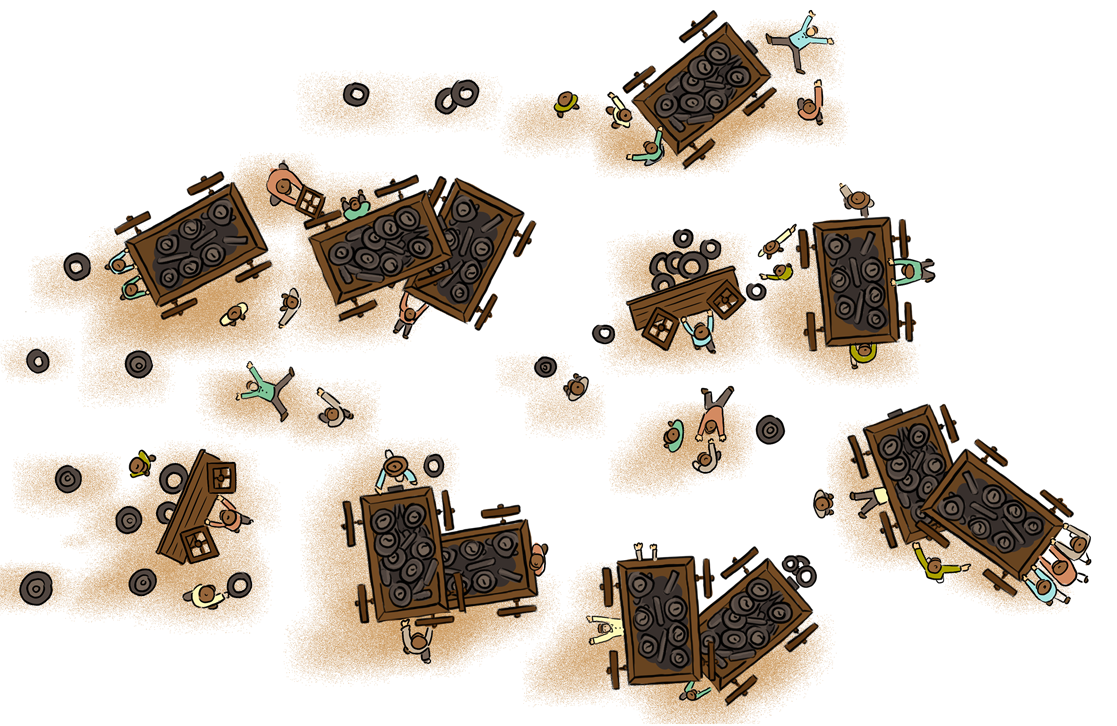
Some Square Wheels scenes show multiple wagons on the same path, bumping into each other, blocking each other, or trying to move at different speeds. These are tailor-made for systems thinking and cross-functional problem solving.
Practical uses:
-
Managing the direction(s) – are we all headed in the same direction or is it better than we are focused on different paths?
-
Breaking down silos – ask each department to pick “their wagon” and describe how the others affect them. Who is upstream? Who is downstream? Where do square wheels in one wagon create problems for others?
-
Mapping interdependencies – use sticky notes or virtual tags to mark where handoffs fail, where information gets stuck, and where coordination is missing.
Instead of optimizing one part of the system at the expense of others, teams learn to search for improvements that benefit the whole flow.
People Around the Wagon: Roles, Engagement, and Leadership
Many images add more characters—people on the wagon, watching from the side, or standing aside with arms crossed. These highlight roles, involvement, and leadership behaviors.
They are especially useful for:
-
Leadership development – images where a boss stands aside while others push raise questions about visibility, support, and credibility. Leaders can explore:
-
“Where am I in this picture right now?”
-
“What would it look like if I were removing Square Wheels instead of just cheering?”
- Where do I want to be in a week or a month?
-
-
Engagement and ownership – characters who are just watching or complaining become a safe way to talk about disengagement and passive resistance. Teams can ask, “What would it take to get this person pushing or offering ideas?”
These conversations sharpen social perception, empathy, and the ability to design better roles and interactions—vital skills in solving “people problems,” not just process problems.
Online and Hybrid Images: Everyday Micro-Interventions
Square Wheels is no longer just flip charts, transparencies and printed cartoons. Digital images and online versions allow quick use in virtual meetings and e-learning modules. And we can certainly port the tools to online brainstorming and project management tools with you. Miro Engage and Stormz are but two of the possibilities.
Examples:
-
Icebreaker in remote meetings – show a single image and ask people in chat: “What’s one Square Wheel in your day right now?” That captures issues fast and gives you a prioritized list to work with.
-
Short learning bites – embed images in micro-learning modules about critical thinking, decision-making, or continuous improvement. Participants interpret the scene, answer questions, and then apply the ideas to a real task.
Over time, this drip-feed approach steadily raises the baseline of problem-solving and reflective thinking across the organization.
Building Thinking Skills, Not Just Fixing Today’s Problems
What makes Square Wheels especially valuable is that it improves how people think, not only what they fix.
Across the different images, participants can learn to:
-
Observe carefully rather than jump to conclusions.
-
Separate symptoms from underlying causes.
-
Consider multiple perspectives and stakeholders.
-
Recognize constraints and tradeoffs.
-
Envision better alternatives and test them.
Each image is a low-risk “mental gym” where people practice these moves on a cartoon before applying them to serious business issues. That playful distance actually speeds up learning and reduces defensiveness.
Using a Portfolio of Images to Shape Culture
Individually, each Square Wheels image is a powerful conversation starter. Together, they form a visual toolkit leaders can use to shape culture over time. And we have a LOT of existing images and can certainly create new, custom ones when needed.
A simple approach:
-
Use the classic Square Wheels® One wagon image to launch improvement thinking and get everyone comfortable with the metaphor.
-
Introduce overloaded wagons and rough roads when tackling prioritization, project overload, or change fatigue.
- Bring in multiple wagons and bystanders when working on cross-functional alignment, stakeholder engagement, and leadership behavior.
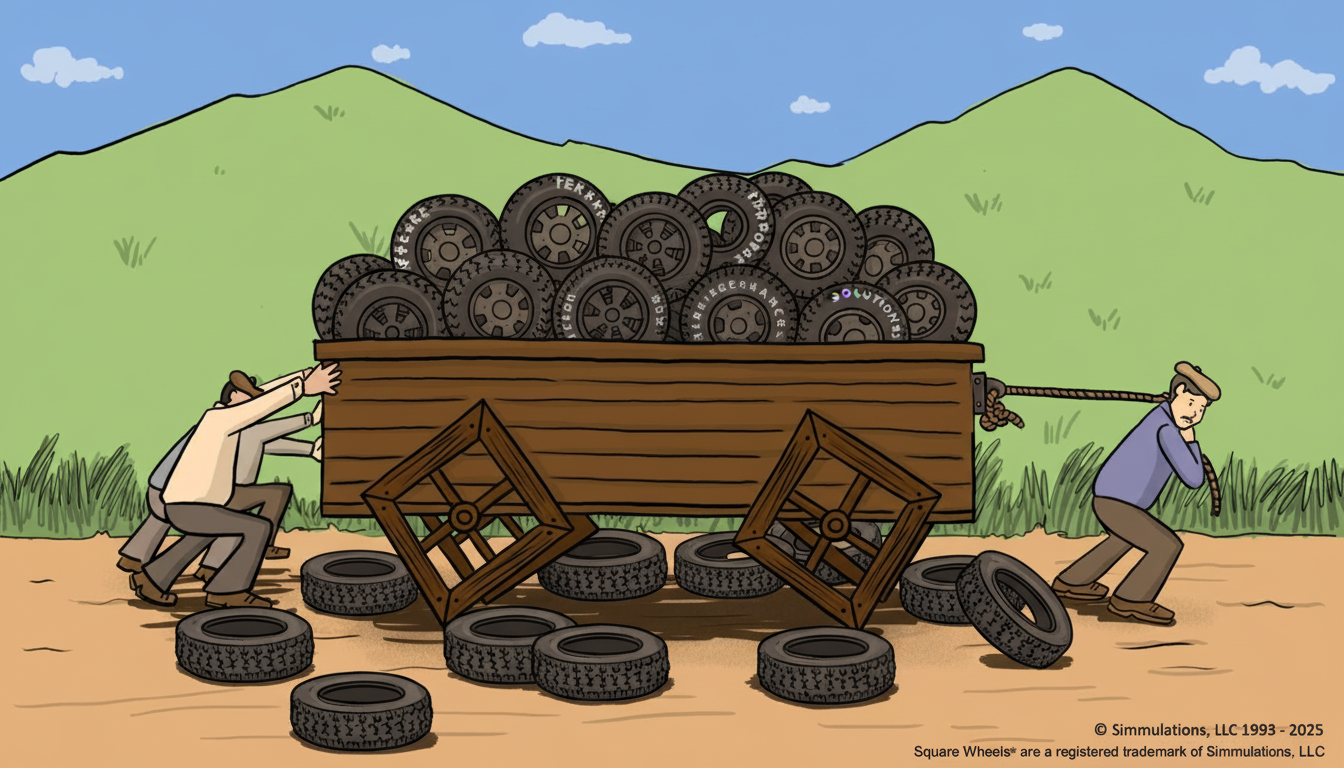
Lots of round wheels can actually make the journey more difficult!
As these images recur in meetings, newsletters, workshops, and one-on-ones, people start using the language themselves: “That’s a Square Wheel,” “We’re on a muddy road,” “We’ve overloaded this wagon,” or “We need to find the round wheels already in our wagon.”
That shared language is the essence of a continuous improvement culture. It normalizes speaking up about problems, searching for better ways, and involving others in solutions.
Used thoughtfully, the full range of Square Wheels images does more than liven up a workshop. It systematically builds the observation, analysis, creativity, and collaboration skills that underlie great problem solving—and it nudges the whole organization toward a mindset where everybody is looking for the next round wheel.
—
For the FUN of It!
 Dr. Scott Simmerman is a designer of team building games and organization improvement tools.
Managing Partner of Performance Management Company since 1984, he is an experienced presenter and consultant who is trying to retire!! He now lives in Cuenca, Ecuador.
You can reach Scott at scott@squarewheels.com
Learn more about Scott at his LinkedIn site.
Square Wheels® are a registered trademark of Simmulations, LLC
and images have been copyrighted since 1993,
© Simmulations, LLC 1993 – 2026
What I’m About:
My Square Wheels blog and website exist to help leaders, trainers, and facilitators make work smoother, more engaging, and more human. I focus on practical tools for process improvement, organizational change, and workplace collaboration that spark insight and deliver measurable results.
And I am convinced, after 30+ years of using Square Wheels®, that it is the best facilitation toolset in the world. One can use it to involve and engage people in designing workplace improvements and building engagement and collaboration. It is a unique metaphorical approach to performance improvement and we can easily license your organization to use these images and approaches.
By blending proven facilitation methods, creative problem-solving, and engaging team activities, my mission is to support organizations in building energized, sustainable cultures of involvement and innovation.
Through accessible — and often free — resources and virtual facilitation tools, I aim to help teams everywhere collaborate more effectively, innovate continuously, and take ownership of their improvement journey.
#SquareWheels #InnovationAtWork #TeamEngagement #FacilitationTools #WorkplaceImprovement #EmployeeEngagement #CreativeProblemSolving #OrganizationalDevelopment #LeadershipTools #collaboration #leadership #motivation #communications #enablement #leadership #CreativeCommons #enablingperformance #teamwork

0 Comments