
From “Supervisor Hellscape” to Flow: What SessionLab’s “State of Facilitation” Tells Us About Square Wheels and some tools to impact workplaces.
If you read the latest State of Facilitation report from SessionLab and then look at life for our front‑line supervisors, you see the same story told two different ways. On the one hand, facilitation is maturing as a discipline and being recognized as a core leadership capability; on the other, we still have supervisors up to their axles in mud, dragging a Square Wheels wagon while Spectator Sheep voice their opinions from the sidelines. And all the damn silos!
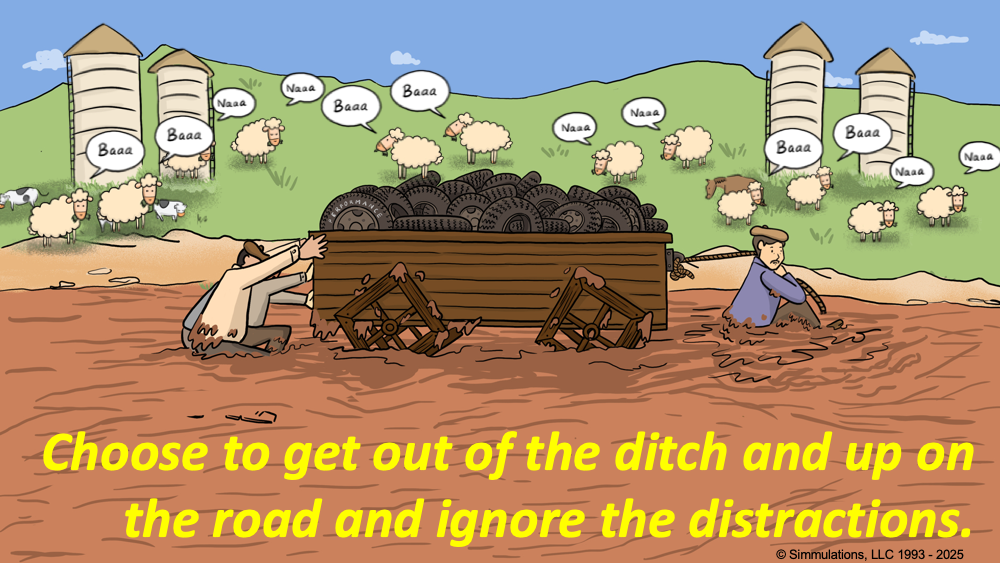
Click on the image for another blog on FLOW
We know managers account for about 70% of the variance in team engagement, and yet roughly 8 out of 10 bosses step into their roles as accidental managers with little or no development in how to actually engage people. That is how you get the Supervisor Hellscape: over‑scheduled, under‑supported, and asked to “drive change” without the tools, time, or facilitation skill to do it. So, of course 70% of supervisors are disengaged (Gallup). (The numbers and the details about The Hellscape link)
The good news: the facilitation trends in the SessionLab data line up almost perfectly with what Square Wheels has been doing for 30 years—making it easy for normal managers to run short, high‑impact conversations that unlock flow and performance.
What the State of Facilitation Is Telling Us
SessionLab’s recent State of Facilitation report paints a clear picture of where the craft is headed. A few patterns jump out when you look at them through a Square Wheels lens:
-
Sessions are getting shorter, with many facilitators reporting that 1–2 hour events are becoming the norm while clients still expect tangible, deliverable results.
-
Facilitation is moving “in‑house” as more organizations expect managers and team leads to host problem‑solving, alignment, and engagement sessions as part of everyday work, not as rare offsites.
-
Multi‑modal is the new normal: in‑person, online, hybrid, and asynchronous facilitation are all in play, and hybrid now shows up as a standard format rather than an experiment.
-
Technology and AI are increasingly used around sessions—to design, prepare, summarize, and report—while the heart of the work remains human connection, trust, and participation.
-
The biggest ongoing challenge is sustaining momentum and turning great workshop insights into consistent execution over time. This is the involvement and enablement stuff that Square Wheels image tools generate so uniquely. Remember that change is resisted unless people are engaged.
If you put those trends next to the supervisor data, that 60% of new managers getting no formal leadership training, two‑thirds of employees disengaged, and managers 36% more likely to report burnout, you have a simple conclusion: we don’t need more “big trainings,” we need more leaders who can facilitate short, focused, repeatable conversations about Square Wheels and Round Wheels in the actual workplace.
Square Wheels anchor Every Day Facilitation
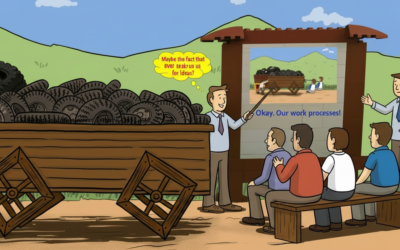
Square Wheels has always been a facilitation platform disguised as cartoons. The wagon, the Square Wheels®, the unseen and unused Round Wheels in the wagon, and the Spectator Sheep are all visual metaphors designed to be projective tools: people see their own reality in the picture and then talk about it.
What the SessionLab’s facilitation research now perfectly confirms is that this kind of simple, visual conversation is exactly what organizations are asking their supervisors to do more of:
-
Help teams brainstorm and focus on improving systems and processes that impact performance results (brainstorming and ideation are reported as the single most common session type).
-
Build alignment and active ownership involvement around change in shorter, more frequent gatherings instead of long offsites that generally fail to produce real workplace change.
-
Do this across formats—on the shop floor, in a conference room, or in a hybrid Teams or Zoom meeting.
- Actively involve the actual line managers who manage the actual workplaces, instead of hoping that the messages will somehow transfer. It is done WITH the workers and not TO them.
When supervisors pull out a Square Wheels image and ask, “Where are we now?” they are effectively running a high‑leverage facilitation moment. They are naming the Square Wheels (friction, rework, bureaucracy, poor tools), surfacing Round Wheel ideas (better processes, tools, collaboration), and doing so in a way that feels psychologically safe because the critique is about the wagon, not the people.
And, Square Wheels One hooks up to almost every important aspect of how organizations really work and their culture of performance. It is an anchor point to continual discussions about what is not working smoothly and ideas of continuous continuous workplace improvement.
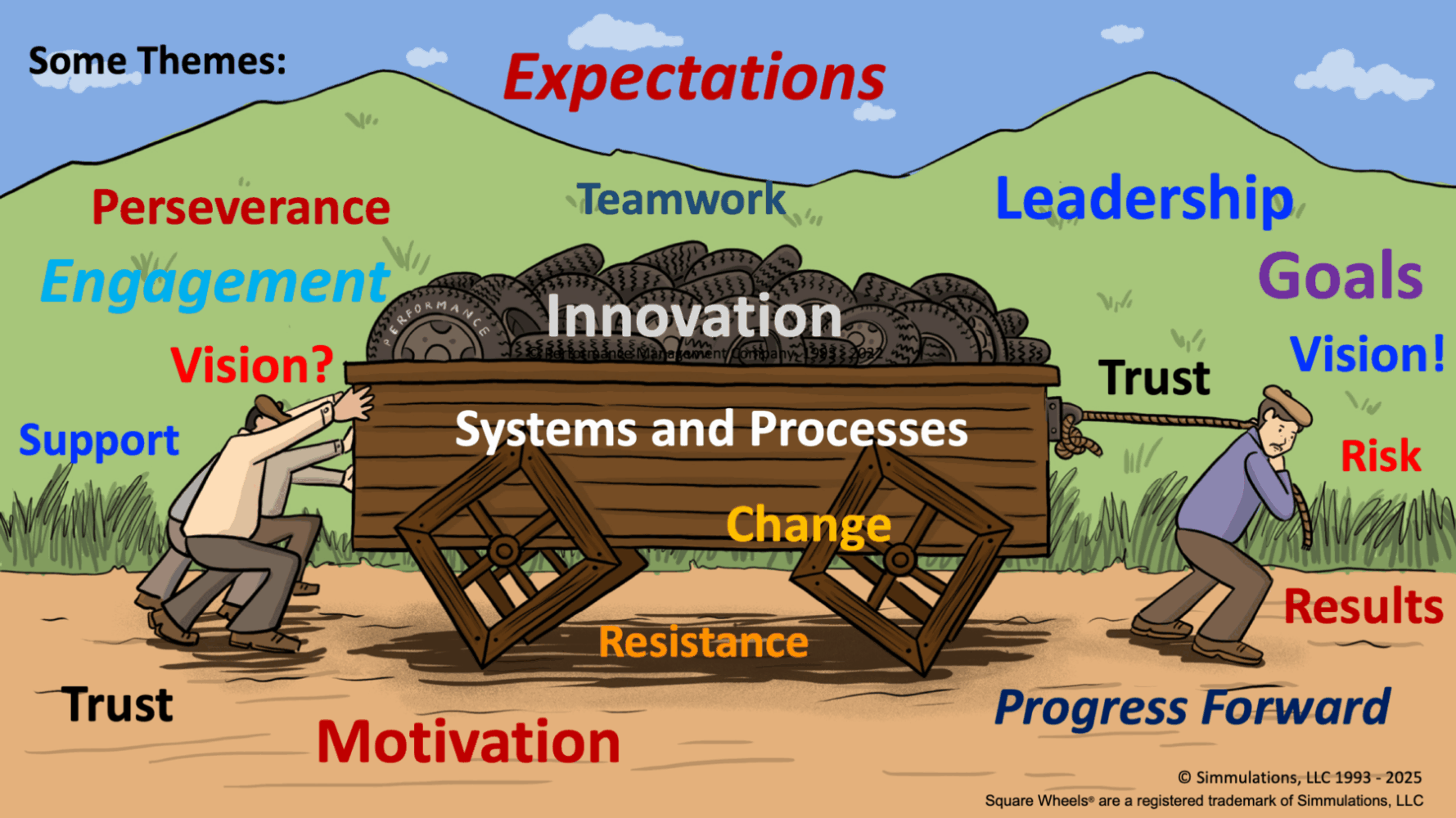
There are many different themes that open for discussion when using Square Wheels One
That is also how you really begin to generate flow at work. The research on work‑related flow shows that when people experience a balance of challenge and skill, clear goals, and immediate feedback, they are more absorbed, energized, and proactive in driving improvement. Square Wheels conversations help define the right level of challenge, clarify shared goals, and create fast feedback loops around small Round Wheel experiments. And these discussions can be run continually by the supervisors.
Turning Fault Tolerance and Flow into Supervisor Tools
My recent writing on fault tolerance and flow adds a critical ingredient into this motivational mix. Studies on organizational fault tolerance show that when managers more openly accept mistakes, dissent, and experiments as learning input rather than misconduct, they create psychological safety and self‑efficacy—what Proactive Motivation Theory would call the “can do” side of motivation.
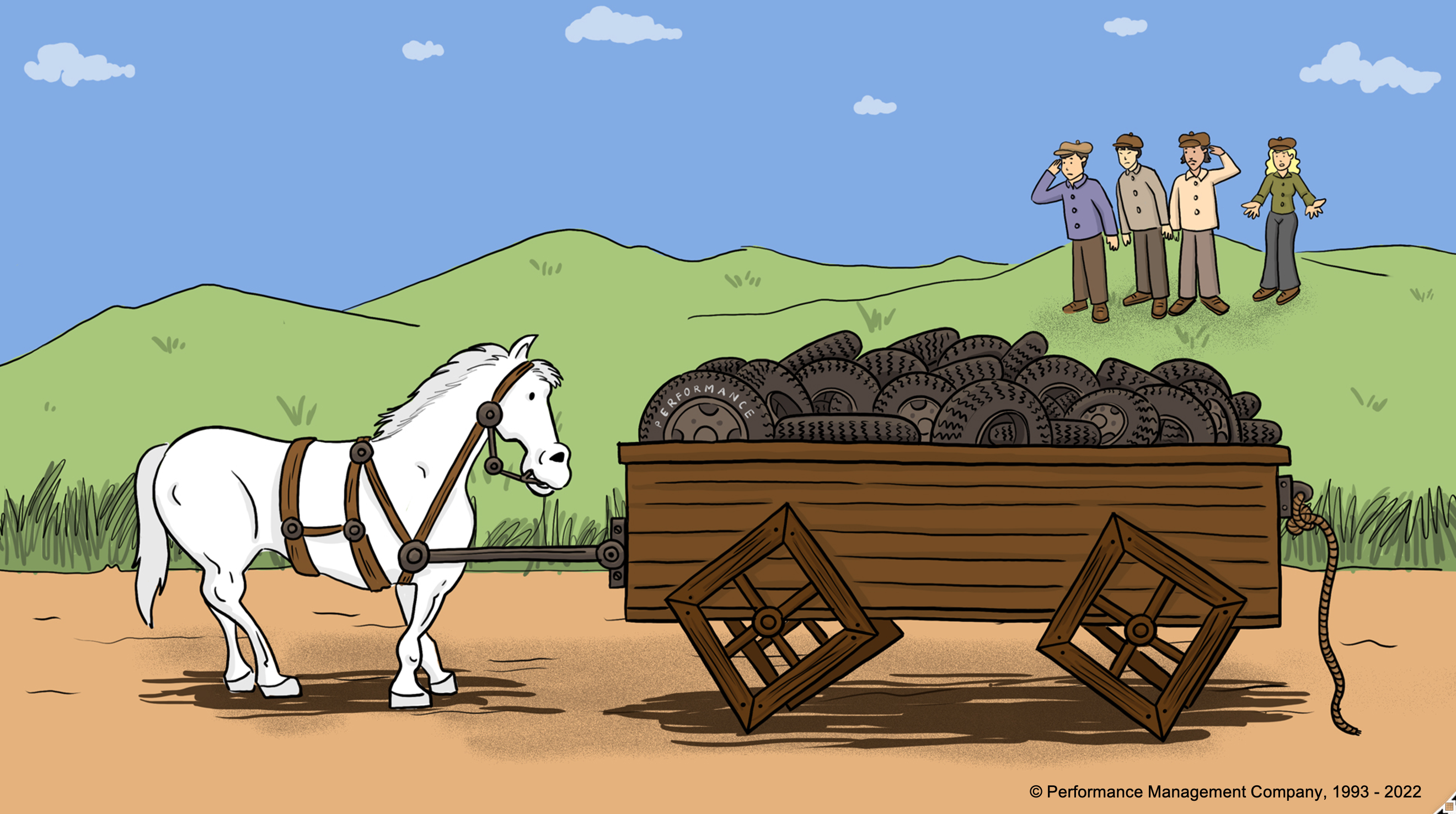
In those climates, employees, and especially for those with high growth need strength, are more likely to experience work‑related flow and to take charge by proposing and implementing improvements that go beyond their formal job descriptions. Flow partially mediates that relationship: feeling absorbed, focused, and energized at work makes people more willing to implement more round wheels on the wagon. Flow can be facilitated to provide personal growth for individuals and teams.
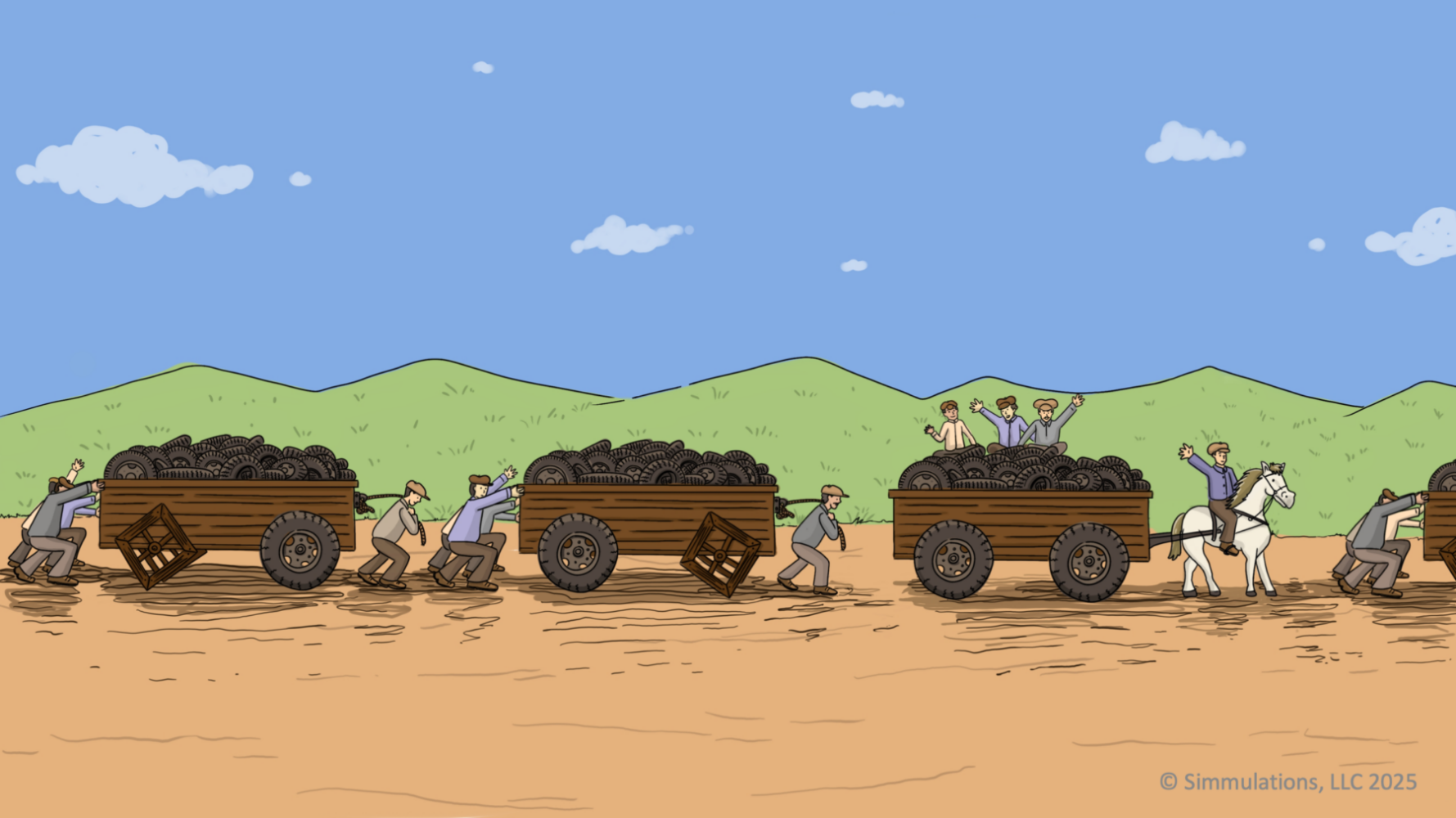
The adoption of round wheels across different wagons – incremental continuous improvement
Square Wheels operationalizes fault tolerance in three simple moves:
-
The image itself separates people from the problem; the wagon has problems and performance issues are not the fault of the workers, which lowers defensiveness and allows honest conversation about what is not working.
-
The discussion invites everyone to name the Square Wheels and suggest various round wheel ideas and possibilities without needing a perfect business case; “crazy” ideas are part of the play, not evidence of insubordination. This divergent thinking is powerful for innovation.
-
The follow‑through has teams choose one or two Round Wheel experiments to try, reinforcing the idea that small tests and partial success are expected and useful.
- Continuous improvement is continuous. One good round wheel idea generally leads to another so that we build a culture of innovation and improvement.
From a facilitation standpoint, a supervisor who does this once a month is building a much more fault‑tolerant climate through repeated, structured conversations. From a performance standpoint, they are engineering more moments of flow by helping people continually match their skills to meaningful challenges, see progress, and receive real‑time feedback on whether their Round Wheels make the wagon roll more smoothly.
Designing “Square Wheels Sessions” That Fit the New Facilitation Reality
So how do we wrap all of this together into something supervisors can actually run inside their overscheduled calendars? Here is a simple pattern that sits right on top of the trends the SessionLab reports are highlighting:
1. Keep things short and focused
Time is under more pressure than ever and we MUST improve and enable actual engagement, and shorter sessions with clear outcomes are now the norm in the facilitation world. For supervisors, that means designing 30‑ to 60‑minute Square Wheels conversations with tight objectives:
-
“Identify three Square Wheels slowing us down this month.”
-
“Generate two Round Wheel ideas we can test before the next team meeting.”
-
“Map where our flow breaks down in this process and pick one friction point to fix.”
Square Wheels sessions are not offsite events; they are regular leadership behaviors that can be run weekly, bi‑weekly, or monthly. And the consulting community can do a lot with supervisors to actually improve actual workplace performance, in addition to decreasing disengagement.
2. Make facilitation an every‑day leadership skill
State of Facilitation data shows that facilitation is increasingly seen as a leadership capability, not just a specialist role. This is exactly where Square Wheels shines: it gives accidental managers a concrete script and image to work from instead of asking them to “be more engaging” in the abstract.
Typical moves you, the professional facilitators, can teach supervisors:
-
Start with the image and a neutral prompt: “What do you see here that looks like us?”
-
Capture everything without judgment—on a flipchart, whiteboard, or digital board if you are remote. Or teach supervisors to use the existing facilitation tools like Stormz or Miro.
-
Ask, “Which of these Square Wheels do we actually control or influence significantly?” and highlight the ones the individuals and teams can impact and influence.
-
Close with, “What two Round Wheel actions will we commit to before we meet again?”
That is basic facilitation, but packaged in a way that feels playful, practical, and directly linked to performance.
3. Design for multi‑modal, multi‑location teams
Hybrid and multi‑modal facilitation are now baked into how work happens. Square Wheels tools are inherently flexible: you can run the same metaphor in a room with sticky notes, on Stormz, Miro or Mural, or even via shared screens and chat.
For supervisors supporting distributed teams, you can:
-
Share the Square Wheels image ahead of time and have people jot their Square Wheels and Round Wheels asynchronously.
-
Use a digital whiteboard to cluster ideas live, borrowing cues from how facilitators use online tools to structure input and participation. Create simple toolkits for others to use. Build and encourage a network of supervisors to choose to do things differently.
-
Follow up with a short summary and a one‑page “Round Wheels in motion” plan, mirroring how expert facilitators now use digital tools and AI to capture and communicate outcomes. A facilitator can build a solid business around supporting organizations with simple tools.
4. Tie every conversation to flow and impact
One of the critiques in the SessionLab reports is that facilitation impact is often felt but not clearly measured or described beyond participant satisfaction. You can help supervisors close that gap by asking three simple questions after each Square Wheels session:
-
“Where did work feel more in flow this week—what tasks felt focused, challenging, and energizing instead of frustrating?”
-
“Which Round Wheel experiments made it easier to do the work that matters?”
-
“What visible impact did we see—fewer errors, faster cycle time, fewer handoffs, less rework?”
Over time, these become the local metrics of impact that connect facilitation behaviors to concrete business and people outcomes. They also reinforce the idea that flow is not a nice‑to‑have; it is a core performance system variable, like cash flow, that supervisors can influence directly.
The Bottom Line for Organizations
If you believe the data, managers are the 70% lever on engagement, most of them were never trained to use facilitation as a tool, and facilitation itself is shifting toward shorter, tech‑enabled, impact‑focused sessions.
At the same time, we are asking those same supervisors to navigate complexity, protect psychological safety, and somehow generate flow while they are drowning in meetings and reporting.
Square Wheels is a great way to close that gap:
-
It gives supervisors a visual, practical method to facilitate real conversations about friction and opportunity.
-
It builds fault tolerance and psychological safety into the dialogue, inviting people to name problems without blame.
-
It nudges teams toward flow by helping them balance challenge and skill, clarify goals, and get immediate feedback on their Round Wheel experiments.
-
It can be delivered in short bursts, across formats, and integrated into the everyday cadence of work in line with how facilitation is actually practiced now.
In other words, if the State of Facilitation describes where the field is going, Square Wheels is a ready‑made vehicle for getting your accidental managers out of the Supervisor Hellscape, onto a better road, and rolling forward with more flow, engagement, and performance.
And realize that, “The Round Wheels of Today are the Square Wheels of Tomorrow.”
Note: Perplexity helped me frame the basics of this article and it knows a LOT about my Square Wheels tools and how they can be used within organizations. If you are interested in building toolkits for a client using my IP, let’s collaborate. If you simply want to take Square Wheels One and use it, get it from my website for FREE under a Creative Commons BY-ND license.
—
For the FUN of It!
 Dr. Scott Simmerman is a designer of team building games and organization improvement tools.
Managing Partner of Performance Management Company since 1984, he is an experienced presenter and consultant who is trying to retire!! He now lives in Cuenca, Ecuador.
You can reach Scott at scott@squarewheels.com
Learn more about Scott at his LinkedIn site.
Square Wheels® are a registered trademark of Simmulations, LLC
and images have been copyrighted since 1993,
© Simmulations, LLC 1993 – 2026
What I’m About:
My Square Wheels blog and website exist to help leaders, trainers, and facilitators make work smoother, more engaging, and more human. I focus on practical tools for process improvement, organizational change, and workplace collaboration that spark insight and deliver measurable results.
And I am convinced, after 30+ years of using Square Wheels®, that it is the best facilitation toolset in the world. One can use it to involve and engage people in designing workplace improvements and building engagement and collaboration. It is a unique metaphorical approach to performance improvement and we can easily license your organization to use these images and approaches.
By blending proven facilitation methods, creative problem-solving, and engaging team activities, my mission is to support organizations in building energized, sustainable cultures of involvement and innovation.
Through accessible — and often free — resources and virtual facilitation tools, I aim to help teams everywhere collaborate more effectively, innovate continuously, and take ownership of their improvement journey.
#SquareWheels #InnovationAtWork #TeamEngagement #FacilitationTools #WorkplaceImprovement #EmployeeEngagement #CreativeProblemSolving #OrganizationalDevelopment #LeadershipTools #collaboration #leadership #motivation #communications #enablement #leadership #CreativeCommons #enablingperformance #teamwork


Scott, once again, you are SPOT ON. Love your take on the SoF and how we can all get better.
This is very valuable information shared by Dr Scott. It gives a step-by-step process for Leaders and Managers to empower teams and get things done…
The operating idea is pragmatic and simple, something that gets things rolling without all the required structural requirements and something that any manager can use. The round wheels ARE in the wagon and there are zillions of Square Wheels everywhere. You CAN make everything complicated if you want but getting people to consider their own possibilities for change is the key.
Thanks, Solomon.