
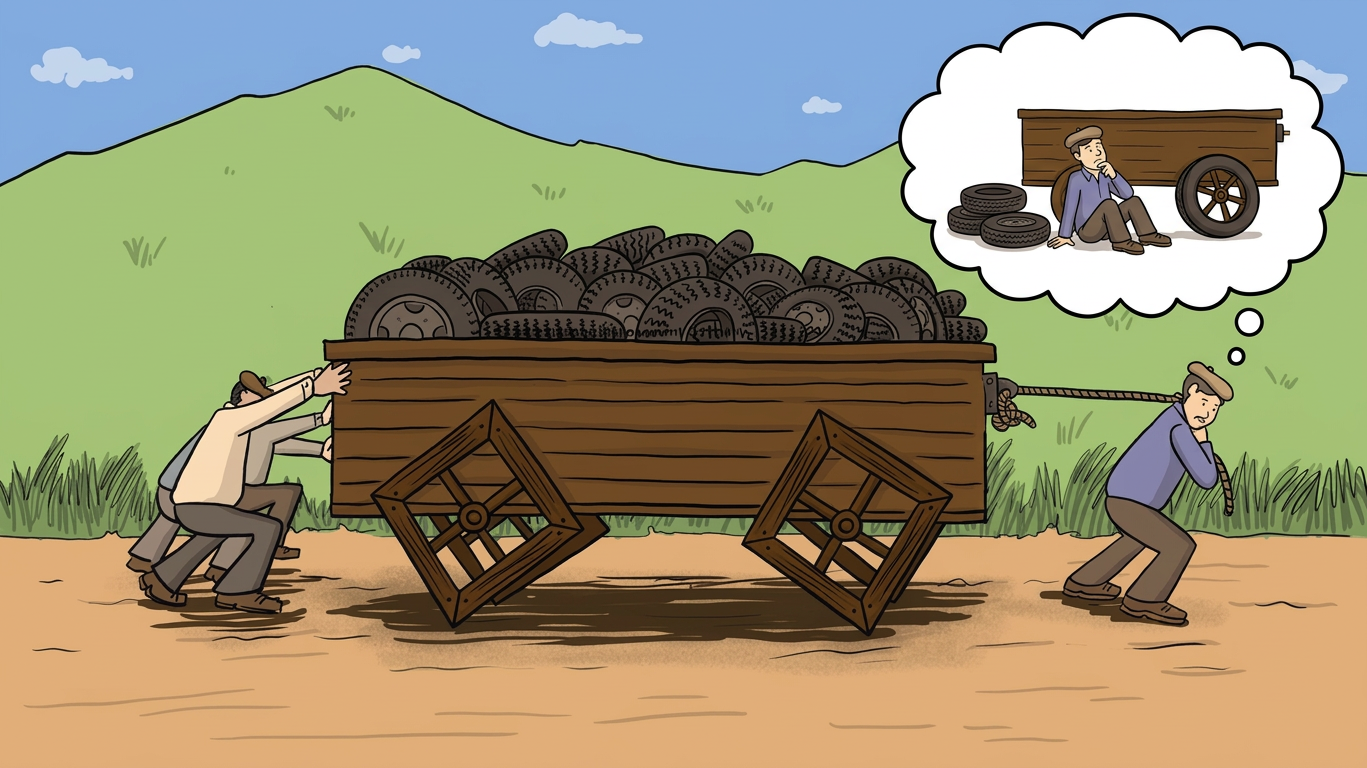
Every now and then, a song delivers a better leadership lesson than management books. “Silent Lucidity” is a “Supervisor Superpower Learning Lesson.”
“Silent Lucidity” by Queensrÿche is an amazing song for leadership. On the surface it is about lucid dreaming, one becoming aware you’re dreaming and learning to guide the dream. Underneath, the song is a masterclass in coaching, safety, and helping people change the meaning of the stories in their own heads about how things work.
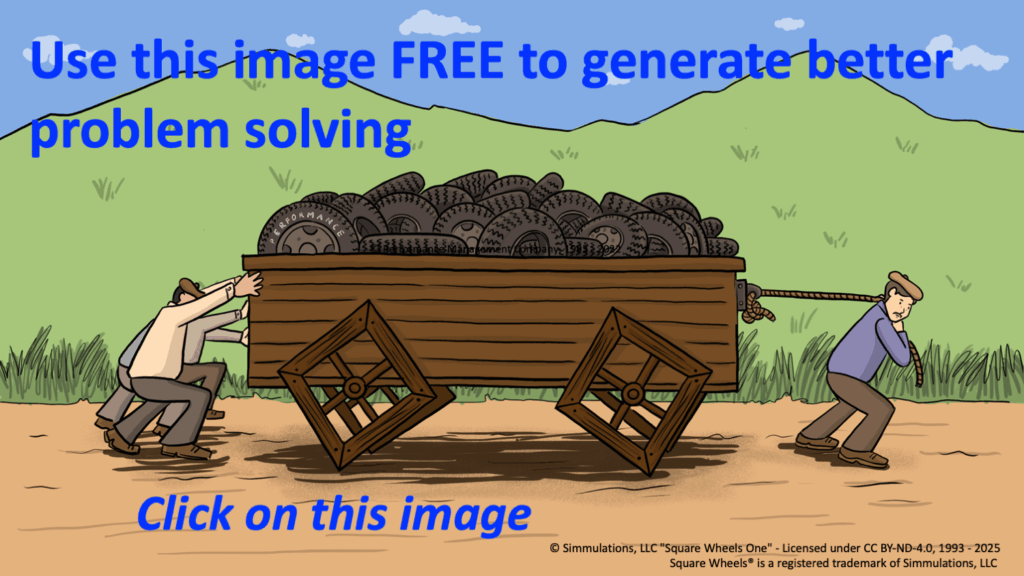
Shaping lucid dreams happens to be exactly what good supervisors do when they use the Square Wheels® metaphor to involve and engage their people in developing visions of the future.
An overview of the song’s development is at the end.
When work feels like a bad dream
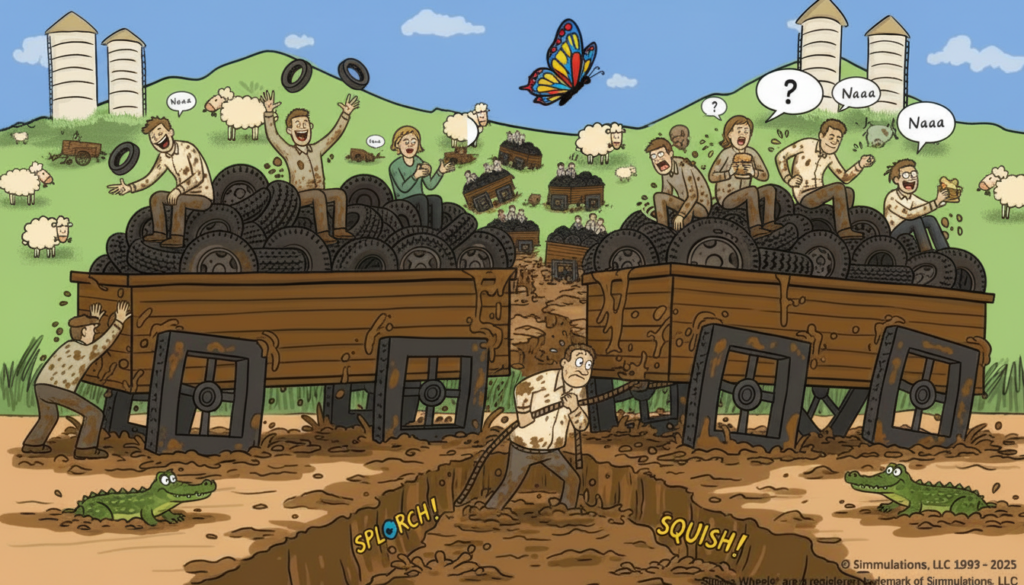
Work can be a Hellscape.
While there is a actual Hellscape out there for workers and managers, with 79% of workers disengaged and so little real leadership involvement in workplace improvement, the song opens with comfort, not criticism:
“Hush now, don’t you cry
Wipe away the teardrop from your eye
You’re lying safe in bed
It was all a bad dream
Spinning in your head…”
It’s a perfect picture of how work often feels for a lot of people – a bad dream. Their day job becomes a kind of nightmare for many: processes that make no sense, systems that fight them, silos blocking collaboration, and all sorts of “Square Wheels” everywhere that make every step harder than it needs to be. They lie awake at night mentally replaying conversations, deadlines, and mistakes.
The key line in the opening is this one:
“Your mind tricked you to feel the pain
Of someone close to you leaving the game of life…”
The song (link here) rightly points out that the real torture is not just the work; it’s the mind’s replay of it and one’s inability to escape that reality. In the workplace, people are constantly reliving past negatives of performance critiques, unfinished changes, reorganizations and confusions, and disappointments and failures that hang over their heads:
- “Last time we tried to fix this, nothing changed.”
- “They don’t want our ideas anyway.”
- “Around here, our wagon always rolls on Square Wheels.”
So they naturally stop trying. They disengage. They push and pull the wagon, but they certainly don’t push for round wheels or making improvement. They give up (and the data is really clear on that as well as the negative impacts and implications (data here) ).
What does the supervisor do with this situation? The Gallup (2025) data show that most do not even care these days, with 70% of supervisors disengaged, too.
How can they change the feelings? How can they add more positives? Some thoughts:
Lucid dreaming and lucid leading
The spoken middle section of “Silent Lucidity” is fascinating and actionable:
“Visualize your dream
Record it in the present tense
Put it into a permanent form
If you persist in your efforts
You can achieve dream control…”
Dream Control. That is textbook coaching and reframing: helping people reframe their personal reality to generate a picture of a different and alternative positive future, to think specific thoughts, to write it down, and keep at it until new habits take hold.
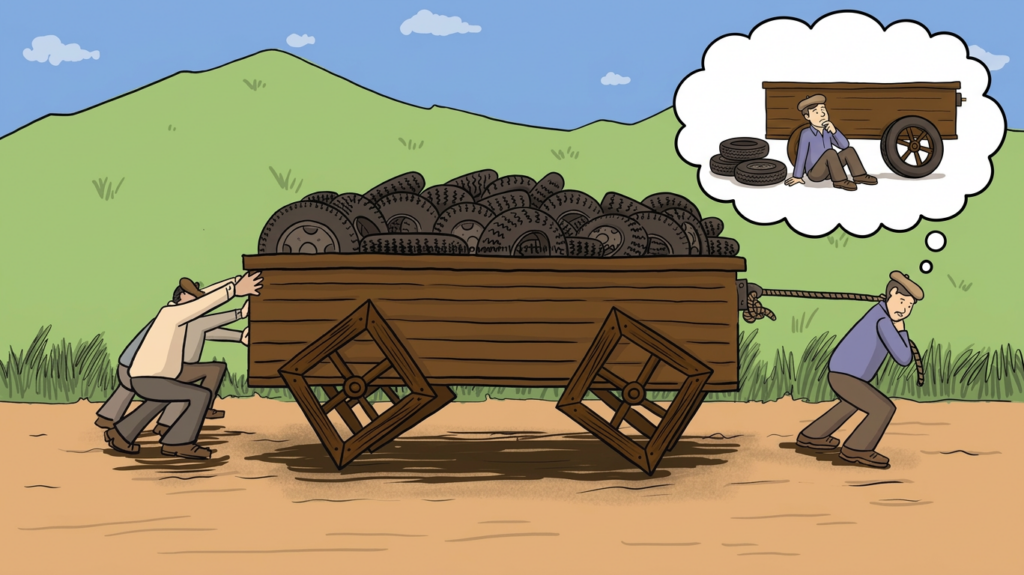
We CAN “Think Different.”
In the language of moving from Square Wheels toward more round wheels possibilities:
- The “dream” is about smoother work, better flow, fewer thumps.
- “Record it in the present tense” is having them describe possible round wheels as if they exist today.
- “Permanent form” is the action plan, the sticky note, the commitment.
- “Persist in your efforts” is the reflective cycle: try something, see what thumps, adjust the wheels.
What a nice framework for future positives. “Lucid dreaming” and “silent lucidity” is simply becoming conscious inside one’s thoughts and dream and choosing what happens next. Lucid leading is becoming conscious inside the culture and choosing how supervisors can respond, coach, involve and enable people.
Supervisors sit right in that dreamspace. They can remain characters inside someone else’s bad dream (“That’s just how it is here”), or they can become the guide and mentor who helps people wake up to possibilities. We have the tools and they can make those choices if they perceive positive impacts! And we can help them; they need to make different choices around possibilities.
The inner walls, the outer silos, and the Spectator Sheep
Later in the song we get this:
“If you open your mind for me
You won’t rely on open eyes to see
The walls you built within
Come tumbling down, and a new world will begin…”
Now we’re right into the territory of behavior change and the choices we make as leaders and mentors.
- “The walls you built within” are those internal stories: “We tried that before,” “My ideas don’t matter,” “It’s risky to speak up.”
- The Silos and the Mud in the images are the external version of those same constraints.
- The Spectator Sheep are everyone watching, waiting to see if it’s safe to say anything about the clunky wagon and the reality of the mud.

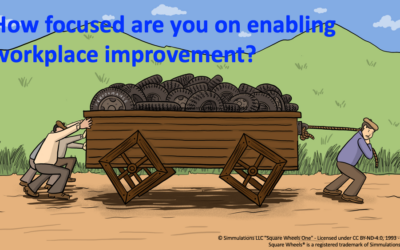
When a supervisor drops a Square Wheels image on the table and simply asks, “Where do you see Square Wheels in our work?”, they are doing what the song suggests: inviting people to see with more than their “open eyes.” They’re giving people a safe, indirect way to talk about:
- The thumps and bumps in their daily reality of getting things done.
- The walls they’ve built to protect themselves.
- The better wheels they’ve thought about but never shared.
The image gives them distance and safety and opens the possibility of some reflection and discussion. The supervisor’s stance, hopefully curious, encouraging, and not defensive, determines whether those inner self-protective walls begin to come down.
“I will be watching over you”: the supervisor as guide
The chorus of “Silent Lucidity” is the leadership voice we wish more supervisors would use:
“I will be watching over you
I am gonna help you see it through
I will protect you in the night
I am smiling next to you, in silent lucidity”
That’s not the voice of a boss barking orders from the front of the wagon or somewhere completely out of view. It’s the voice of someone walking beside you, tuned into your experience, and committed to helping you navigate your fears. It’s the internal soundtrack of a good coaching conversation.
Supervisors can choose to show up in one of two ways:
- As the enforcer of someone else’s dream (“Here’s the new initiative; pull harder”).
- As the guide of their people’s experience (“Let’s look at where this bumps, what feels risky, and what we might change”).
In practical terms, the latter, the mentoring, looks like:
- Starting conversations with “What’s thumping?” rather than “Why didn’t you hit the numbers?”
- Using the wagon image to depersonalize criticism and keep the focus on systems and processes, the things that can work more smoothly down the road.
- Staying present and calm when people surface frustration, so they feel “watched over,” not watched.
When people feel that kind of presence, they are far more willing to look at their own thinking, experiment with new wheels, and take small risks to improve how work gets done.
“You can be the guide”: handing people The Marker
The song ultimately hands agency back to the listener:
“Master of illusion, can you realize
Your dream’s alive, you can be the guide but…”
The unfinished “but…” is the invitation. You can be the guide—if you’re willing to step into that role. You can, as a mentor, see the butterfly that exists within the caterpillars. (Read about teaching the caterpillar to fly by clicking on the image below.)
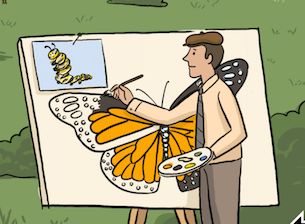
The manager / mentor can see the butterfly potential that exists within the caterpillar.
In your meetings and development conversations, the same turning point is when you stop describing the Square Wheels Workplace Reality and begin to ask:
- “Where do you see the Square Wheels around here?”
- “What round wheels do you think are already in the wagon?”
- “What is one small change you can help test in the next two weeks?”
That’s when a spectator becomes a mechanic, a victim becomes a co‑designer, and a passenger becomes a driver.
For supervisors, the magic is not in having the answers. The magic is in creating the conditions where people feel safe enough to:
- Name the Square Wheels.
- Challenge the old stories.
- Try out one new round wheel, even if it wobbles a bit at first or has no air or the rim needs to be fit to the axle. It takes work to implement new ways of doing anything.
You can almost hear the song in the background of that moment: a quiet presence saying, “I’ll be watching over you…I’m gonna help you see it through.”
Bringing it all together on one picture
So, how do you use this?
- Use Queensryche’s “Silent Lucidity” as a story about awareness: becoming lucid in the dream is like becoming aware of the wagon you’re pulling.
- Use your Square Wheels image as the visual: here is our shared “dream landscape” with the wagon, the Square Wheels, the Round Wheels, the hills, the mud, the Spectator Sheep and all other perceptions of workplace realities.
- Use supervisory coaching and support as the bridge: the way we talk about the image either keeps everyone having nightmares inside the old story or helps them wake up to new possibilities.
When you combine the song’s theme with the Square Wheels® metaphor, you get a simple message for supervisors:
- Your people already know where the wagon thumps.
- Your job is not to give them prettier dreams.
- Your job is to help them become lucid—to see, to speak, and to guide the change to better wheels.
That, in the end, is the quiet superpower of a good supervisor: not just pulling the wagon harder, but helping people wake up to the fact that they can change the wheels.
A deep dive into Queensryche’s song, “Someone Else,” and about it’s snapshot of mid‑life identity crisis and professional burnout that most of us can identify with. It is an insightful post about personal identity:
https://performancemanagementcompany.com/2026/03/18/personal-identity-and-crossroads-edge/
And this song is about personal awakening and rejecting false realities, along with the loneliness of trying to live authentically:
https://performancemanagementcompany.com/2026/03/24/supervisors-is-anybody-listening/
Sidebar: The Story Behind “Silent Lucidity”
“Silent Lucidity” was written by Queensrÿche guitarist Chris DeGarmo for their 1990 album Empire. The song was inspired by psychologist Patricia Garfield’s work on lucid dreaming—how people can become aware they are dreaming and learn to guide the dream instead of being trapped in it.
DeGarmo wanted to capture the feeling of those vivid dream states in music, which led to the song’s cinematic arrangement and orchestral score by film composer Michael Kamen. That collaboration transformed a simple acoustic ballad into the lush, Pink Floyd‑like sound that made it stand out on rock radio.
Released as a single, “Silent Lucidity” became Queensrÿche’s biggest hit, reaching the Top 10 on the U.S. Billboard Hot 100 and earning two Grammy nominations in 1992. One of my favorite songs, it also introduced millions of listeners to the idea of lucid dreaming, wrapping a gentle, almost parental coaching voice around the message: you can notice your fear, work with it, and gain more control over your inner world.
—
For the FUN of It!
 Dr. Scott Simmerman is a designer of team building games and organization improvement tools.
Managing Partner of Performance Management Company since 1984, he is an experienced presenter and consultant who is trying to retire!! He now lives in Cuenca, Ecuador.
You can reach Scott at scott@squarewheels.com
Learn more about Scott at his LinkedIn site.
Note that I often use Perplexity AI to help research and generate ideas for my posts.
Square Wheels® are a registered trademark of Simmulations, LLC
and images have been copyrighted since 1993,
© Simmulations, LLC 1993 – 2026
What I’m About:
My Square Wheels blog and website exist to help leaders, trainers, and facilitators make work smoother, more engaging, and more human. I focus on practical tools for process improvement, organizational change, and workplace collaboration that spark insight and deliver measurable results.
And I am convinced, after 30+ years of using Square Wheels®, that it is the best facilitation toolset in the world. One can use it to involve and engage people in designing workplace improvements and building engagement and collaboration. It is a unique metaphorical approach to performance improvement and we can easily license your organization to use these images and approaches.
By blending proven facilitation methods, creative problem-solving, and engaging team activities, my mission is to support organizations in building energized, sustainable cultures of involvement and innovation.
Through accessible — and often free — resources and virtual facilitation tools, I aim to help teams everywhere collaborate more effectively, innovate continuously, and take ownership of their improvement journey.
#SquareWheels #InnovationAtWork #TeamEngagement #FacilitationTools #WorkplaceImprovement #EmployeeEngagement #CreativeProblemSolving #OrganizationalDevelopment #LeadershipTools #collaboration #leadership #motivation #communications #enablement #leadership #CreativeCommons #enablingperformance #teamwork #storytelling #storyasking

0 Comments