
The Neuroscience Behind Square Wheels: Why a Simple Image and Metaphor dramatically Unlocks Better Conversations and Enables Performance
Facilitators everywhere are paying more attention to the brain science behind engagement, creativity, and psychological safety. What I love about Dee Scarano’s “Neuroscience Secrets for Facilitators” is how clearly it links the design of an activity to what’s happening in people’s heads. Square Wheels® has always been about that same intersection: a simple image that quietly leverages what the brain does best.
Why people disengage – and why using an image and metaphor helps
Neuroscience reminds us that participants don’t disengage because they’re lazy; their brains are often in threat, overload, or “this isn’t worth my energy” mode. When the amygdala senses risk—social, emotional, or political—it pulls energy away from the higher cortex where reasoning, creativity, and collaboration live.
The Square Wheels® One and other images in this collection creates a safe psychological “buffer.” People aren’t criticizing their boss, their colleagues, or their company; they’re just talking about a wagon with square wheels and some round ones lying in the dirt. That distance lowers threat, reduces defensiveness, and lets the higher brain come back online. The metaphor does the emotional de-escalation that neuroscience says we need.
Fast brains, slow brains – designing for both
Dee Scarano highlights that some people’s brains favor fast, dopamine-driven, external thinking, while others lean toward slower, deeper, more internal processing. Good facilitation designs for both, not just the extroverts with their hands always in the air. You can find her presentation, “Neuroscience for Facilitators” (Facilitator’s cafe), here.
Realization: Square Wheels is built for this:
-
First, give people a quiet moment to look at the Square Wheels One image and capture the ideas. That honors the “longer pathway” internal processors to impact creative and divergent thinking..
-
Then, invite sharing in pairs or small groups, and finally in the whole room. That energizes the “shorter pathway” external thinkers without drowning out quieter voices. More details about how to facilitate using the image are here.
Same picture, different processing paths,
all by design. A unique and bombproof tool.
Here are some typical themes when workers and managers look at the Square Wheels One image and consider alternatives: (Grab the Square Wheels One image to use for free by clicking on the image.)
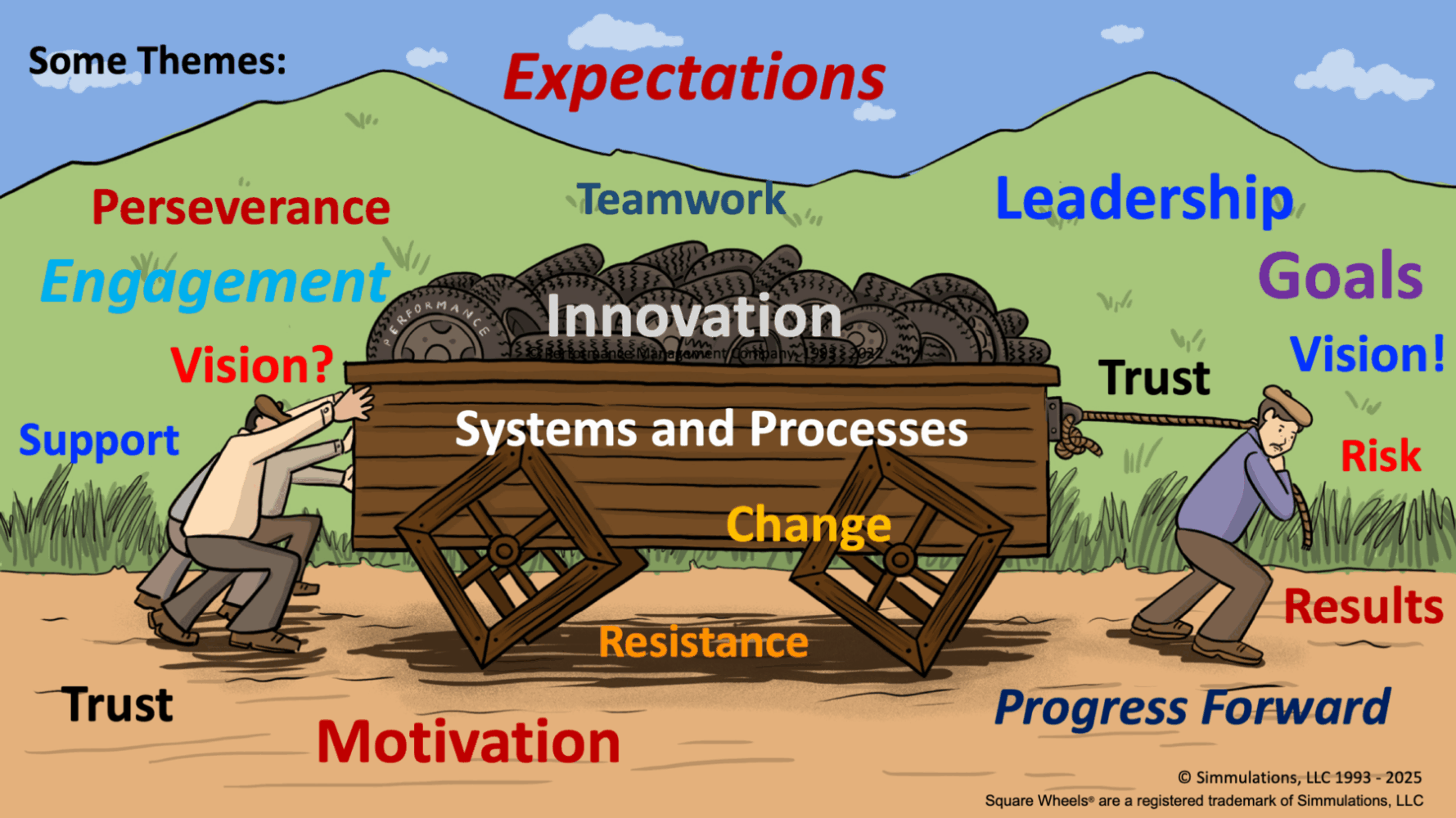
There are many different workplace improvement themes that open for discussion when using Square Wheels One
The creative zone: DMN, reflection, and Round Wheels
Dee’s talks about the Default Mode Network (DMN) (video) as the brain’s “internal workspace” for mind-wandering, connecting memories, and imagining new possibilities. Creativity isn’t just sudden inspiration; it’s the brain quietly playing with patterns, then shifting into more focused evaluation.
When people consider the Square Wheels One wagon, they’re not just looking at a cartoon. They are:
-
Remembering real work issues and individual and shared frustrations
-
Noticing parallels between “the wagon,” the Square Wheels, and their own processes
-
Imagining how things could roll more smoothly
That’s DMN territory. Then, when we ask them to identify possible Round Wheels and prioritize a few to implement, we move them into the evaluation and decision networks. The flow of a Square Wheels conversation mirrors the flow of the creative brain: generate, then evaluate.
Psychological Safety – talking about the wagon, not the person
Dee calls out psychological safety as a core driver of team performance and innovation. When people feel safe to take risks, speak up, and admit problems without fear of punishment, the brain shifts out of fight-or-flight and into curiosity and collaboration.
Square Wheels supports that safety in several simple ways:
-
The problem is “out there” in the image, not “in here” in the person.
-
We can say, “That looks like our process,” instead of “You’re doing it wrong.”
-
Everyone can contribute observations, not just the loudest voices.
Layer in methods like individual note-writing, anonymous idea capture, and structured voting—exactly the kinds of practices Dee recommends—and you have a brain-friendly way to surface tough issues without triggering defensive shutdown.
Scaffolding smarter conversations
Neuroscience encourages us to scaffold activities: don’t ask the brain to notice problems, invent solutions, and commit to action in one messy discussion. Instead, separate steps so different neural processes can do their jobs. Approach the issues, then play with the possibilities before designing the actions. You can lead this by separating the steps.
A typical Square Wheels flow does exactly that:
-
Look at the image and notice what’s happening (perception and sense-making).
-
Name the Square Wheels that are getting in the way (problem recognition).
-
Generate possible Round Wheels (idea generation / DMN).
-
Cluster and prioritize (evaluation and decision-making).
-
Choose a few actions to test (commitment and ownership).
Same image and framework, but now clearly grounded in how the brain actually works.
Bringing Neuroscience and Square Wheels together
Dee’s frameworks give facilitators the “brain language” to justify the choices they already know are important: safety, pacing, reflection, and structure. Square Wheels gives you a simple, visual toolkit to make those neuroscience principles practical in any room.
When you put the two together, you get something powerful: a brain-savvy way to help people see their current reality, talk about it safely, and invent better Round Wheels—one simple image at a time.
—
For the FUN of It!
 Dr. Scott Simmerman is a designer of team building games and organization improvement tools.
Managing Partner of Performance Management Company since 1984, he is an experienced presenter and consultant who is trying to retire!! He now lives in Cuenca, Ecuador.
You can reach Scott at scott@squarewheels.com
Learn more about Scott at his LinkedIn site.
Square Wheels® are a registered trademark of Simmulations, LLC
and images have been copyrighted since 1993,
© Simmulations, LLC 1993 – 2026
What I’m About:
My Square Wheels blog and website exist to help leaders, trainers, and facilitators make work smoother, more engaging, and more human. I focus on practical tools for process improvement, organizational change, and workplace collaboration that spark insight and deliver measurable results.
And I am convinced, after 30+ years of using Square Wheels®, that it is the best facilitation toolset in the world. One can use it to involve and engage people in designing workplace improvements and building engagement and collaboration. It is a unique metaphorical approach to performance improvement and we can easily license your organization to use these images and approaches.
By blending proven facilitation methods, creative problem-solving, and engaging team activities, my mission is to support organizations in building energized, sustainable cultures of involvement and innovation.
Through accessible — and often free — resources and virtual facilitation tools, I aim to help teams everywhere collaborate more effectively, innovate continuously, and take ownership of their improvement journey.
#SquareWheels #InnovationAtWork #TeamEngagement #FacilitationTools #WorkplaceImprovement #EmployeeEngagement #CreativeProblemSolving #OrganizationalDevelopment #LeadershipTools #collaboration #leadership #motivation #communications #enablement #leadership #CreativeCommons #enablingperformance #teamwork #neuroscience #defaultmodenetwork #DMN

0 Comments