
Gemini said: “The most bombproof way to cascade engagement through an organization is to shift the supervisor’s role from taskmaster to facilitator.
Yep. I use Perplexity. And learning Gemini and Notebook. And I publish a LOT so both get to understand me and my thinking pretty well. Writing on Flow has been a recent endeavor. You can read some here.
So, As I am expanding my thinking, I asked Gemini:
What is the most bombproof way for an organization to involve and engage the supervisors in the effort to involve and engage their people to impact engagement and generate more ideas about implementing work improvement processes and innovation. Build out this program with and without the use of the Square Wheels tools. Give examples of how organizations are accomplishing these improvements.
The output was both amazing and educational so I decided to share the ideas with a bit of editing and a few illustrations.
The most bombproof way to cascade engagement through an organization is to shift the supervisor’s role from “taskmaster” to “facilitator.” (This was the first line in Gemini’s analysis of these approaches.)
Supervisors are the critical linchpin in any improvement effort; if they are mandated to push down HR-driven engagement initiatives, the effort will feel like forced compliance and is highly likely to generate resistance. Instead, why not equip and enable supervisors with simple, low-risk frameworks to ask for their team’s ideas, give the team ownership of the solutions, and clear the path for implementation.
As my old continuous continuous improvement adage goes: “Nobody ever washes a rental car.”
People only invest discretionary effort and innovative ideas into systems they feel they own.
So, here is how to build this enablement program in two distinct ways: using a traditional high-involvement methodology, and using the visually driven “Square Wheels” methodology. Note that I like mine better but you may already be using lean tools.
Program 1: The “Micro-Kaizen” Framework (Without Square Wheels)
This approach relies on structured, continuous feedback loops. It strips away heavy corporate “innovation” programs and replaces them with hyper-local, team-led problem-solving.
The 4-Step Process using Kaizen tools
-
- Supervisor Enablement (The “Ask, Don’t Tell” Training):
Supervisors are trained in basic active listening and psychological safety. Their primary directive is to stop solving their team’s problems and start asking, “What is getting in our way today, and how would you fix it?” - The Weekly Friction Huddle:
Supervisors host a dedicated 15-minute stand-up meeting focused solely on friction. They ask the team to identify one small, annoying process that slows down their work. - The “Two-Pizza” Implementation:
The team must choose an idea they can implement themselves within a week, without asking for budget or IT support. The supervisor’s only job is to grant the autonomy to try it and shield the team from outside interference. - The Escalation Pipeline:
If a team identifies a systemic issue that requires cross-departmental collaboration, the supervisor champions that idea upward. This proves to the frontline workers that their insights have executive visibility.
- Supervisor Enablement (The “Ask, Don’t Tell” Training):
How Organizations Can Accomplish This
• Alcoa under Paul O’Neill: Paul O’Neill made worker safety a non-negotiable commitment and a practical foundation for engaging employees in organizational improvement. Workers were encouraged to raise safety concerns and could contact him directly if managers failed to respond. Leaders, in turn, were accountable for reporting serious incidents, identifying their causes, and taking corrective action.
This combination of employee voice and management responsiveness strengthened communication and organizational learning, helping create conditions for broader operational improvement. Alcoa’s safety and financial performance improved substantially during his tenure, although attributing its financial gains solely to the safety initiative would overstate the evidence.
• Toyota’s andon and kaizen practices: Toyota combines disciplined production processes with frontline participation in problem-solving and continuous improvement. Operators can activate an andon signal to report an abnormality and summon a team leader; if the problem remains unresolved within the available response period, the line stops.
Alongside this immediate support system, daily kaizen practices and Toyota’s long-running employee suggestion program encourage people to propose improvements to the work they know firsthand. Together, these practices illustrate an important principle of active involvement and engagement: employee input becomes meaningful when the organization provides clear ways to raise concerns, responds constructively, and supports turning ideas into improvements.
Program 2: The “Visual Metaphor” Framework (With Square Wheels®)
The Square Wheels methodology, developed by Dr. Scott Simmerman (me!) in 1993, uses a projective visual metaphor to bypass organizational defensiveness. It revolves around a cartoon illustration of a leader pulling a wagon on Square Wheels, looking forward and working exhaustingly hard. In the wagon are round wheels, and the workers pushing the wagon from behind can see the square wheels, but nobody is communicating.
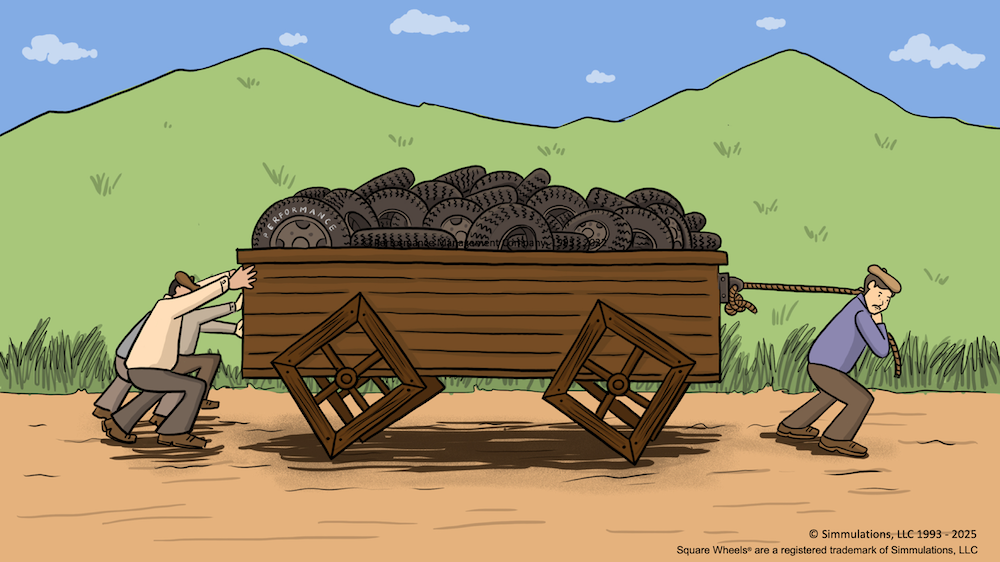
Click on the image to get the image and a toolkit FREE
This is the ultimate “bombproof” tool for supervisors because it removes the pressure of being an expert. The supervisor simply facilitates a conversation around an image.
(Pretty neat that Gemini calls my images and approach
“the ultimate “bombproof” tool for supervisors!”
The 4-Step Process
1 – The Inkblot Test (Setting the Stage):
The supervisor gathers the team (usually for 60–90 minutes) and displays the Square Wheels image. Instead of saying, “We need to improve our engagement,” the supervisor asks, “What do you see in this picture?” and “How might this represent how things really work around here?”
2 – Identifying the “Square Wheels”:
Because participants are critiquing a cartoon rather than their boss or the company, psychological safety is guaranteed. The team breaks into small groups to identify the “Square Wheels” (the processes that go thump, thump, thump—the inefficiencies, bottlenecks, and frustrations in their daily work).
3 – Finding the “Round Wheels”:
The supervisor then guides the team to look at the round wheels already sitting inside the wagon. They ask, “What are the round wheels—the ideas, resources, or existing knowledge—that we already have but aren’t using?” This shifts the team from complaining to problem-solving.
4 – Action and Ownership:
The team votes on the biggest Square Wheel they want to fix and commits to implementing one Round Wheel to solve it. The cognitive dissonance between how hard they are working (square wheels) and how easy it could be (round wheels) provides the internal motivation to change.
Note that we are partnering with Mike Martin and using his Praxis LIVE interactive AI-linked brainstorming tools to produce interactive modules that help individuals generate ideas for improvement and capture and process those ideas to improve implementation.
How Organizations Are Accomplishing This
- Bypassing “Change Fatigue”: Companies suffering from initiative overload use Square Wheels because it doesn’t feel like a corporate program. Supervisors use the imagery in standard staff meetings to diagnose localized burnout. When employees say, “We are the ones pushing the wagon uphill,” the supervisor uses that exact language to design relief strategies.
- Cross-Functional Alignment: Organizations use the imagery to bridge silos. When different departments view the image, they often realize they are in different parts of the wagon—some pulling, some pushing, and nobody communicating. They use the tool to explicitly define what a “Round Wheel” looks like for their interdepartmental hand-offs, generating immediate process improvements without the need for expensive external consultants.
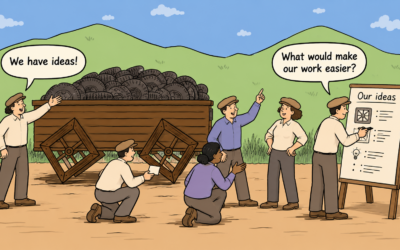
The end result should look something like this, as people see their ideas appreciated as well as implemented:
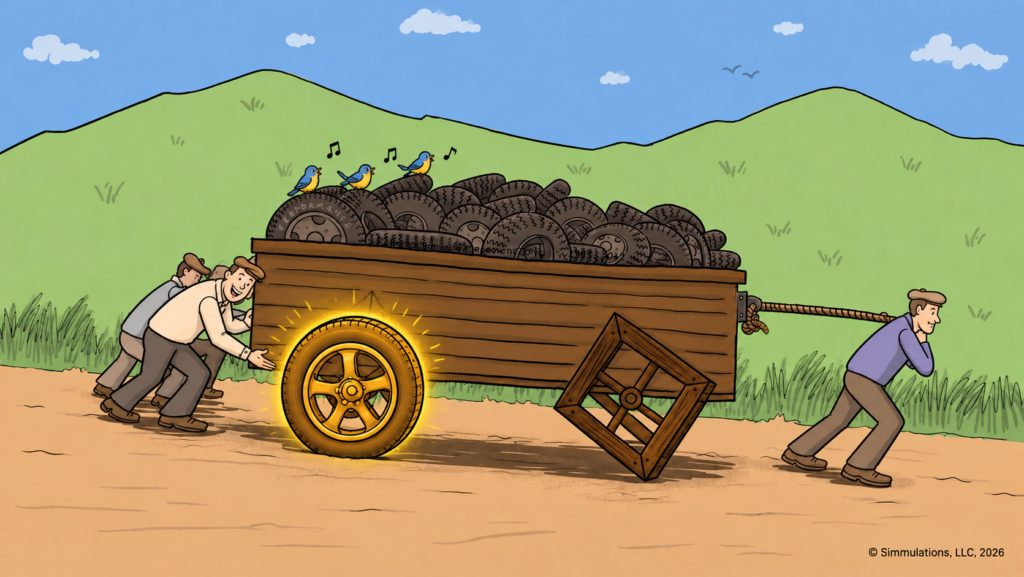
This is how incremental improvement gets institutionalized.
Ultimately, both approaches succeed because they respect the intelligence and interests of the frontline worker. They position the supervisor not as the source of all answers or the person in control, but as the architect of an environment where the team’s existing ideas can finally be put into action. Facilitation is a powerful and simple tool for workplace performance improvement.
If you would like more information to to kick around the tires a bit, I am easily reached and highly enabled to collaborate with you, whether you are a supervisor looking for some tools, a consultant or trainer looking to develop some toolsets to rollout with clients, or a facilitator looking to develop a facilitation business and product wrapped around using these approaches and these images.
—
For the FUN of It!
 Dr. Scott Simmerman is a designer of team building games and organization improvement tools.
Managing Partner of Performance Management Company since 1984, he is an experienced presenter and consultant who is trying to retire!! He now lives in Cuenca, Ecuador.
You can reach Scott at scott@squarewheels.com
Learn more about Scott at his LinkedIn site.
Square Wheels® is a registered trademark of Simmulations, LLC
and images are © Simmulations, LLC 1993 – 2026
Note: Please do not take my images and think about using them. It can generate a whole heap of problems given international copyright law and trademark law. Read this article for more information.
See a detailed overview of my tools, background and experiences by clicking here.
What I’m About:
My Square Wheels blog and website exist to help leaders, trainers, and facilitators make work smoother, more engaging, and more human. I focus on practical tools for process improvement, organizational change, and workplace collaboration that spark insight and deliver measurable results.
And I am convinced, after 30+ years of using Square Wheels®, that it is the best facilitation toolset in the world. One can use it to involve and engage people in designing workplace improvements and building engagement and collaboration. It is a unique metaphorical approach to performance improvement and we can easily license your organization to use these images and approaches.
By blending proven facilitation methods, creative problem-solving, and engaging team activities, my mission is to support organizations in building energized, sustainable cultures of involvement and innovation.
Through accessible — and often free — resources and virtual facilitation tools, I aim to help teams everywhere collaborate more effectively, innovate continuously, and take ownership of their improvement journey.
#SquareWheels #InnovationAtWork #TeamEngagement #FacilitationTools #WorkplaceImprovement #EmployeeEngagement #CreativeProblemSolving #OrganizationalDevelopment #LeadershipTools #collaboration #leadership #motivation #communications #enablement #leadership #CreativeCommons #enablingperformance #teamwork #storytelling #storyasking #enablement #disruptiveengagement #un-dis-engagement #un-dis-empowerment #innovation
© 2026 Simmulations, LLC. Please note that “Square Wheels®” is a registered trademark of Simmulations, LLC. and materials, original wagon line art, text, and visual designs are protected. Original line art by Roy Sabean, used under rights owned by Simmulations, LLC and formerly Performance Management Company, a sole-proprietorship of Dr. Scott J. Simmerman. Original concept and source artwork © Simmulations, LLC; derivative visuals sometimes created with assistance from Perplexity Pro AI.

0 Comments