
Before You Pull Harder: A Giraffe’s Perspective on Square Wheels and Workplace Flow. Look beyond the struggle, notice possibilities and make the good work easier.
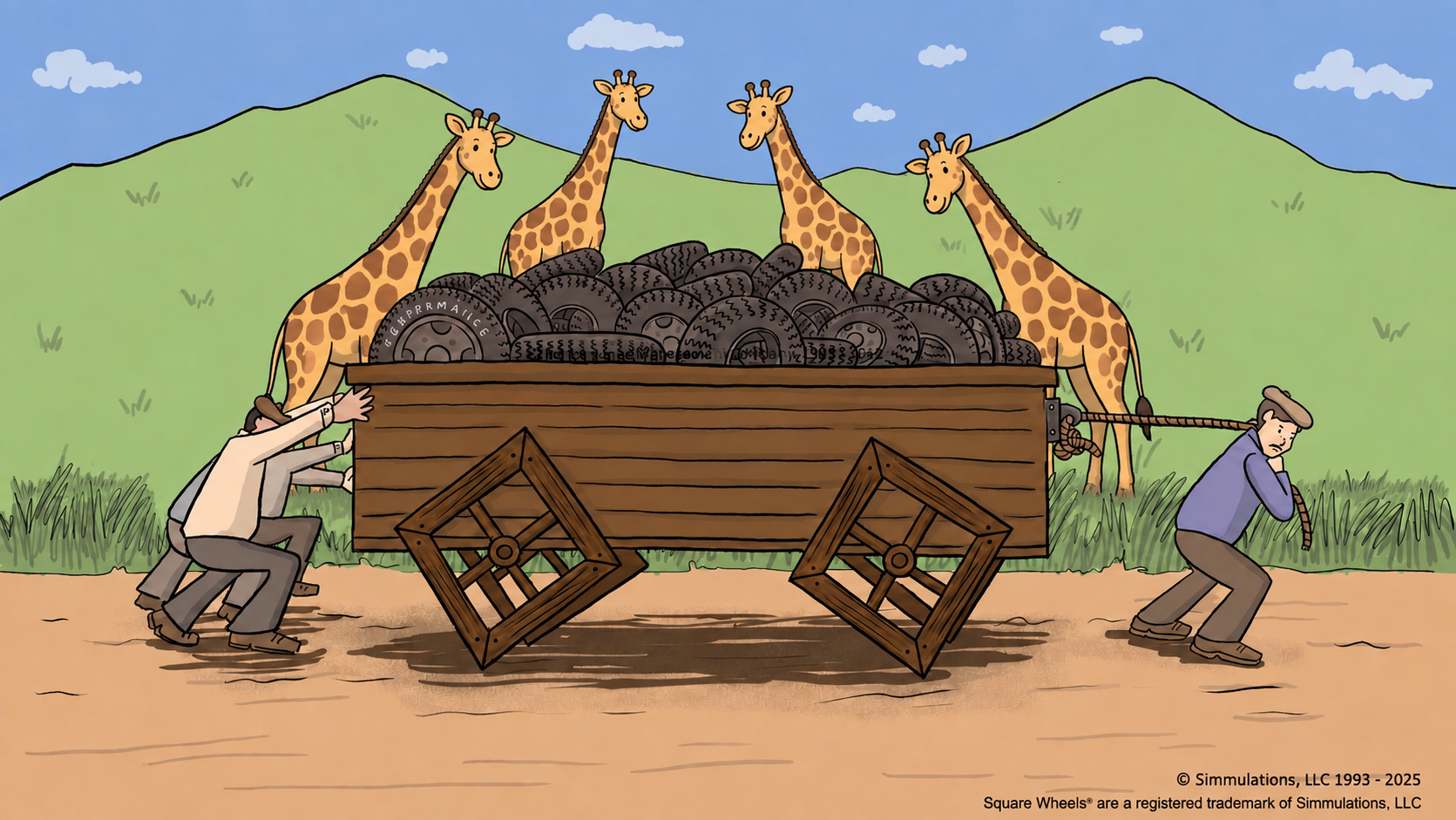
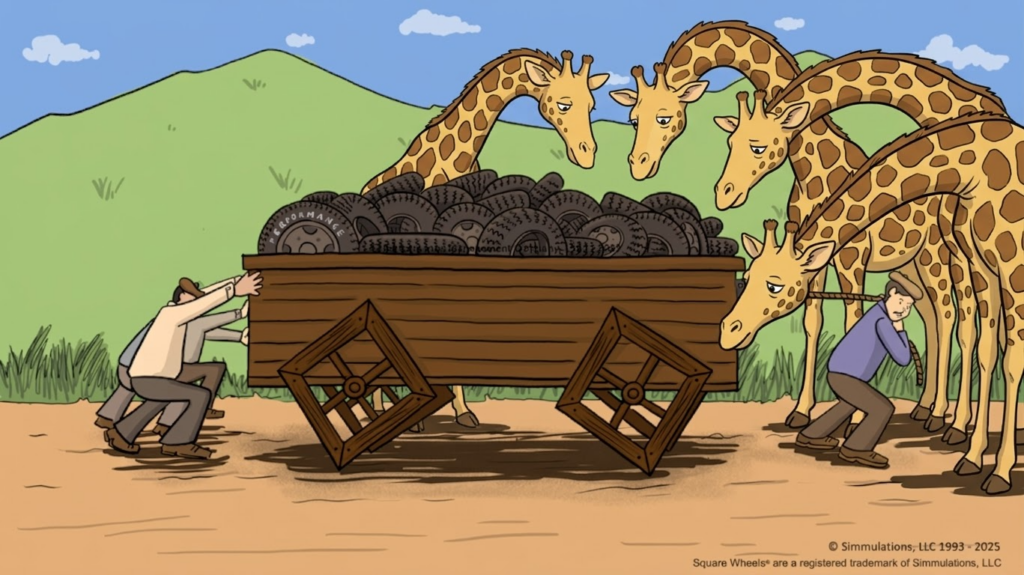
Picture people pushing and pulling a wagon on Square Wheels. Round wheels are already inside the wagon, yet the struggle continues. Everyone is busy keeping things moving. Who has time to stop and consider a different way?
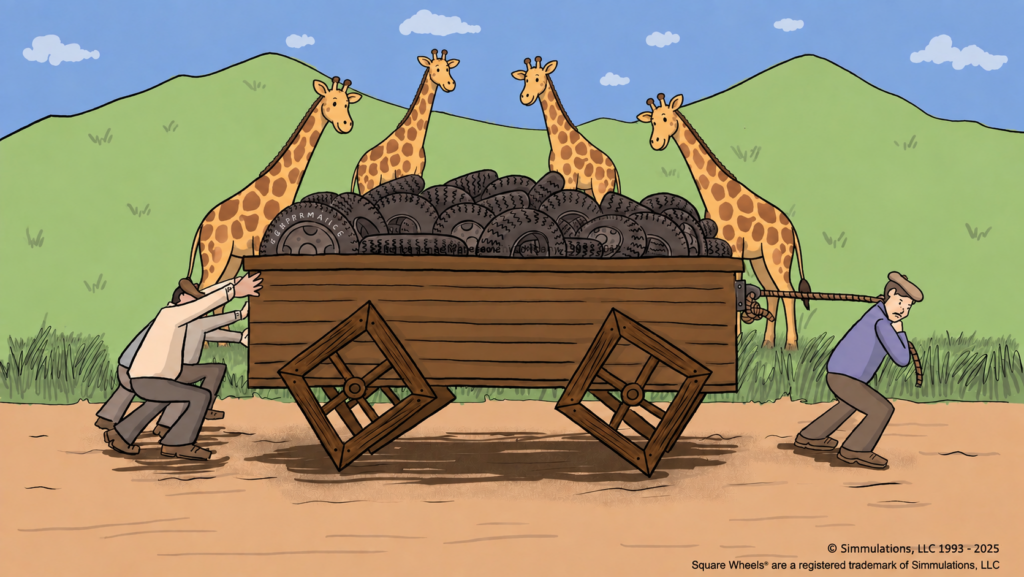
Now add a giraffe—and an invitation to “See the Possibilities.”
The giraffe offers a different viewpoint from the people pushing and pulling. What becomes visible when we look beyond the next difficult step? What resources are we overlooking? What could we change before asking for more effort?
That is the connection to workplace flow: not telling people to concentrate harder, but examining what helps — or prevents — them from becoming absorbed in worthwhile work.
Sometimes the most useful question about performance is not, “How do we get people to work harder?” A much more useful question might be,
“What is making good work unnecessarily difficult?”
Picture people pulling and pushing a wagon rolling on Square Wheels. Round wheels are already available within the wagon yet the struggle continues. Everyone is busy keeping things moving. Who has time to stop and consider a different way?
Square Wheels help us name the friction. Round Wheels help us notice available improvements.
Now, add giraffes and an invitation to “See the Possibilities,” The idea offers a different starting point for a conversation about work. What becomes visible when we look beyond that next difficult step? What resources are we overlooking and what could we change to improve our performance? The Giraffe reminds us to step back far enough to see both
These ideas are the connection to workplace flow: not telling people to concentrate harder, but examining what helps—or prevents—them from becoming absorbed in worthwhile work.
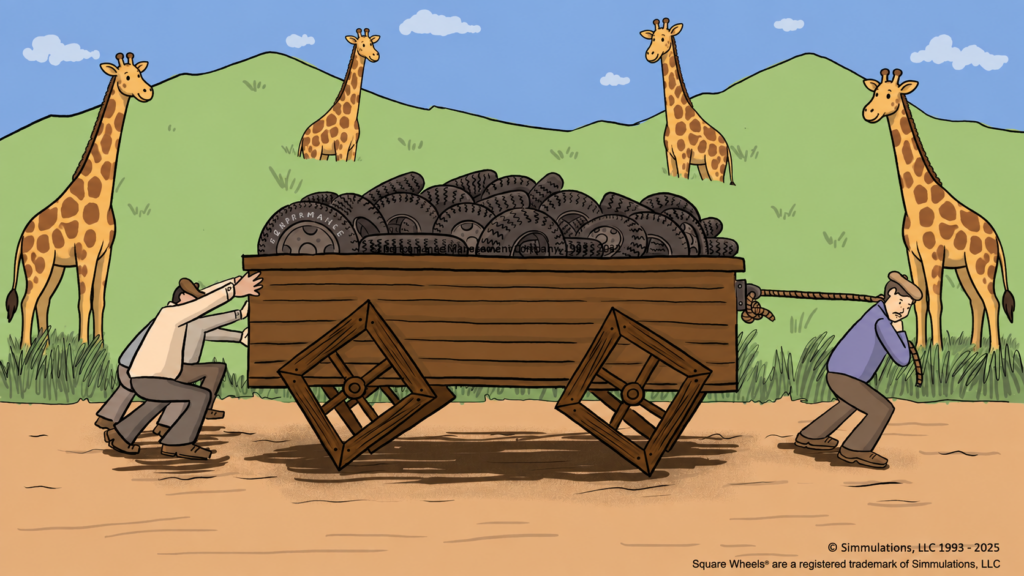
Giraffes can see things differently.
Note: The most common view of a wagon pusher:

Consider thoughts like these when considering productivity and quality:
Where are we struggling? What are we overlooking? What might we see if we lifted our perspective?
These questions create a practical connection to workplace flow: those experiences of becoming deeply absorbed in meaningful work. Rather than telling people to concentrate harder, we can use the Giraffe viewpoint and metaphor to explore — and to change — the situations in which concentration, perspective and reflection become possible.
A good image becomes a visual anchor: a shared reference that helps people remember a useful question, discuss a familiar difficulty, and choose a different action. A change in perspective does not create flow by itself but it can be useful in disrupting non-flow states. Its purpose is to bring people back to the conditions they can influence and thus become more enabled.
The Image Opens a Conversation Without Supplying Every Answer
Imagine opening a team discussion with a familiar question:
“What is preventing you from doing your best work?”
Now imagine displaying the Square Wheels One image and asking:
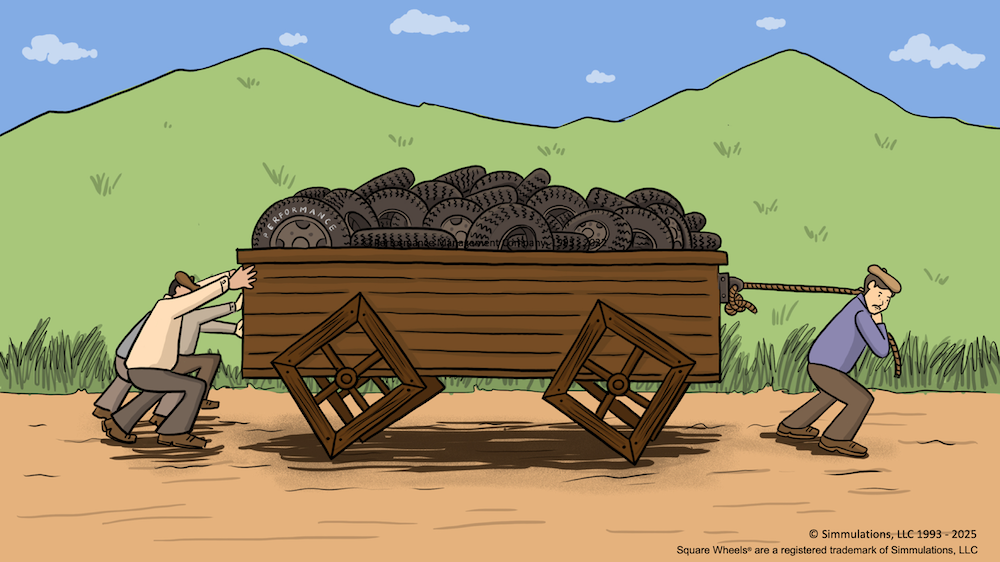
“What do you see happening here—and where does something like this happen in our work?”
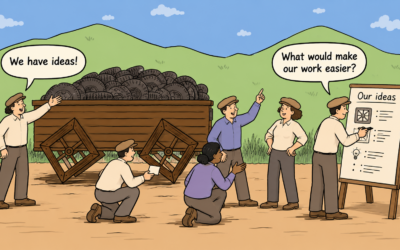
The second part gives people a scene to explore. They can talk about the wagon, the wooden wheels, the direction, the effort, and the round rubber tire possibilities before connecting those observations to their own situations.
A supervisor or facilitator need not explain every element. In fact, we propose allowing participants to develop their own associations. One person might notice wasted effort. Another might focus on resources that nobody is using. Someone else might wonder whether everyone agrees about where the wagon is going. And the collective views of the team can enable even more develop resonance and peer support support some change.
A useful opening sequence would be:
-
What do you see happening in this picture?
-
What might the people involved not be noticing?
-
Where do we experience a similar struggle?
-
What would make that situation more workable?
The point is not to identify who represents the problem. It is to make the work available for examination. (And be careful that you are talking generally when this begins so that people do not feel that they are being attacked. Most people are very practiced in defending themselves.)
“Who is our Square Wheel?” leads toward labeling people
and creating a Blame Frame. Blame Frames are seldom useful..
But a question like, “Where are Square Wheels making our work harder?” directs attention toward conditions we might change with nothing negative about the people who are involved, past and present.
Use the Giraffe’s Perspective Before Putting Your Head Down
The giraffe adds a useful contrast: sometimes we need to lift our perspective before we immerse ourselves in a task.
That suggests two distinct moments.
Before beginning any improvement initiative, look broadly. Clarify the destination, notice obstacles, and select an approach to actively involve and enable the team.
Once the work is underway, engage with it. Do not keep interrupting any flow or useful concentration to inspect whether you are concentrating. Create a situation conducive to going downstream with the ideas.
Create an optimizing situation by positioning the image as a prompt for preparation and not a reminder to monitor yourself continuously. The invitation is simple:
Before you put your head down,
look up long enough to see what would help.
Use the prompt for preparation, not as an invitation to monitor yourself continuously.
That choice turns “Be a giraffe” from an inspirational slogan into a practical question about the next piece of work, not as some oppressive new management belief.
Start With Situations in Which Good Work Already Happened
Rather than beginning only with obstacles, invite people to remember a specific occasion when they became absorbed in worthwhile work.
Ask:
-
What were you doing?
-
What made it easy to become involved?
-
How did you know you were making progress?
-
What support or resources were available?
-
What unnecessary struggle was absent?
Then return to the image:
“Which part of this picture reminds you of something we could reproduce?”
This connects the metaphor with participants’ experience rather than relying entirely on the facilitator’s explanation. This generates active involvement and a sense of ownership. Recalling successful episodes of focused work and choosing a personal meaning for the image helps set the stage for more flow.
The discussion can then move from “I wish I could work like that more often” to a more useful question:
“What was different about that situation—and which part could we recreate?”
Turn the Picture Into a Small Work-Design Experiment
Discussion becomes more useful when it produces a situation someone can actually try to self-enable themselves.
Let me propose taking a brief “Giraffe Pause” built around three questions: identify the destination, spot a Square Wheel, and put a Round Wheel to potential use. Use these situations as a teaching tool, not a validated flow protocol.
For a team conversation, those questions can become a practical sequence to help drive flow.
1. Name the destination
What is the next worthwhile piece of work?
“Work on the proposal” leaves considerable ambiguity.
“Draft the recommendation section so a colleague can review the argument” gives the person a clearer destination.
2. Identify the Square Wheel
What is likely to fragment attention or prevent progress?
Be specific. “Too many distractions” describes a general frustration. “I am expected to monitor incoming messages while drafting” identifies a condition people can discuss.
3. Put a Round Wheel to work
What available resource, agreement, method, or support could help?
Perhaps the team can agree on a protected work period, use an existing outline, clarify review criteria, or resolve a decision before work begins.
4. Adjust the challenge
Is this a manageable stretch?
Would a smaller first step help? Is coaching needed? Is the task too routine to hold interest, or too uncertain to approach confidently?
The purpose is not to promise that the next work session will produce flow. It is to create a more workable situation and learn from what happens.
Give People Their Own Version of the Square Wheels Metaphor
This activity should not become another exercise in asking employees to overcome conditions they cannot control.
A person may prepare carefully and still face shifting priorities, missing decisions, or repeated interruptions.
Give people a parallel interpretation:
Before asking yourself or others to pull harder, look for the Square Wheels you have the authority to change.
A manager’s “Giraffe Pause” and creative self-reflection might include:
-
Have I made the priority clear?
-
Am I about to interrupt work for something that can wait?
-
Does this person need encouragement—or a decision from me?
-
Are we overlooking an improvement someone has already suggested?
That creates complementary conversations: what individuals can do to prepare for absorbing work, and what leaders can change to support it.
A proposed team agreement makes the intention explicit: “When someone asks for a giraffe view, we examine the work, not blame the person.”
Make the Anchor Specific Enough to Use
A memorable image is a starting point. The next step is to connect it with a recognizable moment and a concrete action. Create something tangible. Develop some patterns and useful habits. Create an association such as:
“When I pick up my Be A Giraffe cup , I will .”
For example:
-
Before writing, I will name the section I intend to finish.
-
Before analysis, I will define the question I am trying to answer.
-
Before assigning work, I will clarify what a useful result looks like.
-
After an interruption, I will consult my restart note and identify the next action.
These are proposed applications, not evidence that a particular image automatically triggers a mental state. The image and associated language serves as a reminder to do something useful or be in a positive and focused mental state.
Use it at natural boundaries: before beginning, when genuinely stuck, after an interruption, or during a brief review. Once someone is productively absorbed, let the cup remain a cup.
End the Discussion With a Different Operational Action, Not Just a Better Insight
A workshop can end with people appreciating the metaphor—or with people preparing to change something. The image and the process are not some academic exercise but an attempt to generate and implement some pragmatic solutions to real workplace issues.
Consider asking each participant to complete four statements to help them be in a more productive mental state:
-
The work I want to make more absorbing is…
-
One Square Wheel in that situation is…
-
One round wheel I can put to use is…
-
The action I will take before beginning is…
Then, at the end, revisit the experiment: What changed? What helped? What still needs attention?
The value of using the image and a visual metaphor
lies in that connection between seeing and doing.
The wagon gives us a way to discuss the struggle. The Round Wheels invite us to notice usable possibilities. The Giraffe reminds us to gain perspective before applying more effort.
And the practical question becomes:
Before we ask people to pull harder, what could we change so they can become more fully involved in worthwhile work?
—
For the FUN of It!
 Dr. Scott Simmerman is a designer of team building games and organization improvement tools.
Managing Partner of Performance Management Company since 1984, he is an experienced presenter and consultant who is trying to retire!! He now lives in Cuenca, Ecuador.
You can reach Scott at scott@squarewheels.com
Learn more about Scott at his LinkedIn site.
Note that I often use Perplexity AI to help research and generate ideas for my posts.
Square Wheels® are a registered trademark of Simmulations, LLC
and images have been copyrighted since 1993,
© Simmulations, LLC 1993 – 2026
Note: Interested in using these images? Please review the applicable license terms or contact me about permission. Please do not take my images. Read this article for more information.
See a detailed overview of my tools, background and experiences here.
What I’m About:
My Square Wheels blog and website exist to help leaders, trainers, and facilitators make work smoother, more engaging, and more human. I focus on practical tools for process improvement, organizational change, and workplace collaboration that spark insight and deliver measurable results.
And I am convinced, after 30+ years of using Square Wheels®, that it is the best facilitation toolset in the world. One can use it to involve and engage people in designing workplace improvements and building engagement and collaboration. It is a unique metaphorical approach to performance improvement and we can easily license your organization to use these images and approaches.
By blending proven facilitation methods, creative problem-solving, and engaging team activities, my mission is to support organizations in building energized, sustainable cultures of involvement and innovation.
Through accessible — and often free — resources and virtual facilitation tools, I aim to help teams everywhere collaborate more effectively, innovate continuously, and take ownership of their improvement journey.
#SquareWheels #InnovationAtWork #TeamEngagement #FacilitationTools #WorkplaceImprovement #EmployeeEngagement #CreativeProblemSolving #OrganizationalDevelopment #LeadershipTools #collaboration #leadership #motivation #communications #enablement #leadership #CreativeCommons #enablingperformance #teamwork #storytelling #storyasking #enablement #disruptiveengagement #un-dis-engagement #un-dis-empowerment #innovation
© 2026 Simmulations, LLC. Please note that “Square Wheels®” is a registered trademark of Simmulations, LLC. and materials, original wagon line art, text, and visual designs are protected. Original line art by Roy Sabean, used under rights owned by Simmulations, LLC and formerly Performance Management Company, a sole-proprietorship of Dr. Scott J. Simmerman. Original concept and source artwork © Simmulations, LLC; derivative visuals sometimes created with assistance from Perplexity Pro AI.

0 Comments