
Perspective and Reflection. These are two valuable tools. And the key idea is, “Stand There.” Take a moment. See what you might see.
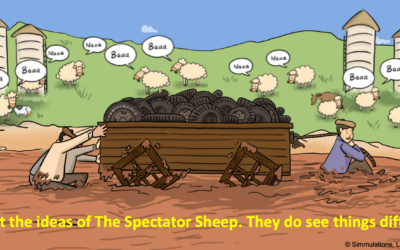
This statement, above, describes the action that we have been teaching as a basic tool of innovation and change since the early 90s. Too often, we are so busy pushing and pulling the wagon, just like always, that we do not step back and look at things from a displaced perspective. Once we do, we can see that things are rolling on Square Wheels while the cargo of the wagon are round rubber tires.

Very often, people who perform better than others — the exemplary performers of any organization — will already be doing things differently than the others.
The round wheels in so many situations are already identified and tested and implemented and refined; they often exist as best practices. But the majority of the people, and especially the poor performers, just keep on keeping on and doing what they have always done and their Square Wheels remain in place.
With the millions of implementations of AI in so many ways and places, what we often see is this lack of reflection about realities as resistance to change. With no perceived problem, it is nearly impossible to generate the cognitive dissonance to close the gaps between what is not working well and what the possibilities for improvement might be.
Sometimes, we just feel that we are too busy and that we need to keep going just to meet our goals, either the ones we set for ourselves or the ones that others give us. That choice often limits what we can accomplish.
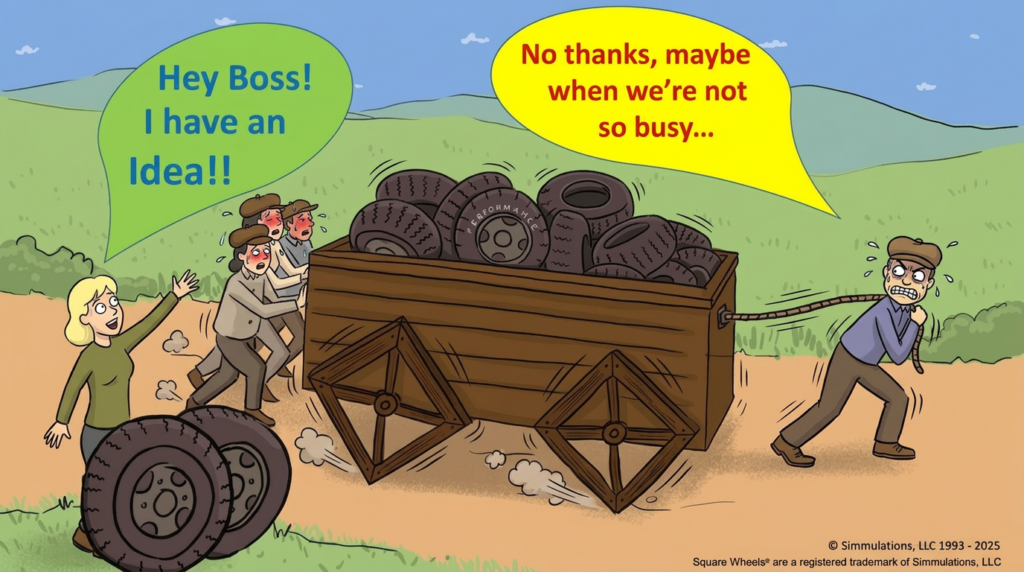
That can be us at the front. We can all get wrapped up in moving forward.

And looking at ourselves can also be useful. Introspection can be useful to identify issues as well as unseen strengths. I’ll keep it simple and just use this to show that understanding our strengths and resources is one of the keys to improving personal performance.
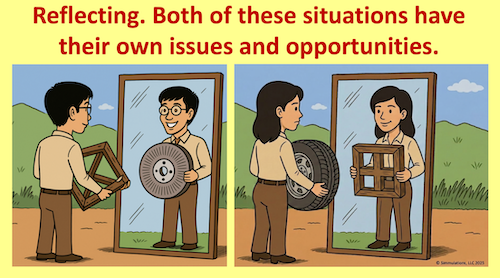
There are different perceptions around how we see ourselves when we reflect on the way things really are.
Innovations can occur quite naturally. Some of us are nearly always looking for ways to do things differently so that it is easier. Tom Gilbert expanded on a framework of “laziness” back in the late 70s in his book, Human Competence. I have always liked Tom’s concept: Because we are naturally lazy, we will always be looking for the easiest and most efficient way to do things.
The Facilitators’ Guild reinforces the thinking behind “Don’t Just DO Something, Stand There”: experience alone is not enough on its own and that we also need reflection, honest feedback, and opportunities to learn from one another. Its approach encourages practitioners to recognize their strengths, examine their blind spots, and identify what would improve their practice.
In Square Wheels® terms, that means pausing long enough to notice what is making the wagon difficult to move—and listening to the people who may already know where the round wheels are and what to do with them.
Reflection is not a retreat from productive work; it is an opportunity to question familiar routines, share what works, and turn individual insights into improvements the whole team can use. Sometimes, the most useful step toward better performance is to stop pushing long enough to have a different conversation.
Discovering ideas for improvement is that powerful motivator for continuous improvement.

Why not look for the downhill route instead of pushing and pulling the wagon uphill (and sometimes through the mud)?
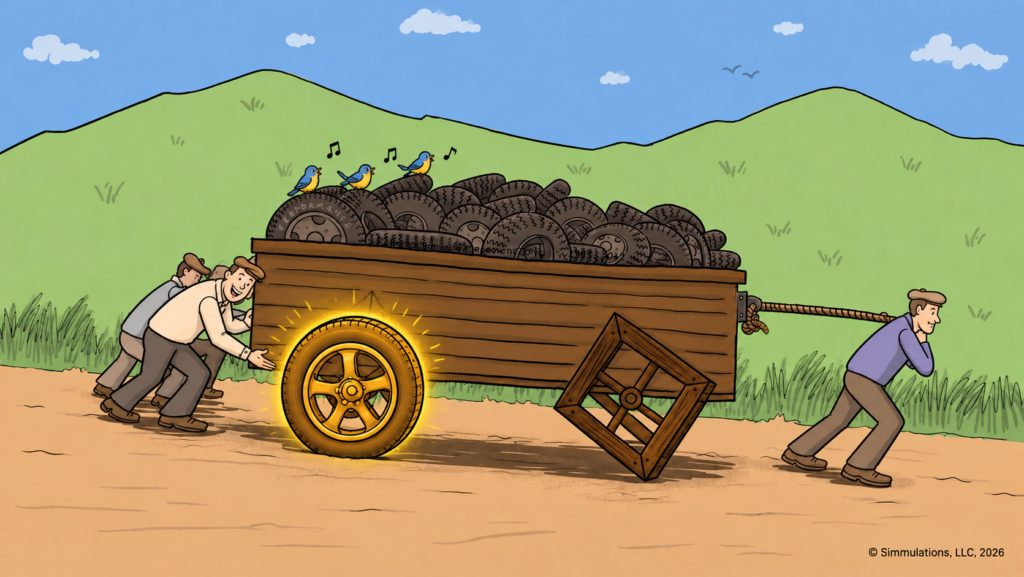
By involving and engaging people in the identification of the things not working smoothly and through the sharing of best practices and round wheels, we do a better job of engaging and involving the workforce. Engagement is a key to motivation and sustaining high performance. Or, putting the Round Wheels to use!
(A post with a similar title was published by me on this blog in August of 2011)
—
For the FUN of It!
 Dr. Scott Simmerman is a designer of team building games and organization improvement tools.
Managing Partner of Performance Management Company since 1984, he is an experienced presenter and consultant who is trying to retire!! He now lives in Cuenca, Ecuador.
You can reach Scott at scott@squarewheels.com
Learn more about Scott at his LinkedIn site.
Square Wheels® is a registered trademark of Simmulations, LLC
and images are © Simmulations, LLC 1993 – 2026
Note: Please do not take my images and think about using them. It can generate a whole heap of problems given international copyright law and trademark law. Read this article for more information.
See a detailed overview of my tools, background and experiences by clicking here.
What I’m About:
My Square Wheels blog and website exist to help leaders, trainers, and facilitators make work smoother, more engaging, and more human. I focus on practical tools for process improvement, organizational change, and workplace collaboration that spark insight and deliver measurable results.
And I am convinced, after 30+ years of using Square Wheels®, that it is the best facilitation toolset in the world. One can use it to involve and engage people in designing workplace improvements and building engagement and collaboration. It is a unique metaphorical approach to performance improvement and we can easily license your organization to use these images and approaches.
By blending proven facilitation methods, creative problem-solving, and engaging team activities, my mission is to support organizations in building energized, sustainable cultures of involvement and innovation.
Through accessible — and often free — resources and virtual facilitation tools, I aim to help teams everywhere collaborate more effectively, innovate continuously, and take ownership of their improvement journey.
#SquareWheels #InnovationAtWork #TeamEngagement #FacilitationTools #WorkplaceImprovement #EmployeeEngagement #CreativeProblemSolving #OrganizationalDevelopment #LeadershipTools #collaboration #leadership #motivation #communications #enablement #leadership #CreativeCommons #enablingperformance #teamwork #storytelling #storyasking #enablement #disruptiveengagement #un-dis-engagement #un-dis-empowerment #innovation
© 2026 Simmulations, LLC. Please note that “Square Wheels®” is a registered trademark of Simmulations, LLC. and materials, original wagon line art, text, and visual designs are protected. Original line art by Roy Sabean, used under rights owned by Simmulations, LLC and formerly Performance Management Company, a sole-proprietorship of Dr. Scott J. Simmerman. Original concept and source artwork © Simmulations, LLC; derivative visuals sometimes created with assistance from Perplexity Pro AI.


0 Comments