
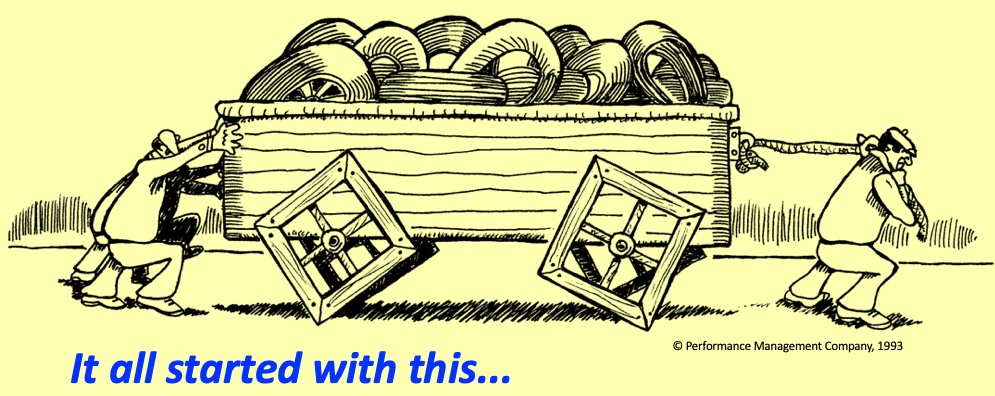
Square Wheels – A metaphor that moves organizations because it involves and engages people into active involvement to create change.
For more than 30 years, my business has revolved around a core idea: using simple visual metaphors to spark conversations about how organizations really work and how they could work better. That work started with a simple line-art wagon, grew into 300 images, evolved through rich LEGO® scenes, and is now rolling into a new branding design that many change agents will find amazing.
From one image to a global brand
The original Square Wheels® One illustration was intentionally simple and context-free done in line art by Roy Sabean, who made it into a powerful Rorschach-type test for how people see their workplaces.
It’s always worked like this: Show the image and ask, “How might this represent how organizations really work?” and discover that people instantly project their general issues, frustrations, ideas, and opportunities onto the scene. Asking, “How might this represent how our organization really works,” generates specific ideas that are generally actionable. And it has worked this way since the beginning.
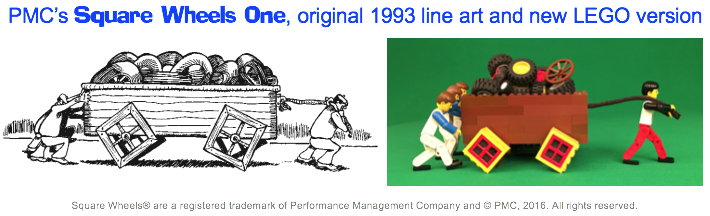
That single image became the anchor for workshops and toolkits delivered in 40+ countries, first with transparencies and then with PowerPoint-based materials for change, motivation, and improvement. Over time, My “Square Wheels Guy” identity emerged as acore personal and product brand, tightly linked to that original wagon drawing.
Evolving into LEGO scenes
Around 10 years ago, the metaphor was re-expressed using LEGO® blocks and Technic figures to build scenes that show similar Square Wheels themes in a more three-dimensional and playful way. These LEGO-based frameworks still focused on how things work, what is not working smoothly, and what “round wheel” possibilities already exist, and they did it with rich detail and good visual impact.

Those scenes appeared across products, toolkits, and online courses that taught supervisors and team leaders how to facilitate conversations around engagement, innovation, implementation, and leadership. LEGO opened the door to simple stop‑motion videos, making it easier to tell short visual stories about workplace reality and change. But we had to move on; we did not really have the tools to sell.
I loved playing with those plastic blocks and I guess I created 4000 different images. They were amazing to play with but they also lost some of the detail around the images and themes. Maybe with AI video, we can go back to recreate some of those images into animations.
Simple visuals, deep conversations
The underlying delivery has never been complex: show an image, ask a question, and let people talk about what they experience at work. Yet that simple structure consistently generates surprisingly deep discussions about people, processes, collaboration, and continuous improvement.
Participants tend to focus on themes like involvement, motivation, innovation, and best practices, often surfacing specific roadblocks and practical “round wheel” ideas that were already available but underused. The images act as a safe and non-threatening mirror that helps them describe reality without feeling personally attacked.
Evolving and Modernizing The Tools
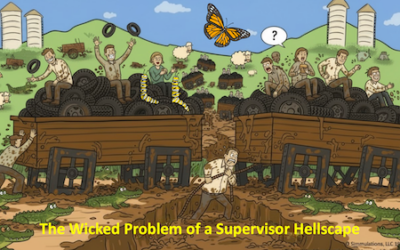
From line art through LEGOs, we now on to more upscale art and the use of AI facilitation tools, things keep changing and we keep evolving. The new image style looks like the one below and with this change, I also started giving the main image away for free! If you want this and a toolkit, click here:
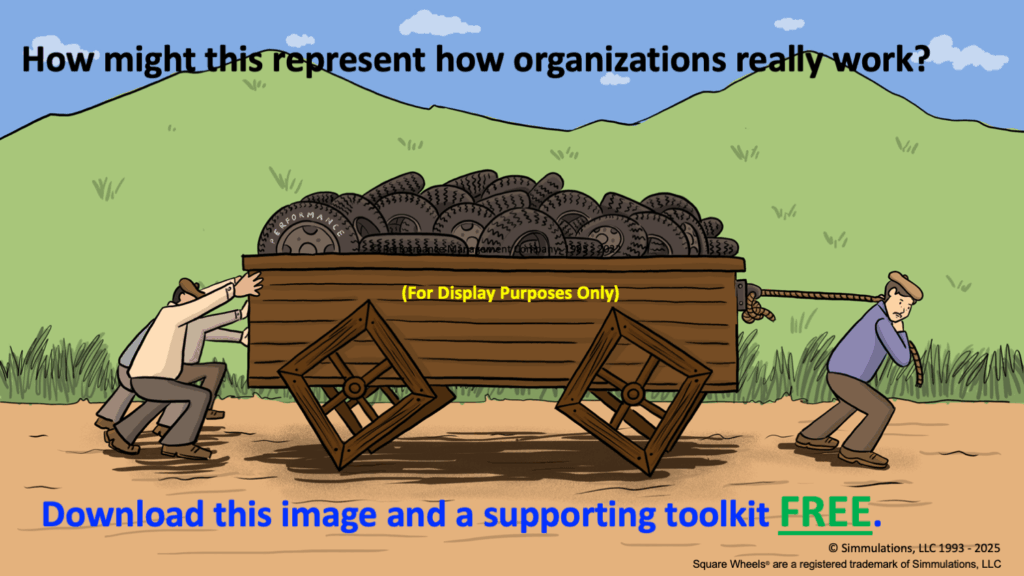
So, what did I do? I started giving my MAIN image away for free under a Creative Commons license, hoping that making the tool more open source would generate more collaborative involvement for new product development.
And Introducing a new image raises several strategic questions that will be very familiar to anyone who manages a visual brand or metaphor. The key tension is balancing creative evolution with the need to protect and reinforce a strong, recognizable identity.
Some central questions include:
-
Does this new image strengthen the Square Wheels® brand or dilute years of intellectual property and identity-building?
-
Will it generate conversations about organizational reality, issues, and opportunities that are as rich and productive as those triggered by the original wagon and the newer LEGO scenes?
-
Will participants respond to it with the same energy, insight, and positive engagement that the earlier images routinely evoked?
Looking specifically at the new images, another set of more tactical design and facilitation questions emerges. These questions go beyond style to focus on how well the scene functions as a conversation catalyst.
Key questions include:
-
If this image were adapted by organizations, what changes and what packaging would make it more effective at generating engagement, insights, and “round wheel” ideas?
- Can these tools really be used easily by supervisors within their workplaces, since that would minimize the need for trainers?
-
Which of the images—the classic line art, the LEGO scenes, or the new proposal—do you personally find most powerful, and why?
-
How do differences in detail, complexity, and emotional tone affect the quality and direction of the conversations you expect it to trigger?
An invitation to practitioners
This entire situation is, in many ways, a live case study in branding change, metaphor management, and tool design for engagement and change. Practitioners who work with facilitation, coaching, and organizational development will recognize how the use of these images can impact workplace performance and change active involvement of people for workplace improvement.
Thoughtful, experience-based perspectives on these questions are genuinely welcome. Insightful and useful comments about the image dilemma and its possible resolution will be acknowledged with a free Square Wheels toolkit to experiment with in your own work.
And if you want to build out some tools, collaborate with me. There are many possibilities to co-brand these tools,
—
For organizations with multiple stuck teams, book a short conversation to design a program using Square Wheels across your organization, We can easily build some really great tools and courses and support systems,
For the FUN of It!
 Dr. Scott Simmerman is a designer of team building games and organization improvement tools.
Managing Partner of Performance Management Company since 1984, he is an experienced presenter and consultant who is trying to retire!! He now lives in Cuenca, Ecuador.
You can reach Scott at scott@squarewheels.com
Learn more about Scott at his LinkedIn site.
Square Wheels® are a registered trademark of Simmulations, LLC
and images have been copyrighted since 1993,
© Simmulations, LLC 1993 – 2025
What I am about:
My Square Wheels blogs and website exist to equip leaders, trainers, and facilitators with practical process improvement tools along with effective organizational change tools. My purpose is to facilitate engagement and active involvement to help make work smoother and more human.
By blending change management facilitation with proven workshop facilitation techniques, team collaboration activities, and creative problem solving activities, my mission is to support organizations in designing employee engagement strategies that are both energizing and sustainable. Through accessible, sometimes free team building resources and virtual facilitation tools, my focus is on helping teams everywhere discover better ways to collaborate together, innovate continuously, and own their path to improvement.
#SquareWheels #InnovationAtWork #TeamEngagement #FacilitationTools #WorkplaceImprovement #EmployeeEngagement #CreativeProblemSolving #OrganizationalDevelopment #LeadershipTools #collaboration #leadership
———————————————–
These conversations around what it might represent as an organizational reality tend to focus on people, engagement, active involvement, innovation, leadership, motivation and similar. They are about issues, opportunities and implementation. They are about innovation and best practices and collaborative dis-un-engagement.
And we package a number of very simple toolkits as well as an online course so that supervisors and team leaders can learn facilitation skills. We have also used the LEGO scenes to create some stop-motion videos, which are easy to do and which would be much harder with line art.
This is NOT rocket science, to show an image and generate a discussion. It is a powerful but elegantly simple tool to generate real discussions about perceived workplace issues.
In our efforts to broaden exposure, we engaged with an organization to sell an Icebreaker toolkit around this theme to their customer base, which is different than mine but very congruent. It is a framework for collaboration and co-marketing that seems to have no downside.
As the two companies discussed this Icebreaker possibility, her staff came up with the idea of using a different representation of the Square Wheels® theme and suggested using an image that looked like this:
 So, I am faced with a marketing decision with a variety of factors.
- Does the above image represent an improvement or is it simply a dilution of my intellectual property?
- Is the image itself going to generate better discussions about organizational reality and issues and opportunities, since it IS a very different scenario and has different features.
- Is the last image going to get the positive reactions from discussion participants like the first two does?
And another set of questions:
- If you were to change the latter image, how would you change it to improve its effect in generating engagement and ideas?
- Which image do you personally prefer and why?
Your thoughts on the above would be most appreciated, and if you share a useful informative considered opinion or idea as a comment, I will send you a free toolkit to play with,
For the FUN of It!
 Dr. Scott Simmerman is a designer of team building games and organization improvement tools. Managing Partner of Performance Management Company since 1984, he is an experienced presenter and consultant.
Scott and Dan Stones built The Square Wheels Project as an LMS, sharing tools and training to support Disruptive Engagement in the workplace.
Visit The Square Wheels Project at www.TheSquareWheelsProject.com
You can reach Scott at scott@squarewheels.com
Square Wheels® is a registered trademark of Performance Management Company
LEGO® is a trademark of The LEGO® Group®
© Performance Management Company, 1993 – 2017. All Rights Reserved.
PMC has no affiliation or relationship with The LEGO® Group®
Please Note: The offer of a free Square Wheels Toolkit is limited to the first twenty (20) people who share a relevant and useful comment about the image dilemma and its resolution.

0 Comments