

This is about Culture, FLOW and using Square Wheels images to dramatically impact and improve your real work culture and flow. It is about improving how most people and teams perform.
In most organizations, culture gets announced from the front of the wagon.
Leaders declare who “we” are while the rest of the organization keeps pushing their wagons on the same old Square Wheels, thump‑thump, thump‑thump, and wondering why work never quite flows. So, the people disengage and become Spectator Sheep. Not exactly a great situation, right?
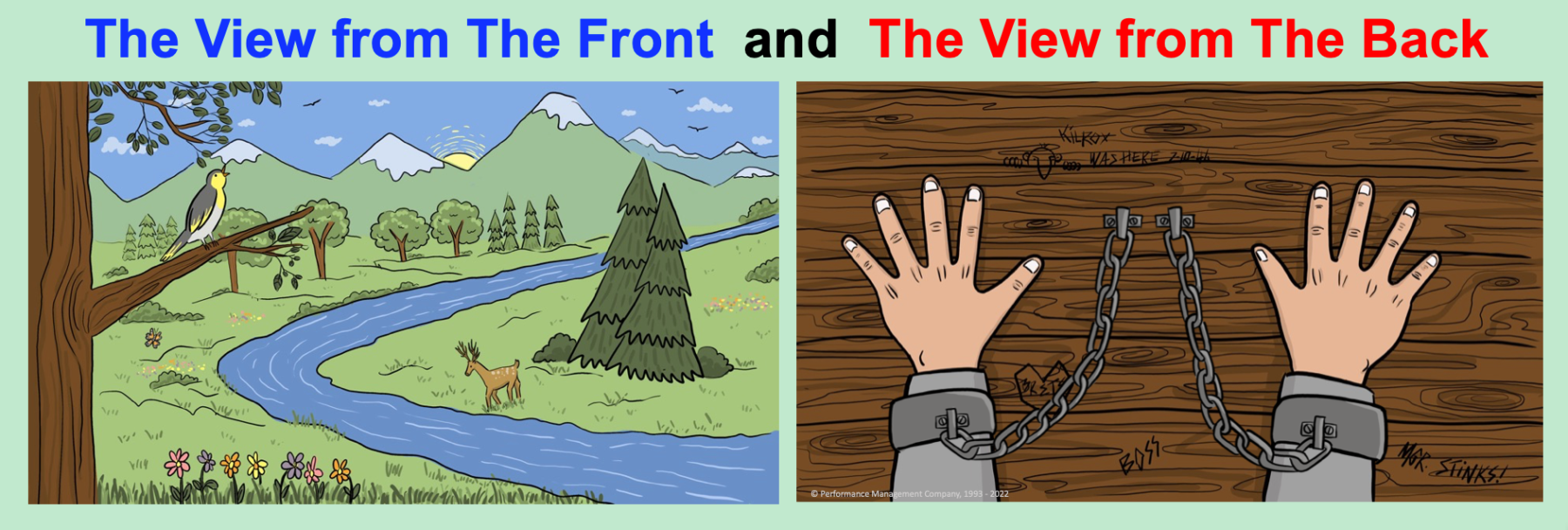
“Here is your vision” on the left and here is our reality on the right.
There was air interesting article for Medium members by Benjamin Cain about how conservative principles generate behaviors that make up organizational cultures. (article) It focused on the idea that nature still rules us through conservative prejudices that favor dominance and status over shared problem‑solving. It obviously got me thinking about how to generate a lot more positive outcomes.
Culture gets real when people can do good work that actually flows, not just when they can describe values on a Mission poster in HR. Using Square Wheels One, you can help people see how conservative prejudices keep things thumping along on square wheels and then co‑design round‑wheel changes that create more FLOW: smoother work, fewer blockers, and more time in the productive, engaging zone.
 Stop declaring culture, start asking about their wagon
Most organizations still try to announce culture they think they want to be. Any guesses why this doesn’t work very well?
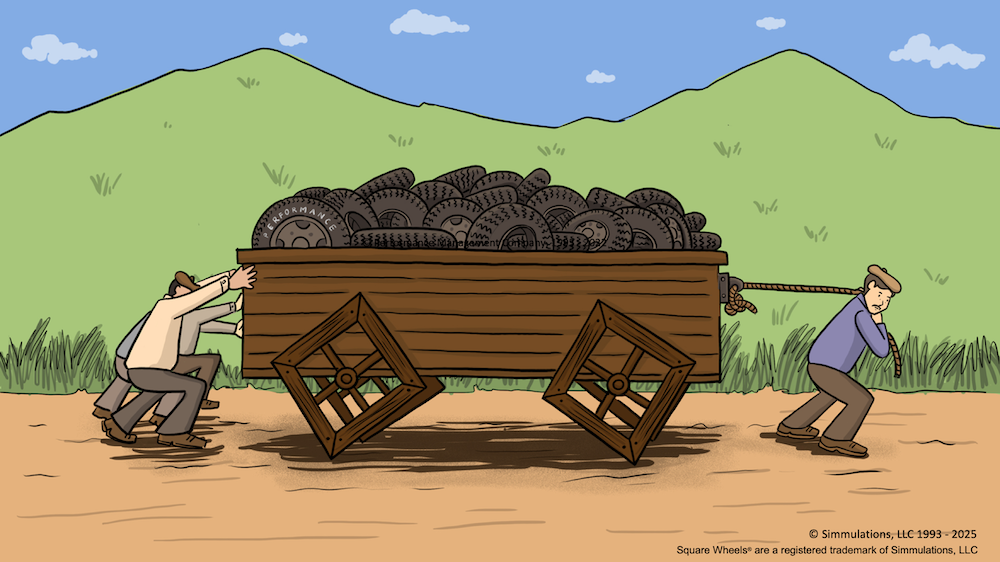
Leaders stand at the front of the room and tell people “who we are,” while the actual experience of work still feels like pulling a heavy wagon on a muddy trail with square wheels thumping and bumping, with boards and hands as their view of reality.
In Cain’s Medium piece, culture shows up as a set of “conservative prejudices” that defend old dominance patterns and rigid hierarchies even when they no longer fit our environments In workplaces, these sound like:
-
“That’s just how we do things.”
- “We meet all of our goals and metrics.”
-
“Run it up the chain before you act.”
-
“Don’t get ahead of your boss.”
These are not neutral customs. These are a significant part of the culture. So, try to see your culture as it really is. Ask your people, walk and talk around the organization. (article)
These and other issues are friction‑generators, keeping people from ever getting into FLOW because they are constantly stopping, waiting, and working around the systems that do not work well instead of moving through the mud. The friction is not producing the kind of heat that we need.
Square Wheels One lets you show this without a single accusatory finger‑point. You simply put up the image: a wagon with Square Wheels, a leader out front pulling the rope, people pushing from behind, and unused round wheels sitting in the wagon bed. (You can get the image for FREE along with an instructor’s guide by clicking below)
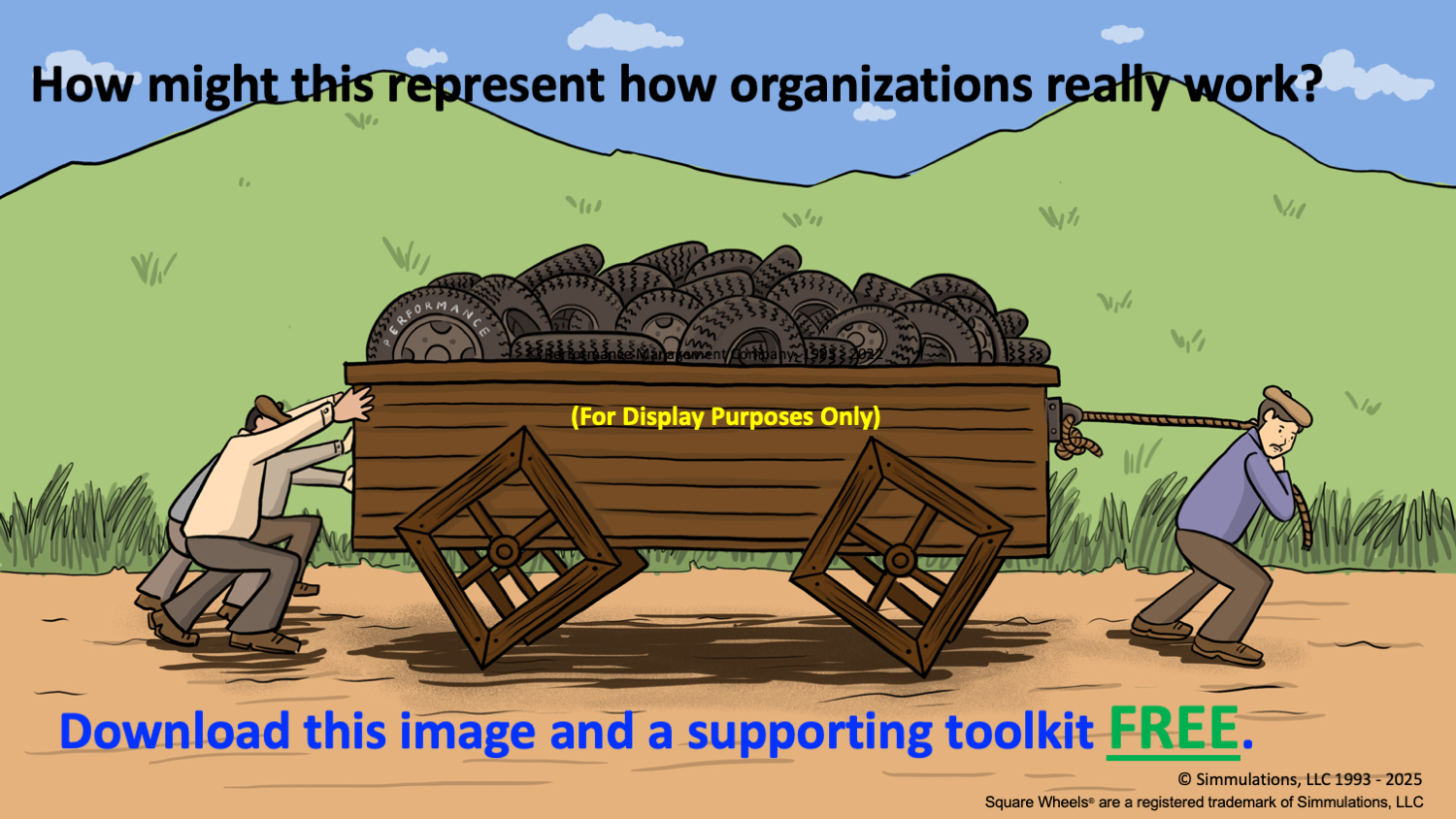
Download the FREE Square Wheels One image under Creative Commons license
Then you ask the question that changes everything:
“What’s this say about how things really work around here?”
Culture as conservative prejudices on wheels
The Medium article’s core idea is that a lot of social (and business) life is still governed by deep, conservative prejudices that favor dominance and status over experimentation and shared problem‑solving.
Translate that into organizational life and you get:
-
Leaders isolated at the front of the wagon, some with much longer ropes than others, seeing only their view of the road and not feeling the thumps and bumps
-
Teams too busy pushing to see possibilities or question the route
- No (apparent) time to step back and look for possible improvements; they got goals and objectives to meet, right?
-
Square Wheels simply being accepted as “just the way things work” because they do roll, after all, and the current performance metrics are built around that model.
Those conservative prejudices show up as cultural rules:
-
“Managers get rewarded for pulling harder, not for suggesting new wheels.”
- “Workers are expected to simply push hard. Some do. many don’t.
-
“We admire ‘heroes’ who work around the frictions, not designers who improve it.”
-
“We design reporting structures for control, then complain about bottlenecks.”
…and all this happening when the exemplary performers are already doing things differently!
- Square Wheels One turns that abstract critique into a shared picture and a safe language.
- People can say, “That approval process is a square wheel” instead of “Our VP is the problem.”
Once you have a common language for friction, you can have a more honest conversation about FLOW.
From thump‑thump-thump to FLOW
FLOW in organizations is not a mystical state; it is the natural by‑product of reasonably well‑designed work plus people who are both engaged (“I want to”) and enabled (“I can”). And it feels like this:

Your Square Wheels sessions are about redesigning your wagon(s) so that FLOW is more available to more people, more of the time. We are more effectively managing personal and team roadblocks and enabling better performance.
Consider using the image to walk groups through steps like these; this is not rocket surgery::
-
Name the thump‑thump
-
Ask: “Where does work thump and bump for you?” and let them label specific Square Wheels: rework loops, clunky tools, redundant approvals, unclear priorities and other things that work but do not work smoothly.
-
This surfaces the local, everyday ways that conservative prejudices and legacy structures are disrupting FLOW: stopping to ask permission, waiting on decisions, repeatedly fixing the same problems.
-
-
Discover the round wheels already in the wagon
-
Ask: “What ideas, tools, or practices are already in the wagon that would make this smoother if we actually used them?”
-
People will point to underused systems, known shortcuts, best practices of the top performers, or simple agreements that would eliminate friction.
-
-
Design FLOW‑friendly experiments
-
Push each table to generate at least three considered alternatives (round wheels) for each square wheel, not just the first fix that comes to mind. Generate considered alternatives.
-
Focus those ideas on making FLOW more possible: fewer stops, clearer handoffs, better tools, more local discretion, faster feedback, and visible removal of stupid friction.
-
The shift is subtle but powerful and the conversation is no longer “How do we get people more engaged?” but “How do we improve the wagon where engaged and enabled people can actually get into FLOW?”
Making FLOW more available as a cultural choice
If culture is “how we do things around here,” then FLOW is “how it feels to do things around here when the wheels are round, when things work more smoothly.”
Leaders cannot push people into FLOW,
but they can deliberately remove the obstacles
that keep FLOW rare and accidental.
You can coach leaders to use the Square Wheels metaphor in three practical ways:
-
Reframe culture from posters to pathways
-
Replace culture statements like “We value innovation and accountability” with questions like, “Where are we pulling the wagon on Square Wheels that make innovation and accountability unlikely? And what can we do differently?”
-
Treat each Square Wheel you remove as a cultural statement: “This is what we now choose to make easier, faster, and safer to do.” Keep a list and keep the process improving.
-
-
Design for enablement, not just engagement
-
Studies on engagement and enablement show that high engagement without enablement creates frustrated strivers; enablement without engagement creates efficient cynics.
-
Use Square Wheels to keep leaders anchored on both halves of the equation: “What are we doing that makes people want to push, and what are we doing that makes it actually possible to push more smoothly?”
-
-
Normalize FLOW as the standard, not the exception
-
Encourage teams to treat FLOW episodes as data: “What was true on those good days when everything clicked? What round wheels were in play?”
-
Ask leaders to publicly celebrate not just heroic effort, but the redesign of work that reduces the need for heroics — the installation of new round wheels that make high performance routine and minimizes the need for heroics.
-
Over time, the culture story becomes less about values as aspirations and more about practices as evidence.
You move from “We say we empower people” to “We no longer require block people from making process improvement,” so more people can get into FLOW while taking smart risks.”
Look: Your wagon will keep rolling regardless of what you do. Your choice is whether it rolls on Square Wheels that consume energy and limit FLOW or on round wheels that your people help design. It is up to you whether you enable and actually engage them to generate a smoother ride and better results.
—
For the FUN of It!
 Dr. Scott Simmerman is a designer of team building games and organization improvement tools.
Managing Partner of Performance Management Company since 1984, he is an experienced presenter and consultant who is trying to retire!! He now lives in Cuenca, Ecuador.
You can reach Scott at scott@squarewheels.com
Learn more about Scott at his LinkedIn site.
Square Wheels® are a registered trademark of Simmulations, LLC
and images have been copyrighted since 1993,
© Simmulations, LLC 1993 – 2026
What I’m About:
My Square Wheels blog and website exist to help leaders, trainers, and facilitators make work smoother, more engaging, and more human. I focus on practical tools for process improvement, organizational change, and workplace collaboration that spark insight and deliver measurable results.
And I am convinced, after 30+ years of using Square Wheels®, that it is the best facilitation toolset in the world. One can use it to involve and engage people in designing workplace improvements and building engagement and collaboration. It is a unique metaphorical approach to performance improvement and we can easily license your organization to use these images and approaches.
By blending proven facilitation methods, creative problem-solving, and engaging team activities, my mission is to support organizations in building energized, sustainable cultures of involvement and innovation.
Through accessible — and often free — resources and virtual facilitation tools, I aim to help teams everywhere collaborate more effectively, innovate continuously, and take ownership of their improvement journey.
#SquareWheels #InnovationAtWork #TeamEngagement #FacilitationTools #WorkplaceImprovement #EmployeeEngagement #CreativeProblemSolving #OrganizationalDevelopment #LeadershipTools #collaboration #leadership #motivation #communications #enablement #leadership #CreativeCommons #enablingperformance #teamwork #flow #enablement #choice


0 Comments