
Great supervisors are not some “nice-to-have round wheels” on the wagon of work; they are the engagers and facilitators impacting how fast we go.
The study of performance in one sentence
Analyzing 869 managers over three months, Happily.ai found that the top 10 percent of managers deliver dramatically higher engagement, advocacy, and well‑being—despite operating in the same organizations, with the same pay, perks, and policies as everyone else.
So, herein, I want to wrap the research of Tareef Jafferi around my Square Wheels® / Round Wheels conversation tools and approach to performance improvement, a discussion to impact our supervisors to better enable their people..
Here is the reality: The round wheels for improvement already exist. Rock and Roll!
Square Wheels on most teams
Let’s start with my main image about how things really work in most organizations based on over 30 years of using the image and metaphor:
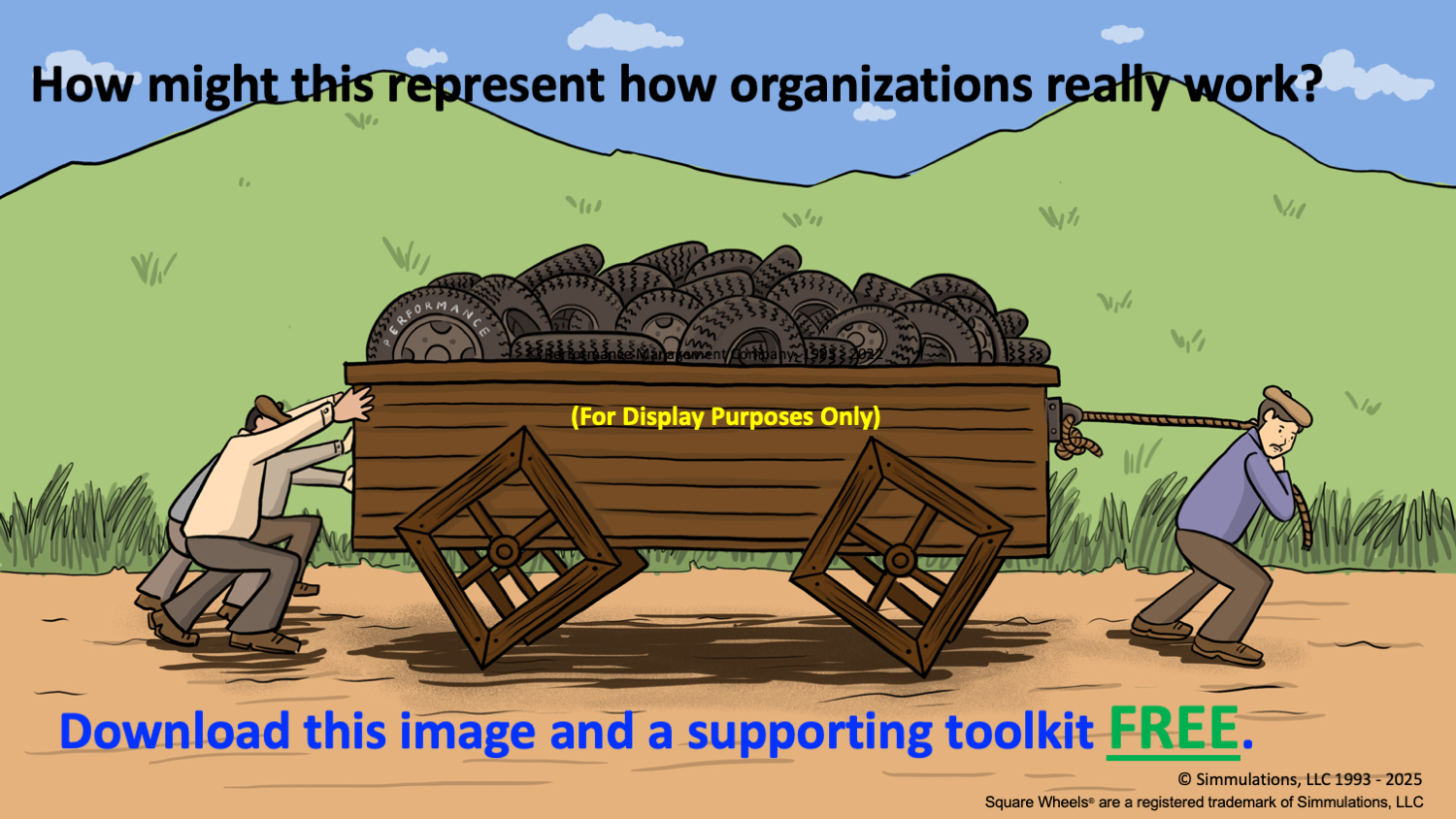
Download the FREE Square Wheels One image under Creative Commons license
Most teams are pushing and pulling a wagon with those familiar Square Wheels: people feel unheard, recognition is sporadic, nothing is working smoothly and performance conversations are rare and often painful. Pushers and Pullers are unengaged and uninvolved in making simple changes. This research showed:
-
Engagement scores for “average” managers typically sit between 19 and 45 on the DEBI index, a picture of people going through the motions more than pulling with full energy.
-
Employee advocacy under those managers ranges from 0 to 40 eNPS, meaning many people would not recommend their workplace to a friend.
-
Well‑being scores for these teams land in the 57–74 range on the WHO‑5, which is “not terrible” but far from thriving.
From my Square Wheels perspective, these are perfectly predictable outcomes around how things really work in most organizations: uneven communication, weak feedback, and thin recognition make the ride bumpy, noisy, and inefficient. And the research above beautifully aligns with much other research such as Gallup and others.
What the round wheels look like
The same study shows what happens when managers actually bolt on a different set of wheels.
-
Teams led by top managers reach engagement scores between 55 and 72 on DEBI, essentially doubling engagement compared to others in the same company.
-
Their teams post advocacy scores between 75 and 100 eNPS, a radical shift toward people actively promoting the organization.
-
Well‑being climbs into the 72–85 range, indicating a significantly healthier day‑to‑day experience of work.
Remember: compensation, benefits, and policies were held constant across these groups, so the “round wheel” variable here is managerial behavior, not organizational structure.
Three behaviors that change the journey
The data is particularly powerful because it reduces “great management” to three observable, actionable, teachable behaviors.
1 – High‑quality responses to performance feedback
- Top managers’ “response quality scores” are about 54% versus 36% for peers.
- Response quality has the strongest correlation with engagement (r = 0.47), which means how managers respond matters more than simply that they respond.
- Their teams also benefit from higher response rates overall (56% vs 32%), so people feel both heard and constructively answered.and enabled.
2 – Frequent, broad, and predictable recognition
-
Great managers give recognition 2.6 times more often: 3.51 vs 1.57 instances per month.
-
Their praise reaches 59% more team members and happens at 2.3 times more regular intervals, making recognition a system, not a surprise.
-
Recognition frequency shows a meaningful correlation with eNPS (r = 0.27), linking everyday appreciation directly to whether people promote the workplace.
3 – Serious, consistent performance feedback
- Only 13% of all managers provide regular performance feedback at all, which is a Square Wheels statistic if ever there was one.
- Top managers average 1.25 feedback instances per month versus just 0.01 for others, making them three times more active in structured feedback and 2.8 times more consistent in follow‑up.
- Even modest correlations between feedback frequency and well‑being (r = 0.12) signal that ongoing conversations about performance protect people from burnout and confusion.
(see my article on Performance Feedback here.)
In Square Wheels language, these behaviors are “low‑cost, high‑impact” round wheels: they require attention and discipline, not new budgets or strategies.
From analytics to action: a Square Wheels challenge
For an OD‑minded leader or HR team, the message is blunt: the wagon is already full of unused round wheels that are effectively a burden and not an opportunity. If these are not something that requires attention, it must be me who doesn’t get it.
-
The study suggests organizations can expect around 79% higher engagement, 131% higher workplace advocacy, and 20% better well‑being when managers master these basic actions.
-
These improvements show up without new perks, new tech stacks, or massive reorganizations; they emerge from consistent execution of fundamental managerial practices.
A simple Square Wheels‑style team exercise (which you can get for FREE) based on this research could be:
-
Ask managers and team members what they see when shown Square Wheels One:
-
What are the Square Wheels around feedback, recognition, and performance conversations?
-
Where do people feel the “thumps and bumps” of silence or inconsistency?
-
-
Have them brainstorm some round wheels suggested by the conversations:
-
How might we double the quality of responses to feedback, not just the speed?
-
What would systematic recognition look like on this team, week by week?
-
How do we make performance conversations small, frequent, and safe?
-
-
Turn each idea for improvement into one small behavioral experiment for the next 30 days:
-
A template for better replies to feedback.
-
A weekly recognition rhythm.
-
A short, recurring performance check‑in.
-
The core insight from the people analytics echoes the core message of Square Wheels: the current way of doing things works, but it clearly doesn’t work well, and the evidence now shows exactly which managerial behaviors will make the wagon roll a whole lot smoother.
I doubt that any other tool will generate such easily actionable conversations around the reality of the workplace and what might be done differently.
I trust you find the above useful and actionable,
—
For the FUN of It!
 Dr. Scott Simmerman is a designer of team building games and organization improvement tools.
Managing Partner of Performance Management Company since 1984, he is an experienced presenter and consultant who is trying to retire!! He now lives in Cuenca, Ecuador.
You can reach Scott at scott@squarewheels.com
Learn more about Scott at his LinkedIn site.
Square Wheels® are a registered trademark of Simmulations, LLC
and images have been copyrighted since 1993,
© Simmulations, LLC 1993 – 2026
What I’m About:
My Square Wheels blog and website exist to help leaders, trainers, and facilitators make work smoother, more engaging, and more human. I focus on practical tools for process improvement, organizational change, and workplace collaboration that spark insight and deliver measurable results.
And I am convinced, after 30+ years of using Square Wheels®, that it is the best facilitation toolset in the world. One can use it to involve and engage people in designing workplace improvements and building engagement and collaboration. It is a unique metaphorical approach to performance improvement and we can easily license your organization to use these images and approaches.
By blending proven facilitation methods, creative problem-solving, and engaging team activities, my mission is to support organizations in building energized, sustainable cultures of involvement and innovation.
Through accessible — and often free — resources and virtual facilitation tools, I aim to help teams everywhere collaborate more effectively, innovate continuously, and take ownership of their improvement journey.
#SquareWheels #InnovationAtWork #TeamEngagement #FacilitationTools #WorkplaceImprovement #EmployeeEngagement #CreativeProblemSolving #OrganizationalDevelopment #LeadershipTools #collaboration #leadership #motivation #communications #enablement #leadership #CreativeCommons #enablingperformance #teamwork #supervisor #performancefeedback



0 Comments