
Your best people are not broken caterpillars waiting for you to fix them — they’re capable butterflies stuck in systems of that make flying feel risky. So, here are some simple thoughts on,
Helping Caterpillars Fly: How Smart Supervisors Can Help Remove Square Wheels and Release Real Talent by enabling Change and Collaboration.
If you’re tired of dragging the same wagon through the same mud on the same Square Wheels week after week while you and your people quietly disengage, it’s time to stop pushing harder and start helping your “caterpillars” become butterflies. Building up the strengths through some training and develop will not help you make much progress, in reality:

You WILL get some improvements from building strengths from training. But it does not IMPROVE things.
The quiet trap: pushing harder on your Square Wheels®
Most supervisors live in a world where the cart must keep moving—orders to fill, customers to satisfy, reports to submit. The wheels under that cart are often square: clunky processes, unclear priorities, outdated tools, and habits that made sense years ago but now just add friction.
When the cart lurches and the ride gets rough, the default reaction is to push harder. Supervisors tell people to “step up,” “focus,” or “be more accountable.” People comply for a while, then quietly check out. The system stays the same, and so do the results.
The core problem is simple: we are trying to get butterfly performance out of caterpillar systems.
The Caterpillar / Butterfly moment
In the Caterpillar / Butterfly metaphor (blog article), change looks magical from the outside, but on the inside it is messy, confusing, and uncomfortable. The caterpillar literally dissolves before it reorganizes into something new.
Your people are in that same space when you ask them to:
-
Take more initiative without changing how decisions are made
-
Be more involved and engaged without redesigning the work
-
Collaborate while keeping all the metrics focused on individual output
They hear the “motivational” speeches about “engagement” but feel the daily grind of crawling, step by step and hopefully while pushing the wagon forward. When talk and reality don’t match, trust erodes and motivation drops and people disengage and take on Spectator Sheep roles.
Using Square Wheels to enable, not blame
The Square Wheels One illustration, that you can get free along with a training program and other support) is powerful because it makes problems visible without making people wrong. The wagon still moves and many people are working hard. The issue is not “lazy employees” or “bad attitudes”—it’s clunky wheels = systems and processes that do not work smoothly.
Let me illustrate…
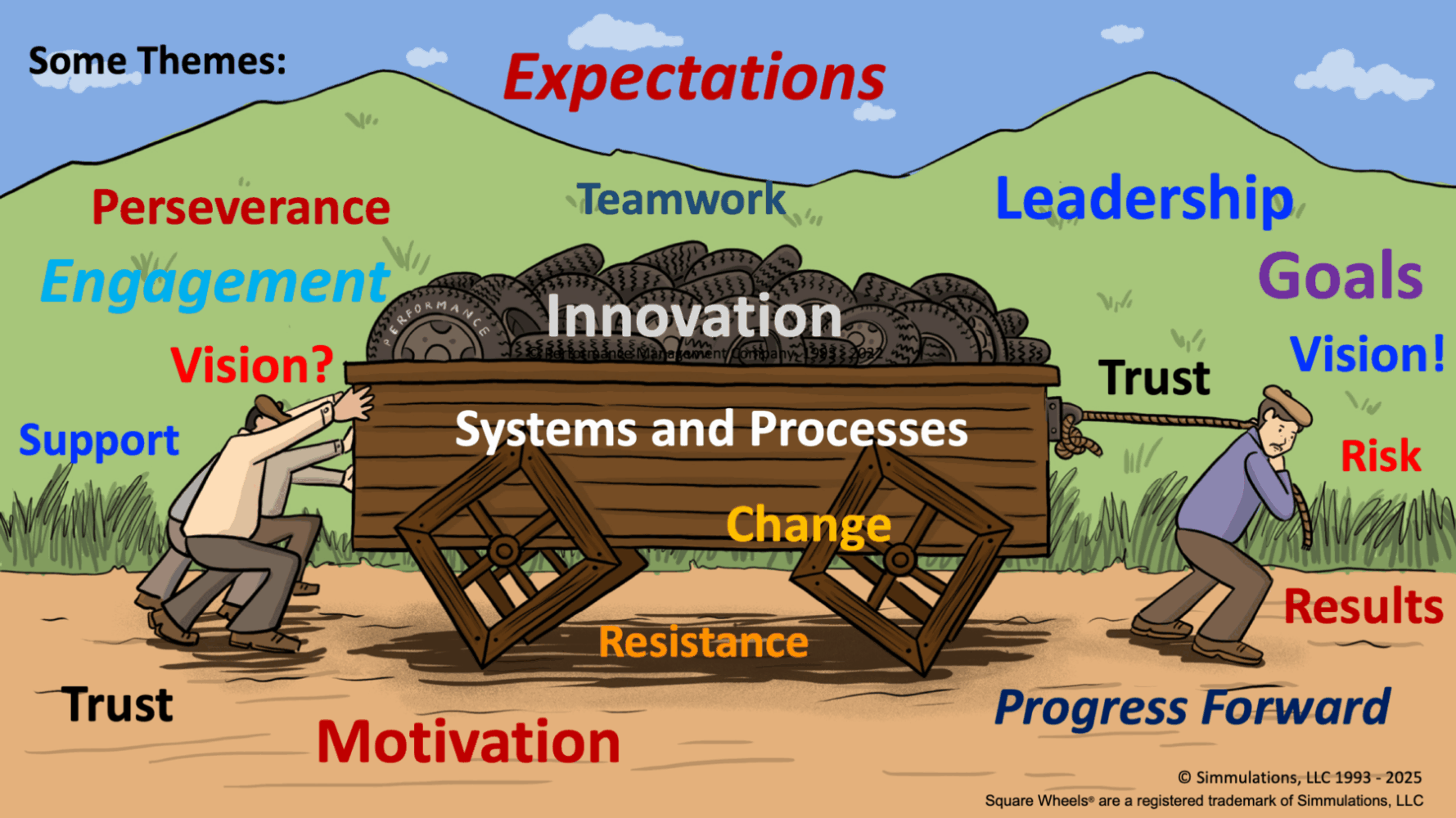
There are many different themes that open for discussion when using Square Wheels One. Get the image free by clicking here or on the image above.
As a supervisor, you can easily use this image in a meeting or meetings or even personal performance coaching to shift from fault-finding to joint problem-solving:
-
The wagon is the work at hand.
-
The Square Wheels® are the many systems, processes, policies, and habits that create drag and make the wagon harder to move.
-
The Round Wheels are the ideas your people already have but haven’t been asked to share. Generally, the improvement ideas already exist and are often the exemplary performers’ “best practices.”
Once people see the image, which they will never forget if they discuss it, you can ask three simple questions:
-
“Where are the Square Wheels around here?”
-
“What Round Wheels do you think we already have but aren’t using?”
-
“What is one small change we could try this week to make our journey smoother?” “What possibilities exist for us?”
These questions tell your team,
“Your experience and insight matter. You’re not the problem; you’re part of the solution.”
That single shift enables people more than any motivational speech.
What enabling workers looks like in practice
Enabling is not about giving people a pep talk and hoping they fly. It is about changing the conditions so that better performance becomes easier, safer, and more natural. For a supervisor, that can look like:
-
Making problems discussable. Use the Square Wheels image to make it safe to talk about what isn’t working without blaming anyone.
-
Inviting small experiments. Instead of demanding big, risky changes, ask for small Round Wheel ideas that can be tested in a day or a week.
-
Sharing control. Involve people in deciding which wheels to replace first and how to measure success.
-
Protecting the cocoon. When change feels awkward or slow, remind the team that discomfort is part of the Caterpillar–Butterfly process, not a sign of failure.
-
Celebrating the first flight. When a small improvement works, call it out, link it back to the team’s idea, and show how their “wingspan” is growing.
When supervisors behave this way, people stop waiting to be told what to do and start looking for better ways to move the cart. That is enabling.
Your next move as a supervisor
The use of this tool is NOT rocket surgery; it is surprisingly simple. You do not have to redesign the whole organization or even your whole workplace to begin to get better results. You can start with one conversation and one discussion about one issue.
Bring your team together, show them the Square Wheels One wagon, and say:
“Today is not about who’s pushing hard enough. It’s about finding the Square Wheels that make all of us work harder than we should and discovering the Round Wheels already in the wagon.”
In that moment, you’re no longer just a boss demanding more effort from tired caterpillars. You’re the leader who creates the conditions where butterflies can run faster and finally emerge and fly.
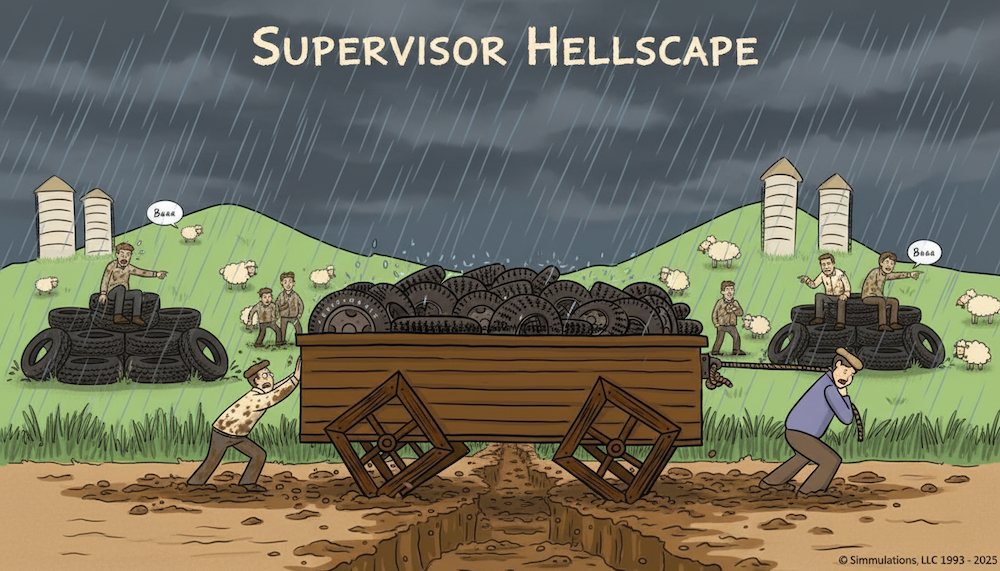
You can find an overview about the statistics on the Supervisor Hellscape by clicking on the image below
—
For the FUN of It!
 Dr. Scott Simmerman is a designer of team building games and organization improvement tools.
Managing Partner of Performance Management Company since 1984, he is an experienced presenter and consultant who is trying to retire!! He now lives in Cuenca, Ecuador.
You can reach Scott at scott@squarewheels.com
Learn more about Scott at his LinkedIn site.
Square Wheels® are a registered trademark of Simmulations, LLC
and images have been copyrighted since 1993,
© Simmulations, LLC 1993 – 2026
What I’m About:
My Square Wheels blog and website exist to help leaders, trainers, and facilitators make work smoother, more engaging, and more human. I focus on practical tools for process improvement, organizational change, and workplace collaboration that spark insight and deliver measurable results.
And I am convinced, after 30+ years of using Square Wheels®, that it is the best facilitation toolset in the world. One can use it to involve and engage people in designing workplace improvements and building engagement and collaboration. It is a unique metaphorical approach to performance improvement and we can easily license your organization to use these images and approaches.
By blending proven facilitation methods, creative problem-solving, and engaging team activities, my mission is to support organizations in building energized, sustainable cultures of involvement and innovation.
Through accessible — and often free — resources and virtual facilitation tools, I aim to help teams everywhere collaborate more effectively, innovate continuously, and take ownership of their improvement journey.
#SquareWheels #InnovationAtWork #TeamEngagement #FacilitationTools #supervisors #WorkplaceImprovement #EmployeeEngagement #CreativeProblemSolving #enablement #OrganizationalDevelopment #LeadershipTools #collaboration #leadership #motivation #communications #enablement #leadership #CreativeCommons #enablingperformance #teamwork


0 Comments