
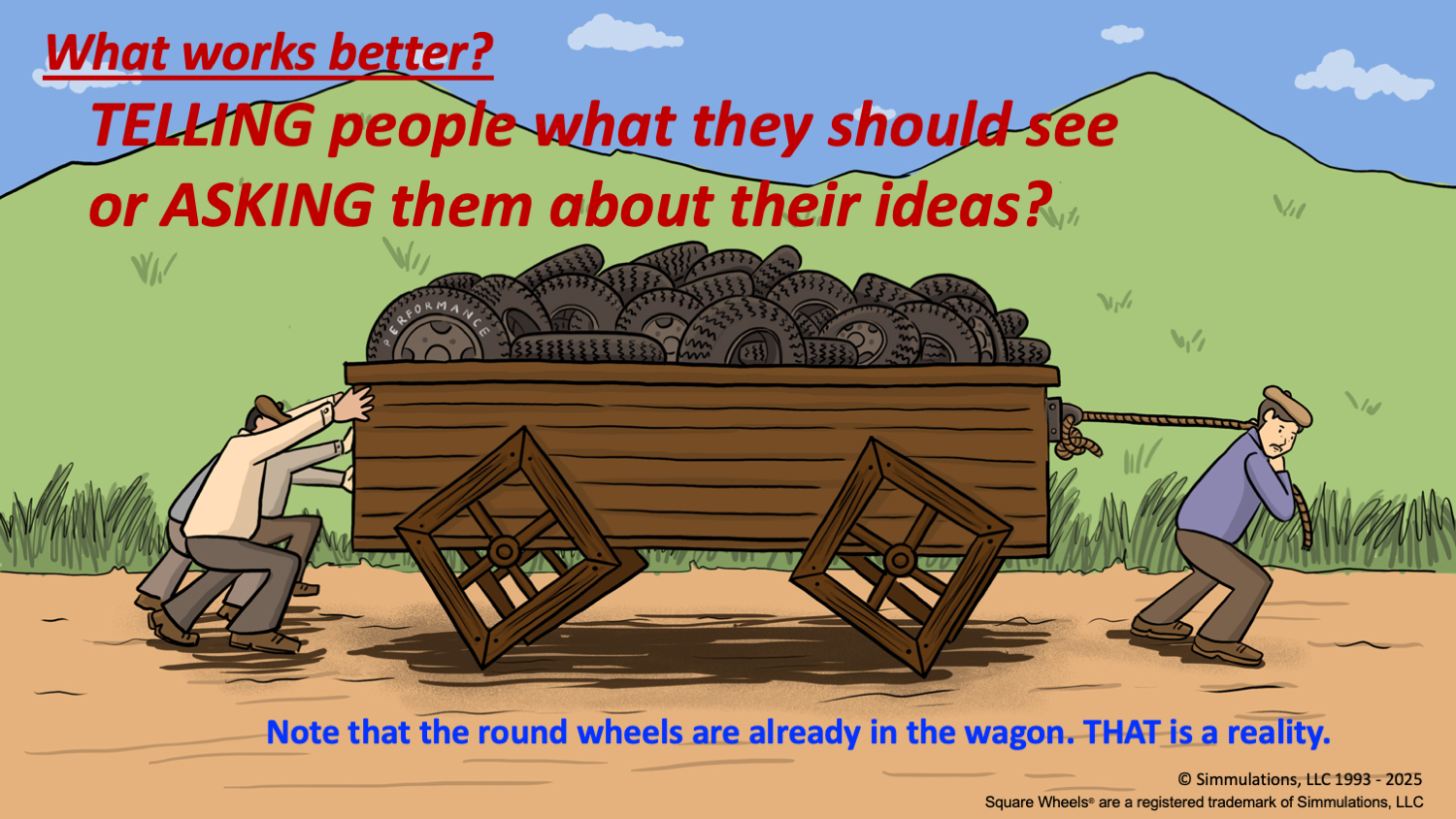
StoryAsking is better than StoryTelling because you actively involving others in developing their own ideas, doing things WITH them not TO them.
Storytelling is great! We all remember good stories. Storytelling captivates audiences in ways information alone cannot, making it a cornerstone for influential engaging leadership. Research shows it boosts engagement, trust, and retention far beyond facts or slides. Stories evoke emotions and activate mirror neurons, fostering empathy between leaders and teams. This humanizes leaders, revealing vulnerability and relatability that builds trust—essential for motivation and cohesion.
A Stanford study found stories are 22 times more memorable than facts, amplifying their persuasive power. Narratives make complex ideas relatable and sticky, helping teams grasp visions or changes easily. Journal of Marketing Research data indicates storytelling increases persuasion by up to 50% over data presentations. Leaders use it to illustrate values in action, strengthening culture and buy-in.
But what if there were something almost as easy as storytelling that is much better for generating active involvement and engagement and something that better enables change? Something that sticks far longer than a story, even?
ASKING for ideas is always better than TELLING people, right? Thus, my shift from one good thing to one great one insofar as impacting the workplace and generating active involvement.

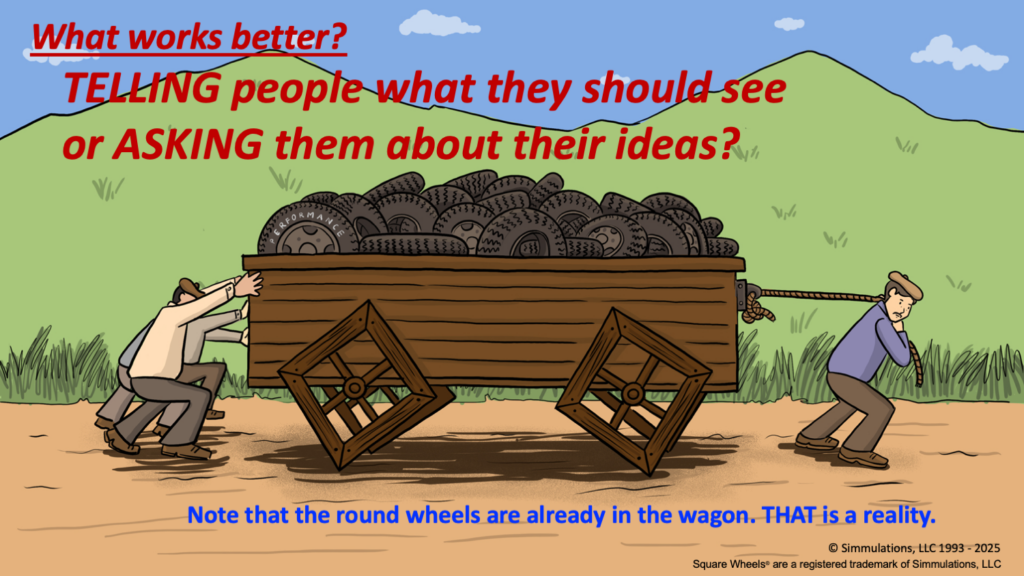
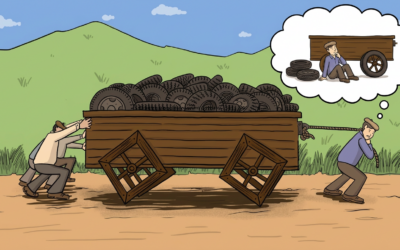
Anyone can facilitate discussions of the workplace Square Wheels – Round Wheels are already in the wagon!
Supervisors and managers do not need to be $500K “chief storytellers” with all the requisite storytelling skills; they benefit by being everyday Story Askers. In a world flooded with AI‑generated slop and generic corporate messages, the real advantage goes to the leader who can spark short, honest stories from their team about the flow of daily work.
Why StoryAsking Beats StoryTelling For Managers
Joe Lazer’s book,Super Skill shares many key points about how the storytelling economy is powerful because attention has become scarce, AI has made mediocre content worthless, and leaders are expected to communicate in ways that actually feel human. You may never apply for a $500K storytelling corporate job, but you face the same challenge every day in your huddles, one‑on‑ones, and project reviews: will people lean in, or tune out?
Traditional “manager as storyteller” training like Joe’s will push one to polish the narrative, tighten a slide deck, and explain the strategy better than before. That still matters, but it is not enough. Your people already live their own stories every day; what they need is a chance to tell you where it feels stuck, confusing, or inspiring. That is where StoryAsking comes in, especially when it is anchored in simple, provocative images.
Why Images Work So Well for Supervisors (and any manager focused on workplace stories)
You do not have time to script TED‑style talks for every meeting. Using an image like Square Wheels One does the heavy lifting by giving your team something concrete to react to, so you can ask instead of tell. They all have ideas and most have been disengaged, so generating active involvement has many side benefits.
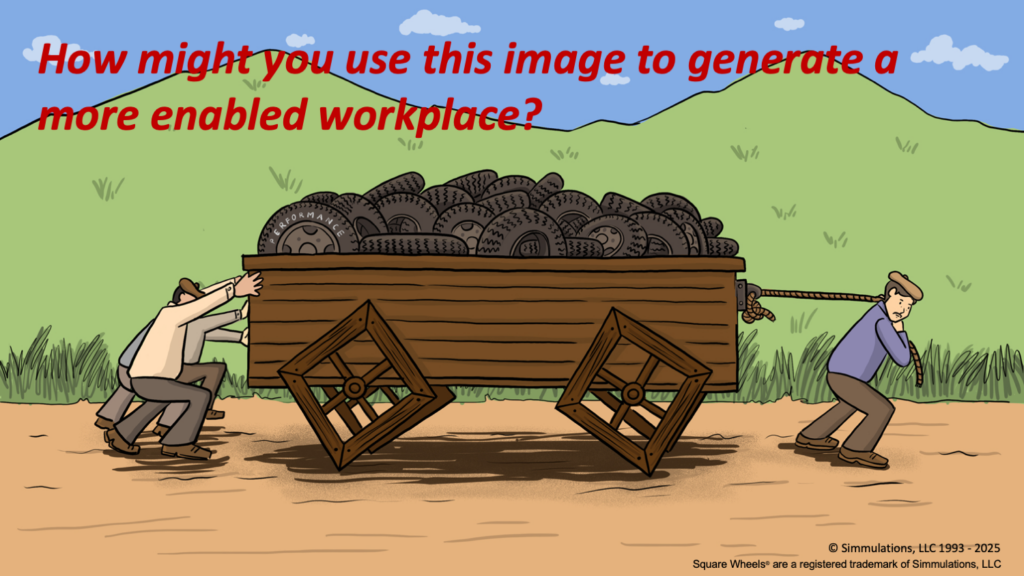
Your question to your people would be different; this one is for YOU!
Visuals like Square Wheels® One above help you:
-
Lower the bar to participation
People might freeze if you say, “Tell me a story about our culture.” But show them the wagon with Square Wheels and unused round wheels, and they immediately say, “That’s our onboarding,” or “This is how we collaborate with other departments.” or “That’s what it feels like when we roll out some new process.” -
Make tension discussable, not dangerous
Instead of blaming individuals, people can talk about “the wagon,” “the road,” or “the wheels.” That lets you surface friction, confusion, and overload without putting anyone on the defensive. -
Capture real, non‑AI language
When you ask, “Where are our Square Wheels this week?” you get vivid phrases and examples straight from your team, not generic corporate speak. That language becomes gold for your own communication and for your leaders’ storytelling.
In short: images turn abstract issues into something you and your team can literally point at and talk about.
The reality is straightforward — people all have experiences and perceptions and ideas and they are seldom asked in effective ways about what can be improved. They are seldom asked as a group and they are often TOLD what to think and what to do and so forth.
Facilitating a discussion about their perceptions for workplace improvement, without the yelling and telling and directing, is an amazingly powerful tool for generating active involvement and actual engagement.
Everyday StoryAsking Moves For Managers
Here is some simple stuff about how supervisors and managers can weave storyasking with images into everyday routines without adding more meetings or prep.
-
Daily or weekly huddles
-
Initially, in a 30 minute meeting, you would show Square Wheels One and discuss the image. (Get the real one for FREE with a free instructor’s guide.)
- Follow the free instructor’s guide for various ideas to anchor the image and the many workplace themes to their general reality and develop a shared language of performance improvement (see the free instructors guide.)
-
At points down the road, ask: “Point to the part of this picture that best represents our work this week. What happened that makes you say that?”
-
Let a few people share quick examples, then ask: “What is one ‘round wheel’ idea we can try before our next huddle?”
-
-
One‑on‑ones
-
Keep a copy of the image handy at your desk.
-
Show the image and ask: “If your week looked like this wagon, where are you pushing hardest? Where do you feel square wheels slowing you down?”
-
Follow up with: “What is one round wheel we could roll into place to make your work easier?”
-
-
Problem‑solving and retros
-
Open with: “Look at the image again and think about the issues and opportunities. Which part feels most like (this project) right now?”
-
Capture their words: “The wagon is overloaded,” “No one is steering,” “We have round wheels but they’re not on the wagon.”
-
Translate those phrases into concrete actions: rebalance workload, clarify ownership, remove a bottleneck.
-
-
Change or new initiatives
-
Before you explain a new plan, show the image.
-
Ask: “What square wheels are we hoping this change will fix? And where might we accidentally create new square wheels if we’re not careful?”
-
Use their answers to refine your rollout and communication.
-
The pattern is always the same: show the picture, ask a simple question, listen for stories, and then act.
And you can build out your narrative over time by using some of
our other images about workplace reality.

A Reusable Mini‑Script For Supervisors
If you want something you can literally use tomorrow, grab the free image and try this three‑step mini‑script in your next team meeting:
-
Frame it
“We are all drowning in information, so instead of another long explanation from me, I want to use this picture to talk about how work really feels for us.” -
Ask three questions
-
“Where in this picture do you see our team right now?”
-
“What is one real example from this week that fits what you see?”
-
“What is one round wheel idea we could try in the next seven days to make this picture a little better?”
-
-
Close the loop
-
“Let’s pick one round wheel we actually commit to before our next meeting.”
-
“Next time, we’ll come back to this image and see if our story has changed.”
-
You are not performing; you are facilitating. The stories come from them, the commitments are owned by them, and your credibility grows because you visibly listen and respond.
Building A Culture Of StoryAsking, One Manager At A Time
When supervisors and managers consistently use images and StoryAsking, three things start to shift:
-
Meetings feel safer and more honest, because people can raise problems through the metaphor rather than through blame. And you are asking and not telling.
-
You discover practical ideas and insights that never show up in dashboards or reports, because they live in people’s lived experience.
- You can reach their emotional reactions to work processes and practices allowing them to think about and discuss their feelings around change and motivation in a safe way. (I write more about that here.)
-
Engagement moves from a survey score to a daily habit of enablement: people see that their stories and suggestions actually shaping decisions and changes.
You do not need the title “storyteller” to play in this new StoryAsking economy. As a supervisor or manager, you are already the daily observer and narrator of your team’s experience. With a simple image and a few good questions, you turn that role from “chief explainer” into “chief story asker”—and that is where the real performance improvement leverage is.
Now that you can easily get this tool and you understand how simple this approach to facilitating active engagement really is, if you were to start using this approach in just one recurring conversation next week, would you choose your team huddle, your one‑on‑ones, or your project review meeting?
—
For the FUN of It!
 Dr. Scott Simmerman is a designer of team building games and organization improvement tools.
Managing Partner of Performance Management Company since 1984, he is an experienced presenter and consultant who is trying to retire!! He now lives in Cuenca, Ecuador.
You can reach Scott at scott@squarewheels.com
Learn more about Scott at his LinkedIn site.
Square Wheels® are a registered trademark of Simmulations, LLC
and images have been copyrighted since 1993,
© Simmulations, LLC 1993 – 2026
What I’m About:
My Square Wheels blog and website exist to help leaders, trainers, and facilitators make work smoother, more engaging, and more human. I focus on practical tools for process improvement, organizational change, and workplace collaboration that spark insight and deliver measurable results.
And I am convinced, after 30+ years of using Square Wheels®, that it is the best facilitation toolset in the world. One can use it to involve and engage people in designing workplace improvements and building engagement and collaboration. It is a unique metaphorical approach to performance improvement and we can easily license your organization to use these images and approaches.
By blending proven facilitation methods, creative problem-solving, and engaging team activities, my mission is to support organizations in building energized, sustainable cultures of involvement and innovation.
Through accessible — and often free — resources and virtual facilitation tools, I aim to help teams everywhere collaborate more effectively, innovate continuously, and take ownership of their improvement journey.
#SquareWheels #InnovationAtWork #TeamEngagement #FacilitationTools #WorkplaceImprovement #EmployeeEngagement #CreativeProblemSolving #OrganizationalDevelopment #LeadershipTools #collaboration #leadership #motivation #communications #enablement #leadership #CreativeCommons #enablingperformance #teamwork #storytelling #storyasking


0 Comments