
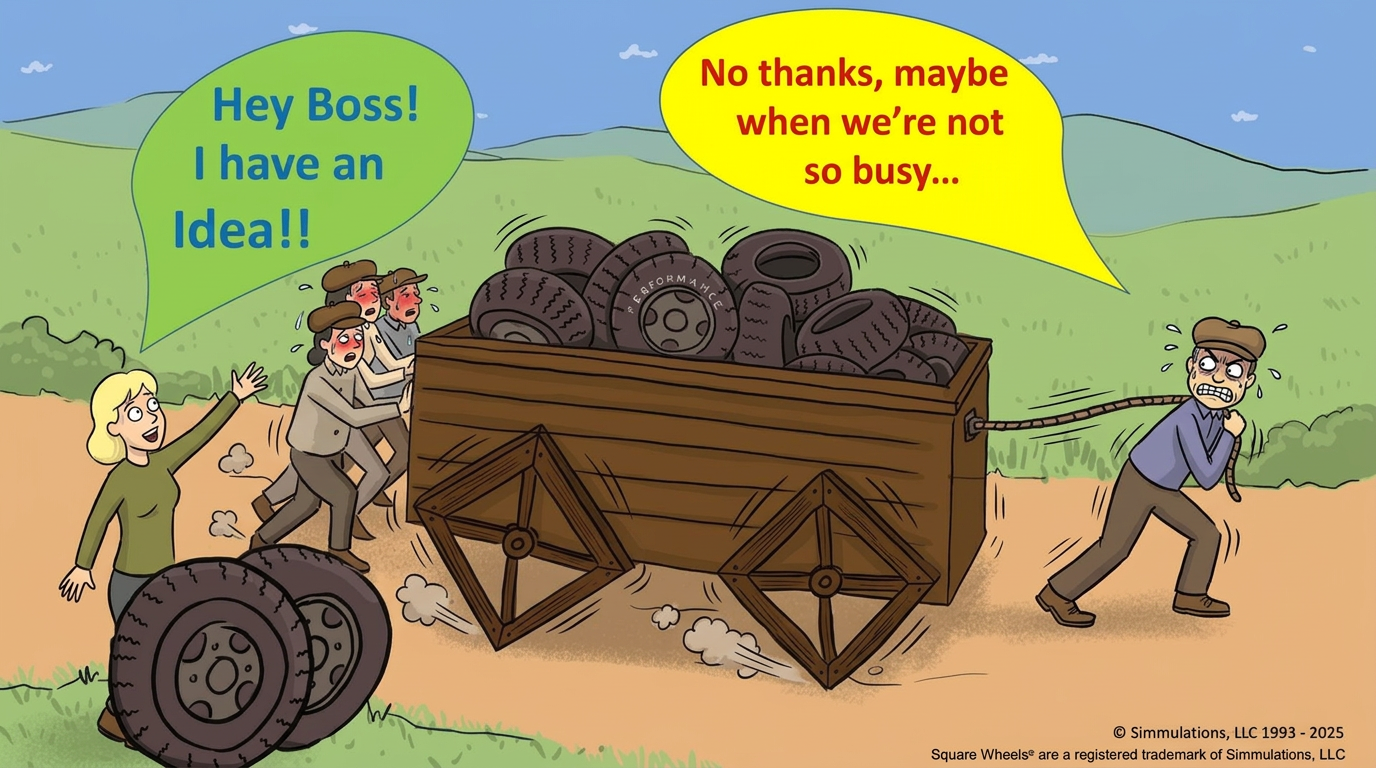
Emotional Metacognition: Using Square Wheels images and metaphors to enable and change how people feel, think, and act at work.
Most “organizational improvement” work focuses on what people should do differently. Far fewer conversations focus on what people are actually feeling and telling themselves in the middle of all that. That’s where emotional metacognition comes in: helping people notice not only how they think about work, but also how their emotions and inner stories shape their behavior. Square Wheels visual metaphors gives us a wonderfully simple tool to make all that visible, discussable, and actionable.
In earlier writing, I framed Square Wheels as a metacognitive engine – a way to help people think about their thinking and see “the way things really work” in a shared, non‑defensive way. In this piece, I want to extend that frame: Square Wheels is also a powerful tool for emotional metacognition, for helping people surface the feelings, narratives, and quiet frustrations that either fuel engagement or quietly kill it. When we surface emotions well, we don’t just get better ideas; we get more honest conversations and more sustainable commitments to change.
What Is Emotional Metacognition?
Metacognition is thinking about thinking – the ability to notice, monitor, and adjust your own mental processes. Emotional metacognition adds another layer: noticing the feelings, impulses, and stories that accompany those thoughts, especially in the heat of real work. It’s the moment when a manager can say to themselves, “I’m feeling frustrated and defensive right now; that’s making me shut down ideas,” instead of unconsciously shutting people down and calling it “being realistic.”
In an organizational development context, emotional metacognition sounds like:
-
“I notice that when senior leaders talk about change, I feel anxious and start assuming they don’t mean people like me.”
-
“When a process fails, I quickly jump to blame, which keeps me from looking at my own contribution.”
-
“I tell myself there’s no point in raising issues, so I stay quiet even when I see better ways.”
Those are not just thoughts; they are emotional positions – stances we take toward the work, toward each other, and toward ourselves. Emotional metacognition is the skill of seeing those positions clearly enough that we can choose something better.
Why Most Improvement Efforts Miss This
Organizations spend tens of billions each year on training, off‑sites, coaching, and “initiatives” meant to drive improvement and innovation. Too much of that energy ends up as what I call “Square Wheels theatre”: people attend a session, enjoy the day, agree with the content, and then quietly slip back into familiar routines. On paper, we know what needs to change. In practice, the old emotional patterns and stories keep running the show, day after day and year after year.
The reason is simple: most improvement programs treat people like rational problem‑solvers who just need better tools and clearer goals.
But people also bring fear, fatigue, hope, resentment, aspiration, and all the rest of the emotional mix to every conversation. When those emotional currents stay underground, they distort the thinking and the decision‑making. Emotional metacognition brings those currents to the surface in a way that is safe, structured, and productive.
Square Wheels – Reflection as an Emotional Mirror
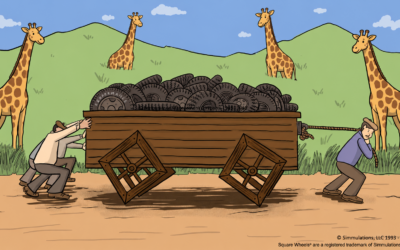
The classic Square Wheels One image below shows a wooden wagon rolling along on Square Wheels®, being pulled by a leader and pushed by the people at the back, with a cargo of round wheels sitting unused in the wagon. People immediately see the cognitive messages: things kind of work, but not very well; there are obvious improvements we are not using; people are working hard to maintain a sub‑optimal reality.
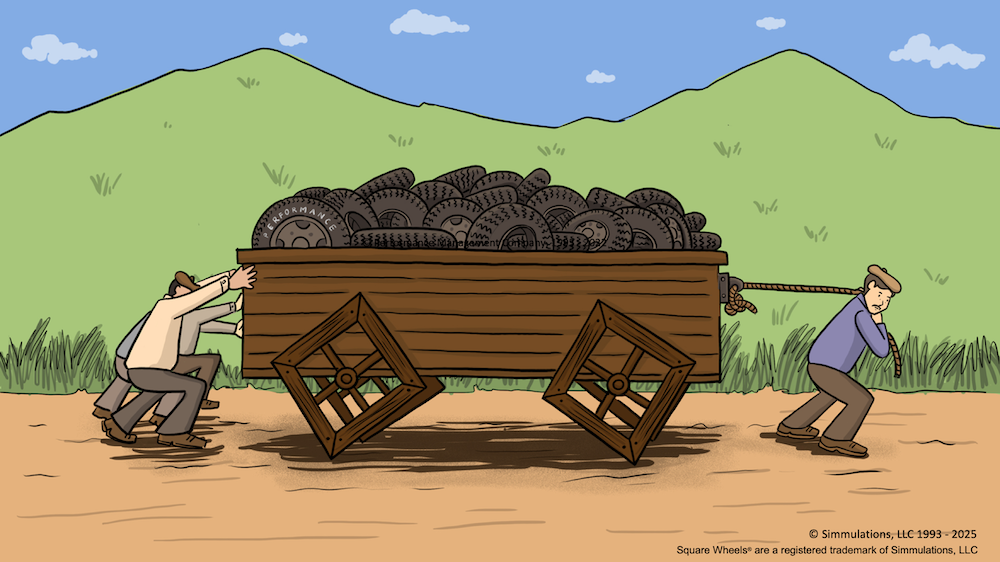
Look a little deeper, and you’ll see that the image also evokes a lot of emotion:
-
The person at the back, pushing hard against those Square Wheels, often feels tired, unheard, or resigned. Day after day.
-
The person at the front, pulling the wagon, can feel burdened, anxious, or isolated – responsible for “making it all work” without clear feedback on how to improve. They see themselves as too busy and too stressed to listen to ideas.
-
The round wheels inside the wagon can feel like the neglected ideas, the lost energy, or the hope people have stopped bringing to work.
When you put Square Wheels One in front of your people and ask about it, you don’t just get process descriptions. You get emotional truth: “I feel like the one pushing,” “I feel like I’m dragging people along,” “I feel like the round wheel that nobody uses.” The cartoon becomes a safe emotional mirror.
And, what manager has the time to deal with this stuff, anyway?
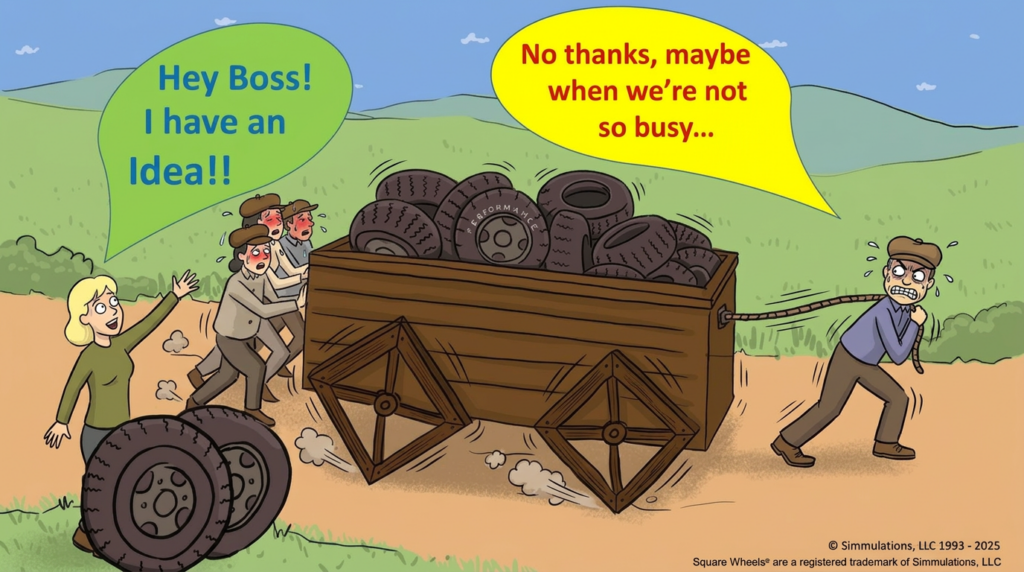
Facilitating Emotional Metacognition with Square Wheels
To use Square Wheels as an emotional metacognition tool, you keep the same basic structure as a good improvement session – but you slightly shift your questions and your stance.
1. Start with the SWs One image, not the participants.
Introduce the Square Wheels image without explanation. Ask open, low‑risk questions such as:
-
“How might this represent how things work in most organizations?”
Let people project their own experience onto the image. Because “it’s just a cartoon,” they will often reveal more than they would if you asked, “How do you feel about your job?”
2. Then invite emotional language
Once people are describing the wagon and the systems and processes and other functional frameworks, gently pivot toward feeling words:
-
“If you were the person pushing, how might you be feeling?”
-
“If you were the person pulling, what emotions might you be carrying?”
-
“How did you feel when you noticed the round wheels as improvement opportunities? Did you relate the image to our workplace?”
You’re not asking anyone to confess their deepest secrets. You’re simply giving people permission to connect feelings to their thinking. That’s the move that often unlocks richer, more honest dialogue.
3. Connect the metaphor back to reality of work
Next, bridge from the metaphor into the workplace:
-
“Where, in our work, do you feel like you’re pushing a square‑wheeled wagon?”
-
“When do you notice yourself emotionally checking out, going onto autopilot?”
-
“Where do you feel excited or hopeful, like a round wheel that’s ready to roll?”
Here you are guiding emotional metacognition: you are asking people to notice what situations trigger certain feelings and stories, and how those internal reactions shape their choices. You are generally asking them to “think different.”
Forever, I have always focused discussions on the pragmatic, realistic, non-emotional kinds of questions, even though I had my own emotional reactions to the content of the sessions. I was choosing not to present the “soft stuff” in my “seriously hard” presentations to senior managers. I never felt that we had the time to focus on feelings and address that aspect of managing and leading change, hoping that the cognitive work would sufficient. You will see that in most of my writings, even though all of my personal decisions anchored to how I felt about things. Go figure.
4. Normalize and de‑personalize
One of the biggest risks in emotional work is shame or defensiveness. A key part of your facilitation is normalizing what emerges:
-
“It’s completely human to feel frustrated when you’re pushing this hard.”
-
“A lot of leaders feel torn between the pressure from above and the needs of their teams.”
By framing emotions as normal and expected, you keep the focus on learning and choice, rather than on blame.
From Emotional Awareness to Action: Round Wheels for the Inner Game
Emotional metacognition isn’t just about naming feelings; it’s about using that awareness to choose better actions. This is where the Round Wheels come back in as a practical, hopeful language.
You can ask:
-
“What emotional ‘Square Wheels’ make it harder for you to engage in improvement?”
-
“What ‘Round Wheels’ – new beliefs, habits, or supports – would make it easier?”
Examples might include:
-
Reframing “They won’t listen” into “I can choose how clearly and constructively I raise issues.”
-
Replacing “I’m on my own” with “I can ask for help or find allies who share this concern.”
-
Shifting from “I have to have all the answers” to “I can facilitate the group to find better answers.”
These are internal round wheels: better ways of thinking and feeling that unlock more productive behavior.
The round wheels are already in the wagon.
A powerful next step is to turn these insights into small, testable experiments:
-
“For the next two weeks, when I feel myself shutting down in a meeting, I’ll name that to myself and ask one curious question instead of going quiet.”
-
“When I’m frustrated with a process, I’ll dialog about the Square Wheels and Round Wheels with my team instead of venting alone.”
By keeping the experiments small and specific, you make it easier for people to practice new emotional and cognitive habits without needing to “change everything” at once.
Emotional Metacognition for Leaders and Facilitators
For leaders and professional facilitators, emotional metacognition is both a personal discipline and a design principle.
Personally, it means noticing your own patterns and our behaviors:
-
When a session gets tense, do you become more controlling or more curious?
-
When senior leaders push back, do you feel intimidated, angry, or energized? Do you choose to get defensive? Do you just give up?
-
How do your own emotions show up in your voice, your body language, your questions during your normal routines?
The more clearly you can see your own inner Square Wheels, the more credible you are in helping others with theirs.
As a design principle, emotional metacognition means building reflection points into your meetings, not just content blocks. With Square Wheels, you might:
-
Add a round of “What were you feeling as you reacted to this image?” after the initial debrief.
-
Include a quiet individual reflection where people write down one emotional pattern that holds them back at work and one Round Wheel they want to try to move forward.
-
Close by asking, “What will you pay more attention to in your own reactions over the next month?”
These small design choices turn a standard improvement workshop into a developmental experience.
Why This Matters for Engagement and Change
When people feel that their inner experience is seen and respected – not just their output – their willingness to engage goes up dramatically. Emotional metacognition sends a powerful message: “We are interested in how this really feels for you, and we believe you have the capacity to notice and shift your own patterns.” That message alone is a Round Wheel to help improve how things work in our Square Wheels world of managing and leading people.
In practical terms, organizations that build this kind of capability see:
-
More honest conversations about what is and is not working.
-
Faster surfacing of hidden resistance or fear before it derails initiatives.
-
Stronger personal ownership of both the problems and the solutions.
Michael Beer’s Strategic Fitness Process (SFP), used in over 800 organizations, enables “raw but necessary truth” from employees, leading to dramatic performance turnarounds like regained employee commitment and interest from other divisions. Google’s Project Aristotle found teams with high psychological safety — where honest input is safe — report 19% higher productivity and 31% more innovation, for example.
Psychological safety allows teams to voice fears and resistance without retribution, preventing groupthink and derailing changes; change leaders using this see refined strategies and resilience during disruptions. In Project Aristotle teams, this surfacing of concerns correlated with 27% lower turnover and faster project completion by 32% after interventions.
Honest dialogue fosters ownership, as seen in Lencioni’s model where healthy conflict builds commitment to decisions, even from dissenters, creating clarity and progress without ambiguity. Employee ownership studies show firms with shared stakes have 24-29% higher survival rates tied to stable employment and problem-solving engagement. SFP task forces confirm redesigns, generating collective buy-in for solutions.
Square Wheels gives you a simple, memorable way to keep that work anchored in a shared image and language. People can say, “I’m in a square‑wheel mindset right now,” or “We’ve got a round wheel we’re not using yet,” and everyone knows that includes both emotional and process realities.
Bringing Emotional Metacognition into Your Next Session
You do not need a three‑day retreat to bring emotional metacognition into your practice. With a single Square Wheels One image (available free) and a handful of well‑timed questions, you can start shifting how people see themselves and each other at work.
In your next meeting or workshop:
-
Show the Square Wheels One wagon and ask what people see.
-
Invite them to name how different roles in the image might feel.
-
Connect the conversation to real situations where they feel like they’re pushing or pulling that wagon.
-
Ask them to identify one emotional Square Wheel pattern and one Round Wheel they will experiment with over the next few weeks.
Then, follow up. Bring the image back. Ask what changed. Celebrate even small shifts in how people talk about their own reactions and choices.
If your organization is serious about improvement and innovation, don’t just change the tools and structures. Start by helping people see the wagon they’re pulling on the inside: the feelings, stories, and habits that make those Square Wheels feel inevitable.
A simple Square Wheels One image, used with emotional metacognition in mind, can unlock not only better ideas – but better, more human ways of working together.
—
For the FUN of It!
 Dr. Scott Simmerman is a designer of team building games and organization improvement tools.
Managing Partner of Performance Management Company since 1984, he is an experienced presenter and consultant who is trying to retire!! He now lives in Cuenca, Ecuador.
You can reach Scott at scott@squarewheels.com
Learn more about Scott at his LinkedIn site.
Square Wheels® are a registered trademark of Simmulations, LLC
and images have been copyrighted since 1993,
© Simmulations, LLC 1993 – 2026
What I’m About:
My Square Wheels blog and website exist to help leaders, trainers, and facilitators make work smoother, more engaging, and more human. I focus on practical tools for process improvement, organizational change, and workplace collaboration that spark insight and deliver measurable results.
And I am convinced, after 30+ years of using Square Wheels®, that it is the best facilitation toolset in the world. One can use it to involve and engage people in designing workplace improvements and building engagement and collaboration. It is a unique metaphorical approach to performance improvement and we can easily license your organization to use these images and approaches.
By blending proven facilitation methods, creative problem-solving, and engaging team activities, my mission is to support organizations in building energized, sustainable cultures of involvement and innovation.
Through accessible — and often free — resources and virtual facilitation tools, I aim to help teams everywhere collaborate more effectively, innovate continuously, and take ownership of their improvement journey.
#SquareWheels #InnovationAtWork #TeamEngagement #FacilitationTools #WorkplaceImprovement #EmployeeEngagement #CreativeProblemSolving #OrganizationalDevelopment #LeadershipTools #collaboration #leadership #motivation #communications #enablement #leadership #CreativeCommons #enablingperformance #teamwork

0 Comments