
“Dealing with Stupid” is the main idea in this performance improvement framework, which shares ideas for supervisors to improve performance.
This is not about stupid people but about what “stupid” means when it comes to organizational behavior and management. It is actually about “more smarter” than anything else. It is about DOING things.
What Actually IS “Stupid?” It is a behavior.
Carlo Cipolla defined a stupid act as one that causes losses to others without any benefit to the actor and sometimes at a cost to them as well.
Stupidity is an action defined by its implications.
Carlo Cipolla was an Italian economic historian (1922–2000), best known for his satirical‑analytic essay, “The Basic Laws of Human Stupidity,”
Stupidity is not about IQ or personality; it is about the negative impacts of actions and decisions. Cipolla’s research suggests that we routinely underestimate how many stupid actions are in circulation and that anyone, regardless of role or intelligence, can act stupidly.
Supervisors don’t usually suffer from low intelligence; they suffer from systems and processes that quietly normalize stupid behavior — actions that hurt everyone without helping anyone — and give them no safe way to challenge.
Most front-line supervisors are living in a muddy, grinding paradox or what I call a Hellscape. They are told to be culture carriers, engagement champions, and continuous-improvement leaders, yet their day is a blur of reports, firefighting, and “urgent” meetings that make real leadership feel structurally impossible. They own results, but not the systems that produce those results; they are accountable for engagement, but inherit processes built with Square Wheels®.
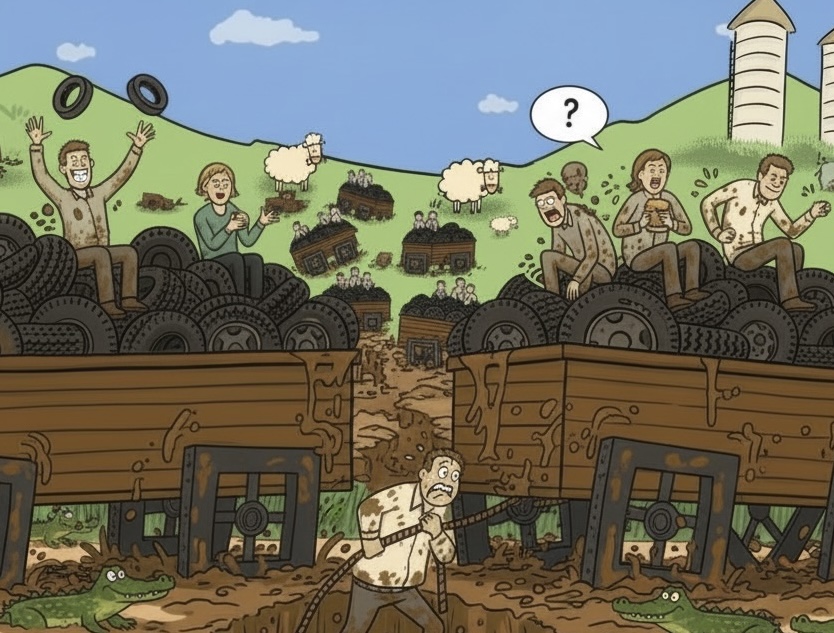
Within that reality, another speech about “being more positive” feels like grinding paste. What supervisors actually need is a simple, visual way to make the real work discussable, reduce defensiveness, and get people actively involved in the wagon improvement, together. That is precisely where the Square Wheels images come in.
Square Wheels images give supervisors a simple, visual way to
surface and reduce “institutional stupidity” by involving their
people in finding and installing better wheels.
Cipolla’s insight is brutally simple: stupidity is not about low IQ but about behaviors that create losses for others without any real gain for anyone, sometimes not even the person acting. In many organizations, supervisors are trapped in systems that quietly normalize exactly that kind of behavior and then get blamed when performance and engagement suffer.
The challenge is not to “motivate harder” inside those systems, but to make stupid behaviors visible, discussable, and replaceable with smarter ways of working. Square Wheels images give supervisors a practical way to do that.
Cipolla’s “Golden Law” claims we underestimate how many stupid actions are in circulation and how much damage they cause. In workplaces, those actions show up as policies that slow everyone down while helping no one, mandatory reports no one reads, meetings that produce no decisions, or metrics that push people to hit numbers in ways that hurt quality and trust.
The above are the organizational equivalent of moving a Square Wheels wagon uphill in the mud full of alligators. The workplace is technically functional, but needlessly painful and wasteful. Supervisors find themselves enforcing these patterns, even when they know they make no sense, because “that’s the way we do it here” and because their own performance is tied to compliance and metrics. Over time, everyone become reluctant agents of stupidity, protecting and perpetuating behaviors that harm customers, employees, and results.
Square Wheels reframes that whole situation. In the core image below, we see a loaded wagon loaded, rolling on wooden Square Wheels (often through the mud), pushed by people at the back and pulled by a leader up front. Ironically, unused Round Wheels are already in the wagon. And the ideas for possible improvement are easy to generate.
The first Square Wheel is actually not knowing
that there ARE Square Wheels!
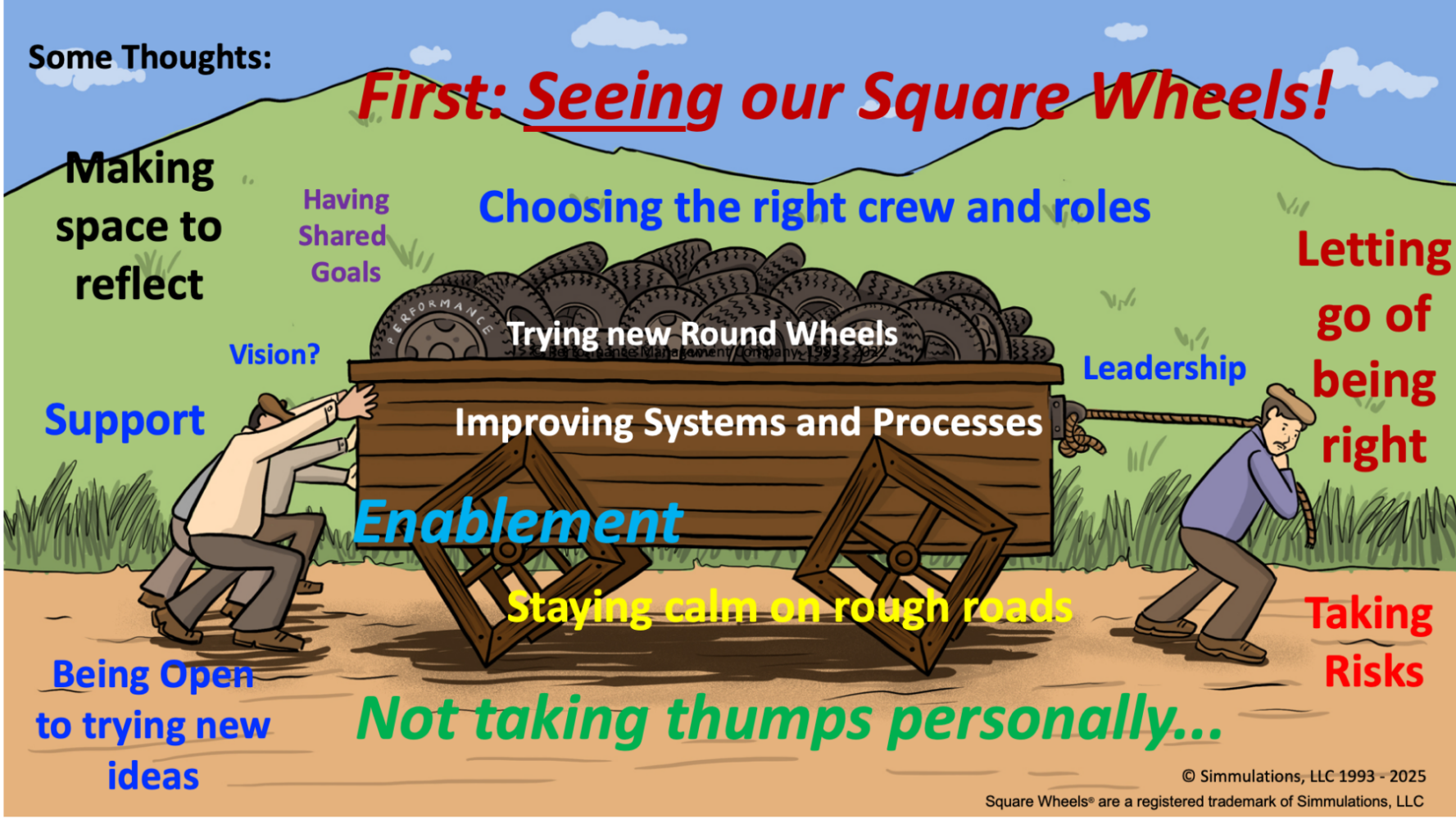
The Square Wheels One wagon — with some simple added thoughts that are generated
The image above captures the central paradox:
the people are not stupid; the wheels are.
It is simply STUPID to use the Square Wheels!
The problem is not a lack of effort, but the persistence of clunky processes, rules, and habits that nobody has stopped long enough to challenge or change. For a supervisor, showing SWs One to their team is a way of saying, “Our daily frustration is not about you or me, it’s about how the work is set up—and that is what we can improve together.”
Anchoring the conversation in Cipolla’s definition and my Square Wheels image allows a supervisor to tackle stupid behaviors directly, but safely. Instead of accusing someone of being stupid, the supervisor can ask, “Where do we see actions in our work that clearly make things worse for customers and for us, without any real benefit?”
Team members will point to specific forms, approvals, handoffs, or rituals that fit that definition, and those become the “Square Wheels” on the wagon. Because the conversation is about wheels rather than people, it reduces defensiveness and encourages candor: people are more willing to admit they spend time on pointless reports if the shared goal is to remove the stupidity from the system, not to blame individuals.
From there, the supervisor can guide the group into exploring alternatives. Cipolla’s framework includes not just stupidity but also intelligent actions (which help both the actor and others), helpless actions (which help others but hurt the actor), and bandit actions (which benefit the actor at others’ expense).
That categorization becomes a lens: the team can inspect their routines and ask, “Which of our behaviors clearly land in the stupid quadrant—everybody loses?” Once a few obvious examples are on the table, the supervisor can pose a, “What could we do differently?” question: “If we replaced this stupid behavior with a small Round Wheel—some simpler step, clearer rule, or shorter path—what might that look like?” The goal is not a grand redesign, but a series of concrete, modest changes that reduces loss and increases mutual benefit.
The power of the Square Wheels idea is that
it encourages collaborative practical imagination.
People can see the Round Wheels right there next to their wagons, representing better ideas and practices that are already possible, just not yet in use. That helps shift the conversation from complaining to designing: instead of dwelling on how bad the bumps feel, the group starts sketching round wheels they could actually install. For example, if they identify a weekly “check-in” meeting that accomplishes nothing and drains energy, they might agree either to eliminate it, replace it with a brief stand‑up focused on decisions, or move the discussion into an asynchronous channel.
In Cipolla’s terms, they are converting a stupid behavior (everyone loses time and attention; no one truly benefits) into an intelligent one (better communication and decisions with less waste).
Supervisors can then use the same imagery to manage up, not just down. When systemic stupid behaviors are larger than a team can change alone—like an overengineered approval process or a counterproductive metric—the supervisor can bring the Square Wheels picture and specific examples to senior leaders. Framed this way, the message is not “your decision was stupid,” but “here is how this rule currently functions as a Square Wheel: it generates losses for customers, staff, and outcomes, without meaningful benefit to anyone.”
They can add, “Here are the Round Wheel alternatives my team suggests and, where possible, early evidence from small tests we’ve run.” This shifts the conversation from personal criticism to joint problem solving and makes it easier for leaders to recognize and correct institutionalized stupidity.
What changes, practically, when supervisors consistently work this way is a subtle but significant shift in culture. Instead of normalizing stupid behaviors because “that’s just how it is,” the team normalizes noticing and challenging them. Instead of interpreting friction and frustration as personal failures, people see them as signals that a Square Wheel needs attention.
The supervisor stops being merely the enforcer of harmful routines and becomes a facilitator of better wheels, someone whose legitimacy rests not just on positional authority but on their willingness to reduce pointless losses in everyday work. Over time, this reduces cynicism and builds a sense of shared agency: people experience that they can do something different—and better—about stupidity in the system. These conversations do so many more positive things, too.
Cipolla warns that stupid actions are uniquely dangerous
because we underestimate them; they show up everywhere,
at every level, and their damage compounds.
Square Wheels gives front-line supervisors a concrete way to see those actions in their own context, to give people language and pictures to talk about them, and to design smarter alternatives together. That combination—clear definition, honest diagnosis, and visual tools for redesign—is what turns an abstract philosophy of stupidity into practical, day‑to‑day performance improvement.
—
For the FUN of It!
 Dr. Scott Simmerman is a designer of team building games and organization improvement tools.
Managing Partner of Performance Management Company since 1984, he is an experienced presenter and consultant who is trying to retire!! He now lives in Cuenca, Ecuador.
You can reach Scott at scott@squarewheels.com
Learn more about Scott at his LinkedIn site.
Square Wheels® are a registered trademark of Simmulations, LLC
and images have been copyrighted since 1993,
© Simmulations, LLC 1993 – 2026
What I’m About:
My Square Wheels blog and website exist to help leaders, trainers, and facilitators make work smoother, more engaging, and more human. I focus on practical tools for process improvement, organizational change, and workplace collaboration that spark insight and deliver measurable results.
And I am convinced, after 30+ years of using Square Wheels®, that it is the best facilitation toolset in the world. One can use it to involve and engage people in designing workplace improvements and building engagement and collaboration. It is a unique metaphorical approach to performance improvement and we can easily license your organization to use these images and approaches.
By blending proven facilitation methods, creative problem-solving, and engaging team activities, my mission is to support organizations in building energized, sustainable cultures of involvement and innovation.
Through accessible — and often free — resources and virtual facilitation tools, I aim to help teams everywhere collaborate more effectively, innovate continuously, and take ownership of their improvement journey.
#SquareWheels #InnovationAtWork #TeamEngagement #FacilitationTools #WorkplaceImprovement #EmployeeEngagement #CreativeProblemSolving #OrganizationalDevelopment #LeadershipTools #collaboration #leadership #motivation #communications #enablement #leadership #CreativeCommons #enablingperformance #teamwork #stupid #supervisors #innovation


0 Comments