
I wanted to build on a coaching model with a Better Actionable Model for Improving Sales Performance in the hopes of having bigger impacts on people and performance.
Many coaching models are like great cookbooks: full of solid recipes that sound good when reading the page, but somehow never quite making it to the table hot and tasty. My mom probably had 100 or more cook books on a shelf in a closet; they just sat there as she just cooked what she had practiced. I kept some of them after she died and I kept them on MY shelf in a closet. I remember reading one about desserts but never experienced any of them.
I like Tim Hagan and The Coaching School’s cooking metaphor that he explains within his model of sales coaching in some detail. It reminds leaders that when the “dish” isn’t turning out, the answer isn’t to blame the oven or yell at the chef to “cook harder.” The answer is to examine the ingredients and the recipe. That works for me. That is good stuff that is memorable.
But there’s a twist here. My issue is that “cooking” isn’t a metaphor that I really personally identify with, since I don’t really like to cook (while I can; my chemistry background comes in handy!) so the metaphor is not involving and engaging me on any level but “indifference.” It is cognitive in nature and not engaging or enabling for me. Being a better cook is not one of my desired outcomes, even though I intellectually understand the process. Why not use a metaphor that is more engaging?
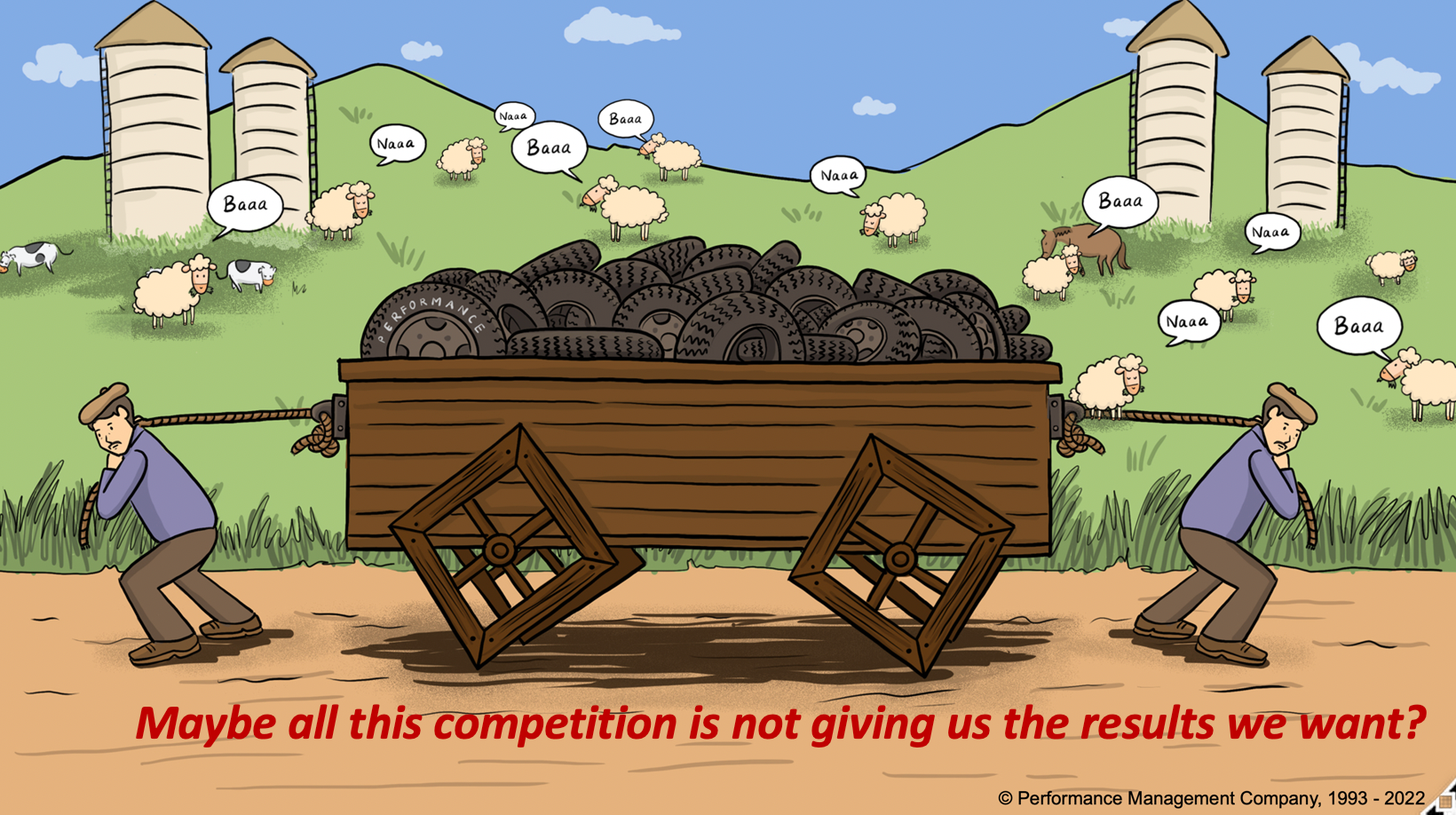
When it comes to engagement, personal growth, and real behavior change, visual metaphors like Square Wheels®, round wheels in the wagon, mud, spectator sheep, and silos are obviously more memorable, more discussable, and far more actionable than even the best verbal recipes. People don’t just hear them; they see themselves in the picture. And once they see themselves, they can start redesigning how they think about working and possibilities for improvement.
Let’s connect the dots.
Here is an image that we can anchor to for generating discussions around issues and opportunities:

From Recipes To Thumping and Bumping Wagons
The Coaching School frame says: every challenge needs the right combination of coaching ingredients, including peer coaching, group coaching, supplemental ideas, and Learning Projects that push people to apply what they’re learning in real work. Application is the key.
That’s powerful. But in a busy workplace, language alone tends to evaporate. People remember that they “should do more peer coaching” the same way they remember they “should eat more vegetables.” The words have very little “stick” and there is no somatic or kinesthetic anchor to make them memorable. Under my TV, I have a sign, “Eat Less, Exercise More” that I find way too easy to ignore. Words alone don’t do it.
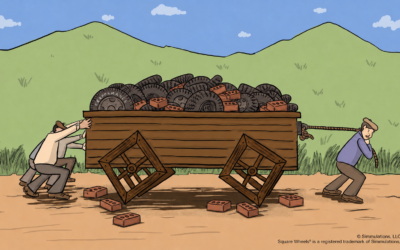
Square Wheels gives them a mental picture instead of an abstract instruction. Imagine discussing the Square Wheels® One wagon below and use it to get possibilities rolling:
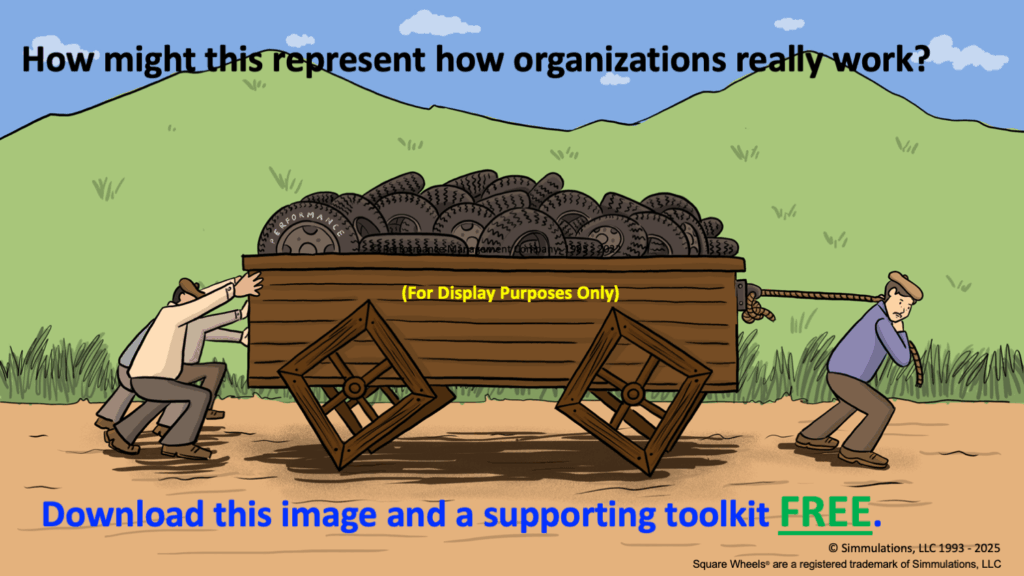
Download the FREE Square Wheels® One image and instructor’s guide under a Creative Commons BY-ND license allowing its use.
-
It’s rolling on wooden Square Wheels that work but that thump and bump inefficiently.
-
There are perfectly good round wheels already in the back of the wagon, unused.
-
The wagon is heavy. The road is bumpy. The team is straining to pull and push.
When you show that wagon to a group and simply ask, “How might this reflect how we sell or work together today?” they immediately begin cooking up their own meanings:
-
“We’re working way too hard with outdated methods.”
-
“We have tools and ideas we never use.”
- “There are better ways to do things already existing in the wagon.”
-
“Leadership keeps us on this rough path, even though we can see a better road.”
Now the conversation is no longer about a generic coaching model. It’s about their wagon, their path, and their Round Wheels waiting to be used. That’s far stickier than a list of coaching ingredients.
Why Pictures Beat Pressure
Most performance conversations, especially with struggling sales teams, lean heavily on pressure and platitudes:
-
“We need more pipeline.”
-
“You’ve got to push harder.”
-
“Just make more calls.”
Everyone nods. No one changes.
Square Wheels turns that lecture into a mirror. You don’t have to tell people they’re stuck; they can see it. You don’t have to insist they need to change the recipe; they can point out the Square Wheels themselves. And they have different round wheel ideas that they can share, best practices that work to positively impact performance.
The advantages of using such an image and approach are real:
-
It’s safer. People can talk about the picture instead of defending themselves. “Our wagon is stuck in the mud” lands very differently than “You’re not performing.” “We’re pushing our wagon uphill,” lends itself to discussing better practices.
-
It’s shared. The whole team is looking at the same wagon, on the same road, with the same round wheels in the wagon. It creates a common language for continuous improvement.
-
It’s sticky. Months later, they still remember “the wagon with the Square Wheels” and use that phrase to flag issues and opportunities.
Leaders often underestimate how much courage it takes for people to admit where they’re struggling. A cartoon wagon makes that admission easier. Once they’re talking honestly, coaching can finally get traction.

Why is that one wagon on the top right flying? They are doing things differently.
The Mud, The Sheep, And The Silos
The basic Square Wheels image is just the start. Over time, the metaphor evolved: mud, spectator sheep, silos, and other elements add nuance to the story of how organizations actually roll. Each becomes a topic for discussion and for generating different ideas for improvement and different emotional reactions.
Each piece fills a gap that traditional coaching language often misses.
Mud: The invisible friction
Mud is what people experience as “the way things are around here”:
-
Outdated systems that slow everyone down.
-
Policies that add steps without adding value.
-
Politics that bog decisions in approval loops.
You can be brilliant, motivated, and well-trained—and still stuck in mud. When that happens, more “motivation” feels insulting. You don’t need someone to tell you to pull harder. You need someone to help you get out of the ditch and up on the road, helping you move your wagon back onto firmer and level ground.
In a Square Wheels conversation, people can point to the mud and say the obvious:
-
“This reporting tool is a Square Wheel.”
-
“Our pricing approvals are a swamp.”
-
“We lose a week every time we need legal signoff.”
That’s a different coaching agenda than “be more enthusiastic.” Now you’re co‑designing Round Wheels at the system level, not just asking individuals to cope. You are permitting teams of people to share the perceived issues and discuss possible alternatives. It is also often the case that an exemplary performer can share their tips on what they choose to do differently. These Best Practices can be thought of as round wheels already in the wagon.
Spectator Sheep: The disengaged observers
Then there are those Spectator Sheep, those characters standing off to the side of the wagon, watching but not helping but also generally voicing their opinions about things: Naaaaaaa Baaaaa. They are the embodiment of disengagement and learned helplessness.
When people look at the image with these sheep, they often say:
-
“That’s upper management.”
-
“That’s us when we’ve given up on speaking up.”
-
“That’s the rest of the organization watching sales struggle.”
Suddenly you have ways to explore:
-
Where people feel like spectators instead of contributors.
-
How often ideas are perceived to be ignored or even punished.
-
Why some folks hesitate to grab a Round Wheel even when they see it as a possibility.
Just as importantly, you can talk about how to invite and enable spectator sheep in:
-
“What would it take to enable them to help us move the wagon?”
-
“What would make it safe for them to call out a better route?”
That’s not a conversation most teams have spontaneously in a standard coaching session.
The image and metaphor absolutely unlocks it. And understand that Spectator Sheep have a different and often more objective perspective on things. They are NOT close to the wagon and they are not actively involved, although they can choose to be. The outsider perspective on things can be really useful. I’ve got the stories to tell about some of their very unique perspectives on choosing to do things differently.
Silos: Separate groups on separate roads moving separately
Silos show up in your Square Wheels World as other wagons, other roads, or literal walls between different groups. They can be anywhere and they can be everywhere in the more dysfunctional workplaces. The sales wagon struggles on one path while marketing, operations, and services roll on entirely different ones. Should they be working together collectively? Absolutely. But they often don’t. And are we having useful discussions around making improvements? We can!
Interdepartmental Collaboration is an excellent example
of that organizational oxymoron called a silo.

People quickly recognize:
-
“We’re pushing or pulling in opposite directions.”
-
“Their Round Wheel is our Square Wheel, and we never talk about it.”
- “We’ve become Accidental Adversaries and are not working collectively.”
-
“We reinvent the wheel in each silo instead of sharing possibilities for improvement.”
This creates an opening to discuss and a big opportunity for improvement, since the leverage of interdepartmental collaboration is so high:
-
Cross‑functional peer coaching: sales learning from customer successes, marketing learning from field feedback about product performance.
-
Shared Round Wheels: templates, tools, and stories that should travel across teams instead of staying locked in one silo. Those round wheels are already in the wagon, but they tend to be working in isolation in so many situations.
-
Coordinated Learning Projects: experiments where multiple groups try a new Round Wheel at the same time and compare results and outcomes
Again, the pictures guide the discussion. People can literally draw new roads, connecting tracks, and shared Round Wheel depots on the flipchart.
Making Coaching More Involving And More Real and Enabling
Here’s where these metaphors plug beautifully into The Coaching School method.
Tim Hagan’s Coaching School says: don’t just talk about performance; build a recipe that combines peer coaching, group coaching, supplemental ideas, and Learning Projects. That’s the structure.
Square Wheels and its related images give you the content for productive conversations about perceptions and feelings:
-
In peer coaching, people can role‑play how to install a specific Round Wheel (for example, deeper discovery questions) and then practice it. They can develop active ownership involvement.
-
In group coaching, the team can identify where the wagon is currently stuck in mud and what needs to change in the environment, not just in individual behavior.
-
In supplemental coaching, new techniques from books or training become explicit Round Wheels that people choose to test and then report back on.
-
In Learning Projects, participants are asked to bring back stories of swapping one Square Wheel for one Round Wheel and what happened as a result.
Instead of “try something new this week,” you’re assigning: “Identify one Square Wheel, bolt on one Round Wheel, and come back with evidence.”
That is far more actionable, and people understand it instantly.
From Talking About Change To Co-Designing It
One of the biggest benefits of a strong metaphor is that it invites people to become designers, not just recipients, of change. You are actively involving them in disruptive engagement and the design of their own considered alternatives.
Put the wagon image in front of a group (you can get it free!) and ask:
-
“Where are our Square Wheels?”
-
“What are the Round Wheels we already have but aren’t using?”
-
“Where is the mud in our path?”
-
“Who are the spectator sheep, and how can we involve them?”
-
“Where are the silos, and how do we connect the roads?”
Then step back. Listen.
You’ll see people:
-
Mapping their own reality onto the image.
-
Arguing—in a good way—about where the real mud is.
-
Discovering that they agree on more than they thought.
-
Generating practical Round Wheel ideas that feel like their ideas.
This is what engagement actually looks like. Not an enthusiastic response (and no change) to a motivational speech, but the energy that emerges when people see a way to make things better and believe they are allowed—even expected—to act on it.
The metaphor does some of the heavy lifting that leaders usually try to do with exhortation. It organizes thinking, spotlights friction, and makes possibilities visible.
Why People Remember The Wagon
If you’ve ever run a workshop, you know that people remember stories, images, and jokes far more than they remember frameworks or bullet points. Months later, you’ll hear:
-
“We’re still rolling on Square Wheels.”
-
“This process is mud.”
-
“Don’t be a Spectator Sheep.”
Those phrases and images are shorthand for entire coaching conversations. They compress complexity into a handful of shared visual and kinesthetic symbols. That’s why they pair so well with The Coaching School’s cooking metaphor:
-
The cooking metaphor explains that we need better recipes, not hotter ovens.
-
The wagon and its friends show exactly where the recipe is failing and what needs to change.
Together, they turn coaching from a vague “be better” directive into a memorable, discussable, and actionable language of change and continuous continuous improvement.
And, Consider that the Round Wheels of Today
will become the Square Wheels of Tomorrow.
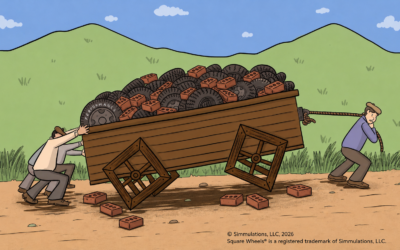
People leave not just with notes, but with pictures in their heads and a few specific Round Wheels they’ve chosen to install. And because they chose them, they are far more likely to follow through. We have given them a simple model of performance improvement, one that can continue to be used as a language of change and one that readily generates peer support for improvement. The metaphor invites adaptation and considered alternatives. It accomplishes disruptive engagement to create situations like this:

Most organizations don’t suffer from a lack of coaching models. They suffer from a lack of shared metaphors that make those models come alive in the real, messy, political, muddy world where work actually happens.
Keep the recipes. They matter.
But if you want higher involvement, deeper engagement, and more visible progress, roll out the wagon. Show people the Square Wheels they’re dragging around, the Round Wheels they already own, the mud that slows them, the sheep that watch, and the silos that separate them.
Then invite them to design a different journey forward. Think Different and Think Engagement,
—
For the FUN of It!
 Dr. Scott Simmerman is a designer of team building games and organization improvement tools.
Managing Partner of Performance Management Company since 1984, he is an experienced presenter and consultant who is trying to retire!! He now lives in Cuenca, Ecuador.
You can reach Scott at scott@squarewheels.com
Learn more about Scott at his LinkedIn site.
Note that I often use Perplexity AI to help research and generate ideas for my posts.
Square Wheels® are a registered trademark of Simmulations, LLC
and images have been copyrighted since 1993,
© Simmulations, LLC 1993 – 2026
What I’m About:
My Square Wheels blog and website exist to help leaders, trainers, and facilitators make work smoother, more engaging, and more human. I focus on practical tools for process improvement, organizational change, and workplace collaboration that spark insight and deliver measurable results.
And I am convinced, after 30+ years of using Square Wheels®, that it is the best facilitation toolset in the world. One can use it to involve and engage people in designing workplace improvements and building engagement and collaboration. It is a unique metaphorical approach to performance improvement and we can easily license your organization to use these images and approaches.
By blending proven facilitation methods, creative problem-solving, and engaging team activities, my mission is to support organizations in building energized, sustainable cultures of involvement and innovation.
Through accessible — and often free — resources and virtual facilitation tools, I aim to help teams everywhere collaborate more effectively, innovate continuously, and take ownership of their improvement journey.
#SquareWheels #InnovationAtWork #TeamEngagement #FacilitationTools #WorkplaceImprovement #EmployeeEngagement #CreativeProblemSolving #OrganizationalDevelopment #LeadershipTools #collaboration #leadership #motivation #communications #enablement #leadership #CreativeCommons #enablingperformance #teamwork #storytelling #storyasking

0 Comments